

Article by
Scott Ward MBA CCMI
Scott Ward is the founder and CEO of Humanise Solutions, which he established three years ago to help organisations elevate their people, leadership and culture through a human-centric, evidence-based approach. Before moving into business and academia, Scott spent seven years as a professional footballer, playing for Luton Town, Crawley Town and Coventry City FC until injury brought his playing career to a close — a turning point that shaped both his research interests and his approach to leadership.
Scott holds an MBA from Warwick Business School, where his research explored the causal relationship between trauma and decision-making — work that continues to inform how he supports young adults, leaders and teams under pressure. Recognised as a Companion of the Chartered Management Institute (CCMI), its highest grade of membership, he combines academic rigour with the discipline, resilience and team-first mindset of the professional game. At the heart of everything he does is a simple belief: that people perform at their best when they are led, developed and valued as human beings first.
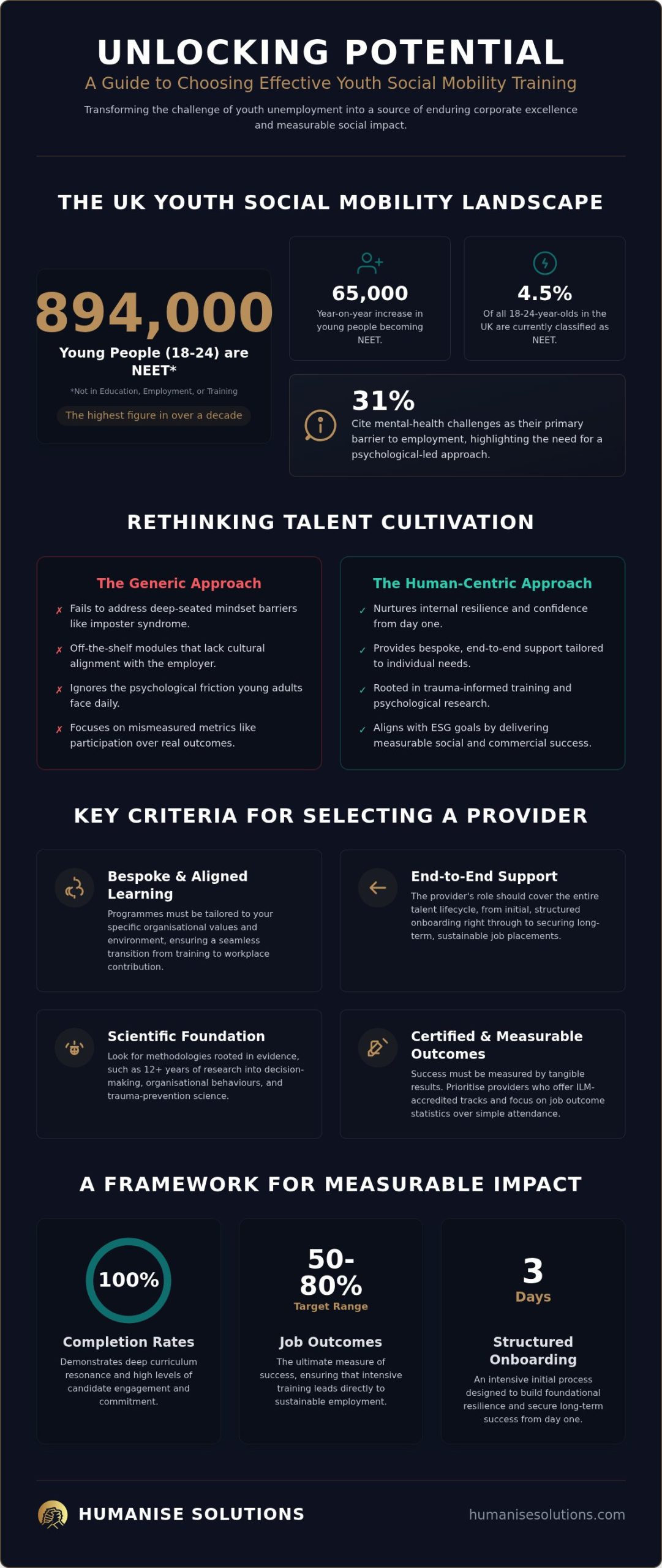
894,000 young people aged 18 to 24 in the UK are currently Not in Education, Employment, or Training (NEET), the highest figure recorded in over a decade. You likely see the human side of this statistic every day through high turnover in your early careers cohorts or the difficulty of supporting young talent who carry the weight of complex mental health barriers. It’s disheartening to invest in generic training that doesn’t stick, especially when you know that 20% of these individuals are navigating significant psychological hurdles. Finding the right youth social mobility training providers is no longer just about meeting a diversity quota; it’s about building a resilient, sustainable workforce that can thrive in a demanding professional world.
This guide will show you how to choose a partner that bridges the talent gap whilst fostering profound professional growth. We’ll explore the essential criteria for selecting a provider that delivers a structured pipeline of talent, ensuring your social impact is as measurable as your commercial success. By focusing on evidence-based methodologies and human flourishing, you can transform these challenges into a source of enduring corporate excellence.
Key Takeaways
- Identify the essential criteria for selecting youth social mobility training providers that offer bespoke, end-to-end support rather than generic, off-the-shelf modules.
- Understand how trauma-informed training and emotional intelligence modules can dismantle mindset barriers like imposter syndrome for disadvantaged young adults.
- Discover the framework for a structured talent pipeline, including a three-day onboarding process designed to secure sustainable employment outcomes.
- Learn how to align your early careers strategy with ESG goals by focusing on programmes that deliver measurable social impact and human-centric growth.
Understanding the Youth Social Mobility Landscape in the UK
In the United Kingdom, Social mobility is often discussed in abstract terms, yet for 807,000 young people, it’s a daily reality of restricted opportunity. Youth social mobility training providers act as vital partners who bridge the gap between untapped potential and professional entry points. Currently, 4.5% of 18-24-year-olds are classified as NEET (Not in Education, Employment, or Training). This is not a static figure. We’ve seen a concerning year-on-year increase of 65,000 individuals entering this category. Perhaps most telling is that 31% of these young adults cite mental-health challenges as their primary barrier to employment, suggesting that professional readiness is as much a psychological journey as it is a practical one.
The Economic and Social Cost of Stagnation
Traditional recruitment often defaults to safe bets, favouring candidates with polished CVs and linear career paths. This approach systematically overlooks high-potential talent from disadvantaged backgrounds, reinforcing a postcode lottery that stifles UK business innovation. When companies fail to look beyond traditional markers of success, they lose out on the diverse perspectives essential for creative problem-solving. Breaking these cycles requires more than just goodwill; it demands a scientific, methodical approach to talent cultivation that recognises the inherent value in varied life experiences.
Why Traditional Training Often Fails Young Adults
Generic “soft skills” workshops frequently miss the mark because they ignore the psychological friction young adults face. Teaching someone how to write an email doesn’t address the deep-seated imposter syndrome that prevents them from hitting “send.” Humanise Solutions has spent over 12 years researching decision-making and trauma prevention to understand these nuances. Effective Young Adult Programmes must focus on Organisational Behaviours from day one, nurturing the internal resilience and confidence required to navigate corporate environments. Choosing the right youth social mobility training providers requires looking beyond tick-box exercises and towards holistic development that addresses both the mind and the skill set. Without this focus, even the most well-intentioned programmes fail to create the lasting change that both individuals and businesses desperately need.
Key Criteria for Selecting Youth Social Mobility Training Providers
Choosing a partner to unlock human potential requires a shift in perspective. It’s not about finding a vendor to deliver a workshop; it’s about finding an architect for your future talent pipeline. Many youth social mobility training providers offer off-the-shelf solutions that fail to resonate because they lack cultural alignment with your specific organisational values. To ensure your investment yields sustainable growth, you must prioritise bespoke learning that is tailored to both the individual’s needs and your company’s unique environment. This alignment ensures that the transition from training to the workplace feels like a natural progression rather than a jarring shift.
High-quality provision must be end-to-end. This means the journey doesn’t conclude with a certificate of attendance. Instead, the provider should manage the entire lifecycle, from initial onboarding through to long-term job placement. This holistic approach is often backed by a scientific foundation. You should ask whether their methodology is rooted in psychological research or trauma prevention. For example, programmes that address the root causes of workplace anxiety or imposter syndrome are far more effective than those that merely teach technical skills. Finally, look for certified outcomes. ILM-accredited leadership tracks provide a recognised benchmark of quality, ensuring that the development young adults receive is rigorous and professionally respected.
Evidence-Based Outcomes vs. Participation Rates
Success in social mobility is often mismeasured by participation alone. Whilst high attendance is positive, completion rates are the first true metric of engagement. We pride ourselves on achieving 100% completion rates, a feat that reflects the deep resonance of our curriculum. However, the ultimate success measure is job outcome statistics. Targeting a range of 50-80% job outcomes ensures that the training leads to tangible professional opportunities. Evidence on Social Mobility submitted to the UK Parliament highlights that targeted skills development is only effective when it’s directly linked to employment. For a deeper look at how these results are achieved, you can explore our bespoke learning and development programmes.
The Importance of a Human-Centric Methodology
A human-centric approach moves beyond transactional training to focus on nurturing leadership. This involves cultivating internal qualities like resilience and confidence in young adults before they step into a global corporate setting. It’s equally vital to train the managers who will receive them. Inclusive leadership training for senior staff ensures they have the emotional intelligence to support the social mobility of their juniors effectively. When both the mentor and the mentee are aligned, the entire team thrives. If you’re ready to build a more resilient workforce, you might reach out to our team to discuss your goals. You can also explore our human-centric services to see how we integrate these principles across all our work.
The Science of Social Mobility: Psychology and Trauma Prevention
Social mobility is more than an economic shift; it’s a psychological transformation. For many young people from disadvantaged backgrounds, entering a corporate environment can trigger deep-seated anxieties that technical skills alone cannot resolve. Leading youth social mobility training providers recognise that trauma prevention is a prerequisite for professional success. Research in The childhood origins of social mobility suggests that early environments significantly shape later life chances, including mental health and confidence. By integrating emotional intelligence modules, we help young adults dismantle “Imposter Syndrome” and “Mindset” barriers that might otherwise lead to an early exit. This isn’t just about the individual. Host organisations must also engage in “Unconscious Bias” training to ensure the environment is ready to receive and support diverse talent whilst fostering an inclusive culture.
Nurturing Potential Through Psychological Safety
Humanise Solutions leverages workplace psychology to cultivate “High Performing Teams” where everyone feels safe to contribute. Our specific “Being You” module encourages authentic leadership, teaching young adults that their unique perspective is an asset rather than a liability. This work is led by Serena Kersten MBE, our Director of People & Performance, who applies elite-level psychological principles to the professional development of young adults. By prioritising psychological safety, we move beyond transactional training and focus on long-term human flourishing. This ensures that the transition from a NEET status to a professional career is supported by a foundation of trust and mutual understanding.
Building Resilience for the Modern Workplace
Retaining Gen Z talent requires addressing the modern pressures of the digital workplace. Modules dedicated to managing “Email Stress” and preventing “Burnout” are essential components of our curriculum. We provide a “Mindset and Attitude Tool Kit” designed to prepare young adults for corporate challenges, ensuring they have the “Self-Care” and “Resilience” skills to navigate high-pressure situations. This methodical preparation is why we see such high retention rates in our Young Adult Programmes. By partnering with specialised youth social mobility training providers, organisations can ensure their early careers cohorts are equipped with the emotional toolkit to thrive. This resilience-building is backed by our 12 years of research into decision-making, providing a roadmap for sustainable professional growth.
Bridging the Gap: Moving from Learning to Long-term Employment
The bridge between a classroom and a career is often where many youth social mobility training providers fail to deliver lasting value. It’s one thing to provide a curriculum; it’s quite another to provide a career. We’ve built an end-to-end talent pipeline that ensures participants don’t just finish a course but enter a profession. As the 5th largest digital recruiter in EMEA, we possess a unique perspective on what employers actually need. We don’t just train; we place. Our UK talent pool serves as a reservoir of resilient, high-potential individuals ready to make an immediate impact. This direct link between development and recruitment ensures that the growth fostered during our programmes leads to sustainable job outcomes.
Our structured three-day onboarding process marks the beginning of this professional journey. During these sessions, participants move from creating personal action plans to setting up their professional job networks. This methodical approach ensures that every young person has a clear, actionable roadmap before they even step into an office. By removing the ambiguity of the job search, we empower young adults to take ownership of their professional future from day one.
A Dedicated Matrix for Career Transition
Our matrix partner system provides a scaffolding of support for each participant, ensuring no one navigates the transition alone. We don’t leave success to chance. Instead, we use specific modules like “Sales Journey” and “Customer Conversations” to build the commercial awareness that many young adults lack. By focusing on “Career and Self-Development Awareness,” we tackle the root causes of early-career dropouts. We want young professionals to understand their own growth trajectory, ensuring they stay engaged and committed during those crucial first months of employment. This focus on long-term sustainability is what sets our Young Adult Programmes apart.
Achieving 50-80% Job Outcomes
Industry averages for job outcomes can often be disappointingly low, leaving potential untapped and budgets wasted. However, our programmes consistently achieve 50-80% job outcomes, a figure that reflects our commitment to excellence. Our 9.98% feedback rating suggests that participants feel deeply seen and supported throughout the process. Success is the intersection of scientific training and direct recruitment access. By combining these two elements, we create a pathway that benefits both the individual and the organisation. If you’re looking to transform your early careers strategy, you can book a consultation with our experts to discuss building your own resilient talent pipeline.
Partnering with Humanise Solutions for Social Impact
Partnering with Humanise Solutions means joining a mission to humanise the way society operates whilst enhancing the human experience at every level. We don’t believe in one-size-fits-all solutions. Instead, we work as a visionary guide and grounded expert to unlock potential that others might overlook. This work is spearheaded by our CEO, Scott Ward, and Serena Kersten MBE, whose combined expertise in recruitment and people performance ensures that our methodologies are both aspirational and practical. Whether you are a global corporate or an elite sport organisation, our approach is designed to celebrate unique abilities whilst driving organisational growth. By choosing specialised youth social mobility training providers, you ensure that your development budget is an investment in long-term human flourishing rather than a temporary fix.
Bespoke Programmes for Young Adult Development
Training should be as dynamic as the talent it serves. We offer a range of certified workshops, from intensive half-day sessions to comprehensive full-day programmes, all designed to fit within the demands of a modern business. One of our standout tracks is the Women Leadership ILM Programme, which provides a dedicated pathway for future female leaders to cultivate their internal confidence and resilience. These programmes are structured around achieving client-driven outcomes, ensuring that every session adds tangible value to your talent pipeline. You can learn more about our Young Adult Programmes to see how these modules can be integrated into your existing early careers strategy and help bridge the talent gap effectively.
Elevating Your Culture and Leadership
Social mobility isn’t a standalone initiative; it’s a catalyst for broader Culture and Change & Transformation goals. When you support young adults from disadvantaged backgrounds, you aren’t just filling a role. You are introducing new perspectives that challenge stagnation and foster innovation across your entire team. Every module we deliver is underpinned by over 12 years of research into decision-making and trauma prevention, ensuring that our interventions are both effective and sustainable. This evidence-based confidence allows us to act as a partner in your journey of development, moving your organisation from its current state to its future potential. We invite you to contact Humanise Solutions to discuss your social mobility strategy and discover how we can help you build a more resilient, inclusive workforce.
Cultivating a Future of Human Excellence
Realising the potential of the UK’s young talent requires more than just a recruitment drive; it demands a deep commitment to human flourishing. By choosing specialised youth social mobility training providers, you move beyond tick-box exercises towards a model that prioritises psychological safety and long-term resilience. Our approach is built on over 12 years of scientific research, ensuring that every intervention is grounded in logic whilst remaining deeply empathetic to the individual experience.
With a 9.98% programme feedback rating and job outcomes ranging from 50-80%, we don’t just train; we transform lives and strengthen organisations. You have the power to dismantle barriers like imposter syndrome and burnout, replacing them with a structured pipeline of confident, career-ready professionals. Partner with us to transform your youth social mobility strategy and begin building a legacy of social impact today. The journey from untapped potential to professional excellence is a shared one, and we’re ready to guide you every step of the way.
Frequently Asked Questions
What should I look for in youth social mobility training providers?
You should prioritise providers that offer bespoke learning and end-to-end pipelines rather than generic, off-the-shelf workshops. It’s essential to partner with youth social mobility training providers who understand the psychological barriers, such as imposter syndrome, that often hinder young adults from disadvantaged backgrounds. Look for evidence-based methodologies and ILM-certified leadership tracks. A human-centric approach ensures that the training aligns perfectly with your specific organisational culture and long-term professional goals.
How much does a social mobility training programme typically cost?
The cost of these programmes varies significantly depending on the level of customisation, the duration of the training, and the number of participants involved. Many organisations offer bespoke pricing models that reflect the specific depth of the curriculum and the extent of the recruitment pipeline support provided. You should consult with individual providers to discuss your specific goals and receive a tailored proposal that aligns with your social impact budget and corporate objectives.
Can social mobility training help with Gen Z employee retention?
Yes, targeted training significantly improves retention by addressing the root causes of early-career friction. By choosing specialised youth social mobility training providers, you equip young adults with a Mindset and Attitude Tool Kit and modules on Email Stress. This supportive onboarding process reduces the likelihood of high turnover amongst Gen Z talent, as they feel better prepared for the emotional and professional demands of their new roles within a corporate environment.
What is the difference between social mobility and diversity and inclusion?
Diversity and inclusion focus on ensuring representation and a sense of belonging for all groups, whereas social mobility specifically addresses the movement of individuals from lower socio-economic backgrounds into higher-status roles. Whilst they are closely related, social mobility often requires a deeper focus on dismantling systemic barriers and providing targeted psychological support. Effective programmes integrate both concepts to create a truly inclusive culture where background does not dictate an individual’s professional potential or career trajectory.
How do you measure the ROI of social mobility training?
Return on investment is measured through a combination of commercial metrics and social impact data. You should track completion rates, long-term retention of early careers cohorts, and the speed at which participants reach full productivity. Additionally, social mobility initiatives provide demonstrable data for ESG reporting, showing a clear commitment to social equity. This blend of reduced recruitment costs and enhanced corporate reputation creates a compelling case for investing in human-centric development programmes.
What happens if a participant has significant mental health barriers?
Effective programmes are designed with a trauma-informed lens to support individuals navigating complex psychological hurdles. We prioritise Fostering Wellbeing and Trauma Prevention through modules like Being You and Personal Resilience. Whilst we don’t provide clinical treatment, our scientific approach focuses on building the internal confidence and emotional intelligence required to manage workplace stress. This ensures that young adults with mental health barriers receive the empathetic support needed to flourish in a professional setting.
How long does a typical young adult development programme last?
The duration of a programme depends on the specific needs of the organisation and the depth of the curriculum required. Options range from intensive half-day or full-day certified workshops to more comprehensive, multi-week initiatives that include a structured three-day onboarding process. This flexibility allows businesses to choose a format that fits their operational schedule whilst ensuring that participants receive enough time to absorb the scientific principles and develop their professional skills effectively.
Is the training delivered online or in person?
Training delivery methods are typically flexible to accommodate the needs of global corporates and diverse talent pools. Many providers offer a blend of in-person workshops, e-learning through a dedicated Learning Management System (LMS), and 1-1 coaching sessions. This hybrid approach ensures that participants can engage with the material in the way that best suits their learning style. We focus on creating high-performing teams through interactive sessions that can be delivered across various platforms without losing the human-centric connection.
