

Article by
Scott Ward MBA CCMI
Scott Ward is the founder and CEO of Humanise Solutions, which he established three years ago to help organisations elevate their people, leadership and culture through a human-centric, evidence-based approach. Before moving into business and academia, Scott spent seven years as a professional footballer, playing for Luton Town, Crawley Town and Coventry City FC until injury brought his playing career to a close — a turning point that shaped both his research interests and his approach to leadership.
Scott holds an MBA from Warwick Business School, where his research explored the causal relationship between trauma and decision-making — work that continues to inform how he supports young adults, leaders and teams under pressure. Recognised as a Companion of the Chartered Management Institute (CCMI), its highest grade of membership, he combines academic rigour with the discipline, resilience and team-first mindset of the professional game. At the heart of everything he does is a simple belief: that people perform at their best when they are led, developed and valued as human beings first.
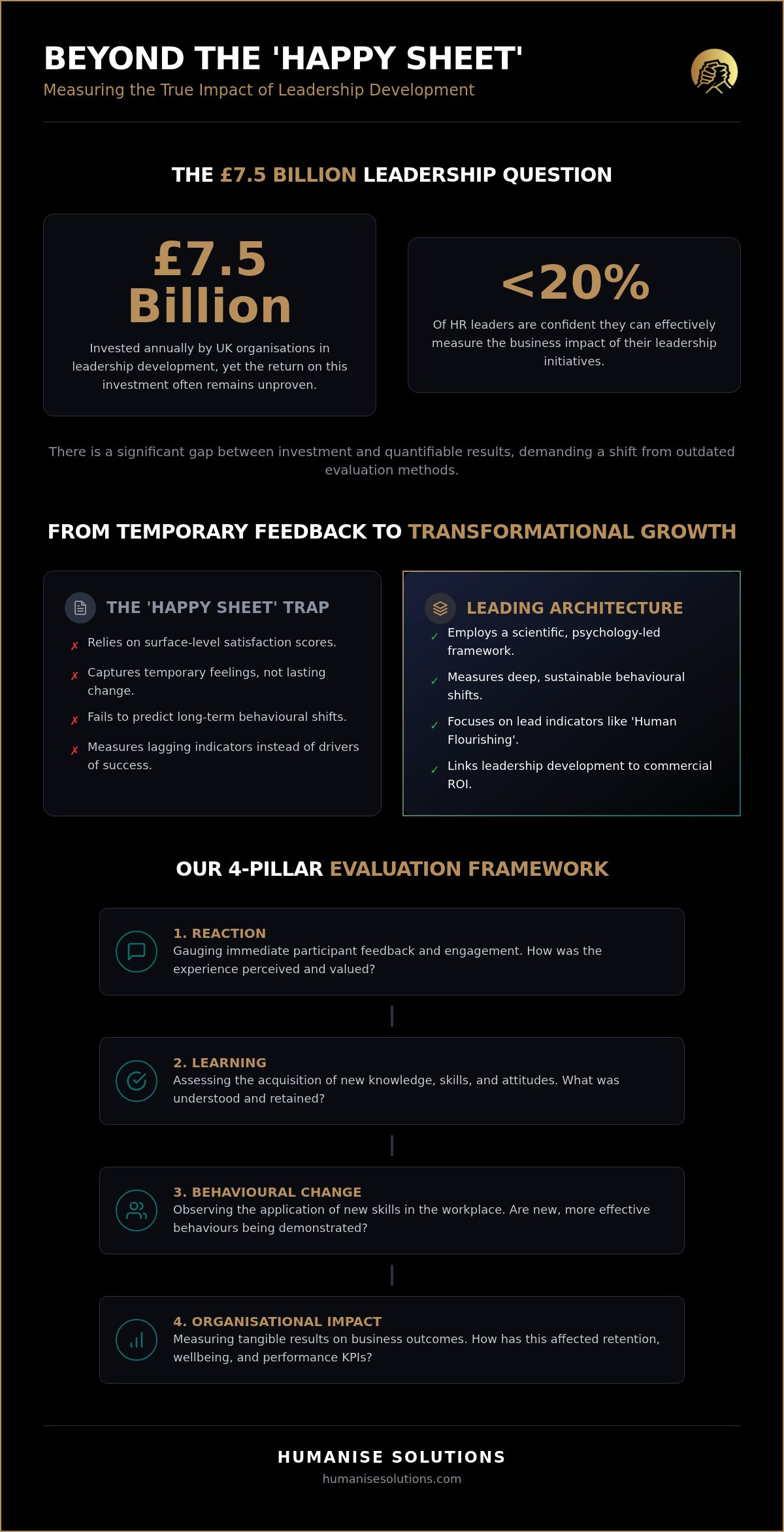
Fewer than 20% of HR leaders believe they can effectively measure the business impact of their leadership initiatives, despite UK organisations investing roughly £7.5 billion in development every year. It’s a frustrating gap that many professionals recognise. You’re likely tired of relying on outdated feedback forms that capture temporary satisfaction rather than long-term growth, especially when the board is demanding clear evidence of ROI. Quantifying the value of empathy or resilience can feel like an impossible task whilst under pressure to justify every penny spent.
We believe that measuring the impact of leadership development requires a shift from sterile corporate metrics to a scientific, human-centred framework. This article promises to show you how to track the true behavioural and cultural shifts that drive commercial success. We’ll explore a methodical approach to “Leading Architecture,” moving from transactional management to nurturing leadership. By the end, you’ll have the evidence needed to justify future investment and the tools to foster lasting team excellence and reduced staff turnover.
Key Takeaways
- Learn why moving beyond “happy sheets” is essential for capturing the deep behavioural and cultural shifts that define true leadership success.
- Discover a scientific, psychology-led framework for measuring the impact of leadership development that bridges the gap between soft skills and commercial ROI.
- Understand how to balance quantitative metrics like retention rates with qualitative insights such as psychological safety and team wellbeing.
- Gain a clear, 5-step methodology for designing leadership initiatives that are anchored in your organisation’s specific, client-driven outcomes.
- Explore how a human-centric approach to evaluation helps you cultivate a sustainable talent pipeline and foster long-term organisational excellence.
Beyond the ‘Happy Sheet’: Why Measuring the Impact of Leadership Development Matters
For too long, the gold standard for evaluating training has been the “happy sheet.” These post-session surveys capture a moment of temporary inspiration, yet they rarely predict whether a leader will actually behave differently when they return to their desk. Measuring the impact of leadership development is far more than a satisfaction score. It’s the systematic evaluation of how training fundamentally alters organisational behaviour and culture over time. Without this rigour, development initiatives remain expensive experiments rather than strategic investments.
At Humanise Solutions, our approach is built on over 12 years of research into decision-making and trauma prevention. We move beyond simple satisfaction scores to look at deep-seated psychological shifts that drive long-term change. This scientific foundation allows us to implement “Leading Architecture,” a process where we design every programme with the final measurement already in mind. By understanding foundational Leadership development concepts, we ensure that every intervention is structured to achieve specific, client-driven outcomes that resonate with the human experience.
The Cost of Misalignment in Leadership Programmes
Many organisations fall into the trap of purchasing off-the-shelf packages. While these might seem cost-effective initially, they often result in a significant financial drain because they fail to address the unique cultural gaps within a team. Transactional management training might teach a person how to run a meeting, but it won’t foster the nurturing leadership required for sustainability. When programmes don’t align with the lived experience of the workforce, senior management quickly develops “initiative fatigue.” They see another new programme as a distraction rather than a solution, leading to wasted resources and stagnant growth.
The Human-Centric Perspective on ROI
We believe that measuring the impact of leadership development should focus on the human experience. While traditional KPIs like productivity and profit are vital, they’re often lagging indicators. Instead, we look at “Human Flourishing” as a lead indicator for success. When leaders prioritise psychological safety and empathy, the results show up in engagement data and a tangible sense of belonging amongst staff. Our leadership programmes focus on these internal qualities. By tracking improvements in wellbeing and team excellence, we provide a more holistic view of return on investment that goes far beyond a simple spreadsheet.
A Scientific Framework for Leadership Evaluation
True evaluation isn’t about intuition; it’s about evidence. At Humanise Solutions, we’ve replaced guesswork with a sophisticated framework that combines workplace psychology with rigorous data collection. Led by experts like Serena Kersten MBE, our team applies scientific principles to the pursuit of team excellence. We structure our evaluation around four key pillars: Reaction, Learning, Behavioural Change, and Organisational Impact. This methodical approach ensures that we aren’t just delivering content but are actively measuring the impact of leadership development at every stage of the journey. It’s this commitment to logic and care that allows our programmes to maintain a 9.98% feedback rating, setting a high benchmark for quality delivery in the UK market.
Tracking Behavioural Shifts and Decision-Making
Meaningful change happens at the level of behaviour. We draw upon 12 years of research into decision-making and trauma prevention to track how a leader’s daily actions evolve after an intervention. It isn’t enough to simply understand a concept; a leader must be able to apply the ‘Power of No’ or demonstrate high emotional intelligence in high-pressure environments. We often use 360-degree feedback to identify ‘nurturing’ traits in managers, providing a clear picture of how their growth affects those around them. By focusing on these specific behavioural shifts, we move beyond surface-level metrics to see the real-world application of new skills and resilience.
Measuring Impact in Certified ILM Programmes
Standardisation provides a vital baseline for any evaluation. Our ILM-certified programmes offer a structured way to measure skill acquisition and professional growth across various levels. For example, in our initiatives focused on women leadership, we track specific outcomes such as increased confidence levels and career progression milestones. This rigorous approach to Measuring leadership development program outcomes ensures that every participant has a clear path to success. Whether you choose a standard route or one of our bespoke L&D programmes, we ensure the data supports the human journey. If you’re ready to see how these scientific principles can transform your organisation, we invite you to connect with our team to explore the possibilities.
Qualitative vs Quantitative Data: Balancing the Human Experience
Numbers tell a story, but they rarely tell the whole story. In the context of measuring the impact of leadership development, quantitative data like retention rates and promotion speed provide the skeleton of success. However, without the muscle and heart of qualitative insight, the picture remains incomplete. We believe that a truly human-centric evaluation must balance “hard” figures with “soft” indicators like psychological safety and cultural sentiment. By applying scientific rigour to qualitative feedback, we transform anecdotal evidence of trauma prevention into objective data that boards can trust. This balance ensures that leadership initiatives aren’t just hitting targets but are genuinely enhancing the human experience within the organisation.
The ROI of Fostering Wellbeing and Resilience
Resilience isn’t just a buzzword; it’s a measurable asset. When leaders undergo modules on self-care and emotional regulation, the impact manifests in reduced absenteeism and lower burnout rates. We track these shifts as lead indicators for staff retention. Replacing a departed employee in the UK is a significant financial burden, often costing thousands in recruitment fees and lost productivity. By fostering wellbeing through our leadership initiatives, organisations create a protective environment that naturally reduces these costs. We use structured assessments to monitor how wellbeing initiatives correlate with long-term commitment, providing a clear narrative of growth and stability.
Measuring the Impact of Young Adult Development
The urgency for effective development is clear in the latest ONS data. As of June 2026, 15.2% of 18 to 24-year-olds in the UK are classified as NEET, representing 894,000 young people. Amongst disabled NEETs, over 40% now cite mental health as their primary barrier to employment. Our Young Adult Programmes address these challenges head-on, achieving job outcome success rates between 50% and 80%. We employ a “Matrix Partner” system for longitudinal impact tracking, ensuring that the transition into the workforce is sustainable. This methodical follow-up allows us to measure success not just at the point of completion, but through the long-term flourishing of the individual within their professional role.
Designing for Impact: 5-Step Framework for UK Organisations
Transitioning from theoretical models to practical results requires a deliberate, structured path. We’ve refined a five-step framework specifically for UK organisations to ensure that measuring the impact of leadership development is a core component of the programme rather than an afterthought. This methodical approach allows us to align every intervention with your unique organisational needs, ensuring that growth is both measurable and meaningful.
- Step 1: Define Client-Driven Outcomes. We begin by clarifying what success looks like for your specific culture. This ensures the programme is built on your goals, not a generic template.
- Step 2: Baseline Assessment. Before any training occurs, we conduct a thorough assessment of current leadership behaviours and employee wellbeing to create a starting point for comparison.
- Step 3: Bespoke Design. Utilising our “Leading Architecture” philosophy, we customise modules, such as Conflict Resolution or Inclusive Leadership, to bridge the specific gaps identified in the baseline.
- Step 4: Continuous Feedback Loops. Progress shouldn’t be a mystery until the end. We integrate regular touchpoints through our LMS and 1-1 coaching to track real-time shifts in mindset and action.
- Step 5: Longitudinal Review. True change takes time to settle. We conduct formal reviews at six and twelve months to verify that new behaviours have become permanent cultural fixtures.
Setting Effective Benchmarks for High-Performing Teams
Achieving team excellence starts with a clear understanding of your current performance landscape. Our workshops help organisations establish specific performance behaviours that serve as a measurable compass for future growth. Following the training, designated performance behaviours leads monitor team dynamics to ensure these new standards are consistently applied in daily operations. High-performing teams are defined by a foundation of psychological safety where individuals feel empowered to innovate and communicate openly.
Utilising Learning Management Systems (LMS) for Data
Modern digital platforms allow us to automate the collection of learning data whilst maintaining a deeply human connection to the development process. When measuring the impact of leadership development through digital engagement, we monitor how staff interact with e-learning modules like Unconscious Bias or Emotional Intelligence. This data serves as a diagnostic tool, helping us identify any remaining skill gaps and tailor future development initiatives accordingly. If you’re ready to implement a framework that provides clear evidence of your team’s growth, you can book a consultation with our experts to start your journey.
Cultivating Sustainable Growth with Humanise Solutions
Sustainable growth isn’t a happy accident. It’s the result of intentional design and a deep commitment to the people who power your organisation. When we talk about measuring the impact of leadership development, we aren’t just looking at quarterly figures or attendance logs. We’re looking at the long-term flourishing of your people and the health of your culture. Our mission is to humanise society by enhancing the human experience within the workplace. This isn’t just a lofty goal; it’s a practical reality backed by over 12 years of research into decision-making and trauma prevention.
We understand the intense pressure leaders face to show immediate results. That’s why our methodology is grounded in logic and evidence. As the 5th largest digital recruiter in EMEA, we possess a unique perspective on the global talent landscape and the evolving needs of the modern workforce. This scale, combined with our end-to-end talent pipeline for young adults, allows us to offer insights that traditional consultants simply can’t match. We’ve seen what works across thousands of interactions, consistently maintaining a 9.98% feedback rating for our programme delivery and ensuring 100% completion rates for our participants.
Choosing to work with us means moving beyond simple training. It’s about building a legacy of nurturing leadership that remains resilient through change. You’re not just buying a course; you’re investing in a scientific framework designed to unlock potential with empathy. This approach ensures that every step you take is structured for success, providing the evidence needed to justify future investment in your most valuable asset: your people. We help you move from the current state of transactional management to a future potential of team excellence.
Partnering with Experts in Human Flourishing
Our team is as diverse as the challenges you face. We bring together a multidisciplinary group of specialists, ranging from Olympic-level performance experts to workplace psychologists like Serena Kersten MBE. This breadth of expertise ensures that we can address every facet of team excellence and wellbeing. We don’t dictate from a distance; we partner with you on a journey of development that respects the human experience at every level. This partnership is built on trust, logic, and a shared commitment to sustainable growth.
Every organisation has its own rhythm and its own unique hurdles. We don’t believe in one-size-fits-all solutions because they don’t respect the nuance of your culture or the specific needs of your teams. Instead, we co-create bespoke programmes that align with your specific client-driven outcomes. If you’re ready to move beyond the “happy sheet” and start measuring the impact of leadership development through real, lasting transformation, we’re here to guide you. We invite you to Contact Humanise Solutions to design your impact-driven programme and begin cultivating a culture of excellence today.
Building a Legacy of Nurturing Leadership
True organisational transformation begins when we stop viewing development as a one-off event and start seeing it as a scientific process. By moving beyond basic feedback forms and embracing a human-centred framework, you can bridge the gap between training and tangible cultural change. We’ve explored how balancing qualitative insights with quantitative metrics ensures that measuring the impact of leadership development becomes a strategic asset rather than a reporting burden. This approach allows you to track real behavioural shifts that lead to lasting team excellence.
Our methodology is anchored in over 12 years of research into decision-making and trauma prevention, providing a logical foundation for high-reaching goals. With a 9.98% average participant feedback rating and ILM-certified programmes, we offer the evidence-based confidence required to justify your L&D investments. Whether you’re fostering wellbeing or cultivating the next generation of talent, the focus must remain on sustainable growth and the flourishing of every individual within your care.
The journey from transactional management to nurturing leadership is within your reach. Elevate your leadership impact-Contact Humanise Solutions today to design an evaluation framework that reflects the true potential of your people. We’re ready to partner with you in creating a workplace where everyone has the opportunity to thrive and succeed.
Frequently Asked Questions
How do you measure the ROI of leadership development?
Measuring the ROI of leadership development involves comparing the total cost of the programme against tangible gains in productivity, retention, and performance. We use a scientific framework to track how behavioural shifts lead to reduced recruitment costs and improved organisational output. By focusing on the long-term sustainability of nurturing leadership, organisations see a clear return through reduced staff turnover and higher engagement, which directly influences the bottom line without relying on sterile corporate metrics.
What are the best KPIs for leadership training?
The best KPIs for leadership training combine quantitative data with qualitative human insights to provide a holistic view of growth. Effective metrics include employee retention rates, promotion speed, and absenteeism figures alongside psychological safety scores and cultural sentiment. By measuring the impact of leadership development through these varied lenses, you gain a comprehensive understanding of how leadership shifts are influencing both the professional environment and the commercial success of the organisation.
Can you measure ‘soft skills’ like empathy and resilience scientifically?
Yes, soft skills like empathy and resilience can be measured scientifically through structured assessments and workplace psychology principles. We draw upon 12 years of research into trauma prevention and decision-making to quantify these internal qualities. By using 360-degree feedback and baseline behavioural assessments, we track how a leader’s increased emotional intelligence correlates with team wellbeing and performance, making these seemingly intangible skills visible through rigorous data collection and expert analysis.
How long does it take to see the impact of a leadership programme?
While some shifts in mindset are immediate, the full impact of a leadership programme typically becomes measurable between six and twelve months post-intervention. Short-term wins often appear in improved communication and team sentiment, whilst long-term sustainability is evidenced through longitudinal reviews. We conduct these reviews to ensure that new behaviours have become permanent cultural fixtures, providing a steady progression from initial learning to deep-seated organisational transformation and lasting team excellence.
What is the difference between transactional management and nurturing leadership?
Transactional management focuses on task completion and short-term efficiency, often neglecting the human element of growth. In contrast, nurturing leadership prioritises the development of internal qualities like confidence and resilience to unlock long-term potential. This human-centric approach fosters a culture of psychological safety and empathy, where leaders act as partners in a journey of development. This shift is essential for measuring the impact of leadership development in a way that promotes sustainable flourishing.
How do Humanise Solutions ensure a 100% completion rate?
Humanise Solutions achieves a 100% completion rate by designing programmes that are deeply engaging and directly aligned with the specific needs of each participant. Our bespoke approach ensures that every individual feels invested in their own growth journey from the very beginning. By combining empathetic warmth with evidence-based methodology and expert-led delivery, we create a supportive environment where learners remain motivated and committed to finishing their ILM-certified programmes and workshops.
Why is psychological safety a critical metric for team excellence?
Psychological safety is a critical metric because it serves as the foundation for innovation, open communication, and team excellence. When employees feel safe to take risks and express themselves without fear of reprisal, productivity and engagement naturally increase. We monitor safety scores as a lead indicator for organisational health, as high levels of psychological safety are consistently linked to reduced staff turnover and improved collective problem-solving within high-performing teams across various sectors.
How do you track the long-term impact of young adult development programmes?
We track the long-term impact of young adult programmes through a dedicated Matrix Partner system that monitors job outcomes and career sustainability. This longitudinal approach allows us to measure success beyond the point of programme completion, focusing on how individuals thrive in their professional roles. With job outcome success rates between 50% and 80%, our framework provides clear evidence of how targeted development helps young people overcome mental health barriers and navigate the job market successfully.
