

Article by
Scott Ward MBA CCMI
Scott Ward is the founder and CEO of Humanise Solutions, which he established three years ago to help organisations elevate their people, leadership and culture through a human-centric, evidence-based approach. Before moving into business and academia, Scott spent seven years as a professional footballer, playing for Luton Town, Crawley Town and Coventry City FC until injury brought his playing career to a close — a turning point that shaped both his research interests and his approach to leadership.
Scott holds an MBA from Warwick Business School, where his research explored the causal relationship between trauma and decision-making — work that continues to inform how he supports young adults, leaders and teams under pressure. Recognised as a Companion of the Chartered Management Institute (CCMI), its highest grade of membership, he combines academic rigour with the discipline, resilience and team-first mindset of the professional game. At the heart of everything he does is a simple belief: that people perform at their best when they are led, developed and valued as human beings first.
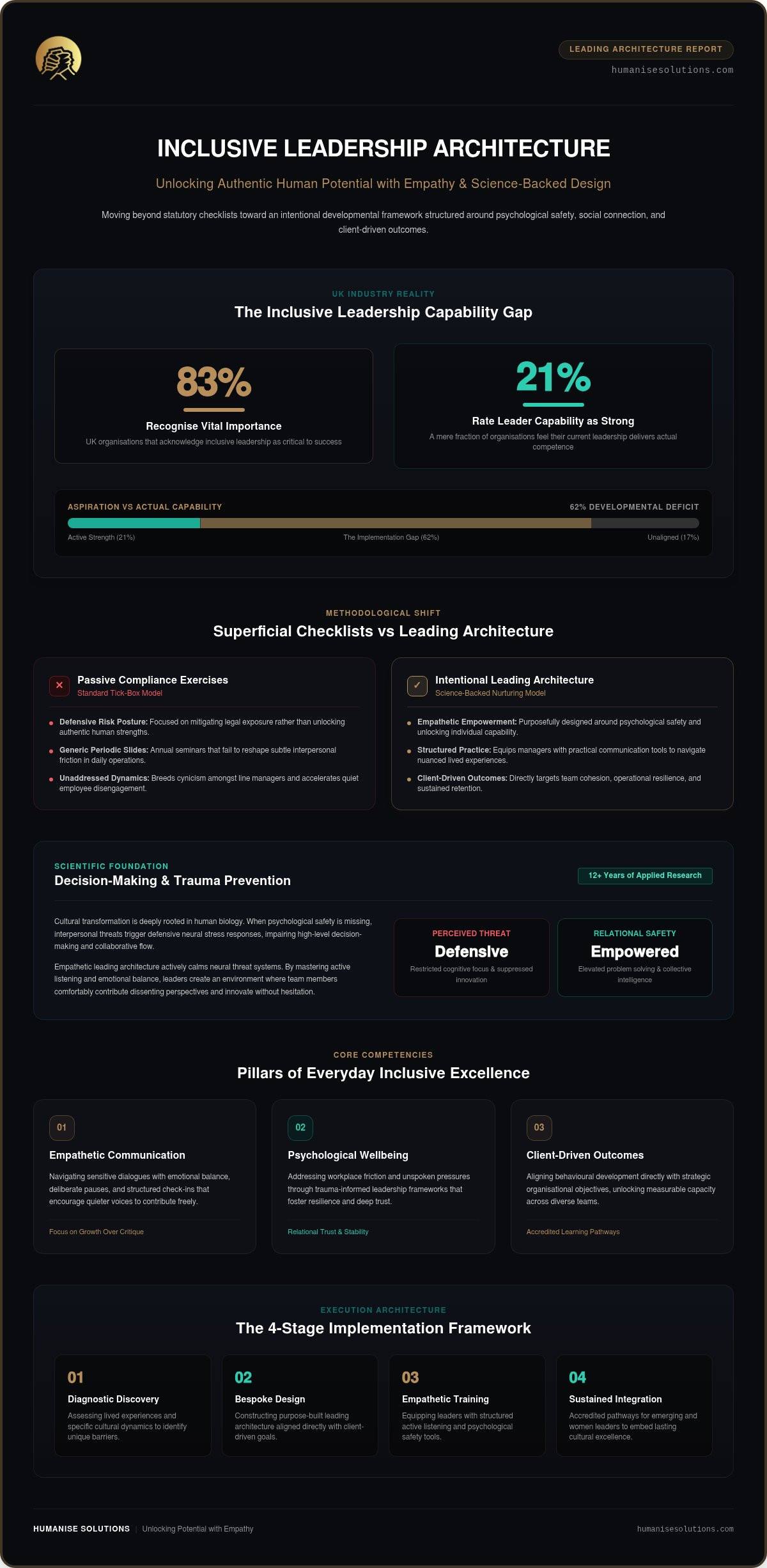
While 83% of UK organisations acknowledge the vital importance of inclusive leadership, a mere 21% rate their leaders’ actual capabilities as strong. For too long, superficial tick-box exercises have failed to shift daily workplace behaviours, leaving managers hesitant to navigate complex conversations around lived experience and cultural friction. Bridging this divide requires purpose-built leadership training for inclusive environments; an intentional discipline grounded in empathy, psychological safety, and bespoke leading architecture designed to nurture individual strengths.
You already recognise that standard corporate slide decks don’t stem rising disengagement or dismantle quiet barriers to collaboration. Meaningful growth takes deliberate care and structured practice. In this guide, you will discover how scientific, human-centric leadership training cultivates psychologically safe, inclusive environments that unlock authentic workplace potential across your entire organisation. We’ll examine the practical communication tools, measurable behavioural benchmarks, and empathetic frameworks needed to turn cultural intentions into sustainable, everyday excellence.
Key Takeaways
- Move beyond passive compliance by adopting an intentional leading architecture structured around client-driven outcomes and social connection.
- Discover how bespoke leadership training for inclusive environments equips managers with empathetic communication tools to build authentic psychological safety.
- Examine the critical differences between transactional diversity workshops and science-backed nurturing leadership programmes that alter daily workplace behaviours.
- Explore a practical four-stage implementation framework, beginning with diagnostic cultural discovery to tailor development to your organisation’s real needs.
- Unlock untapped team capability through accredited learning pathways, such as dedicated initiatives for emerging and women leaders.
Why Traditional Diversity Initiatives Fail Without Inclusive Leadership Architecture
Most diversity initiatives collapse because organisations mistake statutory compliance for cultural evolution. When businesses treat inclusion as a periodic administrative exercise, they miss the subtle relational dynamics that govern human behaviour. Truly transformative leadership training for inclusive environments isn’t an off-the-shelf seminar; it’s a deliberate leading architecture built around clear, client-driven outcomes. Without this deliberate framework, unaddressed cultural friction quietly breeds silent disengagement, damages morale, and accelerates costly talent attrition.
Passive compliance workshops simply don’t reshape day-to-day workplace interactions. They inform people of rules without building the emotional capabilities required to live them. Real progress demands human-centric leadership, which acts as the primary catalyst for psychological safety, operational resilience, and elevated team performance.
The Limitations of Superficial Workplace EDI Checklists
Isolated unconscious bias sessions often spark deep cynicism amongst staff and line managers alike. When teams sit through generic slide decks once a year, they quickly recognise the defensive posture: protecting the organisation from legal exposure rather than nurturing human potential. While established Diversity, equity, and inclusion frameworks offer valuable foundational concepts, checklist compliance cannot equip managers to handle nuanced, real-world tensions.
True empowerment begins when leaders move past defensive risk mitigation. Organisations need sustainable developmental structures that help managers examine lived experiences, resolve interpersonal friction calmly, and establish an authentic sense of belonging across every team.
The Science of Decision-Making and Relational Safety
Cultural transformation is fundamentally rooted in human biology. The brain cannot process complex ideas, communicate openly, or make sound decisions when perceived interpersonal threats trigger defensive stress responses. When psychological safety is missing, cognitive performance drops across the entire team.
Grounded in over 12 years of research into decision-making processes and trauma prevention, an empathetic leading architecture directly calms neural threat responses. When leaders consistently model vulnerability, deep listening, and social connection, team members feel secure enough to share dissenting views, challenge orthodoxies, and innovate without fear. Embedding purposeful leadership training for inclusive environments ensures your organisation unlocks latent human potential with empathy, turning diverse perspectives into everyday collaborative strength.
Core Pillars of Leadership Training for Inclusive Environments
Cultivating a genuinely inclusive environment requires more than good intentions. It demands specific, practical competencies that leaders can exercise under pressure. True cultural change happens when leaders move beyond abstract awareness and master the behavioural mechanics of daily inclusion. By embedding these capabilities into your organisation’s leading architecture, you create an environment where diverse perspectives naturally turn into collaborative strength, directly supporting talent retention and organisational wellbeing.
Empathetic Communication and Active Listening
Inclusive leaders know how to navigate sensitive conversations with emotional balance. Rather than dominating discussions, they create intentional space for quieter team members to contribute through structured check-ins, thoughtful question framing, and deliberate pauses. Research highlighted in a Harvard executive development program underlines how critical emotional intelligence and self-awareness are when aligning everyday communication with wider strategic inclusion goals.
When providing developmental feedback, empathetic leaders focus on growth rather than critique. They separate the individual’s worth from the operational challenge, turning feedback into a mutual problem-solving dialogue that builds trust.
Trauma Prevention and Psychological Wellbeing
Workplace environments carry unspoken pressures, interpersonal misunderstandings, and historical tensions that can trigger profound anxiety. Informed by trauma prevention principles, inclusive leaders proactively identify subtle workplace stressors before they solidify into toxic friction. They understand that psychological wellbeing isn’t an isolated HR initiative; it’s an everyday managerial responsibility.
By protecting psychological safety, leaders offer reassurance during periods of organisational restructuring or rapid growth. This empathetic grounding directly reinforces our fostering wellbeing at work framework, ensuring individuals feel valued and supported through every career transition.
Inclusive Decision-Making and Cognitive Diversity
Homogeneous thinking limits innovation. High-performing teams intentionally welcome cognitive diversity, as diverse teams are 87% better at decision-making when clear evaluation structures exist. Comprehensive leadership training for inclusive environments equips managers with practical techniques to counteract bias:
- Perspective rotating: Systematically inviting alternative viewpoints before finalising critical operational strategies.
- Premortem analysis: Encouraging open critique of proposed plans to reveal hidden assumptions and systemic oversights safely.
- Transparent merit metrics: Evaluating ideas against agreed objective criteria rather than seniority or vocal dominance.
Embedding these three core pillars helps organisations transition from passive intentions to sustainable everyday excellence. If you want to design a tailored framework for your organisation’s teams, you can connect with our specialists to discuss your specific cultural goals.
Compliance Tick-Boxes vs Science-Backed Nurturing Leadership
Compliance checklists treat inclusion as a defensive shield. Science-backed nurturing leadership, however, treats human connection as an operational foundation. When organisations replace transactional seminars with an intentional leading architecture, they move beyond policy memorisation toward lasting behavioural change. This deliberate approach structures development around client-driven outcomes, unlocking authentic capability across every tier of the workforce.
| Dimension | Compliance-Driven Seminars | Nurturing Leadership Architecture |
|---|---|---|
| Core Focus | Statutory liability and defensive risk mitigation | Psychological safety and unlocking human potential |
| Delivery Model | One-off passive slide presentations | Iterative, research-grounded capability development |
| Cultural Impact | Temporary recall with rising staff cynicism | Measurable behavioural change and elevated retention |
Evaluating the Organisational Return on Empathy
Tick-box seminars produce an initial spike in awareness that decays rapidly within weeks. Transformative leadership training for inclusive environments addresses the core emotional dynamics that govern retention, trust, and team cohesion. By cultivating empathetic leadership habits, businesses actively dismantle the subtle micro-frictions that lead to burnout and voluntary staff turnover.
When individuals feel genuinely heard and respected, their capacity for collaboration expands, directly laying the groundwork for sustainable team excellence and higher collective performance across all organisational units.
Addressing Managerial Resistance with Empathy
Most managers don’t resist inclusion out of malice; they hesitate out of anxiety. The fear of saying the wrong thing, misinterpreting lived experience, or inadvertently causing offence often induces paralysis. Punitive compliance frameworks worsen this tension by magnifying personal risk.
Nurturing leadership replaces fear with supportive capability building. By providing leaders with clear relational frameworks grounded in decision-making science, leadership training for inclusive environments builds genuine self-confidence. Leaders learn to approach complex conversations with curiosity and emotional poise, creating a safe harbour where diverse talent flourishes naturally.
How to Implement Leadership Training for Inclusive Environments: A 4-Stage Framework
Shifting organisational culture requires a disciplined roadmap rather than sporadic training days. Sustainable transformation unfolds through structured stages that diagnose hidden friction, align leadership behaviours with strategic goals, and embed relational habits into daily routines. By constructing an intentional leading architecture, organisations ensure every development milestone directly advances client-driven outcomes while unlocking authentic team potential.
Step 1 & 2: Diagnostic Assessment and Bespoke Programme Architecture
Effective change begins with deep cultural discovery. Before introducing new frameworks, organisations must map current employee sentiment, identify communicative roadblocks, and assess existing leadership behaviours across business units. This diagnostic phase uncovers where psychological safety is faltering and where systemic assumptions suppress fresh perspectives.
Once baseline dynamics are clear, the development pathway is shaped around specific business objectives. Rather than adopting generic modules, organisations implement bespoke learning and development programmes tailored to their unique sector challenges. This stage establishes objective benchmarks, defining clear behavioural indicators for empathy, active listening, and relational safety that leaders can track over time.
Step 3 & 4: Experiential Delivery, 1-1 Coaching, and Cultural Embedment
Real capability grows through active practice, not passive observation. Step three immerses leaders in experiential workshops rooted in behavioural psychology. Participants navigate realistic workplace scenarios, practising how to address cultural tension calmly, draw out quieter colleagues, and navigate sensitive feedback conversations without prompting defensiveness.
The fourth stage cements these behaviours through continuous reinforcement. Personalised one-to-one executive coaching provides a confidential space for leaders to reflect on real-time challenges, refine their communication style, and overcome personal hesitations. Regular feedback loops with their teams ensure inclusive habits become second nature within everyday workflows.
A structured four-stage model ensures your investment yields measurable, lasting cultural maturity. If you’re ready to design an evidence-based roadmap tailored to your teams, schedule a discovery consultation with our development team today.
Elevating Organisational Culture Through Bespoke Development Programmes
True cultural elevation happens when an organisation connects leadership development directly to every stage of its talent lifecycle. Rather than treating inclusion as an isolated exercise, forward-thinking businesses embed accredited pathways that dismantle systemic barriers from early careers to executive boardrooms. By establishing an intentional leading architecture, organisations align human growth with clear, client-driven outcomes, turning empathy into a reliable operational strength.
Specialised Tracks: Empowering Women and Emerging Leaders
Senior representation remains uneven across British industry. Whilst women hold 43% of board seats across the FTSE 350, they occupy a mere 7% of chief executive roles. Addressing this disparity demands structured capability building rather than passive hope. Dedicated pathways like our Women Leadership ILM programme equip female leaders with accredited frameworks, strategic confidence, and empathetic peer networks to thrive at the highest executive levels.
Simultaneously, sustainable cultures must nurture the next generation. With 981,000 young people aged 16 to 24 recorded as NEET across the UK in mid-2026, creating accessible pathways into meaningful work is essential for long-term resilience. High-performing leaders understand how to bridge cross-generational divides, creating psychologically secure spaces where junior colleagues find their voice. Integrating targeted young adult programmes into your workforce strategy strengthens early-career retention, accelerates social mobility, and cultivates fresh perspectives across your teams.
Partnering for Sustainable, Human-Centric Growth
Embedding comprehensive leadership training for inclusive environments requires a developmental partner rooted in scientific rigour and relational care. Humanise Solutions designs bespoke developmental pathways informed by over 12 years of research into decision-making processes and trauma prevention. This disciplined, human-first methodology enables leaders across UK organisations to dismantle cultural friction calmly and unlock latent potential with empathy.
Our commitment to excellence is reflected in our 100% programme completion rate and an outstanding 9.98% participant feedback rating across corporate enterprises and elite sport organisations. We work alongside your team to shape custom interventions that reflect your distinct operational landscape. Explore how our tailored pathways can transform your workplace culture by examining the options across our services portfolio.
Architecting a Truly Inclusive Workplace Culture
Moving beyond performative compliance is no longer optional for forward-looking organisations. Lasting cultural evolution requires a deliberate leading architecture that balances the science of decision-making with deep relational empathy. By replacing tick-box exercises with evidence-based leadership training for inclusive environments, you establish authentic psychological safety, dismantle unseen cultural friction, and unlock the latent potential across every team.
Backed by over 12 years of research into decision-making processes and trauma prevention, Humanise Solutions crafts bespoke developmental journeys structured around your distinct client-driven outcomes. From accredited pathways like our Women Leadership ILM programmes to comprehensive organisation-wide transformations, our work is validated by an exceptional 9.98% participant feedback rating across national delivery. Creating a workplace where diverse voices thrive together isn’t an overnight task, but with deliberate practice and compassionate leadership, genuine belonging is entirely within reach. Partner with Humanise Solutions to cultivate your inclusive leadership architecture and begin unlocking your organisation’s authentic potential today.
Frequently Asked Questions
What is leadership training for inclusive environments?
It’s an intentional developmental architecture that equips managers with empathetic communication, decision-making science, and relational behaviours to build psychological safety. Rather than focusing on passive legal compliance, leadership training for inclusive environments addresses daily workplace interactions. By embedding practical habits like active listening and cognitive diversity, leaders learn to cultivate cultures where every individual feels valued and empowered to contribute authentic ideas.
How does inclusive leadership training differ from standard diversity training?
Standard diversity training typically relies on one-off compliance presentations and unconscious bias theory, whereas inclusive leadership training delivers continuous behavioural change. Transactional seminars often induce defensive reactions or tick-box cynicism. Evidence-backed inclusive leadership programmes use experiential simulations and decision-making science to reshape communication patterns. This approach moves beyond theoretical awareness to build lasting, practical capabilities grounded in empathy and mutual respect.
Can inclusive leadership programmes be tailored to specific organisational goals?
Yes, effective programmes are intentionally designed around client-driven outcomes and distinct operational challenges. Every workplace culture operates within unique pressures, whether managing structural changes, bridging cross-generational gaps, or supporting early-career colleagues. Diagnostic assessments allow learning architecture to align directly with strategic priorities. This bespoke structure ensures leadership development delivers measurable progress that directly complements wider organisational objectives and commercial health.
How do you measure the impact of leadership training on workplace inclusion?
Impact is evaluated through measurable shifts in team behaviour, psychological safety scores, and long-term retention rates. Organisations track key indicators such as employee engagement, voluntary turnover, and participation rates during strategic discussions. Qualitative feedback loops and structured cultural sentiment surveys offer clear evidence of whether staff feel supported. Over time, these metrics demonstrate how embedding leadership training for inclusive environments improves operational cohesion.
What role does psychological safety play in inclusive leadership development?
Psychological safety serves as the foundational cornerstone for all genuine workplace inclusion. When individuals feel safe from interpersonal retribution, their cognitive performance rises and fear-based hesitation disappears. Leaders learn to establish this security by responding to mistakes with curiosity rather than reprimand. Building relational safety allows team members from varied backgrounds to voice dissenting perspectives, challenge consensus constructively, and contribute their full capabilities.
Is inclusive leadership training suitable for middle managers as well as executives?
Inclusive leadership training is vital for middle managers, who directly shape day-to-day employee experience and team culture. While executives establish organisational vision, line managers translate policy into daily operational reality. Equipping middle leaders with empathetic communication tools and conflict-resolution strategies prevents friction from escalating into burnout. Providing comprehensive development across all managerial levels ensures cultural values remain consistent throughout the entire organisation.
How does nurturing leadership support employee retention and workplace wellbeing?
Nurturing leadership actively reduces voluntary attrition by replacing high-pressure management with proactive empathy and relational support. Workplace stress frequently escalates when employees experience poor communication, isolation, or unaddressed micro-frictions. Grounded in trauma prevention principles, nurturing leaders recognise early warning signs of disengagement. By fostering genuine dignity and psychological wellbeing within daily workflows, organisations protect staff morale, deepen team loyalty, and sustain high performance.
