

Article by
Scott Ward MBA CCMI
Scott Ward is the founder and CEO of Humanise Solutions, which he established three years ago to help organisations elevate their people, leadership and culture through a human-centric, evidence-based approach. Before moving into business and academia, Scott spent seven years as a professional footballer, playing for Luton Town, Crawley Town and Coventry City FC until injury brought his playing career to a close — a turning point that shaped both his research interests and his approach to leadership.
Scott holds an MBA from Warwick Business School, where his research explored the causal relationship between trauma and decision-making — work that continues to inform how he supports young adults, leaders and teams under pressure. Recognised as a Companion of the Chartered Management Institute (CCMI), its highest grade of membership, he combines academic rigour with the discipline, resilience and team-first mindset of the professional game. At the heart of everything he does is a simple belief: that people perform at their best when they are led, developed and valued as human beings first.
What if the real test of virtual leadership development isn’t how engaging sessions look on screen, but what leaders do differently at work afterwards? That’s the question to ask when considering virtual leadership development programmes, especially when participants are busy and learning needs to support clear organisational priorities.
It’s reasonable to wonder whether a virtual format can hold people’s attention or help new behaviours take root. The answer depends on more than technology. Thoughtful programme design connects organisational outcomes with participant needs, practical learning and opportunities to apply new skills in everyday work.
This guide explains what effective virtual leadership development can involve and how to assess whether an approach fits your goals. You’ll learn what to look for in programme design, how to compare providers and delivery approaches, and which questions can help you judge whether learning is likely to translate into observable behaviour. With a clearer view of the elements that support development, you can take a considered next step towards finding a partner who understands your people and priorities.
Key Takeaways
- Assess virtual leadership development programmes by the workplace outcomes they’re designed to support, not by delivery format alone.
- Connect organisational priorities, participant needs, learning design and follow-through to create a coherent leadership development pathway.
- Look beyond flexibility. Consider how facilitation, participant interaction and opportunities to practise could help learning influence everyday behaviour.
- Clarify intended outcomes, participant needs, programme design and evaluation before comparing providers.
- Explore Humanise Solutions’ leadership and learning services, including Nurturing Leadership, and confirm whether virtual delivery fits your needs.
What are virtual leadership development programmes, and what should they achieve?
Organisations need leadership development shaped around their people, working context and intended outcomes. A programme for remote teams, for example, should reflect the realities of leading across distance, such as communicating clearly when colleagues aren’t in the same room and building trust through regular interactions.
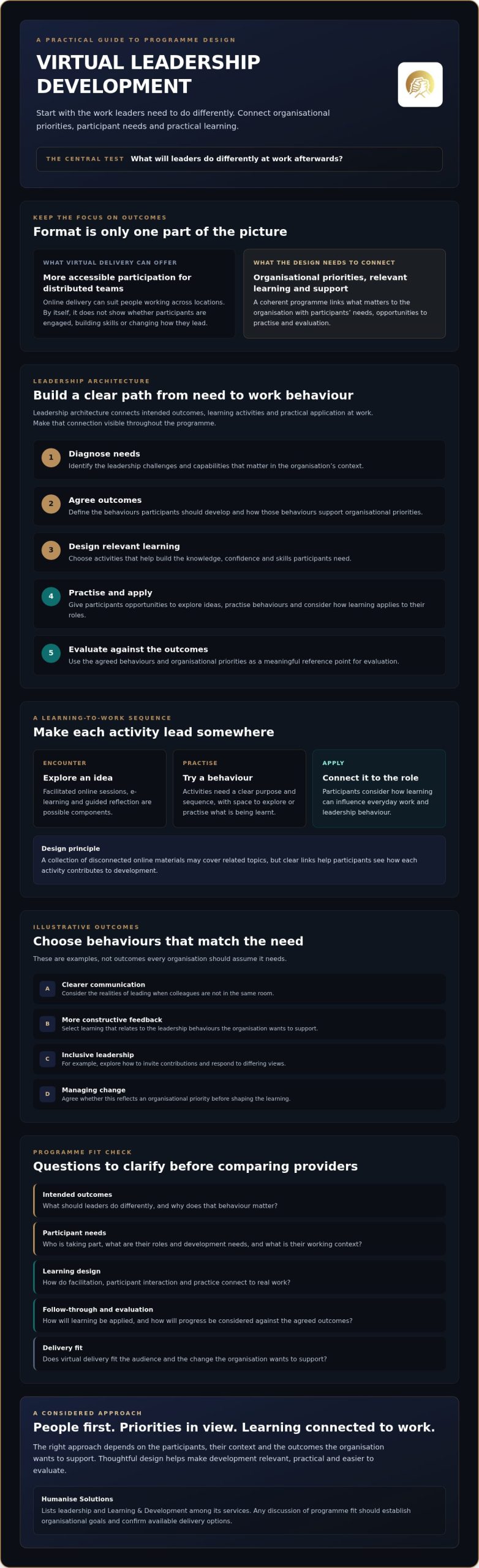
Virtual leadership development programmes are leadership learning experiences delivered through virtual channels. The format may make participation more accessible for distributed teams, but it doesn’t determine the quality of the development. Online delivery alone can’t show whether participants are engaged, building skills or changing how they lead at work. Those outcomes depend on whether the design connects organisational needs with relevant learning and support.
At its foundation, leadership development aims to expand people’s capacity to lead. For a virtual programme to support that growth, its design should connect intended outcomes, participant needs, learning activities, opportunities to apply learning and evaluation. If a programme offers no practical way to try new behaviours, for example, the learning may remain separate from daily work.
What does virtual leadership development include?
Possible components include facilitated online sessions, e-learning and guided reflection on workplace experiences. These are design options, not specifications for any particular provider. A structured programme gives each activity a clear purpose and sequence: participants encounter an idea, explore or practise it, then consider how it applies to their role. A collection of disconnected online materials may cover related topics, but without those links it can be difficult to see how each activity contributes to development.
For remote teams, the design can also account for how people interact across locations and working patterns. The right approach depends on the audience and the change the organisation wants to support, rather than on adding digital activities for their own sake.
Which leadership outcomes can a programme support?
Start by agreeing what leaders need to do differently and why that behaviour matters to the organisation. Depending on its priorities, a programme might focus on clearer communication, more constructive feedback, inclusive leadership or managing change. These are examples, not outcomes every organisation should assume it needs.
Make the link practical. If the priority is more inclusive team discussions, participants might explore how they invite contributions and respond to differing views. The organisation and provider should agree suitable outcomes together, taking account of participants’ roles, existing strengths and development needs. This keeps learning focused on real work and gives evaluation a meaningful reference point.
Humanise Solutions lists leadership and Learning & Development among its services, alongside Young Adult Programmes. These are distinct areas of work, not confirmation of a virtual leadership offer. Any discussion about fit should establish the organisation’s goals and confirm which delivery options are available.
How should virtual leadership programmes connect learning to leadership architecture?
A strong programme begins before anyone logs in. First, understand the organisation’s priorities and the situations leaders need to handle. Then build a learning pathway that helps participants practise relevant behaviours and apply them in their roles. This makes the design purposeful instead of simply moving existing content online.
Leadership architecture is the connection between intended outcomes, learning activities and practical application at work. For virtual leadership development programmes, that connection should be visible at every stage:
- Diagnose needs: Identify the leadership challenges and capabilities that matter to the organisation.
- Agree outcomes: Define the behaviours participants should develop and how those behaviours relate to organisational priorities.
- Design learning: Choose activities that build the knowledge, confidence and skills needed for those outcomes.
- Support application: Create opportunities to reflect, practise and use learning in real workplace situations.
- Evaluate: Decide what evidence would show whether the intended learning and behaviour changes are taking shape.
Start with organisational needs and participant context
Begin with the people and the work, not a preselected curriculum. A remote team leader may need to strengthen communication across distance, whilst a more experienced leader may be focused on guiding colleagues through organisational change. Roles, experience and working context help determine which capabilities need attention and where participants can practise them.
Agree priorities with the organisation and consider participant needs before settling on delivery methods. A standard pathway may offer a useful starting point, but shouldn’t be assumed to fit every leadership group. The aim is to shape development around relevant challenges, not ask participants to adapt to learning that feels disconnected from their responsibilities.
Design a pathway that supports application
Map each learning activity to an intended behaviour and a practical opportunity to use it. Facilitated learning might help participants explore a challenge together; e-learning could introduce a concept, whilst reflection can help a leader connect that idea to an upcoming conversation or decision. Practice and feedback then give participants a chance to consider what worked and what they might adjust.
For example, if an agreed outcome is to give clearer feedback, the pathway could connect learning about feedback with reflection on a real team interaction and an opportunity to try a different approach. The activities will depend on the programme design. Ask providers how they connect these elements, and confirm which formats and delivery options are available rather than assuming virtual delivery is offered.
If you’re clarifying organisational priorities or exploring what kind of leadership learning may fit, you can discuss your leadership development needs with Humanise Solutions.
Do virtual leadership development programmes really change workplace behaviour?
They can support behaviour change, but virtual delivery alone can’t make it happen. The format describes how learning is delivered, not whether participants will engage, develop a skill or use it at work. The quality of the design, the relevance of the learning and the support available afterwards all matter.
Virtual learning may offer flexibility for remote teams, making it easier to bring people together without being in the same place. Yet convenience isn’t the same as engagement. Sessions that rely on passive listening can leave participants with little chance to explore their leadership challenges, whilst a lack of follow-through can make useful ideas easy to forget amid daily demands.
What helps learning transfer into day-to-day leadership?
Learning is more relevant when it reflects situations participants actually face. A manager might explore how to respond when a remote colleague seems disengaged, practise framing a clear conversation, then reflect on what happened after trying that approach at work. The scenario should fit the organisation and the leaders taking part.
Reflection, practice and feedback help participants examine their choices and consider how they might respond differently next time. Organisational support matters too. Leaders are more likely to find space to apply new approaches when their managers understand the programme’s aims and encourage them to try relevant behaviours in their roles. Without that connection, even engaging virtual sessions may sit apart from everyday work.
How can organisations evaluate programme value?
Agree what success should look like with relevant stakeholders before a programme begins. Choose indicators that reflect its intended outcomes, rather than relying on what’s easiest to count. Depending on the aims, useful evidence might include:
- Participant feedback: What felt relevant, and where did participants need more support?
- Learning evidence: Can participants explain or demonstrate the skills the programme aimed to develop?
- Workplace observations: Are relevant leadership behaviours being noticed in practice?
Attendance and completion can show whether people took part, but they don’t establish that behaviour changed. Positive feedback is valuable, though satisfaction alone isn’t proof of workplace impact. Equally, if an outcome improves after a programme, that timing doesn’t show by itself that the programme caused the change. Other factors may have contributed.
Keep evaluation proportionate and connected to the agreed outcomes. A thoughtful approach helps organisations understand what appears to be working, where participants may need further support and what can’t yet be concluded. That creates an honest basis for improving development, without promising that any delivery format will produce the same result for every team.
How can you assess and prepare a virtual leadership development programme?
Choose a programme by testing how well its design fits your organisation, not by comparing delivery features in isolation. A clear assessment helps you understand what participants need, how learning could support those needs and how you’ll review progress. Use this sequence to guide discussions with prospective providers:
- 1. Clarify outcomes: Agree which leadership capabilities and workplace behaviours matter, and how they relate to organisational priorities.
- 2. Profile participants: Consider participants’ roles, experience, working context and development needs. Ask how these factors shape the learning pathway.
- 3. Inspect the design: Explore how activities connect to intended behaviours. Ask about facilitation, interaction, accessibility, opportunities to practise and support for applying learning at work.
- 4. Agree evaluation: Decide in advance what feedback and evidence you’ll review, who will contribute and how findings will inform next steps.
A programme is outcome-led and accountable when its aims, participant needs, learning design, workplace application and evaluation fit together.
Questions to ask a prospective programme provider
Ask how the provider learns about your organisation’s priorities before shaping a programme. How will it account for the behaviours and capabilities you want to develop, and adapt if priorities change? Find out which delivery methods and participant support are actually available; don’t assume virtual delivery or a particular format is offered. Ask how participants will interact, how accessibility needs can be discussed, and how the provider will review learning application and feedback.
Look for a clear explanation of how design decisions connect to your intended outcomes. If the proposed activities could be delivered unchanged to any organisation, ask what would make the learning relevant to your teams and leadership context.
Prepare participants and the workplace for learning
Before the programme begins, explain why it’s taking place, what it aims to support and how the learning relates to participants’ roles. Invite them to identify situations where they’d like to strengthen their leadership approach. This gives learning a meaningful starting point without suggesting that participants are deficient.
Make room for practice and reflection within normal work. Participants might choose a relevant upcoming conversation, consider an approach introduced through the programme, then reflect on what they learned from trying it. Discuss whether managers or other stakeholders could help create opportunities to apply learning or share observations. The right level of involvement depends on organisational context; there’s no single model for every team.
For a conversation about your organisation’s leadership and learning needs, contact Humanise Solutions to discuss your goals and establish whether its services are a suitable fit.
How can Humanise Solutions support a human-centred leadership development conversation?
Choosing a development partner starts with understanding what your organisation wants to help leaders achieve. Humanise Solutions describes its approach as human-centric and scientific, supported by over 12 years of research into decision-making processes and trauma prevention. That perspective can inform a conversation about how leadership learning might reflect people’s needs and workplace context. It doesn’t, by itself, confirm a particular programme format or outcome.
If you’re exploring virtual leadership development programmes, be clear about the questions you need answered: which organisational priorities should the learning support, what do participants need to develop, and how might learning connect with their work? Confirm with any prospective provider whether virtual delivery is available and what it would involve.
Explore the confirmed services that may fit your goals
Humanise Solutions’ relevant services include Nurturing Leadership, Bespoke Learning and Leadership ILM Programmes. Their suitability depends on your organisation’s aims, participant roles and development needs. Explore Nurturing Leadership to understand the organisation’s leadership focus, or review Humanise Solutions’ services to see its areas of work.
These services shouldn’t be assumed to be available as virtual programmes. Ask which design and delivery options could be considered for your requirements, and how they would connect learning with the behaviours and outcomes your organisation values.
Take a low-pressure next step
A useful first conversation can begin with the challenge you’re trying to address. Describe the leadership behaviours you hope to strengthen, the needs of the people taking part and the workplace situations where new learning could be applied. From there, clarify whether the service is a suitable fit and ask about programme design, delivery format and how learning and feedback could be reviewed.
You don’t need every detail resolved before starting that discussion. Sharing your priorities can help establish what questions matter next, without assuming a particular solution is right. If you’d like to explore the fit, discuss your leadership development needs with Humanise Solutions.
Build leadership development around the change you want to see
Effective virtual leadership development programmes are shaped by more than their delivery format. Their design should connect organisational priorities and participant needs with relevant learning, opportunities to apply it at work and a clear way to review progress. Flexibility can help distributed teams take part, but meaningful development depends on that connection.
Humanise Solutions describes its approach as human-centric and scientific, supported by over 12 years of research into decision-making processes and trauma prevention. Its relevant services include Nurturing Leadership, Bespoke Learning and Leadership ILM Programmes. Their suitability depends on your goals and participants, and virtual delivery should be confirmed directly rather than assumed.
Start with the leadership challenges your organisation wants to address. A conversation can help clarify the outcomes you’re seeking, what kind of learning may fit, and how programme design, delivery options and evaluation could be explored. Discuss your leadership development needs with Humanise Solutions.
With a clear purpose and appropriate support, you can create a considered path for leaders to grow and contribute with confidence.
Frequently Asked Questions
What is a virtual leadership development programme?
A virtual leadership development programme delivers learning for people in leadership roles through online channels. Depending on the design, it might combine facilitated sessions, e-learning or guided reflection. The format alone says little about quality: a useful programme connects organisational priorities and participant needs with relevant learning and opportunities to apply it at work. For remote teams, consider whether activities support interaction rather than simply putting materials on screen.
Are virtual leadership development programmes effective?
Virtual leadership development programmes can support development when learning is relevant, interactive and connected to workplace practice. Online delivery may make participation more flexible for distributed teams, but it doesn’t guarantee engagement or behaviour change. Look for opportunities to discuss realistic leadership situations, practise approaches and reflect afterwards. Ask how the provider will support application and how the organisation will review evidence of learning, rather than treating attendance or positive feedback as proof of impact.
What should a virtual leadership development programme include?
It should include elements that work together towards agreed outcomes, rather than a set of unrelated online materials. Depending on participants’ needs, this could involve facilitated learning, e-learning, practical exercises, reflection and feedback. Ask how each activity relates to the leadership behaviours the organisation wants to develop. The specific mix should reflect participants’ roles, experience and working context, and the provider should explain what support is available between or after learning activities.
How do virtual leadership programmes help learning transfer into the workplace?
They can support transfer by linking learning to real situations participants face in their roles. A leader might explore a communication approach, practise using it and reflect on how it went in a team conversation. Feedback and time to consider what to adjust can help participants learn from the experience. Workplace support matters too: managers or stakeholders may help participants find appropriate opportunities to apply learning, depending on the organisation’s needs and circumstances.
How can an organisation measure leadership development outcomes?
Agree the intended outcomes and suitable indicators with stakeholders before the programme starts. Review participant feedback, evidence of learning and relevant observations of behaviour at work, choosing measures that fit the goals. Attendance and completion show participation, not necessarily development. Satisfaction can offer useful insight, but it doesn’t prove impact. If workplace outcomes change after a programme, consider other factors before attributing that change to the learning alone.
Can a virtual leadership programme be tailored to an organisation?
It may be tailored, but confirm this with the provider. Share the leadership challenges you want to address, the behaviours that matter and the roles and experience of participants. Then ask how these factors could shape programme outcomes, learning activities and evaluation. A tailored approach should reflect your context rather than assume the same curriculum suits every group. Confirm which delivery formats are available before planning around virtual participation.
What should I ask a leadership development provider before choosing a programme?
Ask how the provider identifies organisational needs, agrees outcomes and adapts learning to participants’ roles. Find out which delivery methods and support are available, how sessions encourage interaction, and how participants can practise and apply learning at work. Clarify how feedback and outcomes will be reviewed. Humanise Solutions lists Nurturing Leadership, Bespoke Learning and Leadership ILM Programmes among its relevant services; ask directly whether virtual delivery is available and suitable for your needs.
