

Article by
Scott Ward MBA CCMI
Scott Ward is the founder and CEO of Humanise Solutions, which he established three years ago to help organisations elevate their people, leadership and culture through a human-centric, evidence-based approach. Before moving into business and academia, Scott spent seven years as a professional footballer, playing for Luton Town, Crawley Town and Coventry City FC until injury brought his playing career to a close — a turning point that shaped both his research interests and his approach to leadership.
Scott holds an MBA from Warwick Business School, where his research explored the causal relationship between trauma and decision-making — work that continues to inform how he supports young adults, leaders and teams under pressure. Recognised as a Companion of the Chartered Management Institute (CCMI), its highest grade of membership, he combines academic rigour with the discipline, resilience and team-first mindset of the professional game. At the heart of everything he does is a simple belief: that people perform at their best when they are led, developed and valued as human beings first.
Pushback isn’t proof that people are the problem. It may be the clearest signal that a change feels unclear, unfair or difficult to manage. Dealing with resistance to change in the workplace starts with understanding what employees are responding to, rather than trying to silence their concerns.
If you’re unsure whether to communicate more, involve people in decisions or offer practical support, you’re not alone. Each response can help, but only when it reflects what’s driving the resistance. If employees feel a decision has already been made, activity that looks like participation can weaken trust instead of building it.
This guide will help you recognise different forms of resistance, explore the needs and experiences behind them, and choose a proportionate response. You’ll find practical ways to listen, explain what’s changing and where there’s room for input, support people through new expectations, and learn as the change unfolds. The aim isn’t to force compliance. It’s to turn concerns into useful insight and create the conditions for people to take part with greater confidence.
Key Takeaways
- Explore what’s behind hesitation, from uncertainty about expectations to concerns about trust, confidence or capacity.
- Ask open, private questions that invite specific examples before explaining or defending the change.
- When dealing with resistance to change in the workplace, match your response to the concern: clarify context, offer learning support or investigate practical objections.
- Use a repeatable process to listen, agree a next step and follow up, while recording themes without labelling individuals.
- Build lasting change by aligning leadership behaviour, participation and learning with the outcomes your organisation needs.
Dealing with Resistance to Change in the Workplace Starts with Understanding the Concern
A proposed change can raise questions about workload, capability, working relationships and what will be expected in future. Even when the purpose is clear to leaders, employees may be unsure how it will affect their day-to-day work. Dealing with resistance to change in the workplace starts by recognising this uncertainty and making space to understand it.
Workplace resistance may show up as expressed concern, hesitation or behaviour that makes a proposed change harder to adopt. It’s information about how people experience change, not evidence of bad intent. A question or delay doesn’t tell you why someone is responding that way. Ask before interpreting: what looks like reluctance could point to unclear communication, a practical barrier or an impact leaders haven’t considered.
That impact may sit beyond one person. The idea of systemic change resistance helps broaden the view: friction can arise within the wider system, not just from an individual employee. Consider whether processes, team pressures or established ways of working are making the change difficult to take up.
What can resistance to workplace change look like?
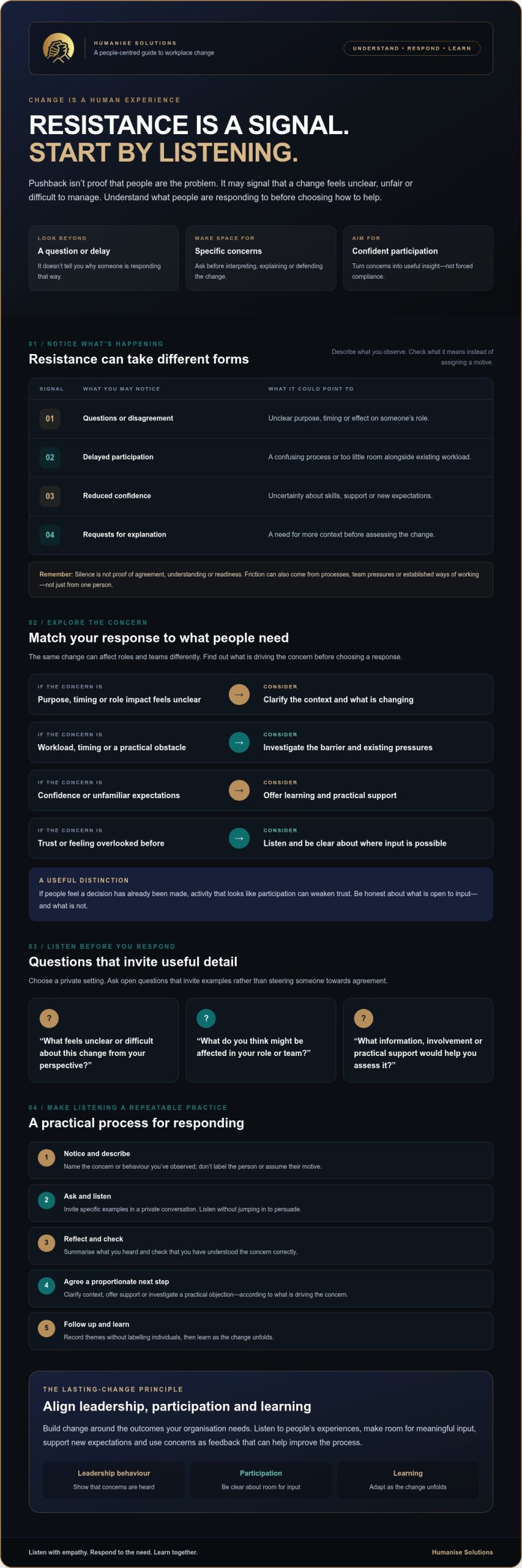
Resistance can be visible, subtle or expressed as a request for more information. Note what’s happening, then check what it means rather than assigning a motive.
- Questions or disagreement: someone may be unclear about the purpose, timing or effect on their role.
- Delayed participation: a process may be confusing, or workload may leave little room to engage.
- Reduced confidence: someone may be unsure they have the skills or support to work in a new way.
- Requests for explanation: employees may need more context before they can assess the change.
Describe the concern you’ve heard, not an assumption about attitude or commitment. Don’t treat silence as agreement, understanding or readiness, either. A quiet room tells you that no one has spoken yet; it doesn’t tell you what people think.
Why might employees push back against change?
Start with the questions that affect people’s working lives. Is the purpose clear? Does the timing feel manageable? Are responsibilities changing, and will people have the skills and support they need? Will familiar processes or relationships be affected? Asking for specific examples can help distinguish a communication gap from a practical obstacle.
Experience matters, too. People who’ve lived through repeated changes, or felt their perspective was overlooked before, may need evidence that this process will be different. Concerns can also vary between roles and teams: one group may be focused on new responsibilities, whilst another is worried about how existing work will continue. Listen for those differences before deciding what explanation or support would help.
Find the Causes of Resistance Before Choosing a Workplace Change Response
Once you’ve noticed a concern, pause before deciding what it means or how to fix it. The employee may be unsure about the purpose, worried about personal impact, uncertain of their skills, or unable to take on new expectations alongside existing work. Trust may also shape their response, particularly if previous changes felt rushed or their perspective was overlooked. Don’t presume which explanation applies. Find out.
The same change can prompt different concerns across roles, teams and experiences. A new process might raise questions about workload for one team and confidence with unfamiliar tasks for another. This is why dealing with resistance to change in the workplace calls for curiosity before persuasion. Harvard Business Review’s discussion of human-centred leadership in change also encourages leaders to treat resistance as feedback that may help improve the change process.
Questions that help uncover the real concern
Choose a private setting where the employee can speak openly. Ask questions that invite examples, rather than questions that defend a decision or steer them towards agreement:
- “What feels unclear or difficult about this change from your perspective?”
- “What do you think might be affected in your role or team?”
- “What information, involvement or practical support would help you assess it?”
Listen without jumping in to persuade. Then reflect back the concern and check your understanding: “It sounds as though the timing is difficult because of the current workload. Have I understood that correctly?” This gives the employee a chance to clarify before you suggest a response.
Separate personal concerns from barriers in the organisation
Look for patterns as well as individual experiences. If people across teams keep asking why the change is happening, the rationale may need a clearer explanation. If employees understand the purpose but can’t act on new expectations, check whether they have enough time, skills, access to what they need and support from managers.
Also explore what may be changing in working relationships, professional identity, influence or familiar team routines. A concern shared by several people may point to a process or leadership issue, but don’t assume every employee has the same experience. Record recurring themes separately from individual examples, then use both to shape a proportionate response.
If your organisation needs support to understand these patterns and develop its approach, you can discuss your change and transformation needs with Humanise Solutions.
Choose the Right Way to Respond to Resistance to Change
Once you’ve identified the concern, choose a response that addresses it rather than reaching for the same tactic each time. Clearer context may help with uncertainty; learning support may build confidence; a practical objection may reveal something in the plan that needs investigating. Choose your response according to the concern you’ve heard, rather than applying one tactic to everyone.
Use the table as a starting point, not a diagnosis. Agree a next step with the people affected, then check whether it has made the change clearer or more workable.
| Concern observed | Response to consider | A sign follow-up is needed |
|---|---|---|
| “I don’t understand why we’re doing this.” | Explain the purpose, what’s known and what remains undecided. Invite questions. | The same questions keep coming up, or people can’t describe what the change means for their work. |
| “I’m not sure I can do this.” | Explore relevant learning, guidance or opportunities to practise. | Confidence remains low, or employees still can’t carry out the new tasks. |
| “This won’t work with our current process.” | Investigate the specific example with affected people. Consider whether implementation can be adjusted. | The barrier persists or depends on decisions beyond the manager’s authority. |
| “We weren’t asked about this.” | Invite meaningful input on implementation where choices are still open. | People are asked for views but can’t see how their input is considered. |
When communication or explanation may be the right first step
Set out why the change is proposed, what has been decided and what is still open to influence. Be honest about limits: inviting ideas about implementation when the core decision is fixed can damage trust. Use two-way conversations alongside announcements, and make room for questions. Check understanding by asking what people think will change in their work, not whether they agree. Understanding is useful even when concerns remain.
When involvement, learning or practical support may help
If employees can shape how a change is put into practice, involve them in identifying risks, testing workable adjustments or clarifying team routines. If the concern is about capability, offer relevant learning or guidance rather than expecting confidence to appear on its own. If people lack time, access or authority to act, raise the barrier with someone who can address it. A manager can listen and advocate, but shouldn’t promise a fix they can’t deliver.
Thoughtful dealing with resistance to change in the workplace keeps momentum grounded in what people need to take part. Review the response after taking action: has uncertainty eased, can people use the new approach, and are practical obstacles being resolved? If not, return to the concern and adapt the support.
Practical Process for Dealing with Resistance at Work
Listening only builds trust when people can see what happens next. A repeatable process helps managers move from a concern to a practical response, while keeping the employee’s experience in view:
- Notice a question, hesitation or barrier without assigning a motive.
- Ask what the person is experiencing and invite a specific example.
- Listen without interrupting or rushing to justify the change.
- Identify the concern: is it about understanding, confidence, capacity or an issue in the plan?
- Agree an action that is realistic and name who will take it forward.
- Follow up to check whether the action helped and whether anything has changed.
Keep a record of useful themes, not labels such as “difficult” or “resistant”. Separate one person’s experience from patterns raised by a team; an individual concern shouldn’t be presented as a shared view unless others have said the same. This makes it easier to respond fairly and notice where communication, processes or support may need attention.
How to hold a constructive conversation about change
Choose a suitable setting and give the employee room to explain how the change affects their work. Acknowledge the impact without promising an outcome you can’t control. For example, you might say, “I can see how this creates uncertainty. I’ll take the workload concern to the project lead and come back to you.” Agree who will do what, then set a suitable point to revisit the concern.
Close the loop, even if the decision hasn’t changed. Explain what you heard, what can be adjusted and what can’t, with a clear reason where you can provide one. If you’re still waiting for an answer, say so and share when you expect to update them. Silence after someone has raised an issue can undermine the trust built in the conversation.
How to keep learning as implementation develops
At appropriate points, review recurring questions and practical barriers with the affected teams. Check progress by asking what people are experiencing and whether they can use the new approach in their work, not simply whether an announcement was sent or training completed. Share adjustments in plain language, including why they were made, and be open about what remains unchanged.
For broader team-development ideas, readers can also explore Humanise Solutions’ Building Team Excellence article. Organisations considering wider support can review organisational change and development services. A sustained, human-centred approach to dealing with resistance to change in the workplace takes listening, clear action and learning over time. Talk with Humanise Solutions about your change and transformation needs.
Build Lasting Workplace Change Through Human-Centred Leadership
Change becomes more workable when leaders create an environment where people can ask questions, raise practical concerns and learn what new expectations require. Their behaviour matters: listening carefully but acting inconsistently can weaken trust, whilst following through on commitments helps people see that their experience has been taken seriously. Dealing with resistance to change in the workplace is therefore not just a communication task. It’s a leadership capability that can grow over time.
External support may be worth considering when the organisation needs help connecting its goals with the experience of the people affected. Before choosing a partner, get clear on:
- The organisational goal: What needs to change, and why?
- The people affected: Which roles and teams will experience the change, and how?
- The desired outcomes: What should people be better able to do as a result?
- The learning needs: What knowledge, skills or leadership development could support progress?
What to look for in change and leadership support
Look for an approach that listens to the people affected and connects their development with the organisation’s aims. Ask how learning, leadership and team needs will shape the support, and how responsibilities will be agreed. Clarify the scope, what the external partner will contribute and what remains with your organisation. This helps you judge whether support is suitable for the challenge, rather than adopting a predetermined solution.
Where leadership capability is central, explore the ideas in Humanise Solutions’ Nurturing Leadership Skills pillar alongside your own priorities. Humanise Solutions’ relevant support includes Change & Transformation and Nurturing Leadership. Its human-centric, scientific approach is informed by over 12 years of research into decision-making processes and trauma prevention. These are foundations for the work, not a promise of a particular result. You can also review its organisational change and development services to consider what may fit your needs.
Take a considered next step
Before a conversation with a potential partner, summarise the change you’re facing, the concerns employees have raised and the outcomes you want to support. Include what you’ve already tried and where you need further understanding. A clear starting point makes it easier to explore whether the approach and scope align with your organisation’s needs.
If you’d like to explore your situation with Humanise Solutions, discuss your workplace change challenge and the outcomes you hope to achieve. A thoughtful next step can help turn employee insight into learning, stronger leadership and change that people are better equipped to take part in.
Turn Employee Concerns into Progress
Resistance can offer a useful starting point. When leaders listen before interpreting, they’re better placed to understand what’s behind a concern and respond with clearer communication, relevant support or a practical adjustment. Dealing with resistance to change in the workplace is not about securing silence or automatic agreement. It’s about helping people understand the change and take part in ways that support the organisation’s goals.
Keep the process moving: ask what employees are experiencing, agree a realistic next step, and follow up to see whether it helped. Consistent leadership and honest updates can make participation meaningful and strengthen trust as change develops.
For organisations considering further support, Humanise Solutions offers Change & Transformation and Nurturing Leadership services, informed by a human-centric, scientific approach and over 12 years of research into decision-making processes and trauma prevention. To explore how this could relate to your organisation’s goals, discuss your workplace change challenge.
Each thoughtful conversation can help build the confidence and shared understanding needed for lasting progress.
Frequently Asked Questions
What causes resistance to change in the workplace?
Resistance to change can have different causes, so explore the concern rather than assuming you know its source. An employee may feel uncertain, lack clear information, worry about the effects on their role or team, disagree with the proposed approach, or feel short of confidence or capacity. Ask open questions such as, “What feels most difficult about this?” Then check what information or practical support could help before choosing a response.
How should managers deal with resistance to change at work?
Managers should notice and describe what’s happening without labelling the person, then ask about their experience and listen for the underlying concern. Agree a proportionate next step, such as clarifying expectations, exploring a practical barrier or arranging relevant learning support. Explain honestly what can and can’t change, and follow up on any agreed action. Dealing with resistance to change in the workplace doesn’t mean every concern can be resolved or every employee will agree.
Is resistance to change always a bad thing?
No. Resistance may highlight unclear plans, overlooked effects or practical barriers that leaders need to understand. It can also reflect uncertainty or genuine disagreement, which deserves a respectful response. Treating it as useful information doesn’t mean assuming every objection is accurate or helpful. Equally, it isn’t automatically harmful or proof of poor commitment. Ask what the concern is based on, consider its implications and investigate before deciding how to respond.
What is the difference between resistance to change and change fatigue?
Resistance is a response to a particular proposed or ongoing change, such as questioning a new process or hesitating to adopt it. Change fatigue generally describes feeling strained or depleted amid repeated or sustained change. The terms aren’t interchangeable, and neither is a diagnosis. Listen for both the specific issue and any wider capacity pressures, such as competing work or limited time, before deciding whether the next step is clearer information, practical support or a review of change activity.
How can leaders communicate change without increasing resistance?
Explain the purpose of the change, its expected effects and what remains uncertain in clear, straightforward language. Make space for questions and feedback, and distinguish decisions already made from parts of implementation employees can influence. Don’t present consultation as open choice if it isn’t. Check what people have understood, return with answers and share updates as decisions develop. A single announcement can introduce a change, but ongoing two-way communication helps people assess what it means for their work.
When should an organisation seek external support with workplace change?
Consider external support if leaders need help connecting a change with organisational outcomes, developing leadership capability, understanding team needs or shaping learning. Before speaking to a provider, clarify the challenge, who is affected and what progress would look like for your organisation. Ask about the proposed scope, responsibilities and how support will reflect those needs. Suitability depends on the challenge and agreed scope; working with an external provider doesn’t guarantee a particular outcome.
Can employee participation help with resistance to change?
Yes, meaningful participation can help leaders understand concerns and identify implementation issues, especially when employees can influence relevant decisions. Be clear about which choices are open and which have already been made. For example, a team might help identify workable steps for adopting a new process even if the decision to introduce it is settled. Participation isn’t a device for securing automatic agreement; its value is in building understanding and informing practical decisions.
To discuss how Humanise Solutions’ Change & Transformation and Nurturing Leadership support could fit your organisation’s needs, get in touch about your workplace change challenge.
