

Article by
Scott Ward MBA CCMI
Scott Ward is the founder and CEO of Humanise Solutions, which he established three years ago to help organisations elevate their people, leadership and culture through a human-centric, evidence-based approach. Before moving into business and academia, Scott spent seven years as a professional footballer, playing for Luton Town, Crawley Town and Coventry City FC until injury brought his playing career to a close — a turning point that shaped both his research interests and his approach to leadership.
Scott holds an MBA from Warwick Business School, where his research explored the causal relationship between trauma and decision-making — work that continues to inform how he supports young adults, leaders and teams under pressure. Recognised as a Companion of the Chartered Management Institute (CCMI), its highest grade of membership, he combines academic rigour with the discipline, resilience and team-first mindset of the professional game. At the heart of everything he does is a simple belief: that people perform at their best when they are led, developed and valued as human beings first.
What if self-doubt isn’t proof that you’re unqualified, but a signal to pause and look at the evidence more fairly? With imposter syndrome in leadership roles, it can be easy to dismiss achievements as luck, worry that colleagues will spot a gap in your knowledge, or hold back from visible decisions and new opportunities. Those feelings can be unsettling, but they don’t erase the skills and experience you bring to your role.
You don’t have to wait until every doubt disappears to lead with care and purpose. This article explores how self-doubt can shape leadership and offers practical, compassionate ways to recognise imposter feelings without treating them as facts. You’ll learn how reflection, constructive feedback and supportive relationships can help you build confidence over time.
We’ll also consider how leaders can create more open, supportive team relationships, so confidence is nurtured through everyday practice rather than demanded as a performance. The aim isn’t to become doubt-free. It’s to lead with greater intention while making room for your strengths and continued growth.
Key Takeaways
- Recognise how imposter syndrome in leadership roles can show up, without mistaking self-doubt for proof that you lack ability.
- Explore how greater visibility, new responsibilities and changing work contexts may influence confidence, without assuming there’s one cause for everyone.
- Challenge common leadership myths and make room for a more balanced view of capability and uncertainty.
- Use a simple process to notice self-doubt, examine the evidence and choose a constructive next step.
- Discover how personal reflection and supportive team practices can help nurture confidence and intentional leadership.
Imposter syndrome in leadership roles: what the experience can look like
Holding responsibility and achieving meaningful results doesn’t always quiet private doubts. A leader may guide a project successfully, earn colleagues’ trust and still wonder whether they’re truly capable of the role. This can feel isolating, especially when others see confidence on the outside.
Imposter feelings generally describe a sense of inadequacy that persists despite evidence of ability or achievement. They describe an experience, not a diagnosis or a definitive measure of someone’s potential. The accessible overview of Impostor syndrome outlines the term and commonly associated experiences. At work, for example, a leader might receive positive feedback after a well-judged decision, then dismiss it as luck or assume the team would have succeeded regardless.
How self-doubt can appear in a leadership role
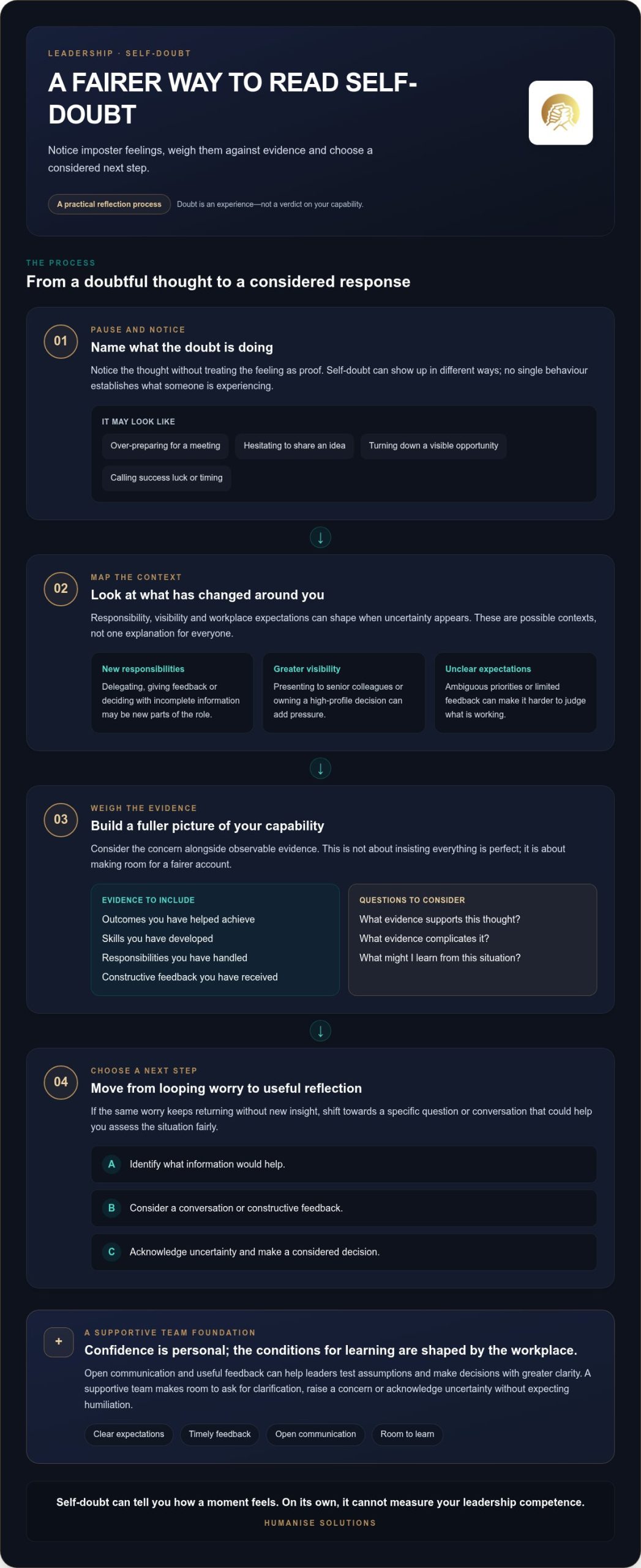
Self-doubt can influence behaviour in different ways, but no single behaviour proves that someone is experiencing imposter feelings. A leader might over-prepare for a meeting, hesitate to share an idea or turn down a visible opportunity. They may credit a successful outcome to good timing, support from colleagues or luck, while overlooking their own judgement and contribution. Responsibility for a team can add another layer: concern about making the wrong decision may make each choice feel unusually high-stakes.
Imposter feelings are not a verdict on your capability
Feelings deserve attention, but they aren’t the whole picture. To understand your leadership more clearly, consider them alongside observable evidence: the outcomes you’ve helped achieve, skills you’ve developed, responsibilities you’ve handled and constructive feedback you’ve received. This isn’t about dismissing a concern or insisting you’re doing everything perfectly. It’s about making room for a fuller, fairer account of your capability.
Self-doubt can tell you how a moment feels; it can’t, on its own, measure your leadership competence.
That distinction matters in imposter syndrome in leadership roles, because treating doubt as proof can narrow the opportunities you’re willing to take. Notice the thought, then ask what evidence supports it, what evidence complicates it and what you might learn from the situation. You can acknowledge uncertainty while still making a considered decision and recognising the strengths you bring.
Why imposter feelings can surface as leadership responsibility grows
Self-doubt doesn’t have one cause, and a demanding role won’t affect every leader in the same way. Still, changes in responsibility, visibility or workplace expectations can provide useful context for understanding when uncertainty shows up. With imposter syndrome in leadership roles, the question isn’t simply “What’s wrong with me?” It can also be “What has changed around me, and what support or clarity would help?”
Role transitions, visibility and high expectations
Moving into management can mean using familiar strengths in unfamiliar ways. Someone confident in their technical expertise may now need to delegate, give feedback or make decisions with incomplete information. The learning curve doesn’t mean they’re unsuited to leadership; it may mean the role asks them to develop new skills.
Greater visibility can add pressure. A leader presenting to senior colleagues or taking responsibility for a high-profile decision may feel that ordinary learning moments will be judged more harshly. Perfectionistic expectations can also play a part: if a leader believes they must always have the answer, asking questions may feel like a failure rather than a sensible way to learn. These are possible patterns, not explanations that apply to everyone.
Clear expectations and timely feedback can help leaders understand what’s working and where to grow. When priorities are ambiguous or feedback is limited, it may be harder to judge performance, leaving more room for second-guessing. That uncertainty doesn’t establish the cause of someone’s feelings, but it is worth noticing as part of the wider context.
The team environment can shape how safe it feels to learn
Leaders don’t develop confidence in isolation. The way colleagues respond to questions, mistakes and differing views can influence whether it feels possible to learn openly. Psychologist Amy Edmondson describes psychological safety as a shared belief that a team is safe for interpersonal risk-taking. In practice, that can mean being able to raise a concern, ask for clarification or acknowledge uncertainty without expecting humiliation.
Confidence is personal, but the conditions for learning are shaped by the workplace. A supportive team can’t remove every doubt, yet open communication and useful feedback may help a leader test assumptions and make decisions with greater clarity.
Reflection is useful when it helps you identify a specific question, gather evidence or choose a next step. It can become less helpful when the same worry loops without producing new insight. If you notice that pattern, try shifting from “What if I’m not capable?” to “What information or conversation would help me assess this fairly?” Human-centred leadership and learning development can also create space to explore confidence alongside the team practices that support learning.
Common leadership misconceptions that can keep self-doubt in place
Ideas about what a “real” leader should feel or do can quietly add pressure. If you expect yourself to be certain, self-sufficient and consistently confident, ordinary moments of learning may start to look like evidence that you don’t belong. A more balanced view makes room for doubt without allowing it to define your leadership.
Myth: good leaders always feel certain
Reality: Confidence doesn’t require complete certainty. Leaders often make considered decisions with the information available, while recognising what remains unknown. The skill lies in weighing the options, being clear about the reasoning and taking responsibility for the next step.
For example, a leader facing a change that will affect several teams might say, “Here’s what we know so far. I’d like input from the people closest to this work before we decide.” They can then gather relevant perspectives, set a point to review the information and make the call. Naming uncertainty hasn’t weakened their authority; it has helped them reach a more considered decision.
That approach is different from delaying every choice until doubt disappears. Reflection should inform action, not become a demand for perfect reassurance. With imposter syndrome in leadership roles, the belief that capable leaders never question themselves can turn an ordinary decision into a test of personal worth. You can acknowledge uncertainty and still lead with direction.
Myth: asking for support exposes weakness
Reality: A focused request for input can be a responsible way to test an assumption or identify a development need. Instead of asking, “Am I any good at this?”, try something specific: “Was my reasoning clear in that meeting?” or “What could I do differently when I delegate this work?” Concrete questions make feedback easier to use.
Seeking perspective doesn’t mean handing someone else your responsibility. You remain accountable for the decision; another person’s insight can help you see what you might have missed. The aim isn’t to collect endless approval, but to learn, make an informed choice and build trust in your judgement.
Leaders also influence whether support-seeking feels acceptable across a team. When they invite thoughtful questions, explain how decisions are made and respond constructively to concerns, they make learning part of the work rather than a sign of inadequacy. And not every dip in confidence means imposter feelings are at play. It may point to an unclear expectation, a genuine skills gap or a need for more information. Responding with curiosity helps you work out what would be most useful next.
Tackling impostor syndrome in leadership: practical steps
There’s no need to force confidence or argue yourself into a positive conclusion. A steadier approach is to notice what’s happening, check your interpretation against the evidence and choose a useful next step. This simple process can help you respond to imposter syndrome in leadership roles with curiosity rather than self-criticism.
- Notice the trigger. Identify the situation in which doubt appeared, such as presenting a proposal, receiving feedback or making a decision with incomplete information.
- Name the thought. Write down the specific message running through your mind, for example, “I’m not ready to lead this project.” Naming a thought helps distinguish it from an established fact.
- Examine the evidence. Ask what observable facts support the thought and what might challenge it. Don’t force a reassuring answer; look for a fair, complete view.
- Choose one proportionate action. You might clarify a decision criterion, ask for specific feedback or identify a skill to practise.
- Review what you learned. After taking action, note what happened and whether it changed your understanding of the situation.
A short reflection practice for moments of doubt
Keep the exercise brief. Write three prompts: What happened? What am I interpreting it to mean? What question or feedback would help me understand it better? For example, after a challenging meeting, the fact might be that a colleague questioned your recommendation; the interpretation might be, “They think I’m incapable”; the useful question could be, “Which part of my reasoning would you like me to explain further?”
Choose one manageable response, then return to the work. If reflection starts to feel overwhelming or increases your distress, pause the exercise and seek appropriate support. These prompts are for professional reflection, not a clinical assessment.
Turn feedback and progress into usable evidence
Keep a factual record of decisions, contributions, outcomes and feedback. Include what you did, what others noticed and what you’d like to develop next. Before dismissing an achievement as luck or accepting an overly harsh judgement, review the record. It won’t tell you that every decision was perfect; it can help you see your contribution more accurately.
Ask for feedback that supports learning, such as, “What’s one strength I should keep building on?” or “What’s a useful next step for me?” Managers can reinforce this practice by making expectations clear and creating regular conversations about learning, not only performance concerns. Humanise Solutions’ Emotional Intelligence module, Imposter Syndrome, offers an educational way to explore these themes. Get in touch to discuss leadership development that supports reflection and growth.
Build leadership confidence through reflective, human-centred development
Confidence can grow through practice, reflection and supportive relationships. It isn’t only an individual task: leaders benefit from opportunities to understand their responses and develop their skills, whilst teams and organisations can help by making expectations clear and learning conversations part of everyday work. This broader approach recognises that imposter syndrome in leadership roles isn’t simply a personal failing to correct.
What supportive leadership development can help you practise
Development can create space to build self-awareness, have constructive conversations about feedback and make decisions with greater clarity. A leader might practise noticing when a concern is based on evidence, when they need another perspective and how to explain a decision to their team. These skills can support more grounded leadership while helping colleagues feel heard and able to contribute.
Nurturing leadership is strengthened through everyday interactions: inviting questions, recognising contributions and treating learning as part of the work. Humanise Solutions takes a human-centred, scientific approach informed by over 12 years of research into decision-making processes and trauma prevention. This research informs a wider focus on reflection and human development.
The Emotional Intelligence module titled Imposter Syndrome is an educational development resource for exploring these experiences. It is not clinical treatment, nor does development promise a particular outcome. Instead, it offers a structured opportunity to reflect on self-doubt and consider how it relates to leadership practice.
Explore a development conversation that starts with your goals
Useful development begins with what the leader and organisation want to work towards. That might mean strengthening confidence in decision-making, improving feedback conversations or building team practices that support learning. A collaborative process can connect individual reflection with practical organisational outcomes, shaping the focus around the people and context involved.
Explore Humanise Solutions’ leadership and learning development services to see how human-centred development can support growth. If you’d like to discuss your goals and the support that could help, you’re welcome to talk with the Humanise Solutions team.
Lead with greater confidence, one considered step at a time
Self-doubt can arise alongside genuine capability. With imposter syndrome in leadership roles, a useful first step is to notice the feeling without treating it as a verdict: consider the evidence, seek specific feedback and choose a constructive action. Confidence doesn’t mean having every answer. It can grow through reflection, learning and supportive conversations.
That growth is strengthened when leaders and teams make room for questions, clear expectations and learning. Humanise Solutions takes a human-centred, scientific approach, informed by over 12 years of research into decision-making processes and trauma prevention. Its Emotional Intelligence module, Imposter Syndrome, is an educational development resource for exploring these experiences.
You don’t need to have everything figured out before taking a next step. To explore leadership development shaped around your goals, talk with Humanise Solutions about leadership development. With reflection and supportive practice, you can keep recognising your strengths and lead with greater intention.
Frequently Asked Questions
What is imposter syndrome in leadership roles?
Imposter syndrome in leadership roles describes feelings of inadequacy or self-doubt that persist despite evidence of capability. A leader might explain a successful outcome as luck, minimise their contribution or worry that others will discover they aren’t qualified. The term describes an experience, not a diagnosis, and these feelings alone don’t establish someone’s ability. Looking at actions, skills, outcomes and feedback can give a more balanced view.
Can successful leaders experience imposter feelings?
Yes. Achievement and self-doubt can coexist: a leader may deliver a strong project, receive positive feedback and still question whether they deserve their position. They might credit the result to colleagues or timing while overlooking their own decisions and effort. Success doesn’t automatically remove uncertainty, and experiencing doubt doesn’t cancel out what someone has accomplished. It can help to acknowledge the feeling and consider it alongside concrete evidence of contribution.
How can I overcome imposter syndrome as a leader?
Start by noticing when the doubt appears, then name the thought it brings up. Separate observable facts from your interpretation, and consider what evidence supports or challenges that interpretation. Choose one practical next step, such as asking for specific feedback or clarifying expectations, then review what you learned. A record of decisions, contributions and outcomes can help you recognise patterns over time without demanding that every doubt disappear.
Does imposter syndrome mean I am not suited to leadership?
No. Self-doubt by itself can’t determine whether you’re suited to lead. Consider it alongside relevant evidence, including the skills you’ve developed, how you handle responsibility, the outcomes of your work and constructive feedback. If you identify a genuine area for development, that can guide learning rather than define your worth. Leadership involves ongoing growth, and asking questions or seeking input can be part of responsible practice.
How can managers support a team member experiencing self-doubt?
Make expectations and priorities clear, then offer specific, balanced feedback that recognises contributions as well as development needs. Ask what support or information would help, and invite the person to share their perspective without pressuring them to disclose more than they wish. Managers can also make learning conversations routine across the team, so questions and thoughtful mistakes are treated as part of development rather than signs of personal failure.
Can imposter feelings affect leadership decisions?
They can influence how a leader approaches decisions, although the effect varies from person to person. Someone might delay a choice while seeking more reassurance, over-prepare to avoid criticism or pass up a stretch opportunity. These behaviours can also have other explanations, so they don’t prove imposter feelings are present. It may help to clarify the decision criteria, identify what information is still needed and set a reasonable point to act.
When should a leader seek additional support for persistent self-doubt?
Consider seeking support if self-doubt persists, feels distressing or makes it harder to work, make decisions or take part in everyday life. A trusted manager, mentor or appropriate workplace support may help you explore professional development needs. If the distress affects your wellbeing, consider speaking with a qualified health professional. Humanise Solutions’ Imposter Syndrome module is an educational development resource, not clinical treatment.
