

Article by
Scott Ward MBA CCMI
Scott Ward is the founder and CEO of Humanise Solutions, which he established three years ago to help organisations elevate their people, leadership and culture through a human-centric, evidence-based approach. Before moving into business and academia, Scott spent seven years as a professional footballer, playing for Luton Town, Crawley Town and Coventry City FC until injury brought his playing career to a close — a turning point that shaped both his research interests and his approach to leadership.
Scott holds an MBA from Warwick Business School, where his research explored the causal relationship between trauma and decision-making — work that continues to inform how he supports young adults, leaders and teams under pressure. Recognised as a Companion of the Chartered Management Institute (CCMI), its highest grade of membership, he combines academic rigour with the discipline, resilience and team-first mindset of the professional game. At the heart of everything he does is a simple belief: that people perform at their best when they are led, developed and valued as human beings first.
The most powerful women’s leadership programme isn’t necessarily the one that focuses most on confidence. Choosing among women in leadership training programmes UK organisations can access means looking beyond the course title to what participants need, the context they work in and the change the organisation hopes to support. Confidence matters, but development is more meaningful when it recognises workplace realities and helps women build on their strengths and aspirations.
It’s understandable to find programmes difficult to compare. A short course, a structured programme and bespoke development can offer very different experiences, and individual learning doesn’t automatically translate into organisational outcomes. This guide offers a practical framework for assessing programme design, participant fit and the link between development goals and wider priorities. You’ll explore what to look for in the learning approach, how to consider participants’ needs and how to define outcomes before choosing. Humanise Solutions’ Women Leadership ILM Programme sits within a human-centric approach to leadership and learning, where empathy, inclusion and a scientific perspective support purposeful growth.
Key Takeaways
- Compare women in leadership training programmes UK by audience, depth, opportunities to practise and connection to workplace priorities.
- Use a four-step review: clarify desired outcomes, understand participants, map the learning and plan how it will be applied.
- Assess whether programme design reflects participants’ responsibilities, career context and organisational priorities.
- Separate delivery feedback, evidence of learning and longer-term organisational outcomes to build a rounded picture of value.
- Explore how Humanise Solutions’ Women Leadership ILM Programme brings a human-centric approach to leadership development.
Why women in leadership training programmes need to fit the real workplace context
A women’s leadership training programme is structured development shaped around participants’ strengths, aspirations and working realities, as well as the outcomes an organisation wants to support. Leadership isn’t practised in a classroom alone. Role expectations, team dynamics, organisational culture and access to opportunities all influence how someone leads and where they can apply new learning. The most useful women in leadership training programmes UK organisations consider therefore connect personal growth with the conditions participants return to at work.
A practical definition: “A women’s leadership programme is a structured learning journey that develops participants over time and connects their growth to real workplace needs; a one-off workshop is a single learning event.” A workshop can be valuable, but a continuing programme gives participants more opportunity to reflect, practise skills and relate learning to changing responsibilities.
Development should strengthen individual capability, not place the burden of creating an inclusive workplace on women themselves. Participants can develop communication, influence and decision-making, while organisations remain responsible for the expectations, behaviours and opportunities that shape people’s working lives. These responsibilities are connected, but they aren’t interchangeable.
What should a women’s leadership programme help participants develop?
Useful areas of development may include communicating clearly, influencing decisions, weighing competing priorities and reflecting on personal leadership choices. Start with what each participant already does well, then consider how those capabilities can grow in line with her aspirations and responsibilities. There’s no single profile of a woman leader: participants bring different ambitions, experience, strengths and barriers. A thoughtful programme makes room for these differences rather than prescribing one ideal style.
For example, one participant may want to contribute more confidently in strategic discussions, while another is preparing to lead a team through change. Both may benefit from developing influence, but they’ll use it in different situations. Learning is more relevant when it gives participants room to work with those differences rather than treating them as exceptions.
Why organisational context belongs in programme design
Workplace culture affects whether participants can practise new approaches. Someone may learn to delegate more clearly, for instance, but need managers to give her the authority and support to do so. Inclusive leadership is shaped not only by individual intent, but also by everyday team behaviours: whose contributions are heard, how decisions are made and whether expectations are applied consistently.
Programme design can bring these realities into the learning conversation. Participants and organisations can consider where leadership is already being exercised, what gets in the way and which changes would make new skills easier to use. The guide to empowering women in the workplace explores how inclusion can be cultivated through organisational practice. A broader overview of sex and gender differences in leadership introduces research and discussion on representation and leadership effectiveness, while reminding readers that broad patterns don’t define any individual.
This perspective can also encourage organisations to nurture potential earlier, rather than treating leadership development as relevant only once someone holds a senior role. For organisations considering development at different career stages, Humanise Solutions’ young adult programmes connect naturally to the wider conversation about building inclusive pathways into leadership.
How to assess the architecture of women in leadership training programmes
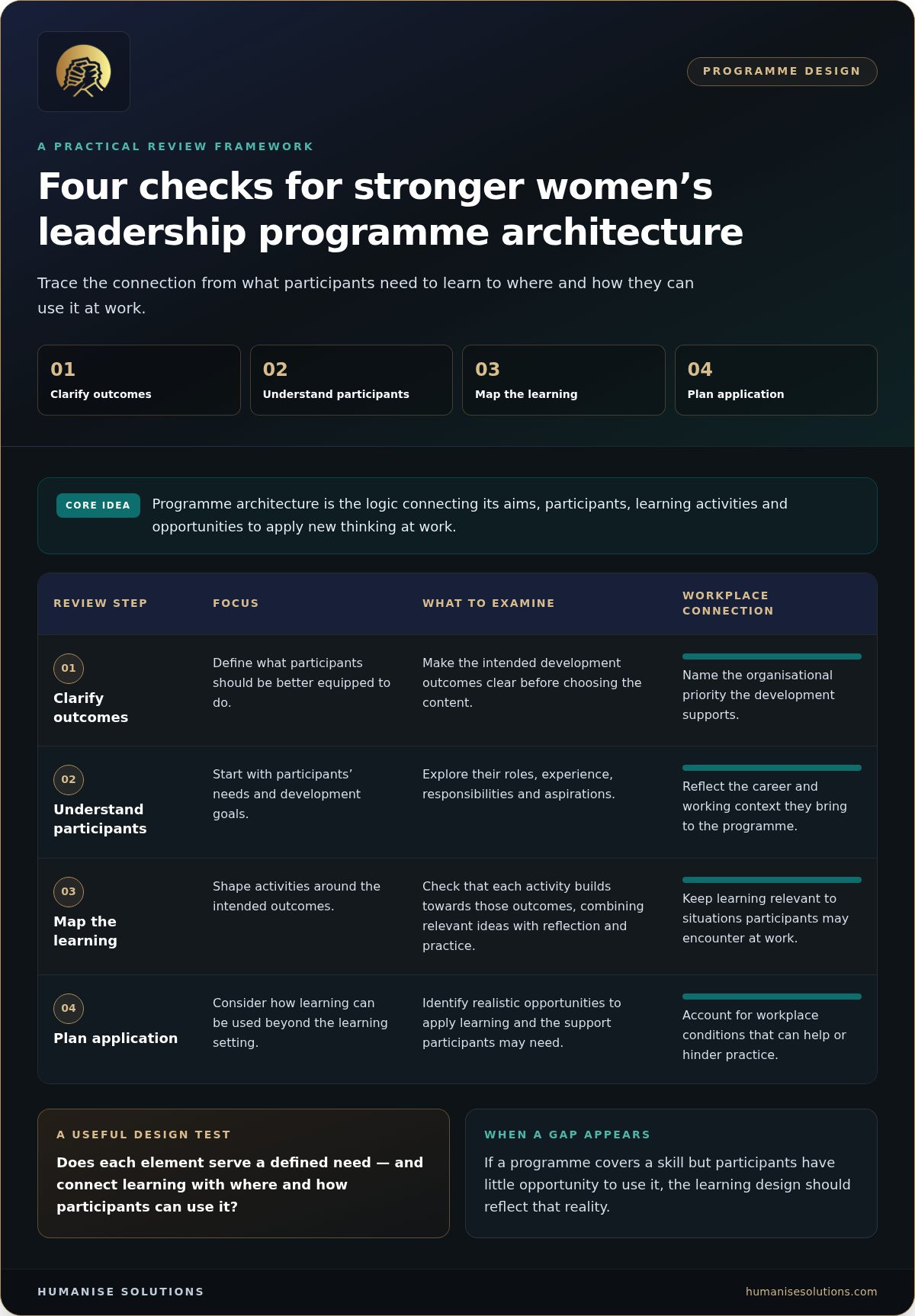
A programme’s architecture is the logic connecting its aims, participants, learning activities and opportunities to apply new thinking at work. Rather than judging content by how many topics it covers, look at whether each element serves a defined need. For organisations comparing women in leadership training programmes UK-wide, clear design makes it easier to see how development can support both participants and organisational priorities.
Strong programme architecture connects what participants learn with where and how they can use it. Use this four-step review to examine that connection:
- Clarify outcomes: Define what participants should be better equipped to do and which organisational priority the development supports.
- Understand participants: Explore their roles, experience, responsibilities and development goals before deciding what to teach.
- Map the learning: Check that each activity builds towards the intended outcomes, combining relevant ideas with reflection and practice.
- Plan application: Identify realistic opportunities to use learning at work and the support participants may need.
This sequence helps reveal gaps. A programme might cover influencing skills, for example, but if participants have little opportunity to contribute to decisions, the learning design should reflect that reality. A UK government report on women in FTSE 100 leadership offers one reference point for considering representation in business. Each organisation still needs to identify the outcomes that matter in its own setting.
Map participant needs before selecting learning content
Begin with participants’ career context, current responsibilities and development goals, rather than assumptions about what women need. An inclusive discovery process might invite people to share challenges and aspirations through a facilitated discussion or reflective questions. Then distinguish shared themes, such as preparing for broader responsibility, from individual priorities that may call for different practice or support. This keeps group learning purposeful without flattening personal experience.
Build a learning journey that supports application
Learning methods work best as connected stages: discussion introduces a challenge, practice lets participants try an approach, reflection helps them make sense of the experience, and action planning identifies a next step. Peer learning can deepen the process by giving participants room to compare perspectives. Managers can reinforce it by discussing application goals and creating appropriate opportunities to practise, rather than leaving participants to translate learning on their own.
For instance, after practising how to frame a recommendation, a participant might identify an upcoming meeting where she can use that approach. A manager can help clarify the opportunity and agree what support would be useful. This practical connection reflects the principles of nurturing leadership, where development is shaped around people and purposeful growth.
To connect these design questions with your organisation’s priorities, discuss your leadership development goals with Humanise Solutions.
Compare women’s leadership training formats by audience and purpose
Format is a useful starting point, not a verdict on quality. A short course may suit a precise learning need, while a cohort programme or bespoke learning journey may create more room for shared reflection or organisational relevance. The right choice depends on who will take part, what they need to develop and which client-driven outcomes the organisation wants to support. When comparing women in leadership training programmes UK organisations consider, assess the learning experience rather than relying on the label alone.
| Format | Possible audience | Depth and practice | Connection to workplace priorities |
|---|---|---|---|
| Short course | Participants seeking a focused introduction or targeted skill development | Concentrated learning; practice and reflection may be more contained | Can address a defined need, with application often dependent on follow-up at work |
| Cohort programme | A group of participants with shared or related development aims | Can create space for peer learning, ongoing reflection and practice across sessions | May connect common learning goals with workplace application, depending on its design |
| Bespoke learning journey | Participants whose development needs relate to a particular organisational context | Can be shaped around relevant challenges and learning activities | Offers scope to align the design with organisational priorities and participant experience |
These are broad comparisons, not guarantees. A programme’s value depends on how clearly its design responds to participants and the work they need to do. For a real-world point of comparison, London Business School’s Women in Leadership course details show how a published course can set out its audience and learning aims. Use descriptions like this to understand the choices available, not as a substitute for defining your own needs.
When a focused course may suit the development need
A focused course can be a sensible fit when the objective is specific and contained, such as exploring a particular leadership challenge or strengthening one area of practice. Concentrated learning can introduce useful ideas efficiently, but may offer less opportunity to revisit them, reflect on experience and try a different approach over time. Consider what will help participants apply the learning after the course, without assuming the format alone will sustain behaviour change.
When a tailored programme may better reflect organisational context
A tailored learning journey can make room for an organisation’s culture, priorities and participants’ experience at work. This can help keep the content relevant, but bespoke design isn’t automatically better. It still needs clear aims, meaningful practice and a realistic path to application. A shared organisational challenge may suit a cohort approach, while varied participant needs could call for more flexibility in learning activities or support.
Choose the format that best connects participant growth with the organisation’s intended outcomes. Ask what people will learn, where they can practise it and how the workplace will support that application. Those answers matter more than the format label.
Evaluate programme fit, inclusion and outcomes before committing
A useful evaluation looks beyond an engaging session or a list of promised outcomes. It asks whether the programme suits its participants, reflects their working context and gives the organisation a credible way to understand what has changed. For organisations comparing women in leadership training programmes UK-wide, this means setting clear expectations before development begins and choosing evidence that matches those aims, without claiming more than it can show.
Questions that reveal whether the programme fits
Start with the intended participants and development goals. Check that these are clearly described, and that the learning recognises varied experiences, responsibilities and routes into leadership. A programme should make room for participants’ perspectives rather than assume they share the same needs. Consider whether they’ll be able to practise relevant learning in their roles, with appropriate support from managers and the wider organisation.
- Participant fit: Are the intended participants’ roles, experience and development aims clearly defined?
- Inclusion: Does the learning welcome different perspectives and leadership pathways, without relying on a single model of success?
- Learning design: Do the activities connect to the stated aims and give participants a chance to reflect, practise and plan?
- Workplace support: Will participants have realistic opportunities to apply learning, and will managers understand how to encourage that application?
- Organisational alignment: Are the development goals connected to priorities the organisation can describe and support?
These questions help surface practical mismatches early. A programme may address influencing skills, for example, while participants have limited access to relevant discussions in which to practise them. That doesn’t invalidate the learning. It signals that organisational support belongs in the design, not as an afterthought.
Set thoughtful measures without overstating impact
Agree what evidence would be meaningful before the programme starts. Match indicators to the stated learning aims and organisational priorities, and keep three kinds of evidence distinct: delivery feedback, evidence of learning and longer-term organisational outcomes. Each answers a different question, so none should stand in for the others.
- Delivery feedback can show how participants experienced the learning and whether it felt relevant and inclusive.
- Learning evidence can include reflections, practice activities or participants’ descriptions of how their understanding has developed.
- Longer-term outcomes need a separate review of whether learning was applied and how this relates to organisational priorities over time.
Participant feedback is valuable evidence of experience, but it doesn’t by itself prove sustained behaviour change or wider organisational impact. Plan a follow-up that gives participants and managers space to discuss what has been applied, what enabled it and what barriers remain. Interpret wider change carefully, without attributing it to a programme unless there’s evidence to support that connection.
For a considered conversation about aligning leadership development with participant needs and organisational priorities, discuss a leadership development need.
How Humanise Solutions can shape women’s leadership development around your goals
Choosing a programme is a starting point. Meaningful development also depends on whether its purpose connects with the people taking part and the outcomes an organisation wants to support. Humanise Solutions delivers the Women Leadership ILM Programme as part of its wider, human-centric approach to leadership and learning. Its scientific approach draws on over 12 years of research into decision-making processes and trauma prevention.
That foundation supports a thoughtful view of leadership growth: people bring valuable capabilities and experience, and the conditions around them can influence how these strengths are recognised and used. For organisations weighing up women in leadership training programmes UK-wide, this means considering both participant development and the culture in which learning will be applied. The aim is not to prescribe one way to lead, but to connect learning with real needs and aspirations.
A human-centric foundation for leadership growth
Empathy, potential and inclusive environments matter because development happens within relationships and organisational systems, not in isolation. Programme architecture should respond to participant context and client-driven outcomes, helping organisations consider what leadership growth means in their setting. That might involve clarifying the capabilities people want to strengthen, the opportunities they need to practise them and the workplace conditions that can support progress.
These principles apply across sectors and career stages, but priorities won’t be identical for every organisation or participant. A considered approach starts by understanding those differences and using them to shape purposeful learning. Humanise Solutions’ broader leadership and learning development services reflect its commitment to nurturing potential and supporting sustainable organisational growth.
The Women Leadership ILM Programme is one part of this offer. When assessing it, consider how its design fits your aims, participants and workplace context. Humanise Solutions brings a human-centric, scientific approach to leadership and learning, with development shaped around people and organisational needs.
Start a conversation about your organisational goals
A useful first step is to describe the people you hope to support, the culture they work within and the outcomes your organisation wants to encourage. You might be developing emerging leaders, supporting women to take on broader responsibilities or connecting individual growth with more inclusive ways of working. Being clear about these priorities creates a stronger basis for exploring a suitable development approach.
You don’t need to have every detail settled before beginning that conversation. Bring the questions you’re considering, the needs you’ve identified and any challenges that feel important to address. Humanise Solutions can explore these with you as a development partner, keeping the focus on people, context and meaningful organisational aims. Discuss your organisation’s leadership goals and take a considered next step towards development that reflects what matters to you.
Turn leadership intent into a purposeful next step
The next step is to create the conditions for leadership potential to grow, not simply to select a learning activity. Start with one question: what would you like people to be better able to contribute, and what needs to be true in the workplace for that contribution to take shape? A clear answer can turn development from an isolated event into a considered investment in people and organisational progress.
For organisations exploring women in leadership training programmes UK-wide, the most meaningful direction will reflect both the people you want to support and the future you’re working towards. Humanise Solutions can help you explore that fit with care, keeping your priorities and participants’ context at the centre of the conversation.
Explore your leadership development priorities and take a thoughtful first step towards creating space for people to thrive.
Frequently Asked Questions
Who should take part in a women’s leadership training programme?
Women who want to strengthen their leadership practice can benefit, whether they’re preparing for a first management role or already leading teams. Start with a genuine development objective, not a job title or an assumption about confidence. Someone newly responsible for colleagues may want to practise setting expectations, while an established leader might focus on influencing decisions across teams. Clear, voluntary participation helps ensure the learning feels relevant.
Can women’s leadership programmes support different career stages?
Yes. Development can be useful at different career stages when its focus reflects the participant’s responsibilities and next steps. An emerging leader may want to explore delegation or giving feedback; someone moving into a broader role may need to consider how to build alignment across functions. These are examples, not fixed stages or needs. Career experience and personal aspirations vary, so programme pathways shouldn’t treat seniority as the only measure of readiness.
How do you compare a short leadership course with a longer programme?
Compare the learning objective with the time participants need to work with it. A short course may suit an immediate, clearly defined topic, such as preparing for a particular presentation. A longer programme may allow participants to revisit ideas as their responsibilities evolve. Consider practical constraints too, including release from work and whether managers can make space for learning. Neither format is automatically more effective; suitability depends on purpose and circumstances.
What should organisations look for in women’s leadership training?
Look for a clear explanation of who the learning is intended to support, what participants will explore and how organisational priorities inform its design. When comparing women in leadership training programmes UK organisations consider, check that examples and activities feel relevant to the work participants actually do. It’s also useful to understand how the programme welcomes different perspectives and enables participants to raise topics that matter to them, rather than expecting them to fit a single leadership template.
How can an organisation evaluate leadership programme outcomes?
Agree what success would look like before learning begins, and use evidence suited to that aim. If the focus is giving feedback, for instance, participants might reflect on a real conversation and identify what they would do differently next time. Attendance and satisfaction describe participation and experience, but they don’t establish lasting change. A later review with participants and managers can explore whether learning was used, what supported its application and what may need further attention.
Does women’s leadership training address organisational culture as well as individual skills?
It can, especially when the organisation treats development as part of its wider working practices. A participant may practise contributing to meetings while managers consider whether meeting routines give people a fair opportunity to speak. Training can help surface these questions, but it doesn’t replace organisational action. A team could review how ideas are invited, discussed and followed up, then decide which everyday behaviours would better support inclusive participation.
What does an ILM programme mean for participants?
ILM appears in the programme name, Women Leadership ILM Programme. The title alone doesn’t specify a qualification level, accreditation status or credential, so distinguish the programme’s stated name from any formal qualification claim. Participants can focus on the development purpose and relevance of the learning. Humanise Solutions presents the programme within its broader work in leadership and learning.
