

Article by
Scott Ward MBA CCMI
Scott Ward is the founder and CEO of Humanise Solutions, which he established three years ago to help organisations elevate their people, leadership and culture through a human-centric, evidence-based approach. Before moving into business and academia, Scott spent seven years as a professional footballer, playing for Luton Town, Crawley Town and Coventry City FC until injury brought his playing career to a close — a turning point that shaped both his research interests and his approach to leadership.
Scott holds an MBA from Warwick Business School, where his research explored the causal relationship between trauma and decision-making — work that continues to inform how he supports young adults, leaders and teams under pressure. Recognised as a Companion of the Chartered Management Institute (CCMI), its highest grade of membership, he combines academic rigour with the discipline, resilience and team-first mindset of the professional game. At the heart of everything he does is a simple belief: that people perform at their best when they are led, developed and valued as human beings first.
In April to June 2026, 981,000 young people aged 16-24 in the UK were not in education, employment or training (NEET), according to the Office for National Statistics. That figure brings a practical question into focus: how can workplace programmes for young adults build readiness for work while recognising each participant’s strengths, needs and barriers?
A generic course may not give everyone what they need to take their next step. Young adults can benefit when personal development is combined with practical workplace learning and consistent, individual support. The most useful programmes connect this development with meaningful employment goals.
This article explores how to shape a programme around outcomes employers value and participants can grow towards. It covers communication, CV writing, interview preparation and wider workplace skills, alongside wellbeing and the role of a dedicated matrix partner in supporting each participant’s journey into employment. It also looks at how to assess completion, gather feedback and track employment outcomes, so confidence-building is matched by evidence of progress.
Key Takeaways
- Shape workplace programmes for young adults around participants’ starting points, distinguishing preparation for work from development for those already employed.
- Build a connected journey from understanding needs and setting outcomes to developing skills and supporting progression.
- Match programme content to whether participants are preparing to work, entering a role or developing in one.
- Plan delivery in clear stages, then assess participation, completion, feedback and employment outcomes separately.
- Explore how Young Adult Development brings personal growth and workplace learning together, with a dedicated matrix partner and three-day onboarding.
Why workplace programmes for young adults need to begin with potential
A workplace programme is structured learning and support designed around real employment needs. It gives young adults opportunities to understand workplace expectations, practise relevant skills and build confidence, while helping employers create a clearer route towards their workforce goals. The starting point matters: participants bring different strengths, ambitions and experiences, so meaningful development begins by recognising what each person can build on.
The need for thoughtful pathways is reflected in the latest figures supplied for this article. The Office for National Statistics estimated that 981,000 people aged 16-24 in the UK were not in education, employment or training in April to June 2026, representing 13.0% of that age group. This figure describes a broad range of circumstances, not a single story or set of needs. A programme should respond to individuals rather than treat a statistic as a profile.
What does a workplace programme for young adults do?
Guided learning helps participants connect personal development with the practical realities of work. Someone preparing to apply for a first role might practise introducing their strengths, writing a CV or responding to interview questions. A young person already employed may benefit more from developing communication, collaboration or confidence in taking on new responsibilities. In both cases, learning is most useful when participants can practise, receive considered feedback and understand how a skill applies at work.
Programmes support development. They are not clinical mental-health treatment, and taking part should not be presented as a promise of guaranteed employment. Progress can mean being better prepared to pursue a role, understanding workplace expectations or growing in an existing position. For a wider example of structured education and vocational learning for young adults, see Job Corps vocational training.
Why combine individual growth with workplace readiness?
Confidence and practical readiness strengthen one another. When participants can identify what they do well, they are better placed to communicate their value, ask for support and engage with new tasks. Employers, in turn, can make learning more relevant by connecting those strengths and aspirations with the behaviours and capabilities needed in their workplace. Set clear outcomes, but do not assume every participant will take the same route to reach them.
Recognising differing needs also helps make participation more accessible. One person may want time to build confidence speaking in a group; another may be ready to practise teamwork in a work-related task. A supportive programme makes room for these differences while keeping progress purposeful. Humanise Solutions’ Young Adult Programmes connect personal development with workplace learning as part of a supported journey towards employment.
- For participants: build practical skills, recognise strengths and work towards a personally meaningful next step.
- For employers: create clearer learning outcomes linked to workplace needs and inclusive opportunity.
- For programme teams: understand progress through development as well as practical readiness.
That balance is the foundation for workplace programmes for young adults: invest in the person, make learning relevant to work and define progress in ways that matter to both participants and employers.
Build workplace programmes for young adults around a connected learning journey
A programme is more useful when each activity prepares participants for the next step, rather than treating confidence-building and employability as separate aims. A connected programme journey is a planned sequence linking what a young person needs to develop with the skills, practice and support that help them move towards work. This gives organisations a structure for pursuing clear outcomes while allowing each participant’s pathway to reflect their starting point.
Start with participants’ strengths, needs and goals
Begin by listening. A conversation about a participant’s interests, existing skills, ambitions and concerns can help identify what will make learning relevant. One person may be ready to practise interview answers; another may want to build confidence communicating in unfamiliar settings before moving on to applications. Avoid treating either person’s starting point as fixed. Needs can shift as someone gains experience and sees new possibilities.
Use these insights to agree realistic development outcomes with the organisation. An employer might want participants to understand team communication, while an individual may be working towards describing their strengths with confidence. A strong plan makes space for both aims and gives everyone a shared sense of what progress could look like. It also helps programme teams choose purposeful learning instead of adding activities simply to fill a schedule.
Link practical learning with supported employment pathways
Learning works best when participants can apply it. CV writing can help someone put their experience into words; interview practice can build familiarity with explaining their skills; communication learning can explore how to ask questions, listen and contribute at work. Personal resilience can sit alongside these modules, helping participants reflect on challenges and identify constructive next steps. It supports workplace learning rather than competing with it.
A clear pathway links each activity to a practical purpose. For example, a participant might explore how they communicate in a team, practise a relevant skill, then reflect on what they would carry into a workplace situation. This connection makes learning easier to understand and helps participants recognise their progress. Humanise Solutions’ Young Adult Programmes bring personal development and workplace learning together as part of supported progression.
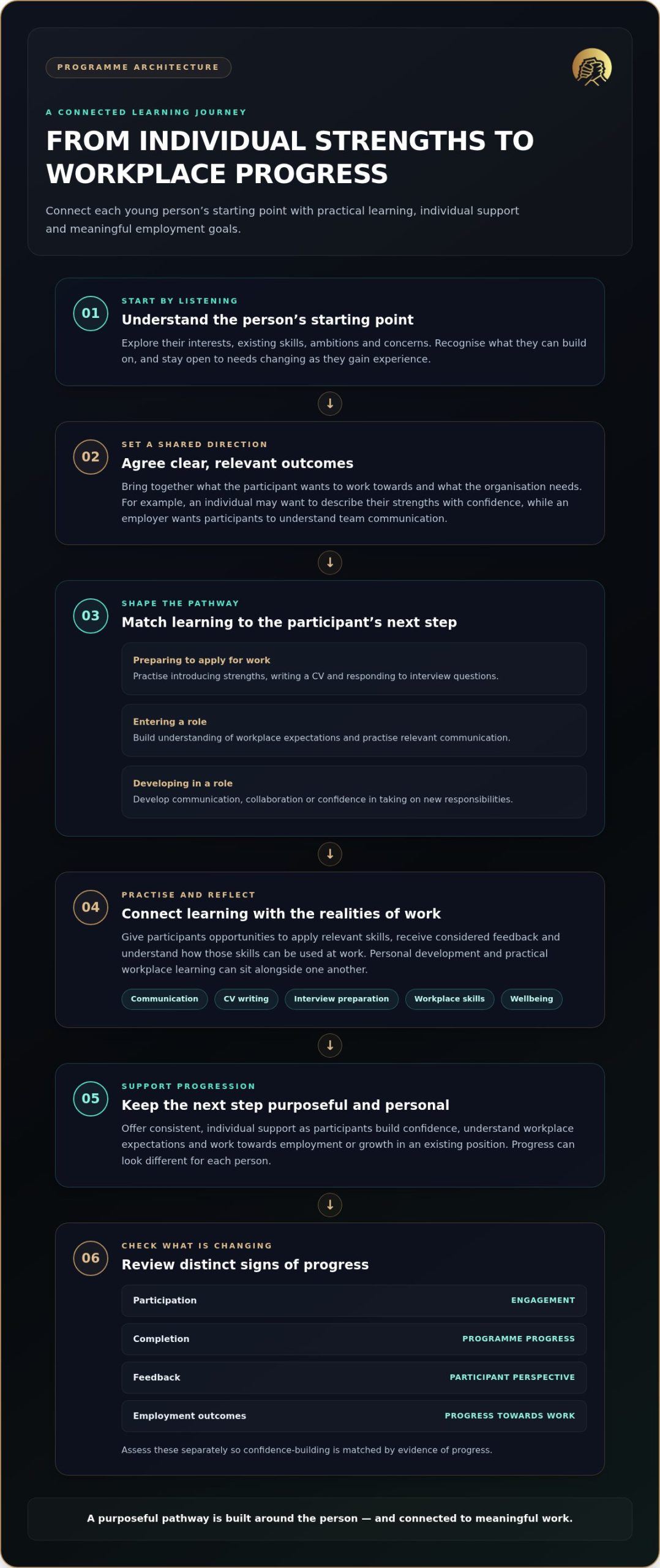
Organisations can shape the journey through five connected stages:
- Understand needs: listen to participants and identify strengths, goals and areas for development.
- Set outcomes: agree what participants and the organisation want the learning to achieve.
- Develop skills: select relevant modules, such as communication, personal resilience, CV writing and interview skills.
- Practise: offer opportunities to apply learning and reflect on feedback.
- Support progression: help each person identify and take a considered next step towards employment or further development.
Reviewing the journey as it unfolds helps keep participant development and organisational aims connected. If a goal changes or a new learning need becomes clear, the programme can respond while keeping its overall purpose in view. For organisations exploring how to align a supported pathway with their goals, discuss programme goals with Humanise Solutions.
Choose programme content that fits young adults and workplace needs
A curriculum can have a clear purpose without being identical for every participant. Workplace programmes for young adults are more useful when their content reflects both a person’s stage and the capabilities an organisation wants to nurture. Someone preparing to apply for work may need a different starting point from a new employee learning to settle into a role, or a young adult ready to grow their contribution at work.
Begin by identifying the outcome each participant and the organisation wants from learning. Then select modules that help move towards it. The examples below offer a framework, not a fixed curriculum. Support and content can be adapted as strengths, goals and workplace needs become clearer.
Match modules to the outcomes participants need
Choose modules for the purpose they serve. Communication, giving and receiving feedback, and managing expectations can help build workplace confidence. CV writing, job applications and interview skills support career preparation. Resilience, emotional intelligence and self-development can strengthen personal foundations. These areas can overlap, but naming the intended outcome helps participants see why each module matters.
| Participant stage | Possible learning and support | Intended outcome |
|---|---|---|
| Preparing for work | CV writing, job applications, interview practice and guided reflection on strengths | Greater readiness to present skills and explore suitable opportunities |
| Entering work | Communication, workplace expectations, feedback practice and supportive check-ins | A more confident transition into a new working environment |
| Developing in role | Emotional intelligence, resilience, self-development and role-relevant learning | Continued growth and stronger contribution at work |
Adapt learning without losing a clear programme purpose
Tailoring does not mean losing structure. Keep a shared programme purpose, then adapt the modules, pace or support to the outcomes identified for participants and the organisation. For instance, if a participant is confident discussing ideas but less sure how to respond to feedback, learning can focus on practising that exchange. The workplace aim remains clear, while the route supports an individual need.
This balance also helps address a common concern: personal development need not take time away from job-relevant learning. It can help participants engage with practical content. A module on resilience, for example, can be linked to reflecting on a challenging task and identifying a useful next step. Make the connection explicit so participants understand how growth supports their workplace goals.
Review the content as the programme progresses. Ask whether participants can apply what they have learnt and whether the modules still align with organisational aims. If needs shift, adjust the learning while keeping the intended outcomes visible. This makes the programme responsive without turning it into a collection of disconnected sessions.
For a deeper look at shaping development around young people’s potential, the guide Nurturing Potential: The Guide to Young Adult Professional Development Programmes offers a useful companion to this approach. Humanise Solutions’ Young Adult Programmes connect personal development with workplace learning, supporting content that is purposeful as well as responsive.
Deliver and evaluate workplace programmes for young adults with care
Thoughtful delivery turns programme design into a consistent experience, while evaluation helps show whether learning supports participants and meets organisational aims. For workplace programmes for young adults, treat delivery as a connected process: prepare, onboard, facilitate learning, provide support and review progress. Each stage should help participants understand what they are working towards and give programme teams useful insight into what may need adjusting.
Create a supportive and inclusive learning environment
Prepare by aligning the learning plan with participant needs and the organisation’s intended outcomes. During onboarding, explain the programme, clarify expectations and help participants feel able to take part. Facilitation should make space for questions, practice and reflection, rather than asking everyone to learn in the same way or at the same pace.
Empathy and psychological safety can support engagement: participants are more likely to try unfamiliar tasks when they can learn from feedback without feeling defined by a mistake. Wellbeing and trauma prevention can inform how learning is structured and support is offered, but these are programme considerations, not clinical mental-health treatment. Regular check-ins can help identify when a participant needs encouragement, a different learning approach or a clearer next step.
Feedback is part of delivery, not just a final form. Invite participants to share what is helping them learn and where they feel less supported. Review their comments alongside observations from facilitators and relevant employer input, then use that information to refine the programme. Explain how feedback will inform improvements, so participants can see that their perspectives matter.
Measure progress without reducing people to a single metric
Keep measures distinct. Participation shows who is engaging with activities; completion records who finishes the programme; feedback captures participants’ views; and employment outcomes indicate progression into work. These measures answer different questions, so report them separately rather than treating one as a substitute for another. Pair the figures with learning evidence, such as skills practised or goals achieved, and relevant employer outcomes.
Humanise Solutions reports that its programmes have concluded with 100% completions, with 50-80% job outcomes. These are separate outcomes: completion describes finishing a programme, while job outcomes relate to employment. They do not mean every participant is guaranteed a role. Humanise Solutions also reports a 9.98% feedback rating. Consider feedback alongside participant comments and other programme measures to understand the experience more fully.
At review, bring the evidence together: what participants developed, whether the planned learning was completed, what feedback suggests about the experience, and what employment outcomes followed. This gives programme teams a fuller basis for improvement without reducing a person’s progress to one number. It also keeps the organisation’s goals visible alongside individual development.
Humanise Solutions’ Young Adult Programmes connect development with workplace learning and supported progression. If you are shaping a programme around participant growth and clear outcomes, discuss your programme goals with Humanise Solutions.
How Humanise Solutions supports young adults from development towards work
For young adults, moving towards employment can involve more than learning how to complete an application. Personal development, workplace learning and practical support can work together, shaped around each participant’s strengths and the organisation’s aims. Humanise Solutions’ Young Adult Development programme takes this connected approach, helping organisations link individual growth with clear workforce and learning outcomes.
A human-centric, supported route into employment
The approach is grounded in over 12 years of research into decision-making processes and trauma prevention. This informs a human-centric programme design that recognises how personal circumstances and experiences can affect someone’s engagement with learning. Wellbeing and trauma prevention are considered as part of supportive development, not as clinical treatment.
Each participant is placed into a UK talent pool, with a dedicated matrix partner supporting their employment journey. The partner provides continuity as participants work through their personal action plans and consider opportunities. This individual support sits alongside programme learning, helping connect development with practical next steps rather than leaving participants to translate their learning into action alone.
Onboarding takes place over three days. Day 1 focuses on personal action plans. Day 2 sets the participant up in the job network. On Day 3, the matrix system begins searching for applicable opportunities. These steps establish a starting structure for each participant’s journey, while leaving room for the programme to respond to individual goals. Humanise Solutions’ Young Adult Programmes bring together personal growth, workplace learning and supported progression.
Humanise Solutions is the 5th largest digital recruiter in EMEA, providing an end-to-end talent pipeline alongside its young adult programmes.
Shape a programme around your organisation’s goals
A tailored programme starts with what your organisation wants to achieve and what participants need to progress. For example, an employer seeking stronger communication across an entry-level team may prioritise communication practice and feedback, while participants may also benefit from confidence-building and support to understand workplace expectations. Programme design can bring these aims together, so learning is relevant for the organisation and valuable for each young person.
Agree the intended outcomes at the outset, then shape learning and support around them. These might include improved understanding of workplace behaviours, progress towards employment, or development in a role. Clear outcomes help keep a tailored programme focused, while regular reflection gives participants and the organisation a way to recognise progress and identify where the pathway could adapt.
Workplace programmes for young adults are strongest when they make space for different starting points without losing sight of the organisation’s purpose. If you are considering a participant-centred approach linked to your workforce goals, discuss a tailored programme with Humanise Solutions.
Turn thoughtful programme design into a next step
The strongest workplace programmes for young adults create room for people to grow while keeping organisational goals in view. Start with a practical conversation about the capabilities your organisation wants to develop, the experiences participants bring and the kind of progress that would make a difference. From there, a programme can connect those priorities with a meaningful development pathway.
You do not need every detail settled before exploring what could work. A clear sense of the outcomes you hope to support is a valuable place to begin, with the learning journey taking shape around those aims and the young people involved.
Discuss a human-centred programme for young adults with Humanise Solutions and explore a considered next step for your organisation. With the right support and purpose, potential can grow into lasting progress.
Frequently Asked Questions
What should a workplace programme for young adults include?
It should include learning that helps participants understand workplace expectations and apply skills in realistic situations. For example, a session on giving and receiving feedback could use a workplace scenario, followed by reflection on what felt comfortable and what to practise next. Modules might also cover managing expectations, listening effectively or personal development. The right mix depends on the programme’s aims and the capabilities participants want to strengthen.
How can employers help young adults prepare for their first job?
Employers can make expectations clearer before a young person starts by explaining the role, everyday tasks and how the team works together. A realistic example of a typical workday can help make unfamiliar routines easier to picture. Employers can also create opportunities to practise asking questions and responding to feedback. Clear guidance about who to approach for support can help a new starter feel more prepared to participate.
Can workplace programmes support young adults who face barriers to employment?
Yes. A programme can adapt its learning and support to the barriers a participant identifies, without assuming that everyone needs the same adjustments. For example, someone who finds group discussion difficult could first practise sharing ideas in a smaller setting, then build towards wider participation. Wellbeing can inform a thoughtful learning environment, but a workplace programme is not a substitute for clinical mental-health treatment.
How do organisations measure the success of a young adult development programme?
Agree what success means before delivery begins, then gather evidence that relates to those aims. Alongside attendance and completion records, an organisation could review examples of work, skills participants can demonstrate and their reflections on progress. Employer observations can show whether learning is relevant to workplace needs. Keep each measure distinct and review the findings together, so a single result does not obscure other forms of development.
What is the difference between employability training and workplace development?
Employability training generally helps someone prepare to seek and enter work, while workplace development supports learning after they have started a role. A participant preparing to apply might work on presenting their experience; someone already employed could focus on contributing to meetings or managing expectations. A programme can include both kinds of learning, but the starting point and intended outcomes should reflect whether participants are entering work or growing in their current role.
How can a workplace programme be tailored to young adults’ individual needs?
Start by understanding what each participant hopes to achieve, what they already feel confident doing and where they would value practice. A short reflection on strengths, followed by a conversation about learning goals, can help shape relevant modules. For example, one person may choose to develop presentation skills, while another focuses on managing time. Keep the overall programme purpose clear and adapt learning choices to support each person’s progress.
Does Humanise Solutions support young adults beyond training sessions?
Yes. Support extends beyond learning sessions through a dedicated matrix partner who supports each participant’s employment journey. This helps participants connect their development with next steps as they explore opportunities. Each participant is also placed into a UK talent pool. The approach supports a continuing pathway, rather than treating attendance at training as the only measure of progress.
