

Article by
Scott Ward MBA CCMI
Scott Ward is the founder and CEO of Humanise Solutions, which he established three years ago to help organisations elevate their people, leadership and culture through a human-centric, evidence-based approach. Before moving into business and academia, Scott spent seven years as a professional footballer, playing for Luton Town, Crawley Town and Coventry City FC until injury brought his playing career to a close — a turning point that shaped both his research interests and his approach to leadership.
Scott holds an MBA from Warwick Business School, where his research explored the causal relationship between trauma and decision-making — work that continues to inform how he supports young adults, leaders and teams under pressure. Recognised as a Companion of the Chartered Management Institute (CCMI), its highest grade of membership, he combines academic rigour with the discipline, resilience and team-first mindset of the professional game. At the heart of everything he does is a simple belief: that people perform at their best when they are led, developed and valued as human beings first.
What if feeling overwhelmed as a manager isn’t a sign that you’re failing, but a signal that the way demands, responsibilities and support are arranged needs attention? When priorities compete and every team concern seems to land with you, it can be hard to know where to begin, let alone admit that the pressure is building.
It makes sense to want to stay dependable and composed. Yet being responsible for your team doesn’t mean carrying every decision alone, and acknowledging strain needn’t weaken confidence. Clearer boundaries, agreed responsibilities and shared ownership can make room to lead with greater steadiness and care.
This article will help you identify what’s contributing to the pressure and choose manageable steps to restore focus. We’ll look at how to sort competing demands, clarify what genuinely needs your attention and involve your team in solving issues where appropriate. The aim isn’t to add another set of expectations to your day. It’s to help you regain clarity and build habits that support sustainable performance for you and your team.
Key Takeaways
- Feeling overwhelmed as a manager can point to pressures in the work, not a flaw in your leadership.
- Use demands, control, support and recovery to spot what’s driving the pressure and what may be changeable.
- Try a manageable sequence: pause, choose priorities, communicate clearly, share responsibility and review what’s working.
- If the pressure keeps returning, consider whether team or organisational patterns need attention alongside personal habits.
- Nurturing leadership supports people while also considering the conditions that help them do their best work.
Feeling overwhelmed as a manager: recognise the pressure without blaming yourself
Feeling overwhelmed as a manager can happen when the demands of leading people leave too little room to think, make decisions or offer the support you want to give. It isn’t proof that you’re a poor leader. Even a capable, thoughtful manager can struggle when urgent tasks, changing expectations and team needs arrive together, without enough clarity or space to respond.
Managerial overwhelm is pressure that makes it harder to prioritise, decide or support others. It describes what you’re experiencing, not what you’re capable of. A demanding week may ease once a deadline passes or responsibilities settle. If the pressure keeps returning, or begins to affect your work and wellbeing, that’s a useful signal to examine what’s sustaining it. It isn’t a diagnosis or a reason to blame yourself.
What can feeling overwhelmed as a manager look like?
The signs can be practical and easy to overlook. You might jump between messages and tasks without finishing either, put off a decision because each option seems to carry new consequences, or find it hard to switch off after work. An overflowing stream of updates can also make it difficult to see which information matters most; Information overload and decision-making describes this challenge.
There may be emotional or relational clues, too: feeling unusually impatient, withdrawing from conversations or worrying that you’re letting people down. These aren’t a checklist, and they won’t look the same for every manager. Notice what has changed for you rather than measuring your experience against someone else’s.
Why overwhelm is not a personal failure
Pressure often builds through several demands at once. A heavy workload can be harder to manage when priorities are unclear, ownership is blurred or team members need your attention at the same time. Each responsibility may seem reasonable on its own. Together, they can leave you with little uninterrupted time to reflect and decide what deserves focus.
Managers also carry responsibility for people, not just tasks. You may want to resolve concerns quickly, protect your team from uncertainty and keep work moving, even when some decisions sit beyond your control. That care matters, but it doesn’t mean you must personally solve every problem.
Recognising the pressure is an act of leadership, not an admission of failure. It gives you a clearer starting point: distinguish what genuinely needs your judgement from what can be clarified, shared or raised as a wider issue. You still have agency, and you don’t need to deny the strain to use it. Naming what’s difficult can help you respond with intention and make space for the conditions in which you and your team can do good work.
Why management demands build up: workload, decisions and people responsibilities
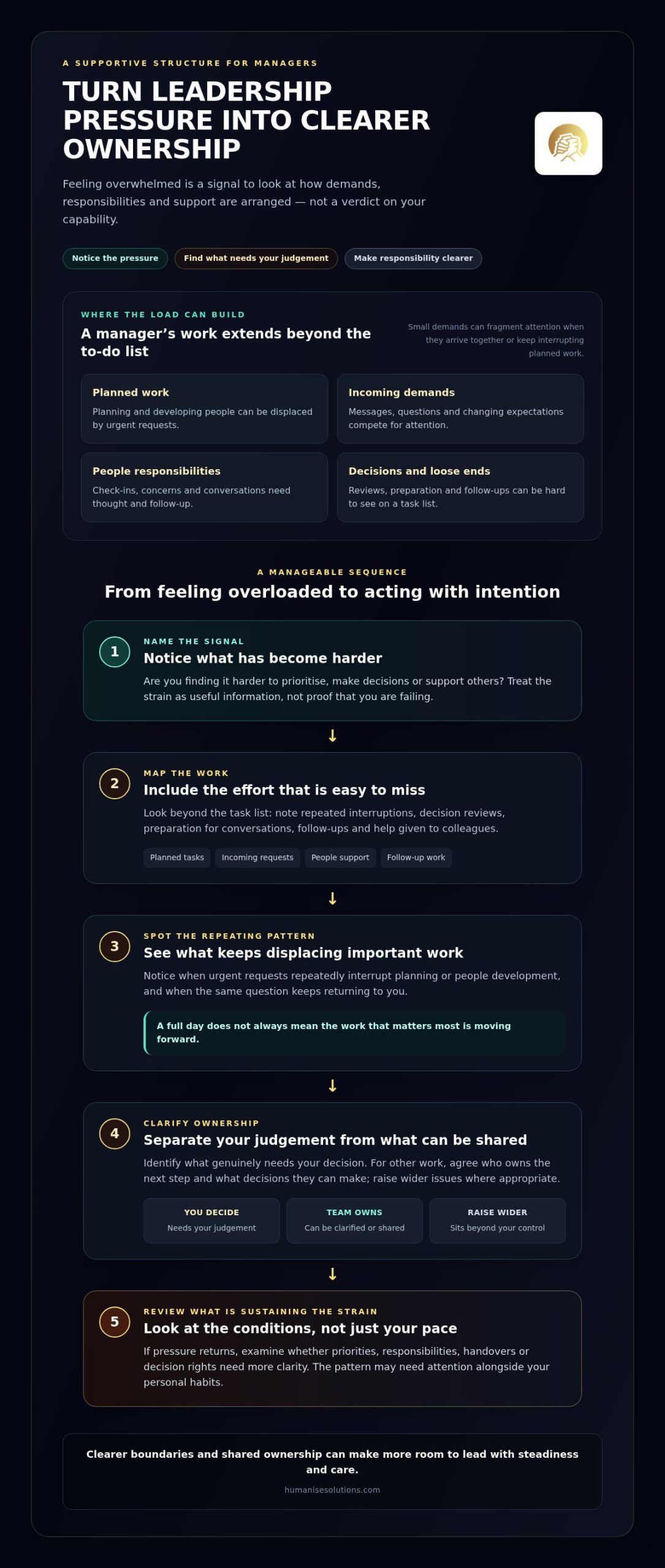
A manager’s workload is rarely limited to the tasks on a to-do list. Alongside planned work sit messages to answer, decisions to review, people to check in with and loose ends to follow up. Each may take only a little time, but together they can fragment attention and make it harder to see what deserves focus.
When priorities are unclear and demands compete, even a capable manager can feel overloaded because the work leaves too little space to judge what matters most. This can happen in different ways depending on the role, team and level of control a manager has over their workload. The pressure isn’t always solved by trying to work faster. Sometimes the pattern of incoming work needs attention.
Frequent interruptions can also create context switching: moving from a planning task to an urgent question, then trying to return to the original work. The effort can be easy to miss because the task still appears on the list, even if it has been paused several times. When urgent requests repeatedly displace important responsibilities, such as planning or developing people, the day can feel full without the work that matters most moving forward.
The hidden load behind a manager’s to-do list
Some of the most demanding work is less visible. A manager may need to prepare for a conversation, follow up afterwards, help a colleague think through a problem and keep plans aligned as circumstances change. These activities support the team, but they can be difficult to protect when urgent requests keep arriving.
Not every manager can control the volume or timing of requests. Still, noticing what repeatedly interrupts planned work can reveal where priorities, handovers or ownership need more clarity. For example, if the same question keeps returning to you, it may help to agree who owns the next step and what decisions they can make.
When responsibility and decision-making feel constant
Managers can become the default escalation point for questions ranging from routine choices to sensitive team concerns. If decision rights are unclear, people may seek approval for matters they could handle, while the manager feels accountable for issues that belong elsewhere. This creates extra decisions and can make delegation feel risky, even when sharing responsibility would be appropriate.
“Decision fatigue” is a useful everyday phrase for the sense of strain that can build when choices seem unrelenting, but it isn’t a diagnosis or a universal response. Clearer agreements about who decides, who contributes and when to escalate can help the team act with greater confidence, not simply move faster. People understand their part, and the manager has room for decisions that genuinely need their judgement.
If unclear responsibilities are a recurring source of pressure, developing leadership practices that strengthen shared ownership can be a constructive place to begin. Talk with Humanise Solutions about leadership development as one way to explore what could support you and your team.
What is driving your overwhelm? Separate urgent demands from changeable patterns
Once you’ve noticed the pressure, the next step is to understand its shape. A simple reflection framework can help: look at the demands coming in, the areas of control you have, the support available and the time or space you have for recovery. It won’t make every demand manageable or put every decision within your reach. It can help you see what needs attention first.
Map what is taking your attention
For a short period, jot down recurring tasks, interruptions and decisions as they arise. Note what keeps being postponed and which responsibilities most directly support your role and your team’s outcomes. Keep the exercise observational, not evaluative. You’re looking for patterns that may be obscured by the pace of the day, not scoring your performance or creating another task to complete perfectly.
Look for patterns, not just urgent moments
An unexpected deadline or staffing change may create a demanding but temporary stretch. By contrast, regular last-minute requests, repeated approval bottlenecks or planning that never gets protected may point to a recurring pattern. If you’re feeling overwhelmed as a manager, this distinction can guide your response: meet the immediate need where necessary, while considering whether the underlying pattern calls for a conversation or a change in how work is arranged.
As you review your notes, ask four questions:
- Demands: What is taking attention, and what outcome does it serve?
- Control: What can you adjust yourself, and what needs agreement from others?
- Support: Who could share the work, clarify a decision or help resolve a blockage?
- Recovery: Where could you protect space to pause, plan or regain focus?
Then use this compact guide to choose a possible next move:
- Stop: Set aside work that no longer serves a clear priority, where you have authority to do so.
- Share: Pass on a suitable task or involve the right colleague rather than holding it by default.
- Clarify: Agree ownership, deadlines or decision authority where uncertainty is creating extra work.
- Schedule: Make space for important work that urgent requests keep displacing.
Identify what can change and where support is needed
Some adjustments may be yours to make, such as reshaping your diary or setting clearer expectations about when you’ll respond. Others, including competing team priorities or unclear responsibilities across roles, may need a shared discussion or organisational decision. Rather than silently absorbing every demand, make a specific request: ask which of two deadlines should take priority, or who should own a recurring task.
Reflection is a starting point, not a promise that every pressure can be controlled. Its value is in helping you distinguish a short-lived surge from a pattern and approach the next conversation with a clearer view of what would help.
How to feel less overwhelmed as a manager: take manageable steps
When you’re feeling overwhelmed as a manager, a useful response isn’t to overhaul your working life in one go. Start with a small sequence that helps you move from pressure to a clearer next step. Adapt it to what your role allows; not every demand can be changed immediately.
- Pause. Take a brief moment before responding to the next request. A breath, a glass of water or a short step away from your screen can create room to consider what needs your attention.
- Choose priorities. Identify the outcomes that matter most now. Keep the list realistic, and decide what can wait rather than treating every task as equally urgent.
- Communicate. Make trade-offs visible to the people affected. If priorities conflict, explain the choices and ask for a decision when you don’t have authority to make one.
- Share responsibility. Give appropriate work to others with enough context and authority to act, rather than delegating a task while keeping every decision with yourself.
- Review. At a natural point in your week, notice what helped and what kept pulling you off course. Use that learning to make one adjustment, not to judge your performance.
Reset priorities and make a realistic plan
Turn a broad responsibility into a concrete next action. For example, instead of writing “sort out project”, identify the next decision or conversation needed and who will take it forward. If a lower-priority task has to move, say so clearly and explain the implication: “I can complete the team update by Thursday, or the proposal today. Which should take precedence?”
This makes capacity visible without framing a difficult trade-off as a personal shortcoming. If you can’t reset the expectations yourself, bring the options to the colleague who can help agree them.
Delegate, set boundaries and involve the team
Delegation works best when the task fits the person’s capability and context, and they know which decisions they can make independently. Agree the outcome, what support is available and when to check in. Shared responsibility is a leadership practice that can strengthen team excellence and leadership development, rather than simply moving tasks elsewhere.
Respectful boundaries also make working relationships clearer. You might tell colleagues when you’ll review non-urgent requests, or ask for a short summary and the decision needed instead of responding to every message as it arrives. Protect recovery time in a way that fits your working pattern, whether that means a proper pause between demanding conversations or keeping some space after work. There’s no single routine that suits every manager; the aim is to make recovery possible and sustainable.
If you’d value support in developing practical leadership habits and shared responsibility, talk with Humanise Solutions about leadership development.
Sustain your leadership capacity with human-centred support
Practical habits can help you respond to pressure, but recurring overwhelm may also point to conditions that need attention beyond your own working style. If priorities are constantly shifting, responsibilities remain unclear or the team lacks space to raise concerns, personal organisation alone can’t resolve the underlying pattern. Sustainable leadership involves noticing both your own capacity and the environment in which your team is expected to work.
Nurturing leadership means developing people whilst paying attention to the conditions that help them contribute. It isn’t about taking responsibility for everyone’s feelings or removing every challenge. It involves creating clearer expectations, listening to what colleagues need to do good work and making space for honest conversations about what is and isn’t working.
Build supportive leadership habits over time
Small, regular reflections can help you stay connected to what matters. Consider whether your priorities still fit the team’s goals, where colleagues need clarity and what your own capacity can reasonably support. Listening without rushing to provide an answer can reveal obstacles that aren’t visible in a task list. Clear expectations and constructive feedback give people a steadier basis for acting, learning and raising concerns early.
These habits develop through practice, not through getting every interaction right. You might agree a clearer outcome for a piece of work, invite a team member’s view before deciding, or explain what would make feedback useful. Exploring nurturing leadership and learning and development can offer further context for strengthening relationships and growing leadership capability with empathy.
When structured development can help
If familiar pressures keep returning, structured learning and development can provide space to practise communication, delegation and resilience, then consider how those skills apply to your team’s real working conditions. The aim isn’t to expect a manager to adapt endlessly to an unsustainable situation. It’s to build capability while recognising where shared agreements or organisational changes may also be needed.
Humanise Solutions takes a human-centred, scientific approach to leadership development, focused on unlocking potential with empathy. The organisation has over 12 years of research into decision-making processes and trauma prevention. This informs a thoughtful perspective on how people make choices and work together, without reducing leadership to a set of techniques detached from human experience.
If you’re feeling overwhelmed as a manager and would like to explore what development could support your leadership needs, you’re welcome to discuss the possibilities with Humanise Solutions. A considered conversation can help you identify a useful next step for you, your team and the conditions that shape your work.
Make space for the leadership you want to practise
Feeling overwhelmed as a manager doesn’t have to define how you lead. It can be a prompt to shape working relationships and expectations with greater intention, while recognising that lasting change may involve more than one person. A small, honest conversation about what would help your team work well can begin a more sustainable way forward.
You don’t need a perfect plan before taking that step. Start with the leadership challenge that matters most to you, whether that’s creating clearer ownership, listening with greater confidence or helping people grow into more responsibility. The right development begins with your context and the outcomes you want to nurture, for yourself and your team.
Humanise Solutions brings a human-centred, scientific approach to leadership development, informed by over 12 years of research into decision-making processes and trauma prevention. If you’re ready to explore what supportive development could look like, talk with Humanise Solutions about nurturing leadership and team development.
Clarity can grow one considered step at a time, and you can take that step with care.
Frequently Asked Questions
Is feeling overwhelmed as a manager normal?
Yes, feeling overwhelmed as a manager is an understandable response to sustained or unusually intense demands, though people experience it differently. A new project, a difficult team situation or competing expectations can stretch your attention and energy. The feeling alone doesn’t tell you whether you’re suited to management. It can prompt you to look at what’s changed and what support or adjustments could help.
Can you be a good manager and still feel overwhelmed?
Yes. Feeling stretched doesn’t erase the care, judgement or experience you bring to your role. A manager might, for example, support a colleague through a challenging change whilst learning to manage unfamiliar responsibilities themselves. Good leadership isn’t the same as having unlimited capacity. Being honest about a constraint and responding thoughtfully can help you make decisions that are fairer to both your team and yourself.
What should I do first when management feels overwhelming?
Start by identifying the decision or responsibility causing the most immediate strain. Write down what needs to happen next, what information is missing and who can help resolve it. If two important tasks conflict, avoid silently attempting both; ask the person who sets the priority to clarify the trade-off. This gives you a concrete point to act on instead of trying to solve every demand at once.
How can I stop feeling responsible for everything as a manager?
Separate being accountable for the team’s work from personally completing or approving every task. For a recurring question, agree what your colleague can decide independently and which situations genuinely need escalation. You could also ask, “What do you recommend?” before offering your own answer. That helps colleagues practise judgement while making responsibility more visible and shared, rather than allowing every uncertainty to default to you.
How do I tell my team that I am overloaded?
Be clear about the impact on the work and what would help, without sharing more personal detail than feels appropriate. For example: “I’m balancing the client update and our planning work, and I can’t give both the attention they need today. Which should we prioritise, and what can the team take forward?” This communicates a practical constraint, invites collaboration and reassures colleagues that you’re working towards a decision together.
What happens if I keep feeling overwhelmed at work?
If the pressure continues, it may become harder to concentrate, make decisions or be present with colleagues. These effects aren’t inevitable, but they’re worth taking seriously if you notice them. Keep track of what is repeatedly difficult and consider discussing the pattern with an appropriate workplace contact. If it’s affecting your health or wellbeing, seek advice from a qualified health professional; leadership development isn’t a substitute for clinical care.
Can leadership training help managers who feel overwhelmed?
It can help managers build and practise skills such as setting expectations, giving feedback, delegating and having difficult conversations. For example, working through a realistic scenario can help you prepare language for asking a senior colleague to clarify competing priorities. Development is most useful when it connects learning with the situations you face and considers how team practices can support change, rather than treating every challenge as an individual shortcoming.
