

Article by
Scott Ward MBA CCMI
Scott Ward is the founder and CEO of Humanise Solutions, which he established three years ago to help organisations elevate their people, leadership and culture through a human-centric, evidence-based approach. Before moving into business and academia, Scott spent seven years as a professional footballer, playing for Luton Town, Crawley Town and Coventry City FC until injury brought his playing career to a close — a turning point that shaped both his research interests and his approach to leadership.
Scott holds an MBA from Warwick Business School, where his research explored the causal relationship between trauma and decision-making — work that continues to inform how he supports young adults, leaders and teams under pressure. Recognised as a Companion of the Chartered Management Institute (CCMI), its highest grade of membership, he combines academic rigour with the discipline, resilience and team-first mindset of the professional game. At the heart of everything he does is a simple belief: that people perform at their best when they are led, developed and valued as human beings first.
What if resilience came less from individual toughness and more from how a leadership team thinks, communicates and adapts together? Developing resilient leadership teams means building a shared capacity to meet pressure without losing clarity, trust or care for people.
When uncertainty rises, even experienced leaders can become reactive. Decisions may pull in different directions, communication can falter, and wellbeing can feel like another responsibility for individuals to manage alone. It’s understandable to want leaders to stay steady, but lasting resilience depends on the conditions and behaviours a team creates together.
This guide explores how to build those foundations around your organisation’s needs and goals. It covers practical behaviours that support clearer decisions, open communication, adaptation and learning, alongside a human-centred approach to leadership development that connects performance with wellbeing. The aim isn’t to eliminate pressure, but to help leaders face it together and sustain meaningful progress.
Key Takeaways
- Define resilience through how the team acknowledges challenges, adapts and learns, rather than expecting leaders to simply endure more.
- Practise communicating what’s known and unknown so decisions stay coordinated when circumstances shift.
- Distinguish adaptation from accepting every demand: recovery and honest discussion matter too.
- Developing resilient leadership teams starts with understanding the pressures and goals shaping the team’s real working context.
- Use needs-led leadership development to connect team behaviours with organisational priorities and human wellbeing.
What developing resilient leadership teams means in practice
Pressure and uncertainty can narrow attention. A shifting priority, an unexpected setback or an unclear decision may leave leaders balancing urgent demands with the needs of colleagues and the wider organisation. That strain isn’t a sign that people need to toughen up. It’s a reason to look at how the team shares information, makes choices and supports one another.
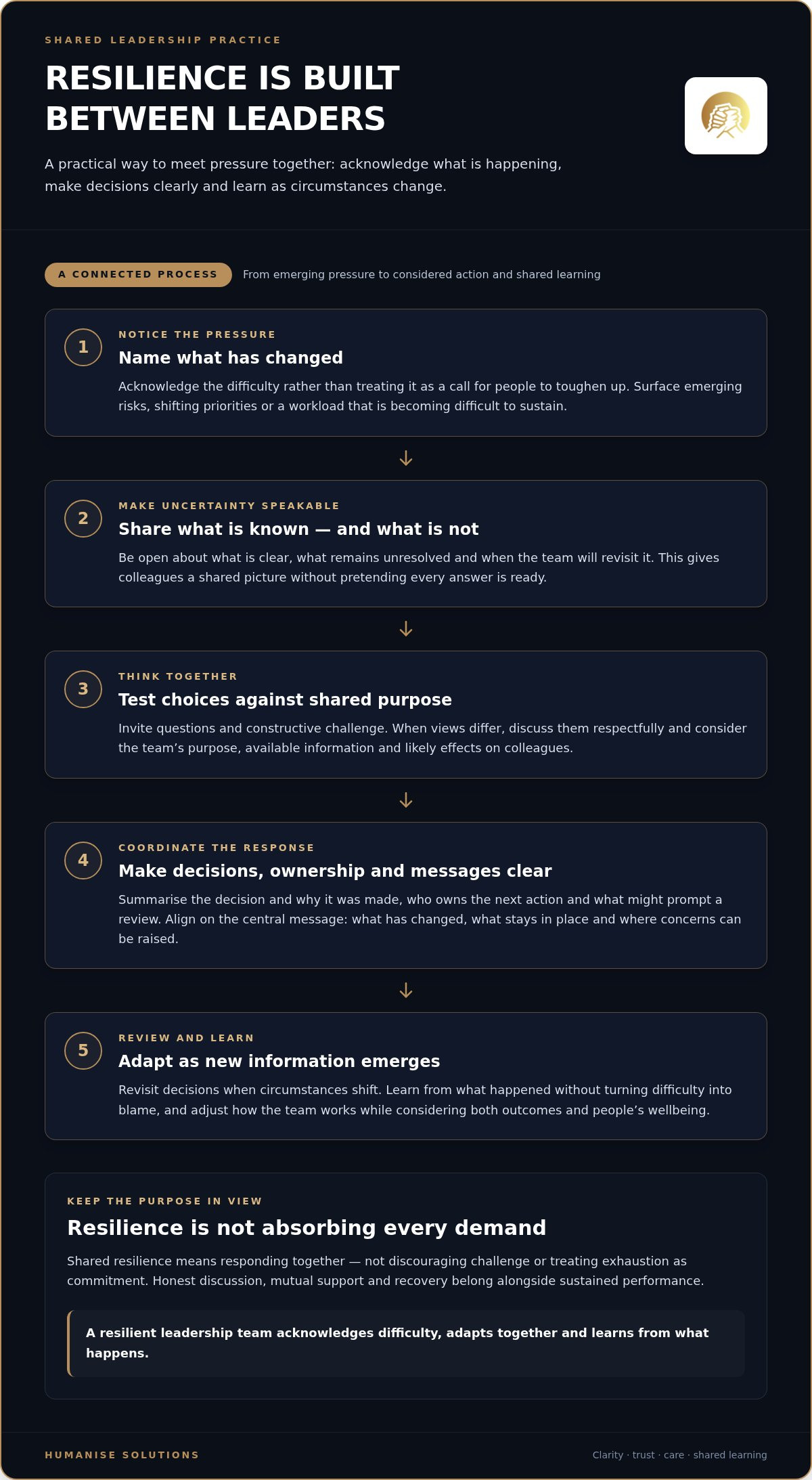
A resilient leadership team acknowledges difficulty, adapts together and learns from what happens.
This definition places resilience in the relationships and working practices between leaders, not solely in an individual’s ability to recover. Developing resilient leadership teams means strengthening the group’s capacity to respond, while recognising that pressure can’t always be solved by changing people’s attitudes. The task is to find a considered way forward together, not to pretend that everything is manageable.
How leadership-team resilience differs from individual resilience
Individual resilience can help a leader manage their own response to challenge. Team resilience depends on how people work together: whether they share concerns early, listen to different perspectives and coordinate decisions rather than acting in isolation. A team may include capable, experienced leaders and still struggle if its norms discourage disagreement or leave responsibilities unclear.
Shared capacity grows through mutual support and collective responsibility. For example, when a plan encounters a setback, leaders can pause to understand what has changed, agree who needs to act and communicate a consistent message to colleagues. No one person has to carry the whole response. Honest communication makes it easier to ask for help, surface risks and learn without turning a difficulty into blame.
For a broader foundation, Understanding Psychological Resilience can help readers explore resilience at an individual level. A leadership team adds a shared dimension: its habits, relationships and decisions shape how members respond collectively.
Why resilience matters when leaders face change
Change often arrives before every detail is clear. Priorities may shift, a project may fall behind or a decision may need revisiting as new information emerges. In these moments, resilience helps a team distinguish what needs attention now from what can wait. It also supports collaboration, so leaders can explain decisions and coordinate next steps rather than sending colleagues conflicting signals.
That doesn’t mean leaders must have every answer. They can be open about uncertainty, share what is known and name what remains unresolved. This gives colleagues a clearer basis for acting and helps trust endure as circumstances develop.
Sustainable performance and human wellbeing belong in the same conversation. If a team responds to each setback by absorbing more work or discouraging challenge, progress may become harder to sustain. A resilient team considers the effect of its choices on people as well as outcomes, then uses experience to adjust how it works. That combination helps leaders keep moving without treating exhaustion as evidence of commitment.
The shared behaviours that help leadership teams adapt and recover
Shared resilience takes shape in ordinary interactions, not only during a crisis. Trust makes it possible to voice a concern; clear communication helps colleagues understand what to do; and a shared purpose gives decisions a common reference point. Together, these behaviours help leaders respond as a team rather than leaving each person to interpret change alone.
Shared leadership behaviours turn uncertainty into a challenge the team can meet together.
That doesn’t require false certainty. Leaders can say what they know, what remains unclear and when they’ll revisit the issue. For example, if a deadline may shift, they can explain which commitments are confirmed, what is still being discussed and who will provide the next update. This gives colleagues a reliable picture without pretending every answer is ready.
Practise clear communication and shared decision-making
Make priorities, responsibilities and decisions explicit. After a discussion, summarise the choice, why it was made, who owns the next action and what might prompt a review. Invite questions and constructive challenge before closing the conversation. If leaders hold different views, name the disagreement respectfully and test it against the team’s purpose, available information and likely effects on colleagues.
Consistency matters, especially when plans change. Leaders don’t need to use identical wording, but they should align on the central message and avoid giving teams competing versions of a decision. A brief shared update can explain what has changed, what stays in place and where people can raise concerns. This reduces avoidable confusion and helps colleagues focus on their work.
Choose communication practices that fit the team’s decision-making needs. A fast-moving operational issue may call for clear ownership and a prompt check-in; a complex change may need wider discussion before a decision is settled. The aim isn’t to impose one routine, but to make it easier for people to contribute and act with a shared understanding.
Build trust, reflection and mutual support
Trust grows when leaders respond to concerns with curiosity rather than defensiveness. Make room for people to say when a risk is emerging, a workload is becoming difficult to sustain or they need another perspective. Leaders can model this by acknowledging their own uncertainty and asking colleagues for input. These actions make support part of how the team works, rather than a sign that someone has failed.
After a setback or demanding period, hold a short reflection. Ask what helped, where communication or coordination became difficult, and what the team would change next time. Keep the focus on conditions, decisions and learning, not on finding someone to blame. If an issue is sensitive, choose a suitable setting and give people space to contribute thoughtfully.
Not every practice will suit every team or situation. Developing resilient leadership teams involves noticing which behaviours support trust and clear action in that organisation, then refining them through experience. Small, deliberate adjustments can help leaders learn together and sustain collaboration through change.
Resilience is not asking leaders to tolerate more pressure
Resilience can be misunderstood as keeping quiet, staying composed at all costs or accepting every demand without question. That interpretation places the burden on people to adapt, even when pressure comes from unclear priorities, conflicting expectations or ways of working that need attention. A team cannot build lasting capacity by treating every difficulty as a test of individual endurance.
Resilience supports adaptation; it doesn’t excuse harmful conditions or make people responsible for carrying pressure alone.
For leaders, this distinction changes the questions they ask. Instead of focusing only on how individuals are coping, the team can consider what is creating pressure and what might be changed. Are responsibilities clear? Do competing priorities need to be resolved? Is there enough space to discuss risks before they become harder to address? These questions help leaders consider both their own responses and the conditions shaping the work.
Spot the difference between adaptability and unhealthy endurance
Adaptability means responding to difficulty with awareness of its effects. A team might adjust a plan after a setback, redistribute responsibilities or decide what can wait. Leaders recognise the impact of the situation and look for a workable response, rather than expecting everyone to act as if nothing has changed.
Unhealthy endurance looks different. Concerns go unspoken, people are expected to absorb each new demand, and asking for support is treated as a lack of commitment. The distinction isn’t whether a team experiences pressure, but whether it can acknowledge that pressure and respond constructively. For instance, if priorities shift, leaders can clarify which work remains essential and what needs to be paused, rather than silently adding tasks to an already full workload.
This calls for curiosity rather than blame. If collaboration becomes strained, leaders can examine what has changed in the workload, decision process or expectations before judging how individuals have responded. Developing resilient leadership teams requires attention to the shared conditions that make effective action possible, not just encouragement to keep going.
Make wellbeing part of leadership-team resilience
Wellbeing belongs in practical leadership conversations about workload, support and competing priorities. A team might ask whether its current commitments can be delivered together, where decisions are getting stuck and what support would help people contribute well. These questions aren’t a substitute for making decisions or meeting organisational needs. They help leaders make choices with a clearer view of their effect on people and progress.
When pressure starts to affect collaboration, the team can adjust its ways of working. It might revisit meeting demands, clarify who has authority to decide or agree how emerging concerns will be raised. The right response depends on the team’s circumstances; a small change to responsibilities may be more useful than adding another process.
Resilience is therefore part of sustainable professional development. Leaders learn to notice pressure, discuss it with respect and adapt the work where possible, while staying accountable for shared goals. Making wellbeing part of how the team operates creates room for people to contribute and grow without confusing commitment with silent endurance.
A practical process for developing resilient leadership teams
Effective development starts with the team’s actual working context, not a generic resilience checklist. Consider the organisation’s goals, the pressures leaders are facing and how the team currently makes decisions, shares information and handles setbacks. Then build a process that connects learning to the outcomes the team needs. The steps below offer a useful structure, with room to adapt each one to your circumstances.
- Understand the pressures. Map the situations where leaders need to coordinate or adapt. These might include a change in priorities, an important decision with incomplete information or a project setback. Explore what currently helps the team respond and where communication, ownership or support becomes less clear.
- Agree the outcomes. Connect development to organisational goals and identify what useful progress would look like in practice. Rather than choosing abstract targets in advance, agree observable behaviours that matter to this team, such as inviting challenge before a decision or making responsibilities clear when plans change.
- Practise the behaviours. Use realistic scenarios drawn from the team’s work to rehearse communication, decision-making and constructive challenge. Practising together lets leaders notice how different perspectives shape a response and explore alternatives in a supportive setting, before applying the learning in everyday work.
- Review the learning. Make time to discuss what helped, what remained difficult and what the team wants to adjust. Use those reflections to shape the next opportunity to practise, so development stays connected to evolving needs rather than becoming a one-off activity.
Start with team needs and clear outcomes
Begin by listening to how leaders experience their current ways of working. Where do decisions slow down? Which situations call for closer coordination? What do colleagues need to communicate more clearly? These questions help distinguish the team’s development needs from assumptions about what resilience should look like.
Then agree outcomes in language the team can recognise. If the challenge is unclear ownership during change, progress might mean making decision-makers and next steps explicit. If concerns are raised too late, the team might practise inviting different views earlier. Measures can be useful where they fit the organisation’s aims, but they should follow shared understanding, not replace it.
Practise, reflect and reinforce new ways of working
Practice turns an intention into a shared reference point. A scenario might ask leaders to respond to a sudden change in project priorities: what information would they share, whose perspective should be heard and how would they explain the decision? Afterwards, structured reflection helps the team explore what supported a coherent response and where it would benefit from trying a different approach.
Reinforcement happens through everyday leadership work. Revisit the agreed behaviours in relevant meetings and decision points, then check whether they’re helping. If they aren’t, adjust them with the team rather than treating the original plan as fixed. This keeps learning responsive to organisational needs and makes development a continuing process.
Humanise Solutions’ contact page provides information about discussing a human-centred approach to your team’s development.
How Humanise Solutions nurtures resilient leadership teams
Putting these principles into practice takes more than a set of generic techniques. Humanise Solutions brings a human-centred, scientific approach to leadership and team development, with empathy at the heart of the work. The focus is on understanding the team’s context, recognising the people within it and shaping learning around the outcomes the organisation wants to achieve.
This approach is informed by over 12 years of research into decision-making processes and trauma prevention. That grounding supports thoughtful development while keeping the work focused on professional leadership practice, team relationships and sustainable organisational growth.
Shape development around the team’s goals and people
Each leadership team has its own strengths, pressures and ambitions. Bespoke Learning can start with those realities, helping leaders explore the behaviours and ways of working that will best support their goals. Humanise Solutions’ Nurturing Leadership and High Performing Teams programmes connect individual growth with shared team capacity, with empathy and inclusion helping people contribute their perspectives and potential.
Development is shaped around the outcomes that matter to the organisation, rather than asking every team to follow the same formula. A team seeking clearer collaboration may need to focus on how its members share perspectives; another may want to strengthen how leaders make decisions together. In either case, learning should respect people’s experiences while helping them build capability.
This human-centred foundation also informs guidance on building team excellence through purposeful, inclusive development. The same principle applies to resilience: create learning that helps people find ways to contribute, adapt and progress together.
Connect leadership growth with lasting team practice
Learning has greater relevance when leaders can apply it in the work they do together. Development can explore how leadership behaviours affect communication, how colleagues navigate different perspectives and how the team carries learning into decisions and relationships. Reflection helps make those patterns visible; practice gives leaders an opportunity to consider what they want to do differently.
Leadership and team development should work towards outcomes that matter to the people and organisation involved. Humanise Solutions’ leadership and team development programmes support a needs-led approach, connecting learning with the team’s priorities and the conditions for sustainable growth. Its Nurturing Leadership service takes a human-centred approach to developing leaders and supporting organisational progress.
Developing resilient leadership teams is an ongoing journey of learning, application and adjustment. The Humanise Solutions contact page is the place to find out more about leadership-team development.
Take the next step towards shared growth
The way a leadership team works together can evolve. A useful next step is to choose one moment in your organisation where clearer alignment or stronger collaboration would make a difference, then consider what the team needs to learn and practise to meet it. Starting with a real need keeps development purposeful and gives leaders a meaningful opportunity to grow together.
Developing resilient leadership teams is not about reaching a fixed destination. It’s an ongoing commitment to creating the conditions in which people can contribute, adapt and make progress with confidence. With thoughtful support, your team can turn its ambitions into practical development shaped around its people and priorities.
Explore leadership development with Humanise Solutions and take a considered first step towards your team’s next stage of growth.
Frequently Asked Questions
Can resilient leadership teams be developed?
Yes, teams can build resilience through intentional learning and practice. Developing resilient leadership teams can include agreeing how to handle decisions that cross departmental boundaries, then reviewing whether those agreements work in real situations. A team might also practise handing over responsibility when a key leader is unavailable. The aim is to grow habits that fit the organisation, rather than rely on a fixed model or assume capability will emerge automatically.
Does developing resilience mean leaders should cope with more pressure?
No. Resilience isn’t a reason to keep adding demands or to expect leaders to hide the effect of pressure. It can help a team respond thoughtfully, but leaders should also consider whether commitments are achievable and whether priorities need to change. For example, if a new project takes precedence, agree which existing work will be delayed or stopped. That makes trade-offs visible instead of leaving individuals to absorb them silently.
How can leadership teams build trust during uncertainty?
Build trust by being reliable about what you communicate and following through on agreed actions. If plans are unsettled, explain when the team will next review them and what information will guide the decision. Invite questions from people affected by the change, including those who may not usually speak first. Trust grows when colleagues see that their concerns are heard and that leaders act consistently, even when answers are still developing.
Is team resilience only important during a crisis?
No. It also matters in routine work, where small misunderstandings or competing demands can gradually weaken coordination. A leadership team might use a regular planning discussion to identify dependencies between departments before they cause delays. Practising thoughtful decisions in ordinary conditions can make it easier to work together when circumstances become more demanding. Resilience is relevant to everyday leadership, not only to exceptional events.
How should a leadership team respond when its members disagree?
Start by understanding what each person is trying to protect or achieve, rather than treating disagreement as disloyalty. Ask which assumptions differ, what evidence would help and what risks each option carries. The team can then agree who has decision authority, record the reasoning and identify a point at which the choice should be reviewed. This approach respects challenge while allowing the group to move forward with clarity.
Can leadership development support resilience during organisational change?
Yes. Development can help leaders prepare for the human and practical demands of change, not just communicate a plan. For example, a team could rehearse how to explain a decision that affects several functions, handle questions it cannot yet answer and gather feedback from colleagues. Learning should relate to the change’s purpose and the organisation’s priorities, so leaders can apply it directly rather than treating it as a separate activity.
How can leaders make resilience part of everyday team culture?
Make it visible in the team’s repeated choices. Leaders can invite quieter perspectives in meetings, recognise when a process creates avoidable friction and make space to discuss what should be improved. They can also model asking for input when a decision is complex. Over time, these actions help establish that learning and mutual support are part of leadership practice, rather than behaviours reserved for difficult moments.
