

Article by
Scott Ward MBA CCMI
Scott Ward is the founder and CEO of Humanise Solutions, which he established three years ago to help organisations elevate their people, leadership and culture through a human-centric, evidence-based approach. Before moving into business and academia, Scott spent seven years as a professional footballer, playing for Luton Town, Crawley Town and Coventry City FC until injury brought his playing career to a close — a turning point that shaped both his research interests and his approach to leadership.
Scott holds an MBA from Warwick Business School, where his research explored the causal relationship between trauma and decision-making — work that continues to inform how he supports young adults, leaders and teams under pressure. Recognised as a Companion of the Chartered Management Institute (CCMI), its highest grade of membership, he combines academic rigour with the discipline, resilience and team-first mindset of the professional game. At the heart of everything he does is a simple belief: that people perform at their best when they are led, developed and valued as human beings first.
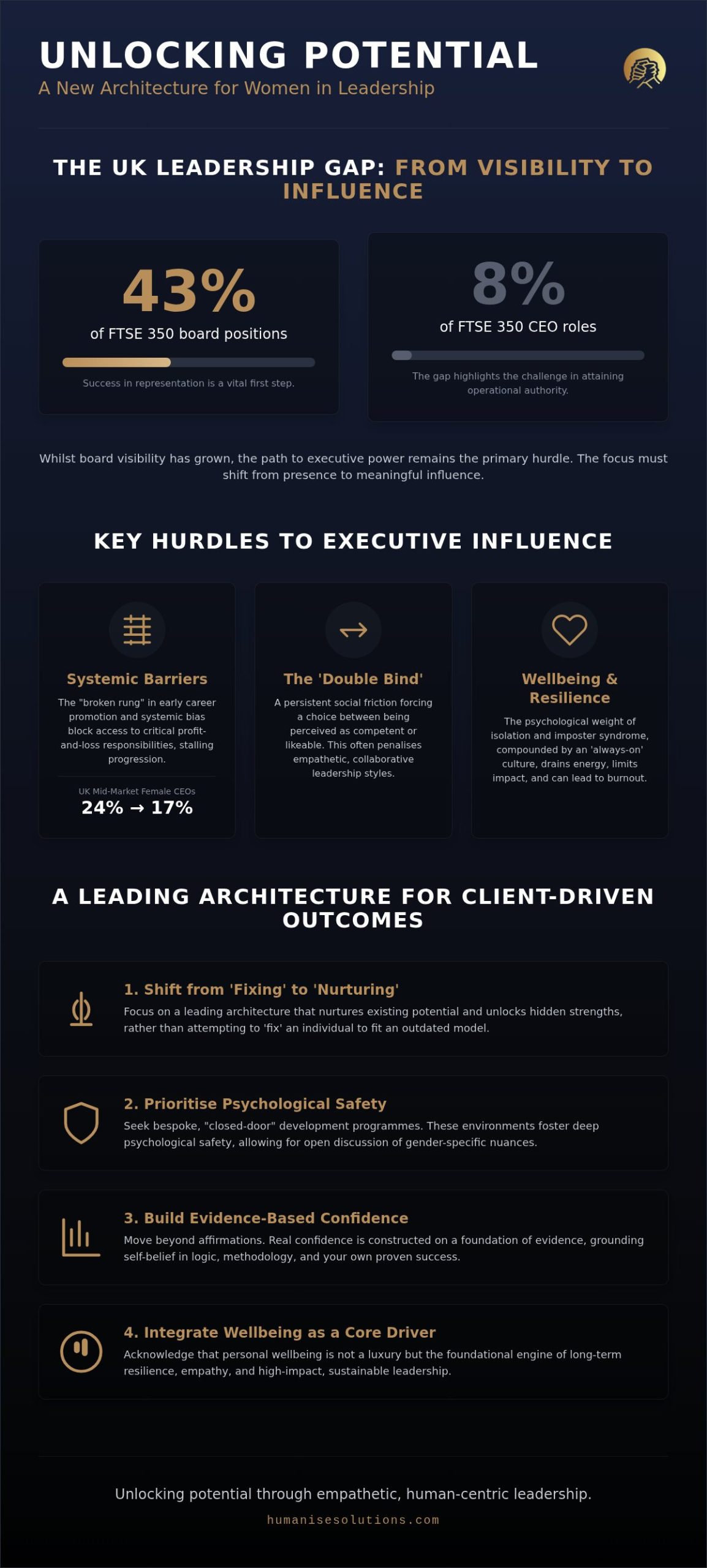
Did you know that whilst women now hold 43% of board positions across the FTSE 350, only 8% of CEO roles are occupied by female leaders? This stark contrast, highlighted in the 2026 FTSE Women Leaders Review, reveals that the executive pipeline remains a complex terrain. You likely feel that the challenges for women in leadership UK professionals encounter are often met with “survival skills” rather than genuine support. It’s exhausting to feel that modern leadership models are still too aggressive, forcing a choice between your professional impact and your personal wellbeing.
We believe that your growth shouldn’t come at the cost of your authenticity. This guide promises to help you understand the unique hurdles facing female leaders today and demonstrates how to select a development programme that fosters sustainable, human-centric growth. We’ll explore evidence-based strategies to overcome bias and provide a leading architecture for choosing a high-impact development partner. By prioritising a nurturing environment, you can move beyond the pressure to conform and begin to unlock your full potential with confidence.
Key Takeaways
- Recognise how the current challenges for women in leadership UK professionals face require a shift from mere representation to sustainable executive influence.
- Identify the psychological “double bind” and learn evidence-based strategies to cultivate resilience without sacrificing your authentic leadership style.
- Understand why bespoke, “closed-door” development environments are essential for addressing gender-specific nuances that generic corporate training often overlooks.
- Gain a clear framework for selecting a development partner that uses leading architecture to prioritise human flourishing and long-term wellbeing.
- Discover how a nurturing approach to leadership can unlock your hidden potential and drive meaningful excellence within your organisation.
The Landscape of Challenges for Women in Leadership in the UK
Whilst numerical targets for board representation have seen success, the path to executive power remains uneven. In the FTSE 350, women now hold 43% of board positions, yet they occupy only 8% of CEO roles. This discrepancy highlights the primary challenges for women in leadership UK firms must address. It’s a move from visibility to actual operational authority. The “double bind” remains a persistent hurdle, where female leaders are often forced to choose between being perceived as competent or likeable. This social friction isn’t new. You can see similar patterns in the history of women in UK Parliament, where pioneers faced intense scrutiny over their personal manner whilst trying to enact systemic change. Today, this translates into a corporate culture that still defaults to masculine-coded “command and control” styles, often excluding those who lead with empathy.
Systemic vs. Psychological Barriers
We must distinguish between the “broken rung” of early career promotion and the internalised weight of being the “only” in the room. In 2026, the proportion of female CEOs in UK mid-market companies fell to 17%, down from 24% the previous year. This regression suggests that systemic bias still prevents talented women from reaching profit-and-loss responsibilities. Our approach focuses on a leading architecture that supports the whole human. We move away from “fixing” the woman. Instead, we focus on nurturing leadership that values diverse perspectives as a foundational excellence for unlocking potential. This empathetic focus allows for growth that feels earned rather than forced.
The Role of Work-Life Integration in the UK
The UK’s “always-on” culture creates a unique pressure point. Whilst flexible working is often touted as a solution, it frequently carries a hidden career penalty, slowing the progression of those who use it. True development isn’t about teaching you to hustle harder. It’s about designing sustainable frameworks that prioritise wellbeing as a driver of team excellence. By focusing on client driven outcomes, we ensure that growth is both high-reaching and rooted in the reality of your daily life. This methodical approach ensures that change is deliberate and reassuring rather than overwhelming, allowing for long-term professional flourishing.
Inner Hurdles: Confidence, Resilience, and Wellbeing
Competence is rarely the issue for high-achieving women. For many, the true challenges for women in leadership UK organisations face are internal. It’s the silent, psychological weight of being the “only woman in the room” whilst carrying the expectations of an entire demographic. This isolation often breeds imposter syndrome, a persistent feeling of being a fraud despite clear evidence of success. Even with official reports celebrating record numbers of female leaders joining boards, the internal narrative often lags behind the professional title. This gap between external achievement and internal certainty creates a friction that drains energy and limits impact.
Emotional intelligence is the bridge to modern excellence. It involves navigating complex social dynamics with a keen awareness of individual needs and systemic pressures. However, this high level of empathy requires a sturdy foundation of self-regard. Wellbeing is that foundation. It’s not a luxury; it’s the core of long-term resilience. Without it, the very qualities that make a leader effective can become sources of burnout. True leadership excellence is found when a leader can hold space for others without losing their own sense of self.
Building “Worthiness Muscles” Through Evidence
Addressing the challenges for women in leadership UK professionals encounter requires a shift in how we view internal development. We move beyond surface-level affirmations. Real confidence is built on a leading architecture of evidence. By cultivating a space of deep psychological safety, leaders can begin to dismantle the limiting beliefs that have been reinforced by years of corporate bias. This isn’t about “fixing” a perceived lack of confidence. Instead, it’s about uncovering the existing potential that is often obscured by systemic noise. We focus on “evidence-based confidence,” which is grounded in logic and methodology. This approach ensures your growth is not just a temporary boost but a permanent shift in how you perceive your own value.
Fostering Wellbeing as a Leadership Competency
Wellbeing is a strategic asset. It’s a performance driver. When a leader prioritises their own flourishing, they set the tempo for nurturing leadership and team excellence throughout the organisation. This isn’t just about avoiding the “always-on” burnout. It’s about maintaining a state of psychological wellbeing that allows for visionary thinking and steady decision-making. A leader’s internal state directly impacts the organisational culture. We provide practical frameworks for maintaining personal growth whilst leading high-pressure teams, ensuring that your transition to future potential is both steady and supported. By treating wellbeing as a core competency, you create a sustainable model for success that inspires those around you to do the same.
Evolving the Model: Why a Female Leadership Development Programme is Essential
Standard corporate training often relies on a “default” leadership model that doesn’t account for the unique challenges for women in leadership UK organisations present. These generic programmes frequently focus on aggressive negotiation or “command and control” tactics, which can feel misaligned with a leader’s authentic self. A bespoke development programme provides a leading architecture for growth, moving away from a one-size-fits-all approach. It offers a “closed-door” environment where leaders can engage in honest peer-to-peer learning, sharing experiences without the pressure of external scrutiny. This psychological safety is vital for cultivating a unique leadership voice that resonates with authority and empathy.
The Power of Nurturing Leadership
We define nurturing leadership as a style rooted in empathy, collaboration, and the creation of psychological safety. Whilst traditional models in many UK industries prioritise hierarchy, a nurturing approach focuses on unlocking potential within every team member. This isn’t a “soft” alternative. It’s a sophisticated strategy that drives team excellence and significantly improves employee retention. When you lead through cultivation rather than demand, you foster an environment where innovation thrives. This transition from current states to future potential is a methodical process. It ensures that your leadership remains sustainable and your impact is felt across the entire organisation.
Cultivating New Leaders from Within
Bridging the gap between middle management and the C-suite requires more than just occasional mentorship. Whilst a mentor provides guidance, a formal development programme offers the structural design needed for client driven outcomes. Targeted programmes ensure that the internal talent pipeline remains robust, directly supporting diversity and inclusion goals. By investing in female-centric development, firms see a clear return on investment through more resilient leadership teams. This structured approach helps high-achieving women navigate the specific challenges for women in leadership UK sectors face during the transition to senior operational roles with confidence, ensuring that their competence is matched by a supportive framework for long-term success.
Choosing a Female Leadership Development Programme: A Buying Guide
Selecting a development partner is a strategic decision that goes beyond simple skill acquisition. To truly address the challenges for women in leadership UK organisations face, you must look for a programme built on a leading architecture of foundational excellence. This means moving past “off-the-shelf” webinars that offer generic, surface-level advice. Instead, seek out deep-work development that is bespoke, expert-led, and fundamentally human-centric. A high-impact programme shouldn’t just tell you what to do; it should provide a robust framework for how to be a more resilient, authentic leader whilst navigating complex corporate structures.
Before hiring a leadership development consultant, ask probing questions about their methodology. Do they rely on outdated corporate jargon, or is their approach rooted in evidence-based logic? You should enquire how they balance theoretical frameworks with practical, actionable workshops that lead to client driven outcomes. A partner who is deeply invested in human flourishing will be able to demonstrate how their training translates into sustainable, long-term growth for both the individual and the organisation. It’s about finding a visionary guide who understands that meaningful change takes time and care.
What to Look for in a UK Provider
A provider must possess a sophisticated understanding of the UK corporate landscape. This includes a keen awareness of the specific social dynamics and promotion biases that exist within British firms. Look for a consultancy that avoids clinical or detached language, opting instead for a voice that feels like a wise mentor. Their philosophy should be one of cultivation, focusing on the long-term sustainability of your career rather than a “quick fix” workshop. This human-centric approach ensures that the development feels supportive and tailored to your unique journey, helping you overcome the challenges for women in leadership UK professionals encounter daily.
Comparing Programme Formats
The structure of the programme determines the depth of the transformation. Whilst individual coaching tracks offer intense personal focus, group workshops provide the essential “closed-door” environment for peer-to-peer learning. The most effective programmes often blend these formats to ensure lasting behavioural change. It’s also vital to check if wellbeing modules are integrated into the core leadership curriculum. We believe that fostering wellbeing is not an optional extra but a performance driver that underpins team excellence. By choosing a partner that prioritises this balance, you ensure your transition to senior leadership is both steady and rewarding.
If you are ready to move from current hurdles to future potential, explore how our nurturing leadership programmes can support your professional journey and unlock your hidden potential.
The Humanise Solutions Approach: Nurturing Your Potential
At Humanise Solutions, we view leadership as a profound journey of human flourishing rather than a mere set of corporate functions. Our philosophy is rooted in the belief that the challenges for women in leadership UK firms face today require a shift towards empathy and evidence-based confidence. We don’t just deliver training; we provide a leading architecture for professional growth. This structural design ensures that your development is grounded in logic whilst remaining deeply invested in your personal wellbeing. Our expert-led workshops are crafted to build authentic, nurturing leaders who can navigate complex social dynamics with ease and authority.
Bespoke Growth Tracks for UK Organisations
We reject the sterile, one-size-fits-all approach of traditional consulting. Instead, we focus on bespoke growth tracks that are tailored to the specific needs of your organisation. This client driven outcomes focus ensures that our initiatives address the “broken rung” and the executive pipeline issues we’ve previously discussed. Our commitment to unlocking potential extends through the entire career span, including Young Adult Programmes designed to cultivate the next generation of visionary thinkers. By making psychological wellbeing a core pillar of our curriculum, we ensure that your leaders don’t just reach the top; they thrive once they get there.
A Partnership for Sustainable Change
We position ourselves as a visionary guide, acting as a partner in your long-term L&D journey. Meaningful change is never a fast-paced or high-pressure event; it is a methodical process that requires care and steady progression. This deliberate pace mirrors our commitment to sustainable growth, ensuring that every participant feels supported rather than overwhelmed. By fostering team excellence through female leadership, we help UK firms build more resilient, innovative cultures. We invite you to step away from aggressive business terminology and move towards a model of leadership that describes the human experience within a professional context.
Your journey towards a more nurturing leadership style starts with a single conversation. We’re here to help you navigate the challenges for women in leadership UK sectors present and turn them into opportunities for profound organisational flourishing. Explore our Women in Leadership programmes to discover how we can partner with you to unlock your team’s full potential.
Step Into Your Future Potential
Understanding the landscape is the first step toward meaningful change. You’ve seen how the executive pipeline remains a complex terrain; overcoming the challenges for women in leadership UK professionals face requires more than just traditional corporate training. It demands a sophisticated blend of psychological evidence and empathetic support that addresses the whole human. By moving away from aggressive, masculine-coded models, you can begin to lead with a voice that is both authentic and authoritative.
We invite you to choose a partner that prioritises long-term sustainability and foundational excellence. Our expert-led workshops are bespoke to the UK corporate landscape; they ensure your development is rooted in logic whilst fostering a deep sense of wellbeing. This leading architecture is specifically designed to unlock your hidden potential and drive client driven outcomes that elevate your entire organisation. Every leader deserves a nurturing environment where their competence is celebrated and their resilience is cultivated through proven methodologies. Discover how our Women in Leadership programmes can transform your organisation. You already possess the competence; now, give yourself the space to truly flourish.
Frequently Asked Questions
What are the most common challenges for women in leadership in the UK today?
The most common hurdles include the “double bind” of balancing likeability with competence and the persistent “broken rung” at the middle management level. These systemic barriers often prevent talented women from accessing high-stakes operational roles. Navigating these challenges for women in leadership UK professionals encounter requires a shift from surviving corporate bias to thriving through nurturing leadership models that value diverse perspectives.
Why should we choose a female-specific leadership programme over a generic one?
Female-specific programmes provide a “closed-door” environment that addresses gender-specific nuances often ignored by generic corporate training. These tracks allow for honest peer-to-peer learning and focus on dismantling the unique psychological barriers women face. By using a leading architecture tailored to the female experience, these programmes foster an authentic leadership voice rather than forcing a one-size-fits-all masculine model that can feel misaligned.
How do these programmes address imposter syndrome and confidence issues?
We address imposter syndrome by moving away from surface-level affirmations towards evidence-based confidence. This methodology involves dismantling limiting beliefs within a safe, psychological space. By building “worthiness muscles” through logic and methodology, leaders learn to recognise their competence as a foundational truth. This process unlocks potential by grounding self-assurance in tangible achievements rather than temporary motivational boosts, ensuring growth is permanent.
Can a leadership development consultant help with our specific UK industry challenges?
A specialist consultant provides bespoke growth tracks that reflect the unique social and professional dynamics of the UK corporate landscape. They offer a visionary guide through industry-specific biases and promotion penalties. By focusing on client driven outcomes, they ensure that the development framework is pragmatic and directly applicable to your organisation’s specific cultural hurdles, ensuring that the training translates into real-world impact.
What is the typical ROI of a female leadership development programme?
The return on investment is seen through significantly improved employee retention and the cultivation of a robust internal talent pipeline. Organisations benefit from enhanced team excellence and a more resilient leadership culture. Investing in these programmes reduces the costs associated with burnout and turnover whilst ensuring that diverse perspectives drive innovative decision-making, leading to better financial and operational performance across the firm.
How does nurturing leadership differ from traditional corporate leadership styles?
Nurturing leadership prioritises empathy, collaboration, and psychological safety over the traditional “command and control” hierarchy. Whilst older models often focus on short-term demands, this human-centric approach values long-term sustainability and the flourishing of every team member. It creates a supportive framework where high performance is a natural outcome of a healthy, inclusive, and well-supported organisational culture that respects the human experience.
Are these programmes suitable for middle managers as well as senior executives?
These programmes are essential for middle managers as they help bridge the gap to senior operational roles. Addressing the challenges for women in leadership UK managers face early on prevents the “broken rung” phenomenon from stalling talented careers. We also offer tailored initiatives like Young Adult Programmes to ensure that leadership potential is nurtured at every stage, providing a steady progression toward future potential.
How do you integrate wellbeing into a leadership development track?
We treat wellbeing as a core leadership competency rather than an optional extra. It is integrated through modules that focus on resilience, sustainable growth, and the psychological health of the leader. By positioning wellbeing as a performance driver, we ensure that leaders can maintain their impact without sacrificing their personal flourishing. This methodical approach builds trust and ensures long-term professional success for both the individual and the team.
