

Article by
Scott Ward MBA CCMI
Scott Ward is the founder and CEO of Humanise Solutions, which he established three years ago to help organisations elevate their people, leadership and culture through a human-centric, evidence-based approach. Before moving into business and academia, Scott spent seven years as a professional footballer, playing for Luton Town, Crawley Town and Coventry City FC until injury brought his playing career to a close — a turning point that shaped both his research interests and his approach to leadership.
Scott holds an MBA from Warwick Business School, where his research explored the causal relationship between trauma and decision-making — work that continues to inform how he supports young adults, leaders and teams under pressure. Recognised as a Companion of the Chartered Management Institute (CCMI), its highest grade of membership, he combines academic rigour with the discipline, resilience and team-first mindset of the professional game. At the heart of everything he does is a simple belief: that people perform at their best when they are led, developed and valued as human beings first.
Did you know that 86% of employees now consider their wellbeing just as important as their salary? You have likely felt the sting of a high-performing team member handing in their notice, despite the office yoga sessions and fresh fruit bowls. It is frustrating to watch talent walk out the door when you have invested heavily in traditional perks that fail to drive employee retention through wellbeing. You aren’t alone in feeling that there is a growing disconnect between corporate benefits and the genuine human need for psychological safety and flourishing.
This guide explores why a human-centric approach is no longer a soft HR initiative but the most powerful strategic lever available for modern British organisations. We’ve moved past the era of superficial fixes. By focusing on nurturing leadership and sustainable growth, you can transform a culture of quiet quitting into one of vibrant engagement. We will provide a clear roadmap for moving beyond standard benefits towards a leadership style that fosters long-term commitment, reduces churn costs, and builds a truly high-performing team.
Key Takeaways
- Move beyond superficial perks to embrace a culture-led strategy that aligns with the modern employee’s search for purpose and psychological health.
- Understand the critical role of psychological safety in preventing “boreout” and maintaining the psychological contract between your organisation and its people.
- Learn why nurturing leadership is the most effective way to improve employee retention through wellbeing, as managers often have more influence over a team member’s health than their GP.
- Discover a five-step framework for transition, highlighting how continuous learning and development serves as a foundation for team excellence.
- Recognise why bespoke development programmes are essential for cultivating long-term resilience and sustainable human growth in the British workplace.
The Evolution of Employee Retention: From Perks to Purpose
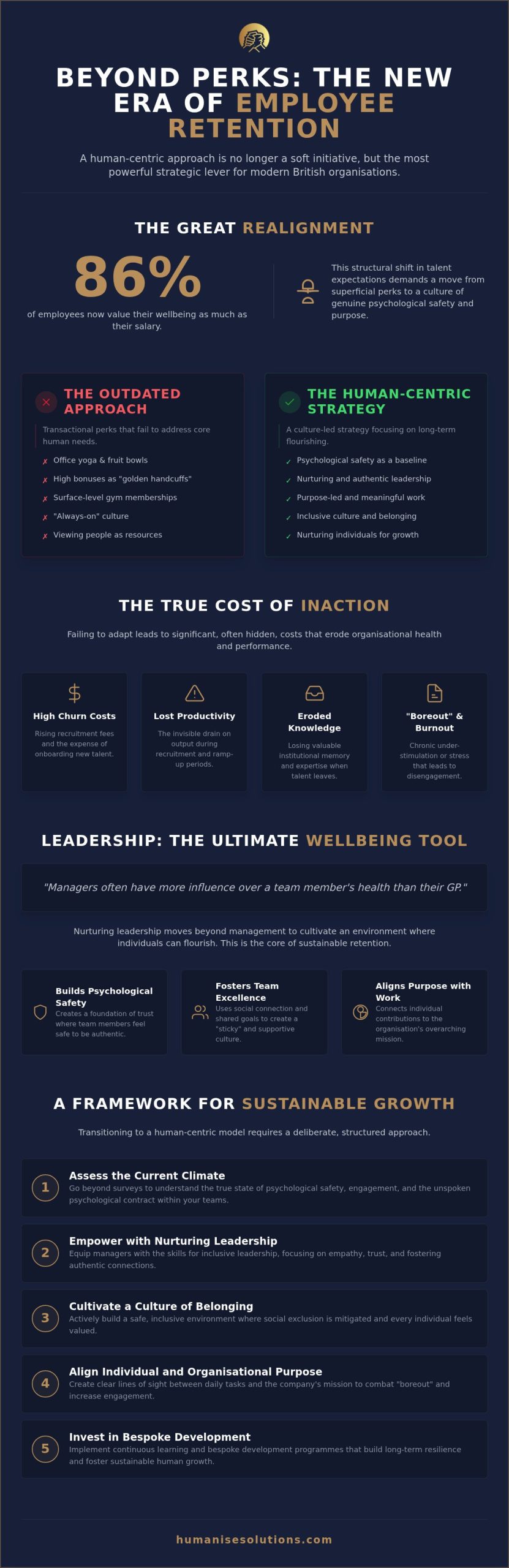
For decades, the concept of keeping staff was treated as a transactional exercise. It was a matter of competitive salaries, annual bonuses, and perhaps a few surface-level benefits. However, we’ve entered the era of the “Great Realignment”. In 2026, the British workforce has fundamentally shifted its priorities. Recent data suggests that 86% of employees now value their psychological health as much as their pay cheque. This isn’t a temporary trend; it’s a structural change in the expectations of talent. True employee retention through wellbeing is no longer about what you give your team, but how you allow them to feel whilst they are with you.
Whilst many associate employee retention with competitive salaries, the reality in 2026 is far more nuanced. Organisations that fail to adapt face a staggering cost of churn. Beyond the immediate recruitment fees, which continue to rise in the UK, there is the invisible drain of lost productivity and the erosion of institutional knowledge. To combat this, top-tier employers are adopting “Human-Centric Growth”. This framework moves away from viewing people as resources to be extracted and instead sees them as individuals to be nurtured. It is a cultural strategy that prioritises long-term flourishing over short-term output. Building this kind of culture requires a robust foundation, and developing a structured workplace wellbeing strategy UK organisations can genuinely embed is the essential first step.
Why Traditional Retention Strategies are Failing
The “golden handcuffs” of the past have lost their shine. High-level bonuses and fancy office gadgets cannot compensate for a toxic environment or a lack of support. Many British businesses are still struggling with the fallout of an “always-on” culture, where digital fatigue has become a primary driver of staff turnover. There is often a profound disconnect between executive perception and the daily employee experience. Whilst leadership might point to a new gym membership scheme, the team is often struggling with the weight of unrealistic expectations and a lack of genuine connection.
The 2026 Talent Landscape: What Employees Actually Value
The modern professional, particularly amongst Gen Z and Millennial cohorts, seeks more than just a job. They demand flexibility, inclusive cultures, and, crucially, authentic leadership. They are looking for “Nurturing Leadership” — a style that recognises the human being behind the job title. This shift requires a move towards environments where psychological safety is the baseline rather than a luxury. People want to work for organisations that see their growth as a shared journey.
Purpose-led retention is the strategic alignment of an individual’s personal wellbeing with the overarching goals of the organisation.
Decoding the Psychological Link Between Wellbeing and Loyalty
Loyalty is rarely a purely logical decision; it is an emotional response to an environment that supports human flourishing. When an individual feels psychologically safe, their brain shifts from a state of defensive survival to one of creative engagement. As research shows, the responsibility for this climate rests largely with leadership. Creating a space where people can be their authentic selves is the most direct route to employee retention through wellbeing. It’s about building a foundation of trust that makes the thought of leaving feel like a personal loss rather than just a career move.
Whilst chronic stress is a visible threat, “boreout” often goes unnoticed until it’s too late. This state of chronic under-stimulation erodes the unspoken psychological contract between employer and employee. When work lacks purpose or the opportunity for growth, the bond of loyalty thins. High-performing cultures counteract this by prioritising Team Excellence, where social connection and shared goals create a “sticky” culture. This social glue doesn’t just improve morale; it creates a sustainable environment for employee retention through wellbeing by significantly boosting cognitive performance, as a secure brain has more bandwidth for innovation and complex problem-solving.
The Neuroscience of Workplace Belonging
Our brains are biologically wired to perceive social exclusion as a physical threat. In environments where people feel like outsiders, the amygdala remains in a state of high alert, which stifles the prefrontal cortex’s ability to think clearly. This “threat response” is a major driver of quiet quitting and disengagement. By embracing inclusive leadership, managers can lower these neurological barriers, making every team member feel seen and valued. At Humanise Solutions, we use bespoke workshops to help teams cultivate this sense of resonance, transforming a group of individuals into a unified, resilient collective.
Growth as a Wellbeing Pillar for Young Adults
For early-career talent, the definition of wellbeing is often tied to their sense of progression. To a young adult, professional development is a form of personal care. If they feel stagnant, their stress levels rise as they worry about their future readiness. This is a nuance many organisations miss. Our Young Adult Programmes address this directly by bridging the gap between formal education and the demands of the modern workforce. When you invest in a young person’s social mobility and resilience, you aren’t just filling a role; you are demonstrating a level of commitment that fosters deep, long-term loyalty.
Beyond the Gym Membership: Why Leadership is the Ultimate Wellbeing Tool
It’s a common frustration amongst HR directors: the organisation offers a comprehensive Employee Assistance Programme (EAP) and private medical insurance, yet the turnover rate remains stubbornly high. This happens because most wellbeing initiatives are reactive. They provide a safety net once someone is already struggling, rather than preventing the struggle in the first place. To achieve genuine employee retention through wellbeing, we must shift from “perk-based” solutions to “leadership-led” cultures. A manager often has more influence over a team member’s mental health and physical vitality than their GP, simply because they control the daily environment, the deadlines, and the social climate of the workplace.
Whilst reactive tools are necessary, they don’t fix a toxic Tuesday morning or a culture of relentless pressure. Studies on The Costs of Burnout and Turnover highlight that organisational-level interventions are significantly more effective than individual ones. This is where Nurturing Leadership becomes the essential antidote to the “toxic boss” syndrome. It’s not about being “soft”; it’s about being strategically human. When leaders prioritise psychological safety as a core business metric, they don’t just reduce churn; they unlock a level of loyalty that no gym membership could ever buy.
The Manager as a Wellbeing Architect
Nurturing leaders act as architects of a healthy team environment. They reduce staff anxiety through clear communication, radical transparency, and the simple act of active listening. By embracing Collaborative Leadership, they ensure that pressure is shared and managed across the collective rather than weighing heavily on a single individual. This prevents the isolation that often leads to burnout. The modern leader has successfully navigated the transition from “command and control” to “coach and cultivate”, recognising that their primary role is to clear the path for their team to flourish.
Empowering Women Leaders to Drive Cultural Change
There is a powerful link between gender-diverse leadership and sustainable organisational growth. Often, Women in Leadership roles excel at fostering the empathetic and inclusive environments that modern talent craves. By investing in female-led development tracks, organisations often see a ripple effect of improved retention across all departments. These leaders tend to prioritise social connection and psychological support, which are the cornerstones of a resilient workplace. When empathy is treated as a professional skill rather than a personality trait, the entire culture shifts towards long-term stability and employee retention through wellbeing.
Strategic Implementation: Cultivating a Culture of Team Excellence
Shifting an organisation from a high-turnover environment to one defined by flourishing requires more than good intentions; it demands a methodical framework. We’ve seen that superficial perks fail to address the root causes of churn. Instead, leaders must integrate wellbeing into the very fabric of their operations. To achieve lasting employee retention through wellbeing, we recommend a five-step transition that moves from reactive fixes to a proactive culture of Team Excellence.
- Conduct Stay Interviews: Don’t wait for an exit interview to learn why people are unhappy. Ask your best talent what makes them stay and what would make their work life more meaningful today.
- Embed Psychological Safety: Normalise the idea that vulnerability is a professional strength. When team members feel safe to speak up, innovation follows.
- Prioritise Continuous Learning: Move away from one-off training days. Learning & Development should be a constant, integrated part of the weekly rhythm.
- Empower Nurturing Leaders: Provide managers with the specific tools they need to coach their teams rather than just managing their tasks.
- Establish Feedback Loops: Create transparent channels where staff can see their suggestions being turned into tangible cultural changes.
This framework ensures that wellbeing isn’t a side project. It becomes the engine that drives performance. By treating Learning & Development as a continuous journey, you signal to your team that you’re invested in their long-term future. This sense of being valued is the primary driver of loyalty in the 2026 workplace.
Building Psychological Safety into Daily Operations
Practical implementation starts with creating “brave spaces”. These are environments where open dialogue is encouraged and mistakes are treated as essential learning opportunities rather than disciplinary triggers. When inclusive leadership is practiced daily, it transforms Team Performance Development. Leaders should actively seek out dissenting voices and reward honesty. This approach lowers the collective threat response, allowing the team to focus their energy on excellence rather than self-protection.
Measuring the ROI of Wellbeing-Led Retention
To sustain these initiatives, you must measure their impact using meaningful metrics. Move beyond generic happiness surveys and adopt the Employee Net Promoter Score (eNPS) to gauge genuine advocacy. When you calculate the savings from reduced recruitment and onboarding costs, the financial case for employee retention through wellbeing becomes undeniable. Linking our Fostering Wellbeing programmes to these tangible business outcomes allows you to see the direct correlation between a nurtured team and a healthier bottom line. If you’re ready to transform your culture, explore how our Team Excellence programmes can help you build a more resilient organisation.
Sustaining Human Growth: The Humanise Solutions Approach
The journey towards a high-retention culture isn’t a destination you reach with a few minor policy changes; it’s a commitment to continuous cultivation. At Humanise Solutions, we believe that lasting change only occurs when development is bespoke and deeply rooted in the unique dynamics of your team. Our philosophy is built on human-centric training for sustainable growth. We move past the sterile, detached language of traditional consulting to focus on the psychological well-being and internal qualities of every individual. By prioritising employee retention through wellbeing, we help UK firms transition from a state of reactive crisis management to one of visionary, grounded leadership.
Our Nurturing Leadership and Team Excellence programmes aren’t off-the-shelf products. We recognise that the challenges faced by a tech startup in London differ significantly from those of a long-standing manufacturing firm in the Midlands. Each programme is tailored to the specific cultural gaps and aspirations of your organisation. This bespoke approach ensures that the skills learned are immediately applicable and culturally resonant, creating a ripple effect of confidence and resilience across all levels of your workforce.
Bespoke Programmes for Lasting Impact
We provide workshops that span the entire professional lifecycle, from Young Adult Programmes that support entry-level talent to advanced tracks for senior executives. Our focus remains steadfastly on human flourishing rather than mere corporate compliance. Whilst compliance ensures you meet a minimum legal standard, flourishing ensures your people feel a deep sense of belonging and purpose. We operate on a long-term partnership model because we understand that meaningful cultural shifts don’t happen overnight. Humanise Solutions stays by your side as your organisation evolves, providing the ongoing support and logic-based methodology required to ensure the seeds of change we plant together continue to grow into a resilient, sustainable future.
Your Next Steps Towards a High-Retention Culture
Creating a sticky workplace culture begins with an honest audit of your current leadership behaviours. Ask yourself: do your managers feel equipped to coach, or are they simply managing tasks? Are your team members flourishing, or are they merely surviving the week? Identifying these gaps is the first step in reclaiming the narrative of your organisation and stopping the drain of talent. We position ourselves as your partner in this journey, offering the expertise needed to turn these insights into a roadmap for growth.
We invite you to move beyond reactive “wellbeing perks” and embrace a strategy that puts people at the centre of your success. The most powerful lever for employee retention through wellbeing is a culture that recognises and rewards the human experience. It is time to transition from sustaining the status quo to cultivating potential.
Organise a consultation with Humanise Solutions to transform your retention strategy and begin the journey towards a more engaged, high-performing future for your team.
Cultivating a Legacy of Flourishing
The future of the British workplace belongs to those who view their people not as resources to be managed, but as humans to be nurtured. We’ve explored how the transition from superficial perks to a culture of purpose is the only sustainable way to secure your most valuable talent. By prioritising psychological safety and inclusive leadership, you create an environment where loyalty is a natural byproduct of growth. True employee retention through wellbeing is achieved when every team member, from young adults to senior executives, feels seen, valued, and empowered to flourish within your organisation.
As an expert-led British consultancy, Humanise Solutions is dedicated to this transformation. We provide bespoke development programmes that focus on human flourishing at every career stage, ensuring your leadership style evolves alongside the needs of your people. It’s time to move beyond reactive fixes and build a foundation of psychological safety that lasts. Discover our bespoke leadership development programmes to improve your retention and start building a more resilient team today.
You have the power to turn your organisation into a sanctuary of excellence. It is a journey worth taking, and the potential for your team’s future is limitless.
Frequently Asked Questions
How does employee wellbeing directly affect retention rates?
Wellbeing acts as the primary emotional anchor for talent in the modern workplace. When staff feel physically and mentally supported, their loyalty increases because the organisation becomes a source of vitality rather than exhaustion. Effective employee retention through wellbeing strategies can more than double the likelihood of keeping top talent. People are far less likely to leave an environment that actively protects their psychological health and fosters genuine flourishing.
Is an EAP enough to support employee wellbeing in 2026?
Whilst Employee Assistance Programmes provide a vital safety net, they’re fundamentally reactive tools. In 2026, talent expects proactive support embedded in daily operations rather than just a phone number to call during a crisis. Relying solely on an EAP often ignores the root causes of workplace stress, such as poor leadership or unrealistic workloads. True flourishing requires a shift towards a leadership-led culture that prevents burnout before it begins.
What are the main causes of high staff turnover in UK organisations?
Negative work environments remain the leading cause of churn in the UK, often accounting for over 32% of resignations. Beyond this, a lack of psychological safety and a disconnect between corporate values and the actual employee experience drive talent away. When people feel like interchangeable units rather than valued individuals, the psychological contract breaks. This leads them to seek organisations that prioritise human-centric leadership and authentic connection.
How can small businesses prioritise wellbeing without a large budget?
High-impact wellbeing doesn’t require a massive budget; it requires a shift in leadership behaviour. Small businesses can prioritise psychological safety by fostering open dialogue and offering genuine flexibility. Simple acts, such as active listening and recognising individual contributions, cost nothing but build immense trust. Focus on Fostering Wellbeing through nurturing leadership rather than expensive subscriptions to create a “sticky” culture where people feel truly seen and valued.
What role does inclusive leadership play in employee retention?
Inclusive leadership is the cornerstone of a high-retention culture because it ensures every team member feels a sense of belonging. By actively seeking diverse perspectives and rewarding honesty, leaders lower the neurological “threat response” in their teams. This creates a secure environment where innovation can thrive. Individuals who feel their unique contributions are recognised develop a deep personal commitment to the organisation’s collective success and long-term goals.
How do you measure the success of a workplace wellbeing programme?
Success should be measured through tangible outcomes like the Employee Net Promoter Score (eNPS) and staff turnover rates. Move beyond surface-level surveys to track deeper metrics such as engagement levels and the uptake of Learning & Development opportunities. When you see a reduction in recruitment costs and an increase in internal promotions, you know your workplace wellbeing strategy UK businesses are adopting is delivering a real return on investment for the business.
Can leadership training really reduce staff burnout?
Yes, because burnout is often a systemic issue rather than an individual failing. Leadership training equips managers with the skills to identify early signs of chronic stress and adjust workloads accordingly. By moving from a “command and control” style to one of Nurturing leadership, managers can distribute pressure more effectively. This creates a supportive climate that protects the team’s long-term health and ensures sustainable high performance across the organisation.
Why is Gen Z more likely to leave a job due to poor wellbeing support?
For Gen Z, wellbeing isn’t a bonus; it’s a fundamental requirement of the professional contract. This cohort prioritises purpose and psychological health over traditional status symbols or even salary alone. If they perceive a lack of authentic support or a toxic culture, they’re far more likely to switch employers to protect their mental health. Investing in Young Adult Programmes helps bridge this gap by aligning organisational culture with their core values.
