

Article by
Scott Ward MBA CCMI
Scott Ward is the founder and CEO of Humanise Solutions, which he established three years ago to help organisations elevate their people, leadership and culture through a human-centric, evidence-based approach. Before moving into business and academia, Scott spent seven years as a professional footballer, playing for Luton Town, Crawley Town and Coventry City FC until injury brought his playing career to a close — a turning point that shaped both his research interests and his approach to leadership.
Scott holds an MBA from Warwick Business School, where his research explored the causal relationship between trauma and decision-making — work that continues to inform how he supports young adults, leaders and teams under pressure. Recognised as a Companion of the Chartered Management Institute (CCMI), its highest grade of membership, he combines academic rigour with the discipline, resilience and team-first mindset of the professional game. At the heart of everything he does is a simple belief: that people perform at their best when they are led, developed and valued as human beings first.
If 77% of organisations are reporting a significant leadership gap despite record spending on training, the traditional approach to professional growth isn’t just failing; it’s obsolete. Finding the right leadership development consultant in 2026 requires looking beyond sterile slide decks and towards the cultivation of genuine human connection. You’ve likely noticed that clinical, off-the-shelf programmes simply don’t stick, especially whilst you’re trying to retain Gen Z talent or build evidence-based confidence in emerging female leaders.
We understand that you want more than a vendor; you need a visionary guide who recognises that sustainable growth starts with psychological safety and empathy. You’re looking for a way to bridge the disconnect between high-level strategy and the daily wellbeing of your teams. This guide promises to show you how to identify a partner who nurtures human potential and drives excellence through both logic and methodology. We will explore the essential criteria for selecting a consultant who champions social mobility and builds a resilient, inclusive leadership tier that thrives in a volatile market.
Key Takeaways
- Learn why a modern leadership development consultant acts as a long-term partner in cultivation rather than a provider of temporary corporate fixes.
- Discover how to distinguish between uninspiring, off-the-shelf modules and bespoke programmes that prioritise social mobility and early career support.
- Understand the vital difference between clinical, metrics-driven consulting and a human-centric approach focused on behaviour, belonging, and sustainable growth.
- Identify the internal steps necessary to audit your current culture and empower champions to ensure your leadership transformation truly takes root.
- Explore how prioritising nurturing leadership and team excellence can bridge the gap between high-level strategy and employee wellbeing.
Beyond Strategy: What Does a Human-Centric Leadership Development Consultant Do?
The era of the clinical, detached consultant is coming to an end. In 2026, a truly effective leadership development consultant acts as a visionary guide rather than a temporary vendor. They don’t just hand over a generic strategy and exit the building; they partner with you to cultivate long-term organisational health from the inside out. This shift reflects a necessary move away from traditional, top-down hierarchies towards a more collaborative, human-centric model that values every individual’s contribution. It’s about moving from a “fix-it” mindset to one of continuous cultivation.
A leadership development consultant is a specialist who bridges the gap between organisational goals and human flourishing. By combining evidence-based confidence with empathetic warmth, these experts help leaders find the delicate balance between hitting commercial targets and supporting their people. By understanding leadership development as a collective journey of growth, organisations can move beyond individual skill-building to systemic transformation. This approach ensures that while the goals remain high-reaching, the foundation is rooted in logic, methodology, and genuine care.
The Move Towards Nurturing Leadership
Sterile corporate jargon is losing its power. Modern teams, especially those amongst the Gen Z cohort, crave authenticity and purpose. Nurturing leadership replaces the old “command and control” style with a focus on psychological safety. When people feel safe to fail, they feel safe to innovate. We’ve seen that consultants now focus on helping leaders transition from simply managing tasks to actively nurturing the talent within their teams. This creates a culture where excellence isn’t forced; it’s grown. It’s a steady progression from current states to future potential.
Fostering Wellbeing as a Strategic Asset
High-performing team excellence cannot exist without a foundation of wellbeing. A disconnect between leadership strategy and employee health leads to burnout and high turnover. A human-centric consultant integrates mental health and personal growth into the heart of professional development programmes. They don’t treat wellbeing as a “nice-to-have” perk but as a strategic asset. By creating inclusive environments that sustain growth, particularly for those in early careers or from diverse backgrounds, consultants ensure that the leadership tier remains resilient. This focus on social mobility and youth training ensures that the talent pipeline is as diverse as it is capable. True growth takes time and care.
Key Evaluation Criteria for Leadership Development Services
Selecting the right partner requires more than a cursory glance at a glossy brochure. You need to assess a consultancy’s ability to provide bespoke learning and development programmes that actually breathe life into your team. Off-the-shelf modules often feel clinical and uninspiring; they fail to “stick” because they ignore the unique heartbeat of your organisation. When researching how to choose a leadership program, look for a methodology that balances visionary guidance with pragmatic, logical foundations. A truly effective leadership development consultant focuses strictly on professional training and growth, steering clear of recruitment services or clinical interventions.
Specialised Tracks: Women and Young Adults
Generic training often misses the mark for female leaders and Gen Z talent. In 2026, the leadership gap remains a persistent hurdle, with 77% of organisations reporting a shortage. Tailored initiatives for young adults are crucial for building diverse talent pipelines and ensuring social mobility. You should seek out consultants with deep expertise in these areas, ensuring that those from underrepresented backgrounds are nurtured with evidence-based confidence. This isn’t about ticking boxes. It’s about fostering an environment where every individual can thrive. Identifying a partner who understands the specific challenges faced by women leadership cohorts will ensure your investment creates a lasting impact.
Bespoke vs. Standardised Programmes
The risks of relying on SaaS-only platforms are significant. Without human-led facilitation, the “human link” is lost, particularly in middle management where relational intelligence is vital. Bespoke designs adapt to your culture, finding gaps in team performance that a generic algorithm would miss. These programmes should feel deeply invested in your people’s flourishing rather than being a box-ticking exercise. A human-centric leadership development consultant will take the time to understand your internal dynamics before proposing a solution. This methodical approach builds trust and ensures the training resonates across all levels of the business.
When evaluating potential partners, look for these specific indicators of quality:
- Human-led workshops: Evidence of interactive, facilitator-led sessions rather than just pre-recorded videos.
- Social mobility focus: Proven experience in supporting early careers and diverse talent.
- Evidence-based methodology: A clear logical framework that supports aspirational goals.
- Cultural alignment: A willingness to adapt content to your specific organisational values and challenges.
This steady pace of evaluation ensures that your choice is deliberate and reassuring. By prioritising a partner who values human connection, you’re not just buying a service; you’re investing in the future resilience of your entire workforce.
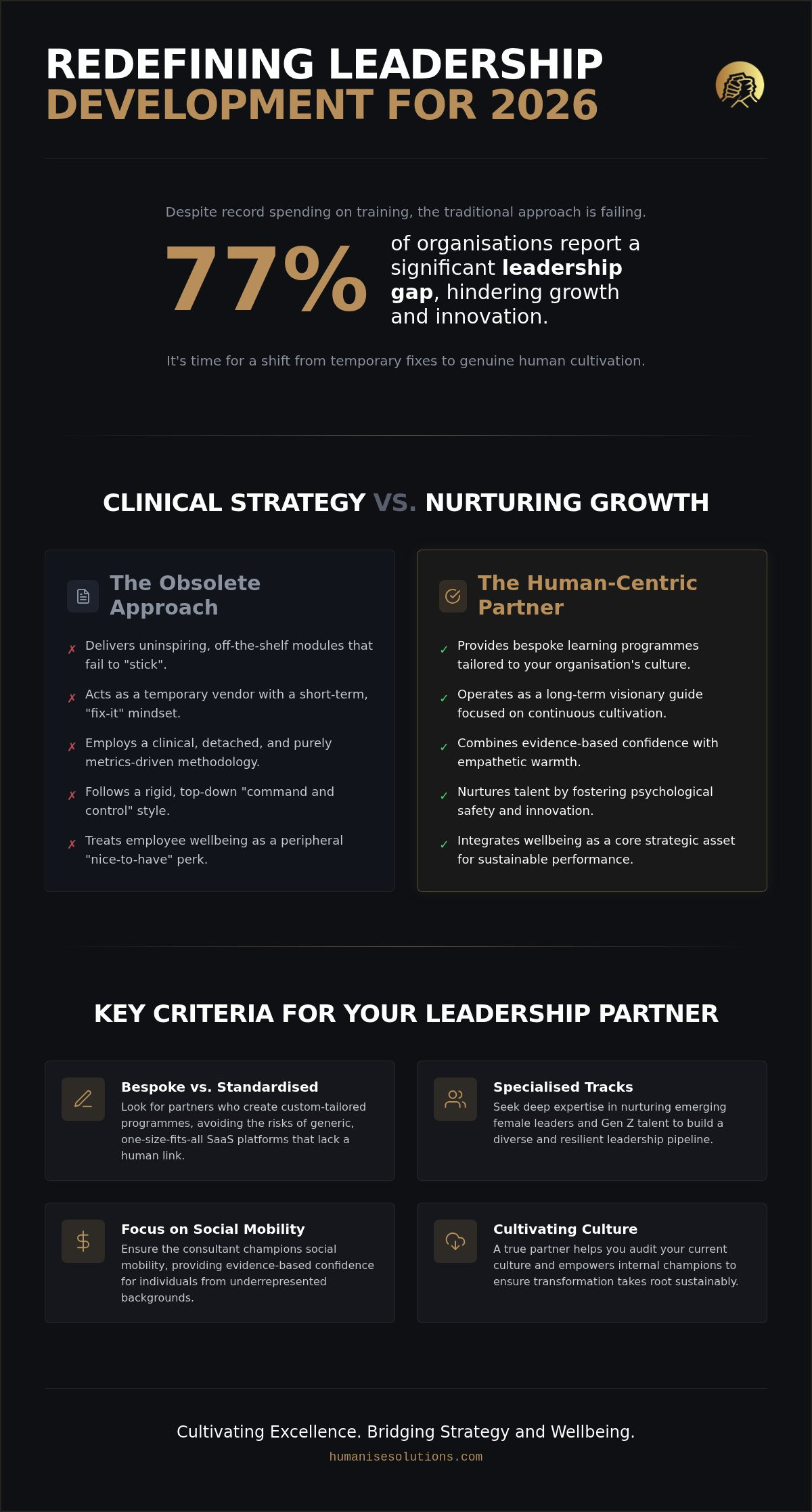
Clinical Strategy vs. Nurturing Growth: Comparing Consultancy Philosophies
Choosing a leadership development consultant often feels like a choice between two distinct worlds. One world is built on architectural precision; the other on the patient art of cultivation. Large, traditional firms often approach organisational change as a clinical overhaul, focusing heavily on rigid metrics and governance structures. Whilst these frameworks provide a sense of order, they can feel detached from the daily human experience of your staff. In contrast, a human-centric boutique focuses on behaviour and belonging, recognising that sustainable growth is rooted in how people actually relate to one another and their work.
The difference often comes down to the “why” behind the training. A clinical strategy seeks to architect people into machines that fit a pre-defined strategy. Nurturing growth, however, seeks to evolve the culture so that the strategy becomes a natural byproduct of a healthy, motivated team. Logic and emotional resonance must coexist to achieve a genuine return on investment. Without the logic, the programme lacks direction; without the emotion, it lacks the soul required to inspire lasting change. This is why the most effective partners balance visionary guidance with a grounded, evidence-based approach.
Which Approach Suits Your Organisation?
Identifying your team’s current state is the first step towards choosing the right path. Does your organisation need a clinical overhaul of its processes, or a human-centric evolution of its culture? Modern UK firms are increasingly favouring partners who prioritise psychological wellbeing over mere task management. This shift is driven by the reality of long-term employee retention. When leaders focus on nurturing leadership development rather than just individual executive coaching, the entire leadership tier becomes more resilient. Even when following government leadership development standards, the most successful programmes are those that treat employees as flourishing individuals rather than just line items on a spreadsheet.
The Role of Evidence-Based Confidence
A human-centric approach does not mean a lack of rigour. On the contrary, building evidence-based confidence requires a methodical and thorough change process. We use data to track progress and identify gaps, but we never lose the personal touch that makes training “stick”. It’s about ensuring the foundation of any programme remains rooted in logic and methodology whilst allowing space for nuance and individual needs. This steady, deliberate pace builds trust amongst participants. They see that the transformation is grounded in fact, yet delivered with a compassionate expert’s touch. By balancing these elements, a leadership development consultant can help your organisation transition from a state of uncertainty to one of resilient, sustainable excellence.
Maximising Impact: Preparing Your Organisation for Leadership Transformation
Transformation is not a spectator sport. To truly reap the rewards of partnering with a leadership development consultant, your organisation must prepare the soil long before the first workshop begins. This preparation involves a deep, honest audit of your current culture to identify specific gaps in team performance and inclusive leadership. By identifying internal champions, those influential individuals who already embody your desired values, you create a vital support network that ensures new behaviours take root across every department. This groundwork transforms the consultancy from an external service into an integrated partnership for growth.
Communication is your most powerful tool during this transition. It is essential to frame the upcoming programmes as a significant investment in your people’s flourishing rather than a remedial fix for “bad” leaders. When your team feels chosen for their potential rather than criticised for their current state, they engage with far greater vulnerability and commitment. Success should be measured through human-centric KPIs that reflect the brand’s focus on flourishing. Track rising confidence levels amongst emerging talent and monitor for a measurable reduction in staff turnover as your leadership tier becomes more resilient and empathetic.
Building Internal Buy-in
Presenting a development strategy to the board requires a shift in narrative from “cost” to “growth driver”. You must address the common objection of being “too busy” by highlighting that the cost of inaction, such as stagnant innovation and high attrition, far outweighs the time spent in training. Frame these sessions as a reward for high-potential talent. This is particularly effective for those in Young Adult Programmes who represent the future of your leadership pipeline. This positioning transforms the initiative from a corporate obligation into a prestigious opportunity for professional advancement. If you are ready to cultivate this level of excellence, our team is here to guide your transition.
Setting Realistic Timelines for Change
Meaningful change requires a methodical and steady communication rhythm. You must avoid the “quick-fix” trap that many traditional firms fall into. True organisational leadership development is a marathon, not a sprint, and it requires a commitment to long-term sustainability. By setting realistic timelines, you allow for the nuance and reflection necessary for new skills to become permanent habits amongst your staff. This deliberate pace ensures that the foundation remains rooted in logic whilst allowing the emotional resonance of the training to flourish over time. A dedicated leadership development consultant will help you maintain this momentum, ensuring that the transition from your current state to future potential is both steady and reassuring.
Cultivating Excellence with Humanise Solutions
Humanise Solutions serves as a dedicated partner in fostering team excellence and nurturing leadership. We believe that the most effective leadership development consultant acts as a wise mentor rather than a clinical vendor. Our methodology is a sophisticated blend of empathetic warmth and evidence-based confidence. We avoid the sterile, detached language of traditional corporate consulting because we know that meaningful change requires a deep investment in human flourishing. By choosing a partner who values relational intelligence, you ensure your leadership strategy is grounded in both logic and genuine care.
Our work is defined by a commitment to long-term sustainability. We don’t rely on aggressive business terminology or uninspiring, off-the-shelf modules. Instead, we offer bespoke learning and development programmes designed specifically for UK firms that want to bridge the gap between organisational goals and employee wellbeing. This methodical approach builds trust and ensures that the transition from your current state to your future potential is both steady and reassuring.
Our Approach to Women in Leadership
Our approach to women leadership focuses on cultivating the internal qualities of confidence and resilience. Generic training often fails to address the specific social dynamics that female leaders navigate. We provide bespoke growth tracks that empower women to reach their full potential through methodical, evidence-based training. This process isn’t a quick fix; it’s a steady progression towards a culture where every individual feels they belong and can flourish. By focusing on the human experience within the professional context, we help your organisation build a diverse and resilient talent pipeline that is prepared for the challenges of 2026.
Partnering for Sustainable Organisational Growth
Sustainability is at the heart of everything we do. We place a unique emphasis on Young Adult Programmes and social mobility training, supporting the leaders of tomorrow as they enter the workforce. Our workshops are human-led and bespoke, avoiding the limitations of SaaS-only platforms that lack the “human link” necessary for true growth. We help you move beyond uninspiring training programmes that don’t stick, opting instead for a journey of development that prioritises wellbeing and psychological safety. This deliberate pace ensures that your leadership tier is not only capable but also deeply connected to your organisation’s core values.
If you are ready to move beyond clinical strategy and embrace a more human-centric evolution, we invite you to organise a consultation with Humanise Solutions to begin your leadership journey. Together, we can cultivate a culture of excellence that drives sustainable growth for years to come.
Cultivate the Future of Your Leadership Legacy
The transition from a clinical, strategy-heavy culture to one rooted in human flourishing requires a deliberate and steady approach. By prioritising nurturing leadership and specialised tracks for women and young adults, you ensure your organisation remains resilient in a volatile market. Choosing the right leadership development consultant is about finding a partner who values evidence-based confidence as much as empathetic warmth. We’ve explored how internal buy-in and human-centric KPIs turn a simple training programme into a sustainable engine for growth.
Humanise Solutions provides expert-led workshops that focus on team excellence and long-term wellbeing. Our bespoke programmes are designed to help your people flourish whilst driving measurable results. Whether you are building a diverse talent pipeline or strengthening your executive tier, the foundation must remain rooted in logic and genuine care. This methodical journey ensures that change isn’t just temporary; it’s transformative.
Discover our bespoke leadership development programmes and begin the journey of transforming your organisational culture today. We look forward to guiding you towards your full potential with confidence and compassion.
Frequently Asked Questions
What is the difference between a leadership coach and a leadership development consultant?
A leadership coach generally focuses on the personal development of an individual, whereas a leadership development consultant partners with your organisation to cultivate systemic change. Consultants audit culture, design bespoke programmes, and align leadership behaviours with broader business goals. They provide a visionary framework that supports the flourishing of entire teams rather than just one executive.
How much do leadership development services typically cost in the UK?
Fees for leadership development services vary significantly based on the scope of the project and the level of bespoke design required. While industry rates often reflect the consultant’s seniority and the length of the engagement, you should focus on the value of long-term sustainability. Investing in a partner who offers human-led workshops rather than generic modules ensures a higher return on your organisational health.
Can a leadership development programme help reduce staff turnover?
Effective programmes directly address the primary causes of staff turnover by fostering a culture of psychological safety and belonging. When leaders transition from managing tasks to nurturing talent, employees feel more valued and invested in their roles. This approach is particularly effective amongst Gen Z talent who prioritise wellbeing and purpose in their professional lives.
How do you measure the ROI of a leadership development consultant?
Measuring ROI involves tracking human-centric KPIs such as improved confidence levels, increased employee engagement scores, and measurable reductions in attrition. A leadership development consultant uses evidence-based confidence to show how these qualitative shifts lead to quantitative business success. By grounding aspirational goals in logical methodology, you can see the steady progression of your team’s excellence.
Are bespoke learning and development programmes better than online courses?
Bespoke programmes are far more effective than standardised online courses because they adapt to your unique organisational culture. Online modules often feel clinical and uninspiring, leading to training that doesn’t “stick”. Human-led facilitation provides the “human link” necessary for middle management to develop the relational intelligence required for modern leadership.
What should I look for in a women in leadership programme?
Look for a programme that prioritises evidence-based confidence and addresses the specific challenges female leaders face in 2026. A high-quality track should focus on building resilience and fostering a sense of belonging. It must move beyond generic strategy to offer a nurturing environment where women can cultivate their unique leadership styles.
How long does a typical organisational leadership development programme take?
Meaningful organisational change takes time and care, typically spanning several months to a year. A steady communication rhythm is essential to ensure new behaviours become permanent habits rather than a temporary trend. A consultant will help you set realistic timelines that prioritise sustainable growth over the “quick-fix” trap.
Do you offer social mobility training for young adults entering the workforce?
Humanise Solutions specialises in social mobility training through our dedicated Young Adult Programmes. We help young adults entering the workforce build the confidence and professional skills they need to become the leaders of tomorrow. This focus on early careers ensures a diverse and resilient talent pipeline that supports your long-term organisational excellence.
