Article by
Scott Ward MBA CCMI
Scott Ward is the founder and CEO of Humanise Solutions, which he established three years ago to help organisations elevate their people, leadership and culture through a human-centric, evidence-based approach. Before moving into business and academia, Scott spent seven years as a professional footballer, playing for Luton Town, Crawley Town and Coventry City FC until injury brought his playing career to a close — a turning point that shaped both his research interests and his approach to leadership.
Scott holds an MBA from Warwick Business School, where his research explored the causal relationship between trauma and decision-making — work that continues to inform how he supports young adults, leaders and teams under pressure. Recognised as a Companion of the Chartered Management Institute (CCMI), its highest grade of membership, he combines academic rigour with the discipline, resilience and team-first mindset of the professional game. At the heart of everything he does is a simple belief: that people perform at their best when they are led, developed and valued as human beings first.
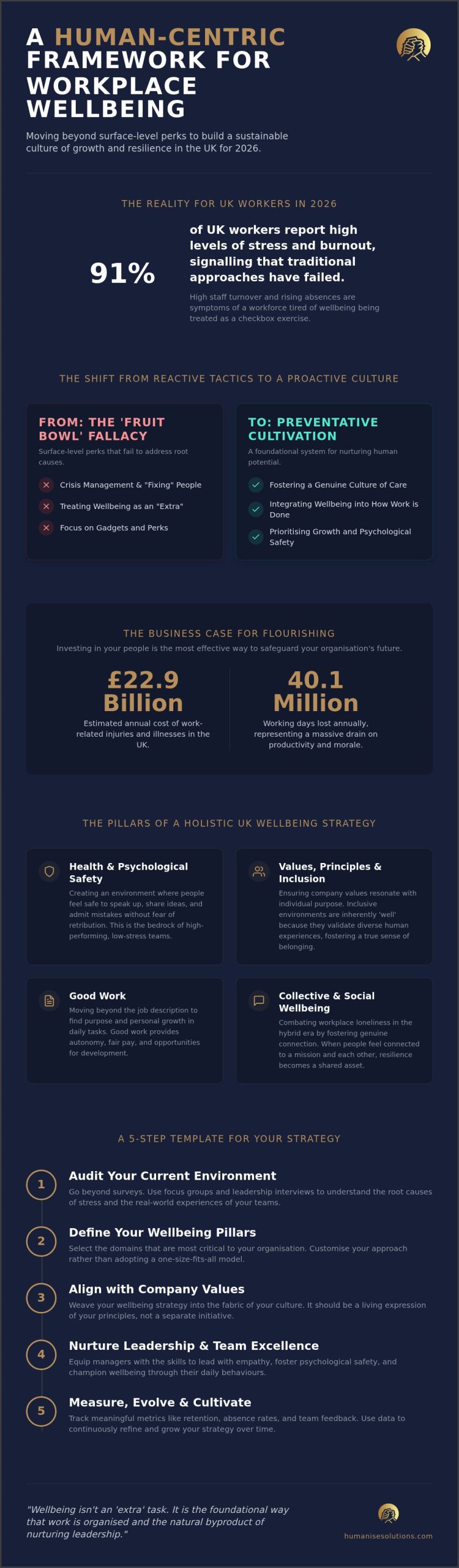
With 91% of UK workers reporting high levels of stress and burnout in 2026, it’s clear that the traditional office fruit bowl has failed to move the needle. You’ve likely seen the engagement fatigue firsthand, where surface-level perks are mistaken for a genuine culture of care. High staff turnover and rising absences aren’t just statistics; they’re signs of a workforce that’s tired of a workplace wellbeing strategy UK being treated as a checkbox exercise. We understand that the current climate feels overwhelming, especially as the Health and Safety Executive increases its focus on psychosocial risks.
There’s a path forward that feels both grounded and aspirational. This article will show you how to build a robust, evidence-based framework that moves from “fixing” people to fostering their natural potential for excellence. We’ll explore a human-centric template for 2026 that prioritises psychological safety, nurtures leadership, and transforms your organisational culture into a sustainable engine for growth.
Key Takeaways
- Understand the shift from reactive crisis management to a proactive culture of preventative cultivation that supports long-term growth.
- Discover how to implement a workplace wellbeing strategy UK that integrates holistic domains to foster genuine psychological safety.
- Learn why wellbeing isn’t an “extra” task on your to-do list, but rather the foundational way that work is organised and delivered.
- Follow a practical five-step template to audit your current environment and align your wellbeing pillars with your unique company values.
- Explore how nurturing leadership and team excellence serve as the primary drivers for improving retention and human flourishing.
What is a Workplace Wellbeing Strategy and Why Does it Matter in 2026?
A workplace wellbeing strategy UK is far more than a static document hidden in an HR folder. It is a proactive, long-term commitment to human flourishing. In 2026, we’ve moved past the era of “crisis management,” where businesses only react when an employee reaches a breaking point. Instead, we’ve entered the age of “preventative cultivation.” This approach treats the workplace as a living ecosystem where health is grown and nurtured, not just protected from harm.
The context of 2026 brings unique challenges that demand a deeper response. Whilst hybrid work offers flexibility, it has also birthed a new wave of digital fatigue and a profound hunger for genuine connection amongst colleagues. Workplace wellness is now the bridge that reconnects isolated teams and restores a sense of belonging. At Humanise Solutions, we view wellbeing as the natural byproduct of nurturing leadership. It isn’t a separate initiative to be added to a to-do list; it’s the beautiful result of how we lead, communicate, and value one another every day.
The ROI of Flourishing: Why British Firms are Investing
The business case for wellbeing has never been sharper. With 91% of UK workers reporting high levels of stress and burnout in 2026, the pressure on organisational stability is immense. Work-related injuries and illnesses in the UK cost an estimated £22.9 billion annually, leading to 40.1 million lost working days. These figures represent a massive drain on productivity and morale. Beyond the balance sheet, there’s a vital human element. Gen Z workers increasingly prioritise purpose and psychological safety. A robust strategy is often the deciding factor between long-term retention and a revolving door of talent. Investing in team excellence is the most effective way to safeguard your most valuable asset: your people.
Moving Beyond the ‘Fruit Bowl’ Fallacy
For too long, wellbeing was reduced to surface-level perks. Free fruit, Friday drinks, and occasional yoga sessions were often seen as sufficient. We call this the “fruit bowl fallacy.” These are tactical “nice-to-haves” that fail to address the root causes of stress, such as excessive workload or poor management behaviours. A true strategic shift requires moving from gadgets to growth. It means examining the very fabric of how work is organised and delivered. A human-centric strategy is one that prioritises growth over gadgets. It focuses on the internal qualities of resilience and confidence, ensuring that every team member feels seen, heard, and supported in their professional journey.
The 7 Essential Domains of a Holistic UK Wellbeing Strategy
While many organisations look at health in isolation, a truly effective workplace wellbeing strategy UK adopts a much wider lens. We build upon the CIPD’s holistic framework, yet we go further by viewing these domains through the lens of human connection and flourishing. “Good Work” isn’t just about a job description; it’s about finding purpose and personal growth within the daily flow of tasks. By prioritising “Collective and Social” wellbeing, we combat the growing epidemic of workplace loneliness that has intensified in the hybrid era. When people feel connected to a larger mission and to each other, their resilience becomes a shared asset rather than an individual burden.
Health and Psychological Safety
Safety isn’t merely the absence of physical hazards. It’s the presence of an environment where people feel safe to speak up, share ideas, or admit mistakes without fear of retribution. This psychological safety is the bedrock of evidence-based approaches to wellbeing. When teams trust one another, stress levels drop and performance soars. We see this transformation daily through our focus on Team Excellence, where groups move from guarded silos to open, collaborative units that support one another through challenges.
Values, Principles, and Inclusion
An organisation’s values shouldn’t just live on a website. They must resonate with the individual purpose of every employee. This alignment is particularly crucial for specialised tracks such as women leadership and underrepresented groups who may feel disconnected from traditional corporate structures. Inclusive environments are inherently “well” because they validate the human experience in all its diversity. When people feel they belong, they don’t just survive; they flourish. Nurturing leadership ensures these values are lived through every interaction, creating a culture where inclusion is the standard, not an initiative.
Young Adult Development and Social Mobility
The transition into the workforce is a high-pressure period, yet it is often overlooked in standard wellbeing policies. Young adults face unique stressors, from financial anxiety to a lack of professional confidence. Bridging this talent gap through social mobility training isn’t just a social good; it’s a strategic imperative. Our Young Adult Programmes provide the nurturing leadership and skills needed to build resilience from day one. By investing in the next generation, you’re not just filling roles; you’re cultivating the future health and excellence of your entire organisation.
Strategy vs. Tactics: Addressing the #1 Wellbeing Objection
One of the most common hurdles we encounter is the belief that there simply isn’t enough time or budget to implement a comprehensive workplace wellbeing strategy UK. This objection usually stems from a fundamental misunderstanding. Wellbeing isn’t an “extra” task to be squeezed into a busy Friday afternoon. It is the very way work is done. It’s the quality of your communication, the clarity of your expectations, and the respect shown in every interaction. When you view health as the foundation of productivity rather than a distraction from it, the budget argument begins to dissolve.
We often see a divide between tactical and strategic thinking. A tactical approach relies on one-off webinars or temporary perks that provide a fleeting boost but fail to address systemic issues. In contrast, a strategic approach focuses on nurturing leadership as the primary engine for health. By investing in the internal qualities of your people, you reduce the long-term need for expensive clinical interventions. Prevention is always more sustainable than a cure. It’s about building a culture where people feel empowered to do their best work because the environment supports their flourishing.
The Role of Line Managers as Wellbeing Gatekeepers
Line managers are the most critical link in any organisational chain. They are the daily gatekeepers of your culture. If a manager lacks the tools to lead with empathy and clarity, even the most expensive wellbeing policy will fail. This is why we prioritise middle management training. We help leaders transition from traditional command-and-control styles to a human-centric model that fosters resilience and confidence within their teams. When managers are equipped to support their people, the entire organisation benefits from improved morale and reduced stress.
Measuring What Matters: Beyond Employee Surveys
To truly understand the health of your organisation, you must move beyond once-a-year employee surveys. These static snapshots often miss the nuance of daily life and can lead to delayed responses. Instead, we encourage a shift towards real-time dialogue and more meaningful metrics. Look at your retention rates, internal promotion paths, and specific “flourishing” scores that track team excellence over time. These indicators provide a much clearer picture of how your workplace wellbeing strategy UK is performing on the ground. If you are unsure which data points will drive the most impact for your business, you can book a consultancy session to define your bespoke metrics.
A 5-Step Template for Your Workplace Wellbeing Strategy
Transforming your organisational culture requires a clear, actionable roadmap that moves beyond theory into lived experience. A successful workplace wellbeing strategy UK is not a “set and forget” policy; it’s a living framework that evolves with your people. By following this five-step template, you can transition from reactive measures to a culture of preventative cultivation where every team member has the opportunity to flourish.
Step 1: The Discovery Phase
Before you can build, you must listen. This initial stage is about gathering data whilst simultaneously building the trust required for honest dialogue. Move beyond the limitations of anonymous surveys by conducting “stay interviews” and small focus groups. These sessions help you understand why your best people choose to remain and what truly drains their energy. Using this data allows you to identify specific “hotspots” of stress or disengagement before they lead to burnout. True inclusion means hearing the unheard voices in the room, those who may not speak up in large meetings but hold vital insights into your culture. This deep listening ensures your strategy is rooted in reality rather than assumptions.
Step 2: Define Your ‘Human’ Pillars
Once you’ve gathered your insights, you must define the core pillars of your workplace wellbeing strategy UK. These shouldn’t be generic corporate goals; they must align directly with your company values. If your business prizes innovation, your pillars should reflect the psychological safety required to take risks. By anchoring your strategy in these human pillars, you ensure that wellbeing becomes a shared language amongst your staff, rather than a separate HR initiative.
Step 3: Leadership as the Engine
Any meaningful change must start with the board and senior leadership. Leaders are the primary engine of your strategy; their behaviours set the tone for the entire organisation. In 2026, the traditional “command and control” style is being replaced by a model of nurturing leadership. This approach focuses on coaching, empathy, and clarity rather than just oversight. When leaders model healthy boundaries and open communication, they give their teams permission to do the same. We invite you to explore our Nurturing leadership programmes to help your senior team lead this transition with confidence and heart.
Step 4: Launch Tailored Programmes
Generic solutions rarely solve specific problems. Step four involves launching bespoke tracks that address the unique needs of different groups within your firm. This might include specialised support for women leadership, dedicated Young Adult Programmes for those early in their careers, or intensive workshops focused on team excellence. Tailoring your approach shows your people that you see them as individuals with distinct professional journeys.
Step 5: Review, Refine, and Flourish
The final step is to establish continuous improvement cycles. Set regular intervals to review your metrics, from retention rates to “flourishing” scores, and refine your approach based on what’s working. This steady, methodical pace ensures that growth is sustainable and that your culture remains resilient in the face of future challenges. If you’re ready to build a foundation for team excellence, explore our Learning & Development tracks to begin your journey.
Nurturing the Future: How Humanise Solutions Can Help
Every organisation possesses a unique heartbeat. While a template provides the necessary structure, a living workplace wellbeing strategy UK requires a partner who understands the nuance of your specific culture. Humanise Solutions is not a traditional corporate consulting firm that delivers a sterile report and disappears. We act as a compassionate mentor and strategic partner, deeply invested in the transition from your current state to a future of human flourishing. We believe that meaningful change takes time, care, and a steady, methodical pace.
Bespoke Learning and Development
We reject the “off-the-shelf” approach because generic solutions fail to address the complex social dynamics of a modern workforce. Our Learning & Development workshops are tailored to your specific environment, ensuring that the skills we teach become a permanent part of your organisational fabric. We focus on long-term impact rather than one-day wonders. By concentrating on Team Excellence, we help you build a culture where wellbeing is a natural byproduct of how people interact. This approach nurtures internal qualities like resilience and confidence, providing your teams with the grounded expertise they need to navigate the challenges of 2026.
Our specialised tracks, such as our Women leadership programmes and our Young Adult Programmes, address the distinct needs of your diverse talent pool. These initiatives are essential components of a robust workplace wellbeing strategy UK. We help bridge the gap for those early in their careers and empower established leaders to lead with empathy and evidence-based confidence. This isn’t just about professional skills; it’s about fostering an environment where every individual feels they have the space to grow and the support to succeed. We provide the logical methodology that turns high-reaching goals into pragmatic, sustainable steps.
Your Next Steps to a Healthier Culture
The journey from a policy on a page to a thriving culture requires a deliberate first step. We invite you to move from theory to action by engaging in a collaborative dialogue with our experts. Our process is designed to be reassuring and thorough, ensuring you feel supported at every stage. We begin with a discovery call to understand your unique challenges, followed by the implementation of a bespoke programme, leading ultimately to sustainable flourishing across your firm. You don’t have to navigate these psychosocial risks alone. Start your journey with Humanise Solutions today and begin the vital work of cultivating a culture of excellence and psychological wellbeing.
Cultivating a Resilient Future
Building a sustainable workplace wellbeing strategy UK is a journey of transformation rather than a quick fix. It requires moving beyond surface-level perks to embrace a culture where psychological safety and team excellence are the standard. By focusing on nurturing leadership and the holistic domains of health, you create an environment where people don’t just survive; they truly flourish. The evidence is clear: when we prioritise the human experience, organisational excellence follows naturally.
As a national UK consultancy, we provide the grounded expertise and expert-led leadership workshops needed to turn these high-reaching goals into reality. Our evidence-based human-centric approach ensures that your development programmes are both aspirational and pragmatic. You have the power to redefine what work feels like for your people, moving from fatigue to steady progression. We invite you to cultivate a flourishing culture with Humanise Solutions. Together, we can build a workplace that celebrates growth, connection, and long-term resilience. The future of your organisation starts with the care you invest today.
Frequently Asked Questions
What should be included in a workplace wellbeing strategy UK?
A comprehensive workplace wellbeing strategy UK must include pillars covering physical health, mental health, social connection, and professional growth. It should align with your organisational values and include clear mechanisms for data collection, leadership training, and tailored support tracks. By integrating these elements, you move from reactive “perks” to a sustainable culture of care that supports every individual’s professional journey.
How do you measure the ROI of a wellbeing strategy?
Measuring the ROI involves tracking tangible metrics like reduced absenteeism, lower staff turnover, and improved productivity levels. You should also look at qualitative data, such as flourishing scores and internal promotion rates. Whilst financial savings from reduced sick pay are significant, the long-term value lies in the increased engagement and innovation of a resilient, confident workforce.
Is a wellbeing strategy a legal requirement for UK employers?
While a written strategy itself isn’t a specific statutory requirement, employers have a legal duty of care under the Health and Safety at Work etc. Act 1974. Additionally, the Management of Health and Safety at Work Regulations 1999 requires you to assess psychosocial risks like stress. In 2026, the HSE is increasing enforcement in these areas, making a formal workplace wellbeing strategy UK essential for legal compliance.
How does leadership impact employee wellbeing?
Leadership is the primary driver of wellbeing because managers set the daily tone for psychological safety and workload expectations. When leaders adopt a nurturing style, they reduce the stress associated with traditional command and control environments. Authentic leadership ensures that wellbeing isn’t just a policy but a lived experience, directly impacting team excellence and individual resilience.
What are the 7 domains of wellbeing according to the CIPD?
The CIPD identifies seven key domains: Health, Good Work, Values and Principles, Social and Collective, Personal Growth, Good Lifestyle, and Financial Wellbeing. A holistic strategy addresses all these areas to support the whole person. This framework ensures that your efforts aren’t siloed but instead create a comprehensive ecosystem for human flourishing and long-term professional success.
How can we support Gen Z wellbeing in the workplace?
Supporting Gen Z requires a focus on purpose, clear career progression, and psychological safety. This demographic values authentic connection and social mobility, making specialised tracks like Young Adult Programmes incredibly effective. By providing mentoring and resilience training early on, you address their unique stressors and build a foundation for long-term retention in a competitive market.
What is the difference between an EAP and a wellbeing strategy?
An Employee Assistance Programme (EAP) is a tactical tool providing reactive support, such as counselling, whilst a wellbeing strategy is a proactive, cultural framework. An EAP fixes problems after they occur; a strategy cultivates an environment that prevents those problems from arising. Both are valuable, but a strategy provides the long-term vision needed for sustainable organisational health.
How do we launch a wellbeing programme with a limited budget?
Launching on a budget starts with auditing your existing culture and prioritising leadership behaviours over expensive gadgets. You can foster wellbeing through simple shifts in communication, regular “stay interviews,” and peer-to-peer support groups. Focus on building psychological safety and trust first, as these foundational elements cost nothing but provide the highest return on human flourishing.