

Article by
Scott Ward MBA CCMI
Scott Ward is the founder and CEO of Humanise Solutions, which he established three years ago to help organisations elevate their people, leadership and culture through a human-centric, evidence-based approach. Before moving into business and academia, Scott spent seven years as a professional footballer, playing for Luton Town, Crawley Town and Coventry City FC until injury brought his playing career to a close — a turning point that shaped both his research interests and his approach to leadership.
Scott holds an MBA from Warwick Business School, where his research explored the causal relationship between trauma and decision-making — work that continues to inform how he supports young adults, leaders and teams under pressure. Recognised as a Companion of the Chartered Management Institute (CCMI), its highest grade of membership, he combines academic rigour with the discipline, resilience and team-first mindset of the professional game. At the heart of everything he does is a simple belief: that people perform at their best when they are led, developed and valued as human beings first.
What if the most effective way to lead wasn’t to hold the reins tighter, but to let them go? Many leaders today feel the exhausting weight of siloed departments and the mounting pressure of top-down decision-making, whilst watching engagement amongst Gen Z talent steadily decline. You likely recognise that the old command-and-control structures are no longer sustainable for a workforce facing burnout and a lack of diverse representation. Embracing collaborative leadership is the key to unlocking a more inclusive and resilient culture that truly thrives.
By shifting your focus from individual authority to collective intelligence, you can foster an environment where every voice contributes to team excellence. This article will show you how to transition towards a human-centric model that prioritises psychological safety and employee wellbeing. We’ll explore the practical steps needed to move from rigid hierarchies to a nurturing leadership style that ensures sustainable growth for both your people and your organisation.
Key Takeaways
- Understand the vital shift from the ‘Heroic Leader’ to a facilitative role that prioritises shared influence and collective intelligence.
- Discover why psychological safety acts as the invisible engine for team excellence by treating employees as whole individuals rather than just resources.
- Learn to reframe disagreement as creative friction and master the art of guiding meaningful conversations to foster innovation.
- Identify how to dismantle organisational silos and support ‘accidental leaders’ through the implementation of a robust collaborative leadership framework.
- Explore how bespoke development programmes can nurture authentic influence and resilience, creating a more inclusive and human-centric workplace culture.
What is Collaborative Leadership in the Modern Workplace?
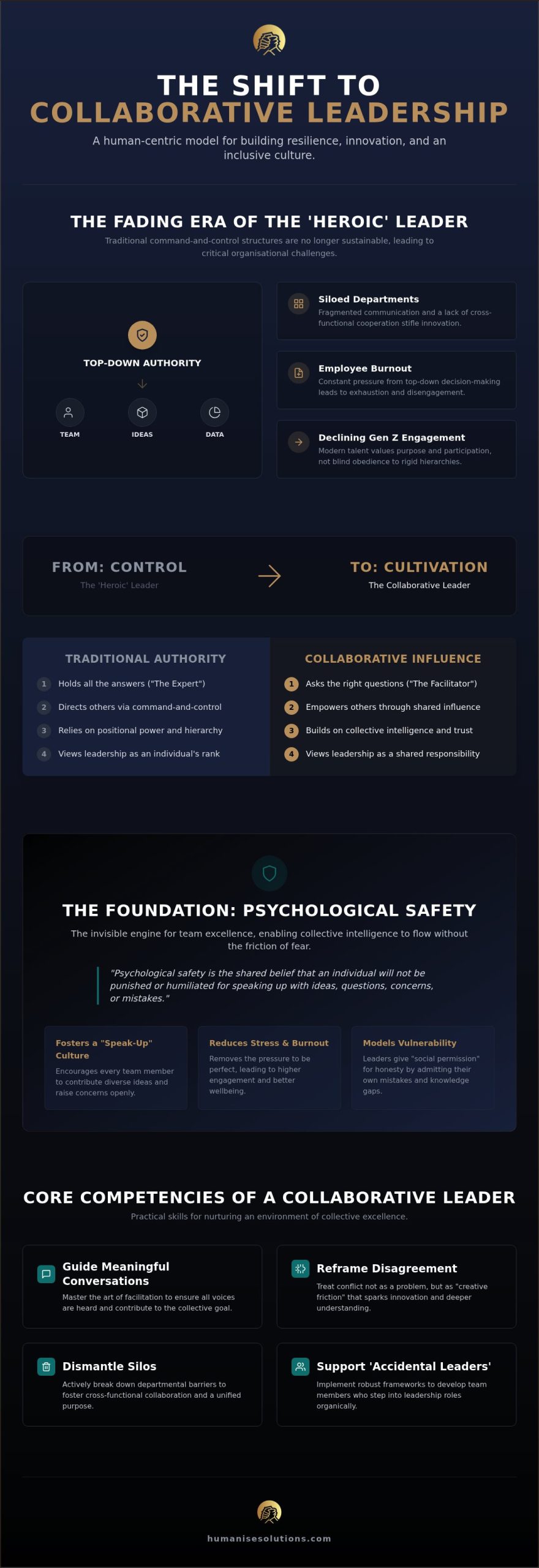
The era of the “Heroic Leader” is quietly fading into the background. In a world where complexity increases by the day, the idea that a single person at the top holds all the answers has become not just outdated, but dangerous. We are seeing a fundamental shift towards a more inclusive model that values the “we” over the “me”. At its heart, the definition of collaborative leadership centres on prioritising shared influence and collective intelligence over traditional positional authority. It’s about moving away from the rigid “command-and-control” structures that often stifle creativity and lead to the very burnout many teams are currently experiencing.
Traditional hierarchies are failing to retain modern talent, particularly amongst Gen Z professionals who value purpose and participation over blind obedience. When leadership is viewed as a shared responsibility rather than a badge of rank, organisational resilience grows. This approach ensures that a company doesn’t just survive uncertain times but actually learns and evolves through them. By fostering collaborative leadership, organisations can tap into a wealth of diverse perspectives that would otherwise remain silenced by the weight of top-down pressure. It’s a transition from directing others to empowering them.
The Evolution of Authority: From Control to Cultivation
The role of a leader has undergone a profound transformation. It’s no longer about being the loudest voice in the room or the one with the most expertise. Instead, modern authority is found in the ability to ask the right questions. As work becomes increasingly decentralised and digital networks replace physical office boundaries, the expectations of the workforce have changed. Leaders must now act as cultivators of talent. They need to create the conditions where multi-generational teams feel safe to contribute. This shift from control to cultivation is essential for managing the nuanced needs of today’s diverse employees, ensuring that every individual feels seen and heard whilst contributing to the collective goal.
Why Collaboration is a Strategic Necessity in 2026
As we look towards 2026, the challenges facing businesses are too multi-faceted for any one person to solve in isolation. Whether it’s navigating rapid technological change or addressing global sustainability, these problems require a blend of skills and viewpoints. Choosing collaborative leadership isn’t just a cultural adjustment; it’s a strategic imperative for driving agility. This model supports social mobility and inclusive growth by breaking down the barriers that historically kept certain voices out of the decision-making process. It allows for a more equitable distribution of power, which in turn fuels the innovation necessary to thrive in a competitive global market.
The Psychological Foundation: Wellbeing and Safety
True collaboration cannot be forced through a project management tool or a mandatory meeting invite. It requires a fertile soil of trust. Psychological safety serves as the invisible engine of any high-performing team, allowing collective intelligence to flow without the friction of fear. When we treat employees as whole individuals rather than just units of production, we create a human-centric environment where people feel safe to bring their best selves to work. This transition is fundamental to collaborative leadership, as it moves the focus from surveillance to support.
Psychological safety is the shared belief that an individual will not be punished or humiliated for speaking up with ideas, questions, concerns, or mistakes.
By adopting this approach, leaders naturally reduce workplace stress. When the pressure to be perfect is removed, burnout rates drop and engagement rises. This inclusive environment is the bedrock of sustainable professional development, ensuring that talent isn’t just recruited but nurtured over the long term. If you are looking to create such a culture, our work at Humanise Solutions focuses on fostering wellbeing through human-centric leadership practices that prioritise the person behind the professional.
Fostering Psychological Safety at Work
Building a “speak-up” culture requires more than just an open-door policy. It demands that leaders actively welcome diverse ideas and, perhaps more importantly, celebrate the learning that comes from mistakes. To build team trust, a leader must be willing to model vulnerability. Admitting when you don’t have the answer or acknowledging a personal error gives your team the “social permission” to do the same. This transparency is one of the core competencies of collaborative leaders that transforms a group of individuals into a cohesive unit.
Emotional Intelligence as a Leadership Anchor
Emotional intelligence serves as the anchor in the often-turbulent waters of team dynamics. It requires a high degree of self-awareness to recognise when your own “command-and-control” triggers are being pulled. Perhaps you feel a loss of control when a project timeline shifts, or you feel defensive when a junior team member questions a decision. Managing these internal reactions is vital for collaborative leadership to succeed. Active listening becomes your most powerful tool. By listening to understand rather than to respond, you demonstrate a level of empathy that validates your team’s experience and encourages deeper participation.
Core Competencies: How to Lead Collaboratively
Leading through collaboration requires a distinct set of interpersonal tools that go beyond the technical expertise often found in traditional management. It’s a shift from directing to facilitating. Instead of simply “running a meeting” to tick boxes, a collaborative leader focuses on “guiding a conversation” that invites genuine participation. This involves mastering the art of influence without authority. By relying on persuasion and consensus-building rather than rank, you create a culture where ideas are judged on their merit. Transparency plays a vital role here. Sharing information openly isn’t just a courtesy; it’s a strategic act that empowers others to make informed decisions independently.
Conflict resolution also takes on a new shape within this framework. Rather than viewing disagreement as a threat to be suppressed, it is embraced as a source of creative friction. This friction, when managed with empathy, often sparks the most innovative solutions because it forces the team to look past the obvious. These skills align with the Center for Creative Leadership model for collaborative leadership, which emphasises the need for leaders to adapt and thrive by leveraging collective strengths. Mastering these competencies is what allows a group to transition from a collection of individuals to a high-performing unit.
Communication as a Tool for Connection
Relational dialogue is the heartbeat of a successful team. Moving beyond transactional communication, where information is merely exchanged, allows for deeper connection and psychological safety. Using “we” instead of “I” builds a shared sense of purpose and reinforces that collaborative leadership is a collective journey. Establishing regular feedback loops ensures that learning is continuous and that mistakes are viewed as data points for improvement. This approach doesn’t just solve immediate problems; it nurtures long-term team excellence by making growth a daily habit amongst all members.
Facilitating Collective Intelligence
Unlocking the full potential of a group requires intentional techniques to ensure every voice is heard. This is particularly important for including quieter team members whose insights might otherwise be lost in a traditional hierarchy. A leader’s role is to synthesise these diverse perspectives into a cohesive strategic plan that everyone feels ownership over. It requires genuine curiosity and a willingness to be surprised. By asking questions rather than making declarations, you uncover hidden talent and foster an environment where collaborative leadership can truly flourish and drive sustainable success.
Overcoming the Barriers to Collaborative Excellence
Transitioning to a more inclusive way of working is rarely a linear path. It requires dismantling deeply ingrained habits that have been reinforced by decades of traditional management theory. One of the most significant hurdles is the presence of organisational silos. These are not just structural divisions between departments; they are psychological barriers that prevent the flow of collective intelligence. When information is guarded rather than shared, the entire team loses its ability to respond with agility to external changes.
We must also address the “Accidental Leader” syndrome. Many individuals are promoted into management roles based on their technical brilliance whilst receiving little support for the human-centric skills required to lead. Without proper guidance, these leaders often fall back on a command-and-control style simply because it feels safer. This reliance on authority is frequently tied to the ego. Letting go of control can feel like a loss of status, yet it is the only way to allow collaborative leadership to take root. By managing our own needs for validation, we create space for others to flourish.
There is also the persistent “time myth” to consider. Many leaders resist collaboration because they believe it is too slow. Whilst a top-down decision might be faster in the immediate moment, it often leads to significant rework, resistance, and a lack of buy-in later. True collaboration saves time in the long run by ensuring that the solution is robust and that the team is fully aligned from the start. If your organisation is ready to move past these hurdles, our bespoke programmes for nurturing leadership provide the logic and methodology needed to sustain this transformation.
Dismantling the Heroic Leader Myth
The cultural pressure to have all the answers is a primary driver of leader burnout. When you carry the weight of every decision, your capacity for strategic thinking diminishes. Redefining success from individual achievement to team performance is vital. This shift allows you to transition from “directing” to “coaching”. By focusing on the growth of your people, you move away from being the bottleneck of the organisation and instead become the catalyst for its collective success.
Navigating Resistance to Change
Resistance is often a mask for fear. In traditional organisations, people may fear that sharing power will lead to a loss of security or relevance. To counter this, it is essential to build “collaboration champions” at every level. These are individuals who model the benefits of collaborative leadership in their daily interactions. Cultural transformation is a methodical process that requires patience. It isn’t about a single grand gesture but rather a series of steady, deliberate steps that build trust and demonstrate the tangible value of a more connected workplace.
Cultivating Collaborative Leadership with Humanise Solutions
Developing the capacity for collaborative leadership is not a task that can be completed in a single afternoon. It is a continuous process of growth that requires both an open heart and a disciplined mind. At Humanise Solutions, we don’t believe in generic, off-the-shelf solutions that ignore the unique pulse of your organisation. Instead, we partner with you to co-create a journey that feels deeply personal whilst remaining rooted in logic and proven methodology. Our approach is designed to move beyond the surface, addressing the underlying human dynamics that either fuel or frustrate team excellence. We focus on the transition from current states to future potential, ensuring every step is methodical and thorough.
We recognise that different stages of a career require different types of support. This is why we offer specialised tracks, such as our programmes for women in leadership, which focus on leading with authentic influence and resilience. Similarly, our Young Adult Programmes are crafted to equip the next generation with a collaborative mindset before they even step into their first management role. By nurturing these qualities early, we help build a foundation for long-term sustainability and inclusive growth. These tracks are expert-led and focused on human flourishing, ensuring that leadership development is a transformative experience rather than a mere box-ticking exercise.
Nurturing Leadership Through Bespoke Programmes
One-size-fits-all training often fails because it ignores the specific culture and challenges of your team. Our bespoke development programmes are different. We integrate wellbeing into every layer of our framework, ensuring that as your leaders grow, they also become more resilient and confident in their roles. We focus on long-term development rather than one-off workshops, as meaningful change takes time and care. This sustained engagement allows for deep behavioural change, moving leaders from a place of command to a place of genuine facilitation and support. It’s about cultivating the internal qualities that allow a leader to thrive amongst their peers.
Building Team Excellence for Sustainable Growth
When collaborative leadership becomes the norm, the impact on employee retention and engagement is profound. People stay where they feel heard, valued, and safe. Team excellence isn’t something that can be demanded; it is the natural outcome of authentic human connection and shared purpose. By fostering an environment of psychological safety and collective intelligence, you create a culture that is not only more productive but also more resilient in the face of change. This approach ensures that your organisation is built for the long term, with a workforce that feels deeply invested in the collective success of the business. Discover how Humanise Solutions can transform your leadership culture and help your team reach its full potential.
Embracing the Future of Human-Centric Leadership
Transitioning towards a model of collaborative leadership is a profound journey of transformation that replaces the isolation of command with the strength of connection. By prioritising psychological safety and dismantling organisational silos, you unlock the collective intelligence that already exists within your team. This shift doesn’t just improve performance; it nurtures a culture where every individual can flourish and find genuine meaning in their work. We’ve explored how the facilitative approach reduces burnout whilst driving innovation through shared influence.
True excellence is found when we stop directing and start facilitating. Through specialised programmes for Women in Leadership and our expert-led Team Excellence workshops, we champion a human-centric approach focused on fostering wellbeing. Sustainable growth is built on the foundation of trust, ensuring your organisation remains resilient in an ever-changing landscape. We invite you to enquire about our bespoke Leadership Development Programmes to begin your own journey of cultivation. Together, we can create a workplace where leadership is a shared gift and every voice contributes to a brighter, more inclusive future.
Frequently Asked Questions
What is the primary difference between collaborative and traditional leadership?
The primary difference lies in the source of influence; traditional leadership relies on positional authority and top-down control, whilst collaborative leadership thrives on shared influence and collective intelligence. In traditional models, the leader is the sole decision-maker. In a collaborative framework, the leader acts as a facilitator who empowers the team to contribute their diverse expertise. This shift moves the focus from individual power to the collective strength and wisdom of the entire group.
Does collaborative leadership mean making every decision by consensus?
No, it doesn’t mean every decision requires a unanimous vote or total consensus. Instead, it’s about ensuring the right voices are heard and the best information is gathered before a path is chosen. The leader still maintains accountability for the final outcome but arrives there through a transparent process of consultation. This approach prevents the decision paralysis that can occur when groups struggle to agree on every minor detail or operational task.
How can collaborative leadership improve employee wellbeing?
This model improves wellbeing by reducing the isolated pressure on individual leaders and fostering a high level of psychological safety for the team. When employees feel their voices matter and their contributions are valued, engagement naturally rises and stress levels drop. By treating people as whole individuals rather than just resources, organisations can significantly lower burnout rates. It creates a nurturing environment where collective support replaces top-down pressure, aiding long-term human flourishing.
What are the most common mistakes leaders make when trying to collaborate?
One common mistake is confusing collaboration with a total lack of direction, which can lead to confusion and a loss of momentum. Leaders also often struggle with pseudo-collaboration, where they ask for input but have already made the decision. Another frequent error is failing to model the vulnerability required to build trust. Without genuine transparency from the top, team members may remain hesitant to share their true perspectives or admit to mistakes during the process.
How do you measure the success of a collaborative leadership model?
Success is measured through a combination of increased employee engagement scores, higher retention rates, and improved innovation cycles. You should also look for qualitative shifts, such as an increase in cross-departmental initiatives and a higher frequency of team members speaking up in meetings. When collaborative leadership is effective, the organisation becomes more agile, responding to challenges with collective intelligence rather than waiting for a single point of command to provide every answer.
Can collaborative leadership work in a remote or hybrid team environment?
Yes, it is highly effective in remote or hybrid settings, though it requires more intentional communication to maintain social connection. Digital tools must be used to facilitate transparent information sharing and to ensure that out of sight doesn’t mean out of mind. Leaders in these environments need to be extra vigilant about fostering psychological safety. Regular virtual check-ins and shared digital workspaces help keep the spirit of collaboration alive across different locations.
How does collaborative leadership support diversity and inclusion?
It supports diversity by moving beyond mere representation to active participation, where diverse perspectives are intentionally sought and valued. In a collaborative environment, the Heroic Leader myth is dismantled, making room for voices that might have been marginalised in traditional hierarchies. This inclusive approach ensures that different life experiences and viewpoints are integrated into the strategic process. It fosters a culture where belonging is a lived reality rather than just a corporate policy.
Is collaborative leadership suitable for all types of organisations?
Whilst the specific application may vary, the core principles of trust and shared intelligence are beneficial across almost every sector. Even in highly regulated or emergency environments, fostering a culture of mutual respect and open communication can improve team excellence. The degree of collaboration might shift depending on the urgency of the situation, but the underlying human-centric foundation remains a powerful tool for long-term organisational resilience and sustainable growth.
