

Article by
Scott Ward MBA CCMI
Scott Ward is the founder and CEO of Humanise Solutions, which he established three years ago to help organisations elevate their people, leadership and culture through a human-centric, evidence-based approach. Before moving into business and academia, Scott spent seven years as a professional footballer, playing for Luton Town, Crawley Town and Coventry City FC until injury brought his playing career to a close — a turning point that shaped both his research interests and his approach to leadership.
Scott holds an MBA from Warwick Business School, where his research explored the causal relationship between trauma and decision-making — work that continues to inform how he supports young adults, leaders and teams under pressure. Recognised as a Companion of the Chartered Management Institute (CCMI), its highest grade of membership, he combines academic rigour with the discipline, resilience and team-first mindset of the professional game. At the heart of everything he does is a simple belief: that people perform at their best when they are led, developed and valued as human beings first.
What if the drive that makes your talent successful is also the thing pushing them toward the exit? With 66% of employees reporting burnout in 2026, it’s clear that the traditional push for results often comes at a heavy cost to human flourishing. You’ve likely noticed that generic perks fail to spark real engagement, whilst the pressure to prove a tangible return on your training spend only intensifies. We believe that sustainable excellence is a byproduct of wellbeing, not a trade-off for it. Integrating bespoke staff wellbeing and performance training allows you to bridge this gap, creating a culture where high performance is nurtured rather than forced.
In this article, you’ll discover how a human-centric approach to development creates lasting organisational growth and reduces recruitment costs by boosting retention. We will examine a specific case study that demonstrates the power of psychological safety and nurturing leadership in action. You’ll see exactly how a shift in perspective can transform a struggling team into a resilient, high-performing workforce that feels valued and empowered.
Key Takeaways
- Understand why generic wellbeing perks fail and how the 2026 professional landscape demands a deeper integration of psychological health and performance.
- Learn how bespoke staff wellbeing and performance training drives deeper cultural shifts and higher retention compared to generic, one-size-fits-all digital platforms.
- Explore a real-world case study of a UK firm that overcame stagnant growth and high turnover by implementing ‘Team Excellence’ and ‘Nurturing Leadership’ programmes.
- Master a structured approach to aligning your wellbeing strategy with commercial goals, ensuring your investment in human flourishing yields measurable organisational results.
- Discover the transformative power of specialist mentorship and empathetic leadership in building a workplace culture rooted in psychological safety and resilience.
The Evolution of Staff Wellbeing and Performance Training in 2026
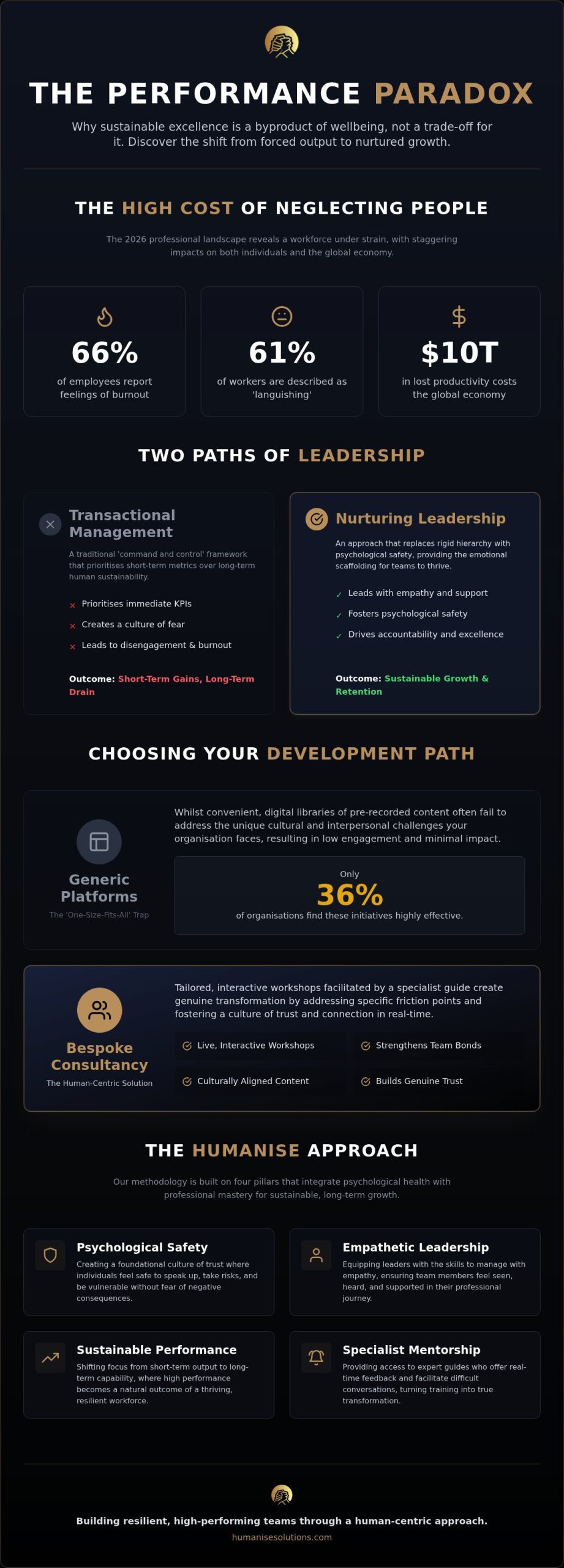
The landscape of professional growth has undergone a radical transformation. For decades, businesses viewed employee health and commercial output as two separate balance sheets. We’ve seen the evolution of workplace wellness move from basic safety standards to the era of ‘perks and yoga’, yet the latter has largely failed to stem the tide of systemic burnout. In 2026, with 66% of employees reporting feelings of exhaustion and 61% of workers described as ‘languishing’, the need for a more integrated approach is undeniable. True staff wellbeing and performance training now sits at the intersection of psychological health and professional mastery. Performance training is a methodical process of cultivating internal resilience and external excellence, ensuring that professional output is supported by personal vitality.
From Transactional Management to Nurturing Leadership
Traditional management often relies on a ‘command and control’ framework that prioritises immediate KPIs over long-term human sustainability. This transactional style might yield short-term gains, but it frequently leaves a trail of disengagement and fear in its wake. We advocate for a shift toward nurturing leadership, an approach that replaces rigid hierarchy with psychological safety. By leading with empathy, you don’t lower the bar; you provide the emotional scaffolding required for teams to reach it. This creates a culture of accountability where people strive for excellence because they feel seen and supported, rather than simply avoiding the consequences of failure.
The True Cost of Neglecting Staff Development
The financial implications of a disengaged workforce are staggering. Globally, lost productivity costs the economy an estimated $10 trillion, a figure driven by the growing gap between employee experience and organisational expectations. When high-performers feel their growth is stagnant or their wellbeing is ignored, they don’t just leave; they often ‘quiet quit’, remaining on the payroll whilst withdrawing their creative energy. Generic, one-size-fits-all training modules rarely stick in high-pressure environments because they lack the nuance of human connection. Investing in bespoke staff wellbeing and performance training addresses these systemic leaks, fostering the social bonds and internal confidence that drive sustainable organisational growth.
Bespoke Consultancy vs. Generic Platforms: Choosing Your Path
Many leaders feel pressured to tick the wellbeing box quickly. This urgency often leads to the adoption of generic digital platforms. Whilst these libraries of pre-recorded videos offer convenience, they often fail to engage the people who need them most. A 2026 survey revealed that only 36% of organisations found their wellbeing initiatives highly effective. This decline suggests that the “one-size-fits-all” approach is losing its potency. When staff wellbeing and performance training is reduced to a login and a password, it loses the human resonance required for genuine change.
True transformation requires a mirror, not just a map. Generic content cannot see the specific dynamics of your boardroom or the silent friction within your creative team. It lacks the nuance to align with your unique organisational values. Red flags in traditional corporate consulting often include a detached, sterile tone that treats your employees as data points rather than people. We believe in a different path. By designing a workplace wellbeing strategy that is bespoke, you ensure the training speaks the language of your culture.
The Power of Human-Centric Learning and Development
Live interaction is the heartbeat of psychological safety. It’s impossible to build trust with a pre-recorded video. Tailored workshops allow a visionary guide to facilitate difficult conversations and address friction points in real-time. This human-centric approach to Learning & Development ensures that every participant feels heard and valued. It turns training from a passive chore into an active, social experience that strengthens the bonds between colleagues. This connection is essential for fostering a resilient environment where talent can actually flourish.
ROI: Measuring the Impact of Bespoke Training
Proving the value of training spend is a constant challenge. Move beyond “happy sheets” that only measure immediate satisfaction. Instead, track long-term performance metrics like reduced absenteeism and internal promotion rates. Data from 2026 shows that 49% of organisations reported improved employee retention as a direct outcome of effective wellbeing programmes. Bespoke interventions often lead to even deeper shifts because they address the root causes of turnover specific to your firm. For a comprehensive look at how to drive employee retention through wellbeing, our strategic guide explores the most effective approaches for modern British organisations. By focusing on sustainable growth, you reduce the significant costs associated with recruitment and onboarding. This makes the investment in human flourishing a clear driver of commercial success.
Case Study: Achieving Team Excellence Through Integrated Wellbeing
A London-based professional services firm found itself at a crossroads. Despite hiring top-tier talent, they faced a 30% staff turnover rate and stagnant commercial growth. The atmosphere was one of quiet exhaustion. High-performers were delivering results, but they were doing so at the cost of their long-term health. They realised that a standard training day wouldn’t suffice. They needed a deep, integrated strategy. By implementing a multi-phase staff wellbeing and performance training programme, they began the journey from fragmented silos to a culture of genuine Team Excellence.
This transformation wasn’t instant. It required a methodical shift in how the firm defined success. The Humanise Approach highlights that when you prioritise the person behind the professional, productivity follows as a natural consequence. The firm moved away from transactional management, opting instead for Nurturing Leadership. This shift allowed for a measurable increase in innovation. Employees who once felt like cogs in a machine began to contribute ideas that drove the business forward. It wasn’t just about feeling better; it was about performing better.
Phase 1: Diagnosis and Psychological Safety
The first step involved a thorough diagnosis of the firm’s internal dynamics. Through specialist consultancy, we identified that a lack of psychological safety was the primary driver of performance dips. People were afraid to admit mistakes or suggest bold ideas for fear of judgment. Establishing a “safe space” was vital. This allowed for honest professional growth and laid the foundation for the upcoming changes. You can read more about building these foundations in our guide on Psychological Safety at Work. We focused on identifying the specific friction points that caused talent to disengage and addressed them through open, facilitated dialogue.
Phase 2: Empowering Leadership and Personal Growth
Once safety was established, the focus shifted to individual development tracks. Our ‘Women in Leadership’ training unlocked hidden potential amongst the senior team, fostering a more inclusive and visionary leadership style. Simultaneously, ‘Young Adult Programmes’ were introduced to support the newest members of the workforce. These sessions focused on building evidence-based confidence, helping young professionals move from anxiety to aspirational goal-setting. This holistic approach to staff wellbeing and performance training ensured that every level of the organisation felt empowered to excel. By focusing on internal qualities like resilience, the firm saw a marked decrease in recruitment costs and a renewed sense of collective purpose.
Designing a Workplace Wellbeing Strategy for Sustainable Performance
Building a strategy that lasts requires more than a checklist. It demands a fundamental shift in how you view your people. The most successful organisations in 2026 are those that move away from standalone initiatives. Instead, they integrate wellbeing into the very fabric of their commercial objectives. This isn’t just about reducing stress; it’s about creating an environment where high-level staff wellbeing and performance training becomes a catalyst for sustainable growth. When professional development is rooted in human flourishing, the results are both measurable and enduring.
To achieve this, follow these five essential steps:
- Step 1: Alignment. Ensure your wellbeing goals directly support your commercial performance objectives. If your aim is innovation, focus on psychological safety.
- Step 2: Cohort Identification. Recognise that a Senior Executive facing high-stakes pressure has different needs than a Gen Z recruit starting their first role.
- Step 3: Partner Selection. Choose a development partner who prioritises human flourishing over sterile KPIs. Look for specialist mentorship that feels like a partnership.
- Step 4: Integration. Embed learning into the daily rhythm of the organisation. This specific staff wellbeing and performance training shouldn’t be an interruption; it should be an evolution of how you work.
- Step 5: Monitoring. Continually refine your approach by monitoring social dynamics and gathering honest feedback through open dialogue.
Cultivating an Inclusive Team Culture
Diversity and inclusion are often relegated to HR box-ticking, yet they are powerful performance multipliers. When a team feels truly inclusive, the collective intelligence of the group rises. Collaborative leadership plays a vital role here, ensuring that every voice is heard and valued. By organising peer-to-peer support networks within your training framework, you create a self-sustaining ecosystem of care and accountability. This strengthens the social bonds that are essential for long-term Team Excellence and resilience.
Supporting Young Adults and Early Careers
Bridging the gap for Gen Z requires a specific focus on mentorship and workforce readiness. Many young professionals are entering a workplace that feels increasingly complex and demanding. Social mobility training acts as a vital tool for widening your talent pool, ensuring that you aren’t just hiring for past experience but for future potential. Our Young Adult Professional Development pillar focuses on building the foundational resilience needed to thrive in a modern professional environment. By investing in the next generation now, you secure the future of your organisation.
Ready to transform your workplace culture? Explore our bespoke Learning & Development programmes to start your journey toward sustainable growth.
The Humanise Approach: Fostering Growth Through Specialist Mentorship
Traditional corporate consulting often feels like a clinical audit. It relies on sterile jargon and detached observations that treat your workforce as a collection of data points rather than a community of individuals. We choose a different path. Humanise Solutions operates with a philosophy of empathetic warmth, replacing the distant consultant role with that of a visionary guide. Our methodology is built on the belief that meaningful change requires a partner who is deeply invested in your team’s flourishing. By moving away from rigid, pre-packaged solutions, we create a space where genuine professional evolution can take place.
Our bespoke staff wellbeing and performance training doesn’t just address immediate friction; it cultivates long-term resilience and confidence. We focus on the internal qualities that allow a person to thrive under pressure, ensuring that excellence becomes a sustainable habit rather than a fleeting effort. As you look toward your organisational goals for 2026, the next step is to design a development roadmap that reflects your unique culture. This involves a transition from managing tasks to nurturing the human potential that drives those tasks forward.
Nurturing Leadership for the Future
Leadership is the cornerstone of any cultural transformation. We provide bespoke leadership tracks designed for both senior executives and middle management, focusing on the principles of Nurturing Leadership. Instead of viewing wellbeing as a separate initiative, we integrate it directly into leadership performance metrics. This ensures that managers are equipped to support their teams whilst maintaining high standards of accountability. The Humanise promise is one of sustainable change. Through human-centric design, we help you build a leadership pipeline that is resilient, empathetic, and prepared for the complexities of the modern workplace.
Partnering for Team Excellence
A partnership with Humanise Solutions is a collaborative journey toward Team Excellence. We don’t dictate from a distance; we work alongside you to understand the social dynamics and individual needs of your workforce. Whether you are looking to support your newest recruits through our Young Adult Programmes or empower your senior talent through specialised Women Leadership tracks, our approach remains grounded in logic and methodology. We invite you to book a discovery session to assess your team’s specific development needs and explore how a tailored intervention can yield measurable growth.
Discover how our bespoke programmes can transform your team excellence and help you build a culture where both your people and your business can truly flourish.
Cultivating Your Organisation’s Future Potential
Sustainable growth is no longer a choice between employee health and commercial success. It’s a recognition that they’re one and the same. By moving away from generic digital platforms and embracing bespoke staff wellbeing and performance training, you create a workplace where talent doesn’t just stay; it flourishes. We’ve explored how replacing sterile corporate silos with psychological safety and nurturing leadership can turn stagnant results into vibrant innovation. True excellence is built on a foundation of internal resilience and deep social connection.
Our evidence-based methodology is specifically designed for UK firms that value human flourishing as a primary performance driver. Through expert-led workshops and specialist mentorship, we help you bridge the gap between current challenges and future potential. It’s time to move beyond transactional management and start building a culture that supports every individual in your team. Your journey toward a more resilient, high-performing workforce begins with a single, meaningful conversation. Book a Discovery Session with Humanise Solutions to start designing your bespoke development roadmap today. We’re here to guide you toward a future where both your people and your business thrive.
Frequently Asked Questions
What is the difference between wellbeing training and performance coaching?
Wellbeing training focuses on the internal resilience and psychological health of the individual, whilst performance coaching traditionally targets external output and skill acquisition. Our integrated approach treats these as inseparable. We believe that sustainable performance is a byproduct of human flourishing. By combining these elements, we ensure that high standards are met without compromising the mental vitality of your team members.
How can we measure the ROI of staff wellbeing and performance training?
Measuring the impact involves tracking tangible metrics like reduced staff turnover and lower absenteeism. In 2026, reports showed that effective wellbeing initiatives improved retention by 49% in many organisations. You should also monitor qualitative shifts, such as increased innovation and improved social dynamics. These indicators prove that staff wellbeing and performance training delivers a clear commercial return by protecting your most valuable assets.
Does wellbeing training actually reduce staff turnover in the UK?
Yes, targeted interventions significantly reduce recruitment costs by keeping talent engaged and valued. With 66% of employees reporting burnout in 2026, addressing the root causes of exhaustion is vital for retention in the UK. When people feel nurtured and psychologically safe, they’re far less likely to seek opportunities elsewhere. This stability allows for steady organisational growth and preserves vital institutional knowledge.
How do bespoke development programmes cater to different age groups, such as Gen Z?
Bespoke programmes address the unique expectations of younger talent by prioritising mentorship and workforce readiness. Gen Z often seeks a deeper sense of purpose and holistic support than generic digital libraries can provide. Our tracks for young adults focus on building confidence and resilience in a modern professional context. This tailored support helps bridge the gap between academic theory and the high-pressure realities of professional life.
Can wellbeing training help with psychological safety in high-pressure teams?
Training is a powerful tool for building the trust required for teams to excel under significant pressure. It creates an environment where people feel safe to voice concerns or admit mistakes without fear of judgment. This openness is essential for innovation and collective problem-solving. By fostering a culture of mutual respect, you ensure that high-pressure situations become opportunities for growth rather than catalysts for burnout.
What should I look for in a leadership development consultant?
Look for a partner who acts as a visionary guide rather than a distant, sterile expert. They should display high emotional intelligence and a deep commitment to nurturing leadership. Ensure their methodology is evidence-based and tailored to your specific organisational values. A good consultant doesn’t just deliver a workshop; they invest in the long-term flourishing of your management team and their direct reports.
How long does it take to see results from a staff wellbeing programme?
Cultural shifts are methodical and require patience to become permanent. Whilst you might see an immediate improvement in team morale following a workshop, commercial impacts like lower turnover usually manifest over six to twelve months. Meaningful change takes time to embed into the daily rhythm of an organisation. Consistent application of these principles ensures that the growth you achieve is sustainable for the long term.
Is bespoke training more expensive than off-the-shelf LMS platforms?
Bespoke staff wellbeing and performance training is an investment in targeted, human-led transformation. Whilst off-the-shelf LMS platforms might seem convenient, they often suffer from low engagement and fail to address the specific friction points in your team. Tailored consultancy ensures that every minute of training is relevant to your commercial goals. This precision reduces the waste of resources on generic content that your talent may never actually use.
