Article by
Scott Ward MBA CCMI
Scott Ward is the founder and CEO of Humanise Solutions, which he established three years ago to help organisations elevate their people, leadership and culture through a human-centric, evidence-based approach. Before moving into business and academia, Scott spent seven years as a professional footballer, playing for Luton Town, Crawley Town and Coventry City FC until injury brought his playing career to a close — a turning point that shaped both his research interests and his approach to leadership.
Scott holds an MBA from Warwick Business School, where his research explored the causal relationship between trauma and decision-making — work that continues to inform how he supports young adults, leaders and teams under pressure. Recognised as a Companion of the Chartered Management Institute (CCMI), its highest grade of membership, he combines academic rigour with the discipline, resilience and team-first mindset of the professional game. At the heart of everything he does is a simple belief: that people perform at their best when they are led, developed and valued as human beings first.
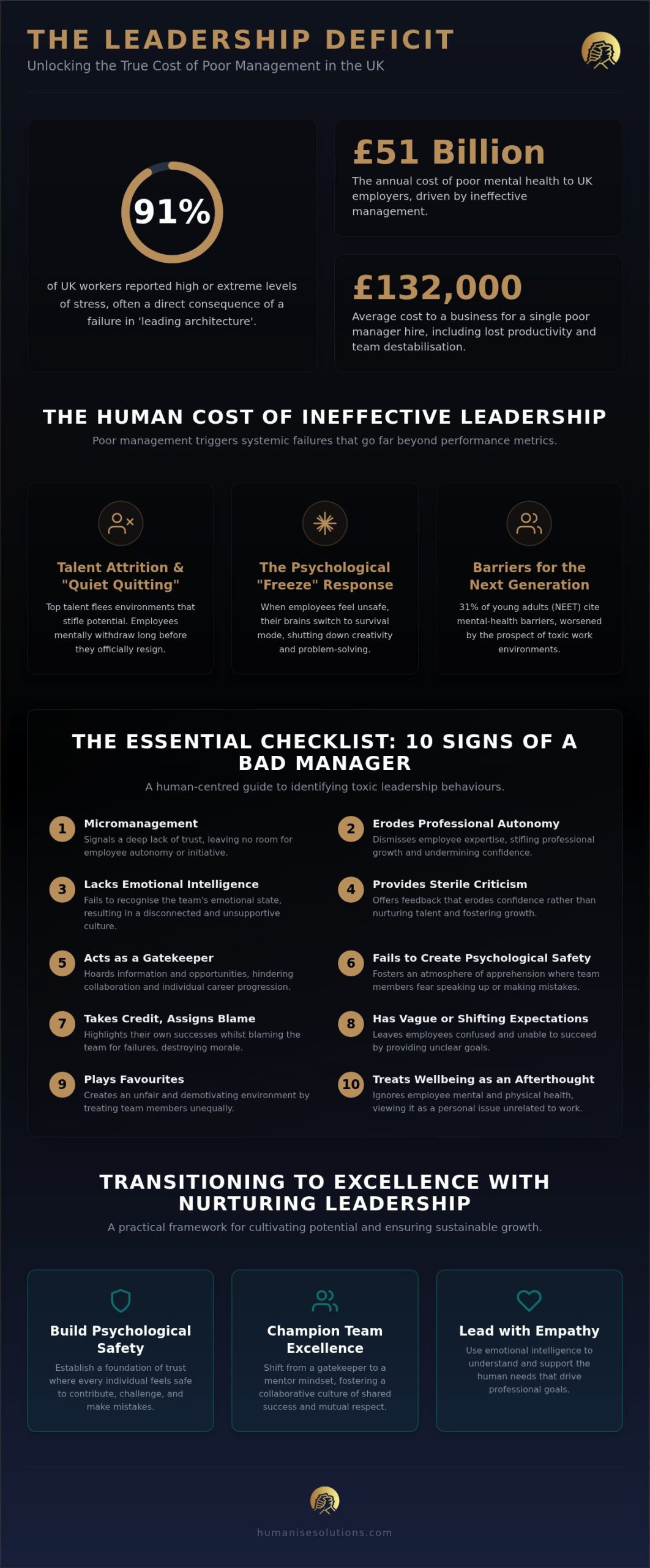
Did you know that 91% of UK workers reported experiencing high or extreme levels of stress in 2026? This staggering figure isn’t just a reflection of heavy workloads; it’s often a direct consequence of a failure in leading architecture. You might find yourself questioning whether your exhaustion is a personal failing or a symptom of a deeper systemic issue. It’s a common struggle to distinguish between healthy professional challenges and the toxic pressure that leads to burnout. Identifying the signs of a bad manager uk is the first step toward reclaiming your psychological well-being and professional confidence.
We understand how isolating it feels to be unsupported in your career growth whilst being expected to deliver peak performance. You deserve a workplace that prioritises human flourishing over sterile metrics. This article promises to validate your experiences by uncovering the psychological and professional warning signs of poor management. We’ll provide a human-centred checklist to help you assess your situation objectively. By the end, you’ll have a clear framework for fostering nurturing leadership and actionable steps to ensure your potential is cultivated rather than crushed.
Key Takeaways
- Understand how a manager’s emotional intelligence and decision-making processes directly shape your daily mental health and the wider team culture.
- Identify the primary signs of a bad manager uk through a human-centred checklist that highlights behaviours like micromanagement and the erosion of professional autonomy.
- Discover the systemic link between poor management and broader social challenges, including the rise in mental-health barriers for young adults entering the workforce.
- Learn how to transition from traditional, high-pressure management to a model of Nurturing Leadership that prioritises sustainable growth and psychological safety.
- Gain a practical framework for assessing management quality, allowing you to align your career development with a culture of Team Excellence and mutual respect.
Recognising the Impact of Poor Management in the UK Workplace
Your daily experience at work is rarely defined by the company’s mission statement or the colour of the office walls. Instead, it’s shaped by the person you report to. Management quality is the single most significant factor dictating an employee’s mental health, yet many organisations treat it as a secondary concern. Recognising the signs of a bad manager uk isn’t about complaining; it’s about identifying where the leading architecture of a business has begun to crumble.
When leadership is absent or aggressive, the atmosphere becomes heavy with apprehension. This isn’t just an emotional burden. The financial consequences are stark, with the annual cost of poor mental health to UK employers reaching £51 billion. Employees don’t just “quit” their jobs; they often withdraw long before they hand in their notice. This “quiet quitting” trend is a direct response to toxic leadership, where individuals feel their contributions are invisible and their wellbeing is an afterthought.
The Hidden Cost of Talent Attrition
Top talent rarely leaves because of the work itself. They leave when they feel their potential is being stifled rather than cultivated. A poor hire at a manager level can cost a UK business an average of £132,000, factoring in lost productivity and the destabilising impact on the remaining team. Without a focus on nurturing leadership skills, organisations face a revolving door of talent. We believe that sustainable growth requires a framework of Team Excellence where leaders act as mentors rather than gatekeepers.
Wellbeing as a Business Metric
Effective management style directly influences psychological safety and employee resilience. It’s no longer enough to offer perks; real support must be woven into the daily interaction between manager and employee. If you’re spotting the signs of a bad manager uk, you’re likely witnessing a lack of the empathy required to build a resilient workforce. Our 12 years of research into trauma prevention and decision-making processes show that when leaders lack emotional intelligence, the entire organisational culture stagnates.
This failure is particularly damaging for the next generation. With 31% of NEET individuals citing mental-health barriers as a reason they aren’t working, the need for supportive leadership has never been more urgent. Fostering wellbeing at work is a strategic necessity that transforms potential into performance, ensuring that every individual feels seen and supported in their professional journey.
The Psychological Anatomy of Ineffective Leadership
Bad management isn’t just a collection of annoying habits; it’s a fundamental breakdown in the decision-making processes that underpin human interaction. When a leader lacks the emotional intelligence to navigate complex social dynamics, the result is a fractured leading architecture that fails to support the weight of the team. Instead of a collaborative journey toward growth, the workplace becomes a site of psychological friction where potential is stifled by a lack of empathy and insight.
Backed by over 12 years of research into decision-making and trauma prevention, we’ve observed how poor leadership triggers a physiological “freeze” response within teams. When employees feel unsafe or undervalued, their brains shift from creative problem-solving to survival mode. This biological reaction to stress aligns closely with the HSE’s management standards, which identify poor relationships and a lack of support as critical triggers for work-related ill health. Without a scientific understanding of these behaviours, organisations remain trapped in cycles of low engagement and high anxiety.
Decision-Making and Emotional Intelligence
Emotional intelligence is the invisible thread that weaves empathy into every interaction, allowing a manager to balance organisational goals with the psychological needs of their team. Ineffective managers often lack this awareness, which makes providing constructive, growth-oriented feedback nearly impossible. Instead of nurturing talent, they default to sterile criticism that erodes confidence. We advocate for the use of mindset toolkits that move beyond traditional consulting, encouraging a “Being You” philosophy where leaders lead with authenticity and courage.
Unconscious Bias and Its Impact on Diversity
A lack of self-awareness often manifests as unconscious bias, leading managers to play favourites or exclude diverse voices without even realising it. This is one of the more subtle signs of a bad manager uk that can quietly dismantle a team’s culture and innovation. Fostering Inclusive Leadership is not just a policy; it’s a commitment to Equality In The Workplace that ensures every individual can flourish. Our focus on Equality, Diversity & Inclusion (ED&I) helps leaders recognise these blind spots before they cause lasting damage. If you’re concerned about how these dynamics are affecting your team, you can reach out to our specialist team for a collaborative discussion on building a more equitable workplace.
The Essential Checklist: 10 Signs of a Bad Manager in the UK
Identifying the signs of a bad manager uk requires looking beyond occasional friction. It involves recognising persistent patterns that dismantle trust and stifle growth. When leading architecture fails, the impact ripples through the entire team, turning a place of potential into one of stagnation. Use the following checklist to assess whether your current management culture is nurturing or hindering your professional journey.
- Micromanagement: This is often the most visible trait of ineffective leadership. By smothering autonomy and obsessing over minor details, a manager signals a profound lack of trust. This prevents employees from owning their successes and developing the confidence needed for high performance.
- Lack of Support: Leaving individuals to navigate complex challenges without guidance is a form of professional abandonment. A true leader acts as a mentor, providing the resources and emotional support necessary for their team to thrive.
- Poor Communication: Inconsistent messaging creates a landscape of confusion. This often manifests as “Conference Call Etiquette” failures, where voices are talked over, instructions remain vague, and feedback is non-existent.
- Conflict Avoidance: Allowing toxic dynamics to fester is a choice. Without active Conflict Resolution, a manager permits a culture of resentment to take root, which eventually erodes the team’s collective resilience.
- Taking Sole Credit: Failing to celebrate the unique abilities and skills of the team is a sign of deep insecurity. It devalues the hard work of others and destroys the motivation required for long-term commitment.
The “Banter” Trap and Psychological Safety
In many UK workplaces, there’s a thin, dangerous line between healthy humour and systemic bullying. Bad managers often hide behind the excuse of “just banter” to mask exclusionary behaviour or personal attacks. This creates an environment where psychological safety is non-existent, and employees feel they must constantly be on guard. Our “Banter & Bullying” and “Dignity At Work” modules are essential tools for shifting this culture, ensuring that the workplace remains a space of mutual respect and genuine connection.
Inconsistency and Lack of Vision
Nothing erodes confidence faster than moving goalposts. When expectations shift without warning, employees are left in a state of constant anxiety, never quite sure if they’re meeting the mark. A lack of clear vision prevents a team from achieving excellence because they don’t know which direction they’re heading. Mastery in Managing Expectations and Leading and Managing Change is vital for any leader who wishes to foster a culture of stability. Without these skills, a manager isn’t leading; they’re simply reacting to chaos, whilst their team pays the price in stress and lost potential.
How Toxic Management Behaviours Erode Organisational Wellbeing
The impact of poor leadership extends far beyond the office walls, influencing the very fabric of our society. In the UK, we’re witnessing a concerning trend where management failures contribute to a year-on-year increase of 65,000 NEET individuals. When young people enter the workforce only to encounter the signs of a bad manager uk, the resulting psychological friction can be devastating. This isn’t merely a matter of workplace dissatisfaction; it’s a systemic issue where 31% of young adults now cite mental-health barriers as a primary reason they aren’t in work or education.
Toxic behaviours act as a catalyst for burnout, a state that transcends simple tiredness. It manifests as a triad of physical exhaustion, a cynical attitude toward one’s role, and a sharp reduction in professional efficacy. When a leader fails to prioritise Stress Awareness or encourage genuine Self-Care, they’re essentially presiding over a culture of depletion. Recognising these patterns early is vital for preserving the human potential that drives every successful organisation.
Trauma Prevention in the Workplace
We view toxic management not just as a performance issue, but as a potential source of long-term professional trauma. Our scientific approach, rooted in over 12 years of research, focuses on trauma prevention and building personal resilience within teams. By addressing the root causes of workplace distress, we help organisations move from reactive crisis management to proactive flourishing. Our certified workshops in Mental Health Awareness and Avoiding Burnout provide leaders with the tools to identify the signs of a bad manager uk before they lead to systemic collapse.
Supporting Young Adult Professional Development
Emerging leaders are particularly vulnerable to the corrosive effects of poor management. A bad boss can permanently damage a young person’s career trajectory, instilling a sense of invisibility that takes years to overcome. We’ve developed specialised young adult programmes to bridge this gap, ensuring that Gen Z employees feel seen, heard, and supported. Nurturing Leadership is the only sustainable way to secure employee engagement amongst a generation that values purpose and wellbeing as much as performance.
If you’re ready to transform your organisational culture and protect your team’s wellbeing, book a consultation with our People & Performance experts to discuss bespoke L&D solutions tailored to your needs.
Transitioning to Excellence with Nurturing Leadership
Identifying the signs of a bad manager uk within an organisation is not an end point; it’s a powerful catalyst for transformation. The path from toxic pressure to professional flourishing requires a deliberate shift toward Nurturing Leadership. This model moves away from the sterile, detached styles of the past and instead focuses on the cultivation of internal qualities like resilience and confidence. By redesigning your leading architecture, you ensure that every managerial interaction is purposeful and directly aligned with achieving client-driven outcomes.
Meaningful change takes time and care. We facilitate this transition through Bespoke Learning and Leadership ILM Programmes that are rooted in over 12 years of research into decision-making and human behaviour. Our methodology isn’t just theoretical; it’s proven to work. The 9.98% feedback rating for our programme delivery serves as a benchmark for quality, demonstrating that when leaders are given the right tools, they can successfully bridge the gap between current challenges and future potential.
Developing Your Leadership Skills
The first step in any developmental journey is a grounded assessment of current capabilities. Identifying skill gaps allows senior leaders to move beyond reactive habits and toward a culture of lifelong learning. Training and Development for Managers should never be a tick-box exercise. Instead, it should be a rhythmic process of growth supported by 1-1 Coaching and Mentoring. These personalised sessions provide the safe space needed to explore complex social dynamics and refine the emotional intelligence required to lead with evidence-based confidence.
The Path to High Performing Teams
Optimising Team Performance starts with the recognition that people are an organisation’s most vital architecture. When management is human-centric, teams feel seen and supported, which naturally leads to higher engagement and better job outcomes. Inclusive growth is a cornerstone of this excellence, which is why our Women Leadership ILM Programme is designed to empower diverse voices within the professional landscape. We invite you to explore our full range of bespoke leadership and team development programmes to discover how we can partner with you in your journey toward organisational excellence. By prioritising the psychological well-being of your people, you create a foundation for sustainable growth that benefits everyone.
Cultivating a Culture of Human Flourishing
Recognising the signs of a bad manager uk is the critical first step in shifting from a culture of survival to one of thriving. We’ve explored how identifying patterns like micromanagement and poor communication can protect your team’s psychological safety and prevent long-term professional trauma. By moving toward a model of nurturing leadership, you don’t just solve a management crisis; you unlock the latent potential within every individual in your organisation. True excellence is built on a foundation of trust and leading architecture that prioritises human wellbeing above all else.
Led by Scott Ward MBA and Serena Kersten MBE, Humanise Solutions brings over 12 years of research to every partnership. Our development programmes boast a 100% completion rate and a 9.98% feedback rating for delivery, ensuring that your investment in people leads to measurable, sustainable growth. You have the power to transform your workplace into a centre of excellence where every voice is heard and every career is cultivated with care.
Elevate your leadership and culture with Humanise Solutions today. Together, we can build a professional environment where everyone has the opportunity to flourish.
Frequently Asked Questions
Is my manager “bad” or just highly demanding?
A demanding manager sets high expectations whilst providing the necessary support and resources for you to reach them. In contrast, one of the primary signs of a bad manager uk is the imposition of high pressure without the corresponding “Leading Architecture” to support your growth. If you feel invisible or unsupported despite your performance, you’re likely dealing with poor management rather than a healthy professional challenge that nurtures your potential.
What are the legal warning signs of a failing manager in the UK?
Legal warning signs often centre on breaches of the duty of care regarding workplace stress and harassment. Under the Employment Rights Act 2025, employers have a proactive duty to prevent harassment, meaning a manager who ignores bullying or creates an environment leading to work-related ill health is failing their legal obligations. These behaviours can lead to costly Employment Tribunals, especially with the 2026 extension of claim time limits to six months.
Can a bad manager be “fixed” through training and development?
Change is entirely possible when a manager is willing to engage in deep self-reflection and bespoke Learning & Development. Our Leadership ILM Programmes focus on shifting from traditional control to Nurturing Leadership by addressing decision-making processes and emotional intelligence. However, this transformation requires a genuine commitment to personal growth and a willingness to adopt a more human-centric approach. Unlearning toxic habits takes time, but the right framework can successfully rebuild a manager’s professional confidence.
How does poor management affect employee mental health and wellbeing?
Poor management is a primary driver of work-related stress, which accounts for 52% of all work-related ill health in Great Britain. When leadership is toxic, it triggers a physiological “freeze” response, leaving employees feeling perpetually anxious and undervalued. This erosion of psychological safety leads to burnout and cynical attitudes. Over time, these negative interactions damage personal resilience and can create long-term professional trauma that affects an individual’s career trajectory and overall wellbeing.
What should I do if my manager is using “banter” to bully me?
You should document specific instances where “banter” feels exclusionary or harmful and refer to your company’s Dignity At Work policy. Legitimate humour never comes at the expense of an individual’s psychological safety or professional standing. If the behaviour persists, it’s a clear sign of a failure in management standards. Addressing this through formal channels ensures the organisation recognises the need for specific training, such as our “Banter & Bullying” modules, to restore a respectful culture.
How do I bring up concerns about management style to HR?
Approach HR with a clear, evidence-based record of how the management style is impacting team performance and your personal wellbeing. Instead of focusing solely on personality clashes, frame your concerns around the lack of support or inconsistent messaging you’ve experienced. This objective approach aligns with organisational outcomes, making it easier for HR to identify the need for interventions like 1-1 coaching or broader leadership development to improve the team’s leading architecture and overall excellence.
What are the signs of a bad manager during a job interview?
During an interview, look for subtle cues such as the interviewer talking over you or giving vague answers about team culture and professional development. A manager who focuses entirely on their own achievements without mentioning their team’s unique abilities is a significant red flag. If they seem distracted or fail to explain how they support their staff’s growth, it’s often a precursor to the more systemic signs of a bad manager uk you might face later.
How can bespoke leadership programmes improve team excellence?
Bespoke leadership programmes improve Team Excellence by aligning individual potential with organisational goals through a human-centric lens. Unlike generic training, these programmes address the specific social dynamics and developmental needs of a unique team. By fostering a culture of Nurturing Leadership, they empower managers to build resilient, high-performing units. This scientific approach ensures that professional growth is sustainable, resulting in higher engagement and the 100% completion rates we see across our specialised development tracks.