

Article by
Scott Ward MBA CCMI
Scott Ward is the founder and CEO of Humanise Solutions, which he established three years ago to help organisations elevate their people, leadership and culture through a human-centric, evidence-based approach. Before moving into business and academia, Scott spent seven years as a professional footballer, playing for Luton Town, Crawley Town and Coventry City FC until injury brought his playing career to a close — a turning point that shaped both his research interests and his approach to leadership.
Scott holds an MBA from Warwick Business School, where his research explored the causal relationship between trauma and decision-making — work that continues to inform how he supports young adults, leaders and teams under pressure. Recognised as a Companion of the Chartered Management Institute (CCMI), its highest grade of membership, he combines academic rigour with the discipline, resilience and team-first mindset of the professional game. At the heart of everything he does is a simple belief: that people perform at their best when they are led, developed and valued as human beings first.
What if building confidence as a female leader isn’t about becoming louder, tougher or certain all the time, but about trusting your judgement and making your thinking visible? You can be thoughtful and collaborative while still leading with conviction. Confidence can grow through practical choices in the moments that matter: sharing a recommendation, explaining a decision or speaking up in a meeting.
If you second-guess yourself or hold back when attention turns to you, it’s understandable to wonder whether you need to change your style. But confidence isn’t a personality type, and development isn’t about fixing a flaw. Workplace expectations, support and opportunities can all shape how confident you feel, so consider both your own development goals and the conditions around you.
This guide explores how to communicate your decisions and expertise clearly, practise confidence in everyday work and choose development that fits your goals. You’ll find ways to turn reflection into action while keeping your strengths at the centre. We’ll also look at how tailored learning and coaching can support your individual journey, so your next steps feel relevant, realistic and grounded in the leadership you want to offer.
Key Takeaways
- Define leadership confidence in a way that fits you. Self-doubt isn’t proof that you’re unsuited to lead.
- Build confidence through a repeatable cycle: choose a situation, practise one behaviour, reflect and adjust.
- Explore how building confidence as a female leader can be supported by self-directed practice, coaching or structured learning, depending on your goals.
- Turn insight into a practical plan with preparation, a realistic action and a follow-up review.
- Explore how human-centred development, including the Women Leadership ILM Programme and Bespoke Learning, can support continued growth.
Building confidence as a female leader starts with defining what confidence means to you
Second-guessing a decision or replaying a meeting afterwards doesn’t mean you’re unsuited to leadership. It may reflect how much care you bring to your choices, or that a particular situation feels exposed or unfamiliar. Instead of judging yourself for feeling uncertain, identify what confidence would help you do in that moment.
Leadership confidence isn’t constant certainty. It’s using considered judgement, communicating your reasoning and taking a purposeful next step, even when you don’t have every answer. Building confidence as a female leader is less about adopting a prescribed personality and more about strengthening behaviours that support your leadership goals.
What does confidence look like in everyday leadership?
Leadership confidence is acting on considered judgement and communicating your view, even when certainty is incomplete. In practice, that might mean contributing a recommendation in a meeting, explaining the reasoning behind a decision or clearly stating what you know and what you still need to find out.
These are observable actions, not measures of personality or worth. A confident leader doesn’t have to dominate a conversation or speak without hesitation. She might listen carefully, then offer a concise perspective. She might acknowledge a risk, explain how she’ll address it and invite relevant questions. Confidence can be quiet and considered while still being clear.
Why can confidence feel complicated for women leaders?
Women leaders don’t all share the same experience. Your confidence may be shaped by expectations attached to your role, the feedback you receive, your working relationships and how safe it feels to contribute. Look closely at the situation: are you developing a particular skill, responding to unhelpful feedback or facing conditions that make it harder for your contribution to be recognised?
This distinction matters. If you want to speak more clearly in senior meetings, that may be a skill you can practise. It doesn’t mean you need to become more forceful or change your identity. Personal development can build useful capabilities, but it shouldn’t make you solely responsible for workplace dynamics that affect your ability to lead.
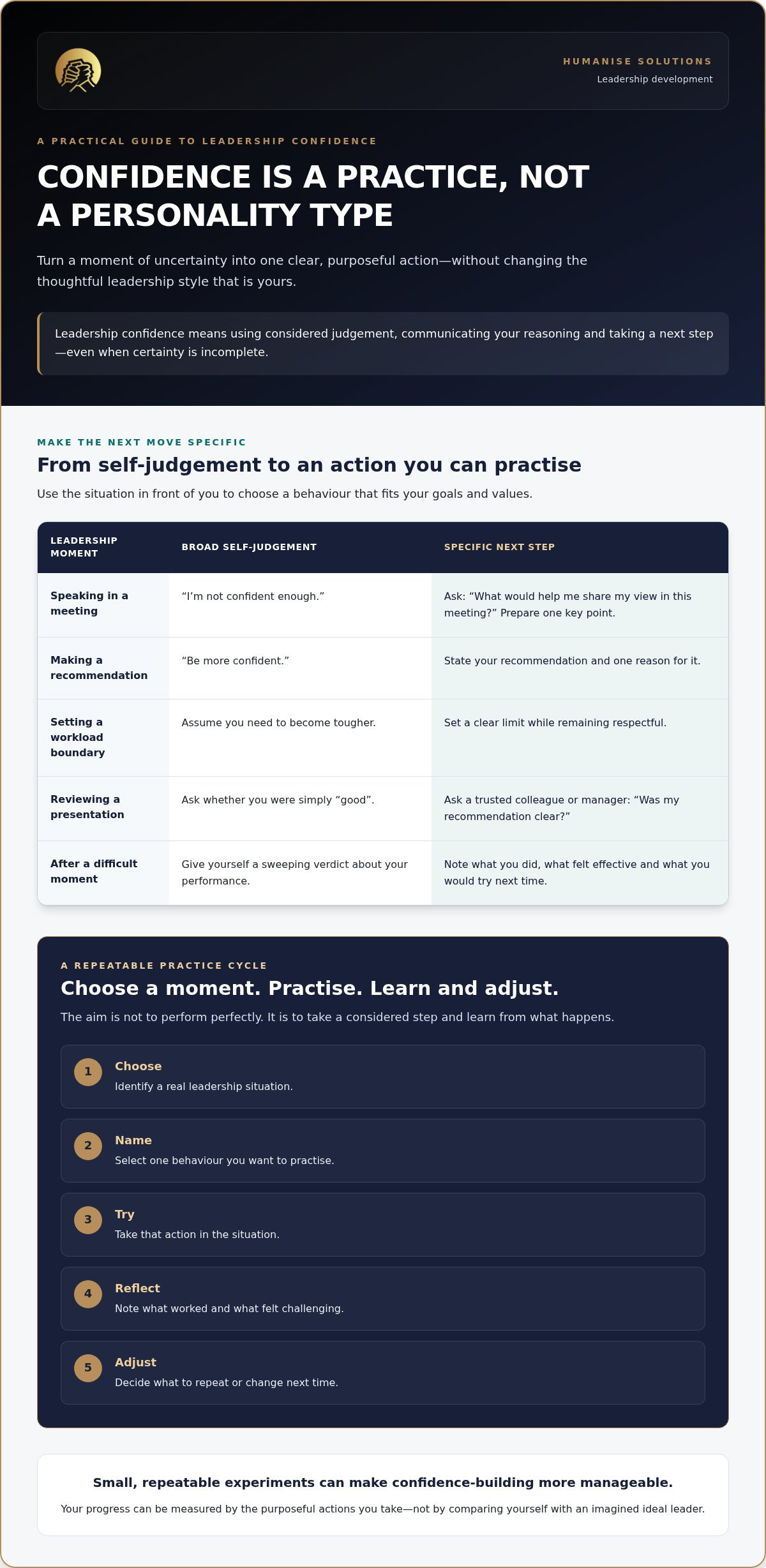
Replace a broad judgement such as “I’m not confident enough” with a specific question: “What would help me share my view in this meeting?” You might prepare one key point, ask for clarity about a decision or seek focused feedback on how your recommendation landed. Confidence can grow through experience, reflection and appropriate support, while your thoughtful leadership style remains intact.
Build leadership confidence through deliberate practice, reflection and support
Confidence often grows through action rather than arriving beforehand. Instead of waiting until you feel completely ready, treat a challenging leadership moment as a small experiment: choose a situation, decide how you want to respond, try it and learn from what happens. The aim isn’t to perform perfectly. It’s to build experience of taking a considered step and adapting.
Turn a confidence challenge into a specific development goal
Start with the situation where you’d most like to feel assured. Perhaps you want to share your view in a senior meeting, set a boundary when your workload is full or ask for feedback after presenting a recommendation. Make the goal observable. Instead of “be more confident”, try “state my recommendation and one reason for it”.
Decide what progress would look like for you before you act. It might mean expressing your view even if your voice shakes, or setting a clear limit while remaining respectful. These personal measures are more useful than comparing yourself with an imagined ideal leader. Choose a step that stretches you without asking you to abandon your values or style.
Use feedback and reflection to strengthen learning
After trying the behaviour, pause for a brief review. What felt effective? What was difficult? What would you try next time? Write down what you did rather than giving yourself a sweeping verdict about your performance. This helps you recognise progress and identify a specific skill to practise further.
Focused feedback can add another perspective. Ask a trusted colleague or manager a question such as, “Was my recommendation clear?” or “How did I communicate that boundary?” A specific question is more likely to give you something practical to work with than asking whether you were simply “good” in the moment. Consider constructive feedback alongside your own judgement and the context.
- Choose: Identify a real leadership situation.
- Name: Select one behaviour you want to practise.
- Try: Take that action in the situation.
- Reflect: Note what worked and what felt challenging.
- Adjust: Decide what to repeat or change next time.
Small, repeatable experiments make building confidence as a female leader more manageable. If you’d like support connecting your goals with human-centred leadership development, explore leadership development services. You can also discuss tailored leadership development that reflects your needs and the outcomes you’re working towards.
Compare confidence-building approaches to find support that fits your leadership goals
There’s no single route to stronger leadership confidence. The right support depends on what you want to develop, where you can practise and what kind of reflection or guidance would help you move forward. Self-directed practice, coaching and structured learning can each play a useful role, and they can complement one another.
When might self-directed practice be a useful starting point?
If you’ve identified a specific situation, such as contributing more in meetings, reflection and practice can help you discover what works for you. Prepare one key point before a team discussion, share it, then consider how clearly you expressed your view. This can clarify your development goal and help you build confidence through experience.
This approach depends on having relevant opportunities to practise and feedback that helps you learn. If you rarely get the chance to contribute, or the responses you receive aren’t constructive, independent effort may not be enough. Confidence development shouldn’t place the whole responsibility on you when workplace relationships, expectations and access to opportunities also shape your experience.
When could coaching or structured learning add value?
Coaching can offer focused space to explore your individual goals and the leadership situations you’re navigating. It may help you think through a challenge, identify what’s holding you back or consider how to approach a specific conversation. Structured learning can help you develop knowledge and practise leadership skills with purposeful guidance.
Humanise Solutions’ Women Leadership ILM Programme is one relevant development option. Its leadership development services also include 1-1 Coaching and Bespoke Learning, which can be tailored to participant and organisational outcomes. These options serve different purposes, and one isn’t automatically better than another. Consider whether your priority is personal reflection, building knowledge, practising skills or a combination.
To choose a starting point, ask yourself:
- What’s my immediate goal? A specific behaviour may call for practice; a broader development need may benefit from structured learning.
- Where can I apply what I learn? Look for genuine opportunities to use new approaches in your role.
- What support would help? Consider whether you need independent reflection, individual guidance or a learning environment with clear structure.
Building confidence as a female leader can involve different forms of support at different stages. Broader conversations about inclusive development, such as those explored in Empowering Women in the Workplace, can also place individual growth in the wider context of workplace culture and opportunity.
Build confidence as a female leader: a practical plan
A useful confidence plan doesn’t need to cover every leadership challenge at once. Choose one situation that matters to you, then practise one realistic behaviour within it. This keeps your development connected to your actual role, rather than an abstract idea of how a leader should act.
Choose one real leadership moment to practise
Pick an upcoming meeting contribution, conversation or decision where you’d like to feel more assured. Before it happens, decide what you want to do. You might share a recommendation, explain a decision or ask a question that brings a key issue into the open.
Prepare a concise message that reflects your judgement and values. For example: “My recommendation is to prioritise this task because it addresses the main risk.” You don’t need to script every word. A clear opening point can help you stay grounded while leaving room to listen and respond.
Afterwards, review the attempt without demanding a flawless performance. Did you take the action you planned? What did you learn about the situation? Success might mean speaking up despite feeling nervous, or recognising that you need more information before making a decision. Both can guide your next step.
Build reflection and support into the plan
Keep a brief record after each practice: what happened, what you learned and one adjustment you’ll make next time. A short note can help you spot patterns, such as which settings make it easier to contribute or what preparation helps you communicate clearly.
Where it feels appropriate, ask a trusted colleague or manager for specific feedback. “Was my main point clear?” gives you more useful information than a general request for an opinion. Consider what support or workplace adjustment could make the next attempt more constructive, such as clearer meeting expectations or time to prepare. Personal practice can help, but it doesn’t replace the conditions and relationships that enable people to contribute.
- Prepare: Choose one situation and the behaviour you want to practise.
- Practise: Take the action, even if it feels unfamiliar.
- Reflect: Record what happened and what you learned.
- Review: Decide what to repeat or adjust next time.
Building confidence as a female leader becomes more sustainable when practice connects with meaningful goals and the support around you. For organisations shaping development around people’s needs, Bespoke L&D Programmes: A Guide for UK Organisations offers relevant context. To explore support tailored to your leadership development goals, discuss your development needs with Humanise Solutions.
Explore human-centred leadership development to sustain confidence over time
Practising a new leadership behaviour can be a valuable start. Longer-term development can help you build on that practice, especially when your goals connect with wider responsibilities, relationships or workplace expectations. Humanise Solutions provides human-centred leadership development shaped around participants’ needs and organisational outcomes. This creates space for growth without asking you to perform a version of confidence that doesn’t feel like you.
What to expect from a human-centred development approach
A useful development conversation starts with your goals and the situations you actually face. You might want to communicate decisions more clearly, contribute with greater assurance or lead through a particular challenge. Learning and reflection can then help you identify relevant skills, explore different approaches and consider how to apply them in your role.
This isn’t about pressure to appear certain. It’s about creating supportive opportunities to develop, reflect and practise in ways that respect your experience and leadership style. Humanise Solutions’ approach is informed by over 12 years of research into decision-making processes and trauma prevention. Its leadership and learning services include the Women Leadership ILM Programme and Bespoke Learning, supporting women’s leadership development and tailored learning needs.
Structured learning can provide a purposeful framework for developing leadership knowledge, while Bespoke Learning can be shaped around participant and organisational outcomes. The most suitable focus depends on what you want to work towards and the context in which you lead. Confidence development is an individual journey, supported by learning that connects insight with practical application.
Take the next step towards leadership confidence
Begin by naming one confidence goal you’d like to work on. Perhaps you want to voice your judgement more clearly, feel steadier when making decisions or strengthen a particular aspect of your leadership. A specific goal makes it easier to consider what kind of development could support your next steps.
If you’re ready to explore a pathway that reflects your needs and leadership context, discuss your leadership development goals with Humanise Solutions. You can consider relevant support and learning in relation to your goals and the situations you face.
Take your next step with confidence
Leadership confidence doesn’t require constant certainty or a change in personality. It can grow as you practise behaviours that matter to your role, reflect on what you learn and seek support that fits your goals. That’s the heart of building confidence as a female leader: progress grounded in your judgement, values and real working context.
Start with one situation you’d like to approach differently, then choose a realistic action to practise. Review what happened with curiosity, not a demand for perfection. If you need more structure, coaching or learning can help you explore your next steps, while workplace conditions and relationships remain part of the picture.
Humanise Solutions’ development approach draws on over 12 years of research into decision-making processes and trauma prevention. The Women Leadership ILM Programme and Bespoke Learning offer relevant options for leadership development, shaped around individual and organisational needs.
Discuss your leadership development goals and explore a pathway that feels relevant to you. Confidence can take root one considered step at a time, and your leadership has room to grow.
Frequently Asked Questions
Can confidence as a female leader be developed?
Yes, confidence can develop through experience, reflection and relevant support. Building confidence as a female leader doesn’t mean becoming certain in every situation; it can mean acting on considered judgement and communicating your reasoning. Choose a real work situation, practise a behaviour such as offering a recommendation, then review what helped. Coaching or structured learning may add support when you want guidance or a clearer development framework.
How can I speak up with more confidence in meetings?
Prepare one point you want to contribute and the reason it matters. You could open with, “My view is…” or ask a focused question that helps the group consider an important issue. Aim to share your thinking clearly rather than waiting for the perfect moment or wording. After the meeting, note what felt effective and what you might adjust next time. Confidence can grow through repeated, manageable practice.
Does a female leader need to be extroverted to feel confident?
No. Confidence isn’t the same as extroversion, constant certainty or being the loudest person in the room. A thoughtful leader can listen carefully, consider different perspectives and then communicate a clear decision or recommendation. You might prefer to prepare before speaking or contribute in a smaller discussion. The useful question is whether your approach lets you share your judgement and lead effectively, not whether it matches someone else’s style.
What should I do if I keep second-guessing my decisions as a leader?
Separate the decision itself from the feeling of uncertainty. Write down the information you used, the options you considered and why you chose your course of action. If you need more evidence or input, identify exactly what is missing and who can help. Once you’ve decided, agree when you’ll review the outcome rather than reopening the question repeatedly. Also consider whether unclear expectations or limited support are contributing to the doubt.
Is coaching or leadership training better for building confidence?
Neither is universally better; the right fit depends on your goal. Coaching can provide space to explore individual leadership situations and reflect on possible approaches. Structured learning can help you develop knowledge and practise skills with purposeful guidance. Humanise Solutions offers 1-1 Coaching, Bespoke Learning and the Women Leadership ILM Programme. Consider whether you’d benefit most from individual reflection, a learning framework or a combination that supports practical application.
How can an organisation support confidence in women leaders?
Organisations can support confidence by making leadership expectations clear, offering constructive and specific feedback, and creating genuine opportunities for women to contribute and develop. Managers can invite different perspectives in meetings and recognise expertise without expecting everyone to lead in the same way. Development support is most useful when it connects with participants’ goals and real work situations. It’s also important to consider how workplace culture and relationships affect people’s ability to lead.
