

Article by
Scott Ward MBA CCMI
Scott Ward is the founder and CEO of Humanise Solutions, which he established three years ago to help organisations elevate their people, leadership and culture through a human-centric, evidence-based approach. Before moving into business and academia, Scott spent seven years as a professional footballer, playing for Luton Town, Crawley Town and Coventry City FC until injury brought his playing career to a close — a turning point that shaped both his research interests and his approach to leadership.
Scott holds an MBA from Warwick Business School, where his research explored the causal relationship between trauma and decision-making — work that continues to inform how he supports young adults, leaders and teams under pressure. Recognised as a Companion of the Chartered Management Institute (CCMI), its highest grade of membership, he combines academic rigour with the discipline, resilience and team-first mindset of the professional game. At the heart of everything he does is a simple belief: that people perform at their best when they are led, developed and valued as human beings first.
What if trust in a remote team depends less on the tools you use and more on the small promises you keep? Building trust in a remote team can feel difficult when you can’t read a colleague’s expression, sense uncertainty in the room or check that expectations are clear.
If communication gaps leave people guessing, or digital meetings feel more transactional than connecting, you’re not alone. Remote leadership means balancing accountability with autonomy while helping each person feel included, respected and able to speak up. That balance comes from deliberate, everyday behaviours, not closer monitoring.
This guide covers practical ways to make communication and follow-through dependable, create space for honest conversations and strengthen performance without undermining independence. You’ll learn how clarity, consistency and human connection can help your team work with greater confidence, wherever its members are based.
Key Takeaways
- Understand how distance can make reliability, intentions and expectations harder to read, and identify where your team needs more clarity.
- Building trust in a remote team depends on consistent leadership behaviours, including setting clear expectations and following through.
- Choose communication to suit the purpose: quick coordination, shared decisions and sensitive conversations may each need a different approach.
- Ask what creates uncertainty or makes participation harder, then agree working norms with the team and review what’s helping.
- Explore how leadership development and bespoke learning can help your team practise trust-building behaviours that reflect its needs.
Building trust in a remote team starts with understanding what distance changes
In a shared workplace, people can pick up useful context through a quick conversation, a change in tone or a reassuring word after a meeting. Remote work can make those everyday signals less visible. A message may arrive without the explanation that would have come with it in person, and a pause before someone replies can be easy to misread.
A virtual team brings people together to work towards shared goals across distance, often relying on communication technology to coordinate their efforts. This context helps explain why building trust in a remote team calls for thoughtful communication. Don’t assume everyone will interpret silence or a brief message in the same way.
What does trust look like in a remote team?
Trust in a remote team is confidence that colleagues will act reliably, communicate honestly and approach one another with good intentions. It develops through observable behaviours: keeping commitments, sharing relevant context, raising concerns early and asking for help when needed. These actions make it easier to coordinate and take shared responsibility without expecting everyone to work in the same way.
One person may prefer to think through a task before discussing it; another may develop ideas aloud. Trust doesn’t require matching styles. It means agreeing how to work together, making responsibilities clear and respecting different approaches while staying open about what the work requires.
Why can distance make trust feel harder to build?
Fewer informal interactions can leave gaps around intent and progress. A short reply might reflect a busy moment, not irritation. A missed update might mean someone wasn’t sure what to share, rather than that they’re unreliable. Without enough context, people can fill in the blanks with assumptions, especially when expectations haven’t been discussed clearly.
Separate a communication gap from a pattern of broken commitments. If an update hasn’t arrived, first check what happened and whether the process was clear. If commitments repeatedly aren’t met, address the specific behaviour directly and agree what needs to change. This leaves room for an honest explanation while maintaining shared responsibility.
Trust isn’t the same as being constantly available. Online status checks, immediate replies and frequent monitoring can show activity, but they don’t establish confidence in someone’s judgement or intentions. Focus instead on agreed expectations, useful progress updates and reliable follow-through. The aim isn’t to eliminate every uncertainty, but to build working relationships where people can ask, clarify and depend on one another.
How leaders build trust in a remote team through consistent behaviour
Trust grows through the pattern people experience over time, not a single team-building exercise. Each clear commitment, thoughtful response and honest explanation helps colleagues understand what they can expect from one another. Leaders set the tone, and trust strengthens across the team when people see these behaviours practised consistently.
Remote trust is supported by leaders who set clear expectations, follow through, explain decisions, listen to concerns and make participation possible across different working styles. Research explored by Fisher College of Business considers how team virtuality relates to trust and conflict. It highlights why leaders should pay attention to the effect of distance on collaboration instead of relying on assumptions.
How do clarity and follow-through strengthen confidence?
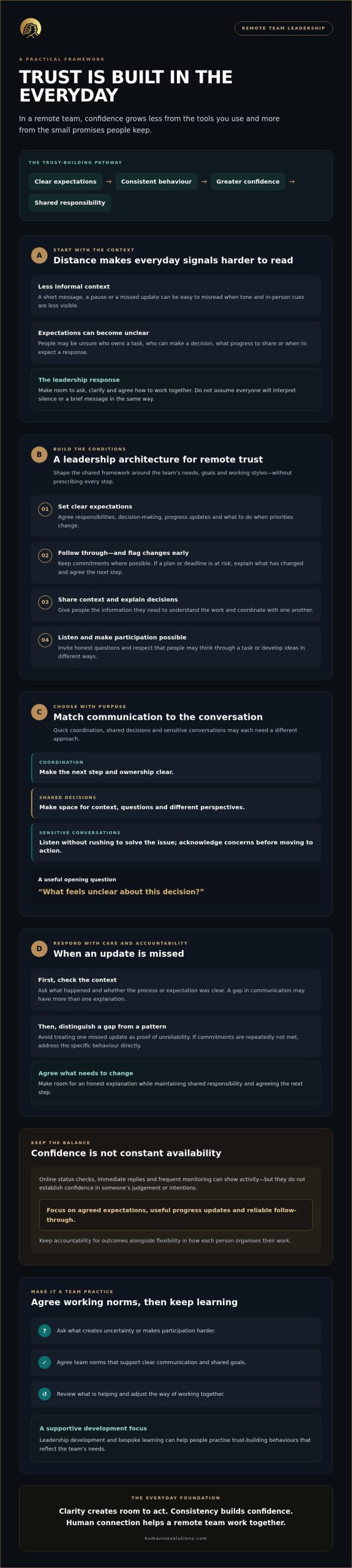
Unclear responsibilities can leave people unsure who owns a task, who can make a decision or when to expect a response. Agree these working arrangements together, including how the team will share progress and what to do when priorities change. The aim isn’t to prescribe every step. It’s to make the shared framework clear enough for people to act with confidence.
Follow-through matters just as much. If a deadline or plan is at risk, say so early, explain what has changed and agree the next step. Silence leaves colleagues to fill in the gaps. Consistent expectations for outcomes and communication can sit alongside flexibility in how each person organises their work.
How can leaders make remote communication feel more human?
Meetings can become a sequence of updates. Make room for dialogue by asking open questions, listening without rushing to solve the issue and acknowledging concerns before moving to action. For example, “What feels unclear about this decision?” invites a different response from “Any questions?”
Not everyone will contribute in the same way or at the same pace. Invite views from people who haven’t spoken, and offer an agreed written channel for those who prefer time to reflect. Match the method to the need: use a brief message for urgent coordination, while decisions with wider implications may need more context and time for discussion.
These practices make building trust in a remote team part of daily leadership, rather than a separate initiative. Leaders who want to strengthen these habits over time could explore leadership development with Humanise Solutions, shaped around the outcomes their team wants to achieve.
Can you build trust in a remote team without constant video calls?
Yes. Trust can grow through remote communication, and frequent video calls aren’t a universal requirement for connection. What matters is choosing a communication method that fits the purpose and giving people enough context to understand decisions, responsibilities and next steps. The right rhythm depends on the team’s work and needs, not a fixed meeting quota.
A written update can work well for sharing progress when it explains what’s changed, what’s needed and who’s responsible. A live conversation may be more helpful when a decision needs discussion, a topic carries nuance or people need space to ask questions. Using each format thoughtfully can make connection more intentional without asking everyone to stay on camera to prove they’re engaged.
Match the communication to the purpose
Before scheduling a call, ask what the team needs to achieve. A quick coordination question may need only a clear message; a sensitive discussion may benefit from a private, two-way conversation. Harvard Business Review describes competence, benevolence and integrity as indicators of trust. Leaders can reflect these in how they communicate, make decisions and treat colleagues.
| Purpose | Suitable approach | Trust-building consideration |
|---|---|---|
| Quick coordination | Concise written message | Include the owner, action and any relevant timing. |
| Shared decision | Written context and discussion | Explain options and how the decision will be made. |
| Sensitive conversation | Private, live discussion where suitable | Listen carefully and agree how to follow up. |
How is accountability different from monitoring?
Accountability centres on agreed responsibilities, progress and outcomes. Monitoring centres on visible activity, such as whether someone appears online or responds instantly. The first helps colleagues coordinate around the work; the second can confuse presence with contribution. Agree which progress updates are useful, and give people room to organise their work in a way that meets shared expectations.
Make it safe to raise a risk before it becomes a missed commitment. If someone flags a delay, ask what has changed, what support or decision is needed, and what the revised plan should be. Apply standards fairly, explain decisions that affect the team and invite questions. Building trust in a remote team can go hand in hand with accountability: people know what they own, can speak candidly about obstacles and are assessed against clear expectations rather than constant visibility.
Practical ways to build trust in a remote team, one interaction at a time
Trust-building is more sustainable when it grows from the way your team works every day. Instead of introducing a policy and assuming it will solve every issue, use an adaptable cycle: listen, agree, practise and review. First understand what helps people contribute with confidence, then shape team habits around those needs.
Agree working norms that support the work
Start by asking where uncertainty or barriers to participation arise. Do people know which channel to use for a quick question? Are response expectations understood? Can everyone see who owns a task, how decisions are made and how changes will be shared with those affected?
Agree these norms as a team and keep them somewhere everyone can refer to. Include the purpose of recurring meetings, how progress will be communicated and what to do when priorities shift. Make the agreements practical, not prescriptive. Shared expectations create a dependable foundation while people retain flexibility in how they organise their work. Revisit the norms when the work or the team’s needs change.
Notice concerns with curiosity
Recurring confusion, unspoken concerns or uneven participation are reasons to check in, not proof that someone is disengaged or untrustworthy. Ask open questions without blame. A private conversation may help someone explain a personal concern; a team discussion may be better for clarifying a shared process. Listen for what needs to change, agree a next step and follow up.
Use this checklist to put the approach into practice:
- Listen: Ask what makes work unclear or makes it harder to contribute.
- Agree: Set shared expectations for communication, decisions and ownership.
- Practise: Apply the agreements consistently, and speak up early when something changes.
- Review: Invite feedback on what’s working and adjust habits that aren’t helping.
Building trust in a remote team is an ongoing practice, not a one-off fix. If you’re exploring broader team-development ideas, see Building Team Excellence: A Human-Centred Guide for 2026. For support shaping leadership and team-development learning around your goals, contact Humanise Solutions about your team’s development needs.
How Humanise Solutions can support trust-building in a remote team
Practical habits are an important starting point. Sustaining them can also involve developing the leadership and team behaviours that help people communicate clearly, share responsibility and raise concerns. This takes practice over time, rather than a one-off exercise or a promise of immediate change.
Humanise Solutions brings a human-centric, scientific approach to leadership, team excellence and learning and development. Its work is informed by over 12 years of research into decision-making processes and trauma prevention. This research background informs its approach; it doesn’t mean any particular programme guarantees remote-team outcomes.
What kind of development support might help a remote team?
Nurturing Leadership and High Performing Teams are relevant areas of support for organisations looking to develop how people lead and work together. Bespoke Learning can be discussed in relation to your organisation’s stated goals, such as clarifying expectations or helping leaders respond constructively when team members raise concerns.
Explore Humanise Solutions’ leadership and team development services to understand its areas of work. Development can give leaders and teams the opportunity to practise trust-building behaviours and reflect on their effect on day-to-day collaboration. The focus is on supporting your team’s needs, not applying a generic solution to every remote workplace.
What should an organisation clarify before seeking support?
A little reflection can help you describe what would make a difference. Consider where trust feels strained or uncertain, what changes you’d like to see and what the team has already tried. Note the feedback people have shared, including whether some voices or perspectives were harder to hear. These details can help frame a conversation around outcomes that matter to your organisation.
For example, you might want people to feel more confident asking for clarification, or to develop a clearer shared understanding of how decisions are communicated. Be as specific as you can while remaining open to what the team identifies as the underlying need. That gives development work a more useful starting point without assuming the cause or the answer in advance.
Building trust in a remote team is ongoing work, shaped by the behaviours people experience together. If you’d like to explore what leadership or team development could look like in your organisation, contact Humanise Solutions to discuss your needs. It’s a considered next step, not a promise of guaranteed results.
Make trust part of how your team works
Building trust in a remote team isn’t about more calls or closer monitoring. It grows through clear expectations, reliable follow-through and communication that gives people room to ask questions, share concerns and take responsibility. Small, consistent behaviours can make remote collaboration more dependable and inclusive.
Start by listening to what creates uncertainty for your team, then agree practical working norms and revisit them as needs change. Trust is cultivated over time, so treat these agreements as a foundation for learning together, not a one-off fix.
Humanise Solutions brings a human-centric, scientific approach to leadership, learning and team development, informed by over 12 years of research into decision-making processes and trauma prevention. If you’re considering how development could respond to your organisation’s needs, discuss your team’s development needs with Humanise Solutions.
With empathy, clarity and steady practice, your team can build stronger connections and fulfil its potential, wherever its members work.
Frequently Asked Questions
Can you build trust in a remote team without meeting in person?
Yes, trust can develop without in-person meetings. Colleagues can build confidence in one another by communicating clearly, sharing context, keeping commitments and raising issues early. Choose communication methods to suit the work: written updates can clarify actions and decisions, while a live conversation can help with sensitive or complex topics. In-person contact may suit some teams, but it isn’t a universal prerequisite for trust.
How do you build trust in a remote team as a manager?
Build trust through consistent behaviour: clarify what people are responsible for, explain how decisions are made, listen to concerns and follow through on commitments. Building trust in a remote team also means noticing when expectations are unclear and inviting people to say what would help them contribute. Agree how progress will be shared, then apply those expectations fairly without treating constant availability as evidence of good work.
What are the signs of low trust in a remote team?
Possible signs include repeated confusion about ownership, reluctance to raise concerns, decisions being questioned because their context is missing, or colleagues avoiding requests for help. These behaviours aren’t proof of low trust on their own; unclear processes, workload or communication habits may also be involved. Look for recurring patterns, then ask open questions privately or as a team before deciding what needs to change.
How can remote teams communicate more openly?
Make it clear where people can ask questions, share progress and flag risks, and agree what response expectations are reasonable for the work. Leaders can invite different perspectives by asking specific, open questions and giving people time to respond in a meeting or an agreed written channel. Explain the context behind decisions, acknowledge concerns and close the loop by sharing what happens next.
Does trust mean giving remote employees complete autonomy?
No. Trust and autonomy can sit alongside clear responsibilities and shared standards. Managers can agree the outcomes needed, decision-making boundaries and points for checking progress, while allowing people flexibility in how they organise their work. The right balance depends on the task and the support a person needs. If something is unclear, discuss it directly rather than relying on constant status checks.
How can a manager balance accountability and trust remotely?
Make accountability about agreed responsibilities, progress and outcomes, not visible online activity. Clarify who owns each task, how changes will be communicated and when colleagues need an update. If a risk or delay arises, encourage people to raise it early and focus the discussion on what has changed and what happens next. Apply expectations consistently while making space to understand individual circumstances.
Can team-building activities improve trust in a remote team?
Team-building activities can create opportunities for people to connect, but one event alone can’t replace dependable everyday behaviour. Choose an activity with a purpose that fits the team, such as helping colleagues understand how others prefer to communicate or collaborate. Make participation welcoming rather than compulsory, then follow up by bringing useful insights into team agreements and daily ways of working.
