

Article by
Scott Ward MBA CCMI
Scott Ward is the founder and CEO of Humanise Solutions, which he established three years ago to help organisations elevate their people, leadership and culture through a human-centric, evidence-based approach. Before moving into business and academia, Scott spent seven years as a professional footballer, playing for Luton Town, Crawley Town and Coventry City FC until injury brought his playing career to a close — a turning point that shaped both his research interests and his approach to leadership.
Scott holds an MBA from Warwick Business School, where his research explored the causal relationship between trauma and decision-making — work that continues to inform how he supports young adults, leaders and teams under pressure. Recognised as a Companion of the Chartered Management Institute (CCMI), its highest grade of membership, he combines academic rigour with the discipline, resilience and team-first mindset of the professional game. At the heart of everything he does is a simple belief: that people perform at their best when they are led, developed and valued as human beings first.
What if the most expensive diversity initiative in your budget is actually the one doing the least for your culture? Many organisations find themselves trapped in a cycle of generic, tick-box exercises that fail to engage middle management or provide a clear return on investment. You likely recognise that true progress requires more than just meeting the 2026 priorities set by the Competition and Markets Authority; it demands a fundamental shift in how your leaders nurture their teams. Finding the right inclusive leadership programme UK is the first step toward moving from mere compliance to a state of genuine human flourishing.
You already know that a culture of belonging is the engine of high performance, yet measuring the impact of these initiatives remains a persistent challenge. This article promises to guide you through the process of selecting a development path that fosters psychological safety and retains your most diverse talent, including Gen Z and women. We’ll explore how to identify programmes that lead with empathy and evidence, ensuring your leadership team doesn’t just manage diversity but actively cultivates an environment where every individual can thrive.
Key Takeaways
- Learn how to move beyond basic compliance with the Equality Act 2010 by adopting a proactive model of leadership that prioritises genuine belonging over tick-box exercises.
- Understand the psychological foundations of high-performing teams and why fostering psychological safety is the most effective way to unlock collective potential.
- Discover the essential criteria for selecting a bespoke inclusive leadership programme UK that uses evidence-based methodologies rather than generic, off-the-shelf content.
- Identify how to measure the tangible impact of inclusion on your bottom line, from reduced recruitment costs to enhanced innovation and talent retention.
- Explore the power of nurturing leadership tracks designed specifically to support the growth and resilience of women and Gen Z professionals within your organisation.
What is an Inclusive Leadership Programme in the UK?
An inclusive leadership programme is far more than a series of workshops or a digital training module. It is a structured development journey designed to equip leaders with the specific mindsets and behaviours required to foster a culture of genuine belonging. Whilst many organisations begin this path to ensure compliance with the Equality Act 2010, the most impactful initiatives recognise that legal adherence is merely the baseline. In the British workplace of 2026, a truly effective inclusive leadership programme UK moves leaders beyond the “what” of diversity toward the “how” of inclusion and the “result” of belonging. It is about moving from a passive awareness of differences to an active cultivation of an environment where every individual feels seen, heard, and valued.
The landscape of work in the UK is shifting rapidly. Leaders now face the challenge of managing multi-generational teams, including a socially conscious Gen Z, whilst addressing the nuances of neurodiversity and psychological safety. Understanding what is inclusive management helps clarify that this isn’t about simple participation; it is about creating equitable systems that allow diverse perspectives to drive innovation. By 2026, the ability to lead inclusively has become a core competency rather than an optional skill, reflecting a broader societal move toward transparency and human-centric management.
The Core Pillars of Inclusive Leadership
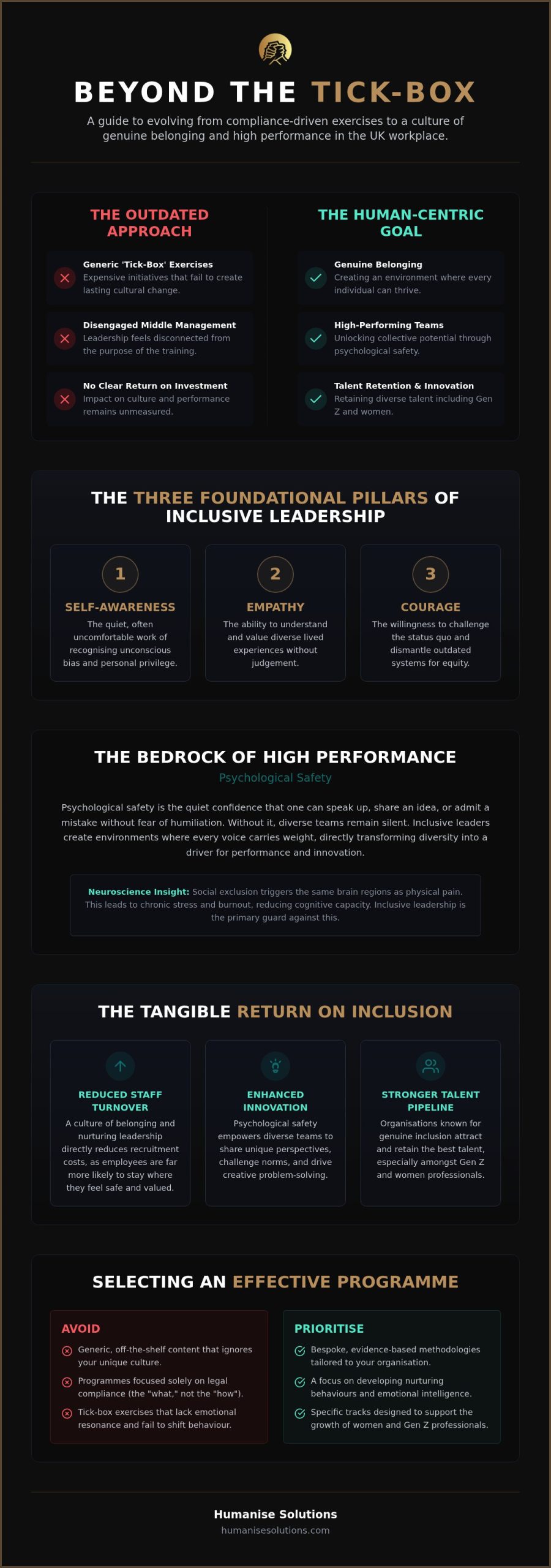
To lead inclusively, a manager must develop three foundational qualities. First is self-awareness, which involves the quiet, often uncomfortable work of recognising unconscious bias and personal privilege. Second is empathy, the ability to understand and value diverse lived experiences without judgement. Finally, courage is essential. Leaders must be willing to challenge the status quo and dismantle outdated systems to create more equitable paths for their teams. These pillars ensure that an inclusive leadership programme UK creates lasting change rather than temporary compliance.
Why Nurturing Behaviours Matter Most
Inclusive leadership is fundamentally a nurturing skill rather than a technical one. It requires the emotional intelligence to sense when a team member feels excluded and the resilience to hold space for difficult conversations. When leaders prioritise these nurturing behaviours, they build a foundation of trust that directly impacts the bottom line. Data consistently shows a strong link between inclusive behaviour and reduced staff turnover; employees are far more likely to stay amongst teams where they feel safe to be their authentic selves. Inclusive leadership is the bridge between diversity and performance.
Moving Beyond Compliance: The Psychology of Nurturing Inclusive Teams
Traditional EDI training often fails because it treats people like problems to be solved rather than humans to be nurtured. When diversity initiatives become a mere tick-box exercise, they lose the emotional resonance required to shift deep-seated organisational habits. Real transformation happens when leaders understand the psychological mechanisms of belonging. This shift is echoed in the UK government review of leadership, which emphasises that embedding equality and inclusion is a core responsibility for those at the top. It’s not a side project; it’s the work.
Psychological safety is the bedrock of any high-performing team in the UK. It’s the quiet confidence that one can speak up, share an idea, or admit a mistake without fear of humiliation. Without it, even the most diverse team will remain silent, stifling the very innovation you hope to achieve. Selecting a sophisticated inclusive leadership programme UK ensures that your managers don’t just learn definitions. They learn to create environments where every voice carries weight and every perspective is seen as an asset to the collective goal.
The Link Between Inclusion and Wellbeing
Neuroscience shows that social exclusion triggers the same regions in the brain as physical pain. When an employee feels marginalised, their cognitive capacity drops, leading to chronic stress and eventual burnout. Inclusive leaders act as the primary guardians of a team’s mental health. For young adults entering the workforce, especially those navigating social mobility challenges, this support is vital. It’s about building confidence whilst removing the invisible barriers that prevent talented individuals from contributing their best work. Nurturing these internal qualities leads to long-term resilience amongst the entire workforce.
Inclusive Leadership for Women in the Workplace
The UK corporate landscape still presents unique hurdles for women, from the gender pay gap to the subtle biases that hinder progression. Traditional “command and control” leadership styles often alienate female talent who may thrive under a more collaborative, empathetic approach. Bespoke growth tracks for women focus on these nuances, helping female leaders lead with evidence-based confidence. By prioritising nurturing leadership, organisations move away from sterile hierarchies toward a culture of mutual respect. This approach is particularly effective at retaining high-potential talent who value empathy as much as professional excellence.
Essential Criteria for Choosing an Inclusive Leadership Programme
Choosing a development path for your senior team is a significant commitment of both time and trust. When evaluating an inclusive leadership programme UK, the first question must always be whether the content is bespoke or merely off-the-shelf. Every organisation possesses a unique cultural fingerprint, shaped by its history, sector, and people. A generic, one-size-fits-all module cannot address the specific frictions or opportunities within your team. Real growth requires a tailored approach that aligns with your values whilst addressing the actual lived experiences of your workforce.
The most effective programmes are rooted in evidence-based methodology. Look for frameworks that draw from social science and psychology rather than just corporate trends. This ensures the training is not just a performance but a grounded expert-led journey. You need a partner who understands the UK’s social and professional nuances, from the complexities of the class system to the specific expectations of a British corporate environment. This expertise allows for a deeper level of empathy and a more sophisticated dialogue about power and influence. When comparing your options, reviewing the leading corporate leadership training providers UK organisations are choosing in 2026 can help you benchmark the quality and depth of provision available.
Delivery format is equally vital. A successful inclusive leadership programme UK should balance intensive workshops with peer-to-peer coaching and long-term mentorship. Change doesn’t happen in a single afternoon; it requires a steady, methodical pace that allows for reflection and practice. By integrating different learning styles, you ensure that the concepts of nurturing leadership are not just understood intellectually but are felt and embodied by your managers.
Evaluation Framework for UK L&D Managers
To ensure your investment yields lasting results, use a rigorous framework for assessment. Ask potential partners how they address social mobility and support those in their early careers, such as Gen Z. It’s also essential to check if there’s a specific focus on psychological safety and wellbeing, as these are the drivers of performance. Finally, demand clarity on how behavioural change is measured over a 6 to 12 month period. If a provider cannot show you a logical sequence for tracking progression, the impact will likely be fleeting.
Red Flags to Avoid in EDI Training
Steer clear of programmes that utilise aggressive or shaming language. Such tactics often create defensive behaviours and resentment, which are the antithesis of an inclusive culture. You should also be wary of purely digital or SaaS-based solutions. Whilst technology has its place, the deep work of human connection requires human interaction and expert-led consultancy. One-off “lunch and learn” sessions are another common pitfall. Without follow-up support and a commitment to long-term sustainability, these sessions rarely move the needle on organisational culture.
Measuring the ROI of Inclusive Leadership: Culture and Performance
Investing in an inclusive leadership programme UK is often viewed through the lens of social responsibility, yet the most successful organisations recognise it as a strategic investment in their commercial future. True inclusion directly impacts the bottom line by drastically reducing recruitment costs and fostering a culture of high performance. When leaders move beyond the baseline of compliance, they begin to see measurable shifts in how talent is retained and how innovation is sparked within their teams. It is no longer enough to simply invite people to the table; the return on investment lies in how effectively those individuals are empowered to contribute.
Tracking this impact requires a blend of quantitative data and qualitative insight. Whilst engagement surveys are excellent for monitoring the growth of psychological safety, the real evidence of change often appears in performance reviews. We are seeing a significant rise in “nurturing leadership” as a core competency, where managers are rewarded for their ability to cultivate resilience and confidence in others. These qualitative markers indicate a leadership team that leads with empathy and evidence-based confidence, creating a ripple effect that enhances the wellbeing of the entire organisation.
Retention and Gen Z Engagement
For the socially conscious Gen Z talent entering the British workforce, an inclusive culture is often a higher priority than traditional salary perks. This generation seeks environments where they can flourish without compromising their identity. When organisations fail to provide this, they face the high cost of “quiet quitting” and rapid turnover. By focusing on social mobility and early career development, an inclusive leadership programme UK helps bridge the gap between young talent and senior management. This proactive approach ensures that your most diverse talent feels a sense of genuine belonging, which is the single greatest predictor of long-term retention.
High-Performance Team Excellence
Inclusive teams are inherently more innovative because they are built on a foundation of diverse thought and collaborative problem-solving. When a leader nurtures an environment where it is safe to challenge the status quo, complex problems are solved faster and with greater creativity. This collaborative leadership style is the engine of sustainable growth in a competitive market. Evidence from established UK initiatives shows that 78% of participants in structured inclusive leadership programmes progress into new or enhanced roles within 12 months, highlighting the significant impact on internal talent pipelines and organisational resilience. To begin your journey toward measurable cultural change, explore our bespoke Learning & Development pathways.
Humanise Solutions: Crafting Bespoke Inclusive Growth Paths
At Humanise Solutions, we believe that the most profound organisational shifts begin with a single, courageous choice to prioritise the human experience. We’ve moved away from the detached, sterile models of corporate consulting to offer a voice that is deeply invested in your team’s psychological well-being. Our work is not about delivering a series of lectures; it is about cultivating the internal qualities of confidence and resilience that allow leaders to truly flourish. We see ourselves as visionary guides, helping you transition from a state of mere compliance to a future of limitless potential.
Every organisation possesses its own rhythm and unique challenges. Our bespoke inclusive leadership programme UK is designed to meet you exactly where you are. We recognise that your culture is a living entity, which is why we don’t rely on SaaS-only solutions or generic, pre-packaged modules. Instead, we provide expert-led consultancy that integrates wellbeing and nurturing into every interaction. This methodical approach ensures that change is not just a temporary spike in morale but a sustainable evolution of your workplace behaviour.
Our Specialised Development Tracks
We have developed specific pathways to address the most pressing gaps in modern British leadership. Our Women in Leadership track focuses on building inner confidence and nurturing excellence, helping female leaders navigate the corporate landscape with evidence-based authority. For the next generation, our Young Adult Programmes are specifically designed to bridge the gap for Gen Z talent, with a particular focus on social mobility and early career development. Finally, our Team Excellence workshops provide the tools to cultivate high performance through the lens of inclusion and psychological safety.
The Humanise Methodology
Our methodology strikes a balance between empathetic warmth and evidence-based confidence. We root every programme in psychological logic, ensuring that our guidance is as pragmatic as it is encouraging. We don’t just deliver a workshop; we nurture a transformation through a long-term partnership that values steady, reassuring progression over high-pressure tactics. This creates a safe space for leaders to grow, reflect, and eventually lead with a sense of quiet authority. If you are ready to move beyond tick-box diversity and foster a culture of genuine belonging, we invite you to enquire about a bespoke inclusive leadership programme for your team.
Cultivating a Future of Genuine Belonging
The journey toward a truly inclusive culture is a methodical process of growth and reflection. By choosing an inclusive leadership programme UK that prioritises nurturing behaviours over sterile compliance, you are investing in the long-term resilience of your organisation. We have explored how psychological safety serves as the bedrock for high performance and why bespoke pathways for women and young adults are essential for bridging the talent gap. These initiatives do more than meet regulatory standards; they unlock the human potential that drives innovation and sustainable growth.
Humanise Solutions provides national UK coverage for professional services, offering specialised tracks that combine evidence-based confidence with empathetic warmth. Our approach focuses on the steady transition from current challenges to future excellence. If you are ready to move beyond the tick-box and foster a culture where every individual can flourish, we are here to guide you as a dedicated partner in development.
Explore our bespoke leadership development programmes and begin the transformation of your leadership team today. Your commitment to nurturing talent is the most powerful tool for creating a workplace where everyone belongs.
Frequently Asked Questions
What is an inclusive leadership programme?
An inclusive leadership programme is a structured development journey that equips managers with the mindsets and behaviours needed to foster a culture of genuine belonging. It focuses on building internal qualities like empathy, self-awareness, and the courage to challenge inequitable systems. Unlike simple awareness sessions, these programmes aim to transform how leaders interact with their teams on a daily basis, ensuring every individual feels seen and valued.
How much does an inclusive leadership programme cost in the UK?
Costs for leadership development vary widely across the UK market based on the depth of the intervention and the level of expert involvement. For example, some unaccredited online certificates are available for under £100, whilst intensive, six-month programmes led by specialists can cost upwards of £3,000 per participant. Organisations should evaluate whether they require a low-cost digital overview or a more substantial investment in expert-led consultancy to achieve long-term cultural change.
How do you measure the success of inclusive leadership training?
Success is measured through a blend of quantitative metrics and qualitative shifts in organisational behaviour. You can track progress by monitoring engagement survey scores related to psychological safety, observing improvements in the retention of diverse talent, and noting the rise of nurturing behaviours in performance reviews. A successful inclusive leadership programme UK will show a clear correlation between these markers and overall team excellence over a six to twelve month period.
Can inclusive leadership be taught, or is it an innate trait?
Inclusive leadership is a set of skills and behaviours that can be cultivated through deliberate practice and expert guidance. Whilst some individuals may naturally lead with more empathy, the specific competencies required to interrupt bias and create equitable systems are learned. With the right support, any leader can develop the evidence-based confidence needed to nurture a more inclusive and high-performing environment.
How long does it take to see results from a leadership development programme?
Initial shifts in awareness and individual behaviour often appear within the first few weeks of a programme. However, meaningful cultural transformation typically requires a methodical pace over six to twelve months to ensure new habits are deeply embedded. This steady progression allows leaders to move through challenges and apply their new skills in real-world scenarios, leading to sustainable growth across the organisation.
Is inclusive leadership training different from standard EDI training?
Yes, inclusive leadership training focuses on active behavioural change whilst standard EDI training often centres on legal compliance and awareness. An inclusive leadership programme UK goes beyond the “what” of the Equality Act 2010 to address the “how” of daily management. It provides leaders with the practical tools to foster psychological safety and wellbeing, moving past tick-box exercises to create a culture of genuine flourishing.
How do you engage skeptical senior leaders in an inclusion programme?
Engagement is most effective when you connect inclusion directly to core business objectives and evidence-based ROI. Skeptical leaders are often won over when they see how inclusive behaviours reduce recruitment costs, enhance innovation, and improve team resilience. By positioning inclusion as a driver of performance rather than just a social responsibility, you help them recognise the pragmatic value of nurturing their talent.
What are the benefits of a bespoke programme vs. an off-the-shelf course?
Bespoke programmes address the unique cultural fingerprint and specific challenges of your organisation, making the learning far more relevant for your managers. Off-the-shelf courses often feel generic and fail to engage leaders because they don’t reflect their actual lived experiences. A tailored approach ensures that the development journey is aligned with your values and provides the specific support your team needs to thrive.
