

Article by
Scott Ward MBA CCMI
Scott Ward is the founder and CEO of Humanise Solutions, which he established three years ago to help organisations elevate their people, leadership and culture through a human-centric, evidence-based approach. Before moving into business and academia, Scott spent seven years as a professional footballer, playing for Luton Town, Crawley Town and Coventry City FC until injury brought his playing career to a close — a turning point that shaped both his research interests and his approach to leadership.
Scott holds an MBA from Warwick Business School, where his research explored the causal relationship between trauma and decision-making — work that continues to inform how he supports young adults, leaders and teams under pressure. Recognised as a Companion of the Chartered Management Institute (CCMI), its highest grade of membership, he combines academic rigour with the discipline, resilience and team-first mindset of the professional game. At the heart of everything he does is a simple belief: that people perform at their best when they are led, developed and valued as human beings first.
With workplace conflict costing the UK economy over £60 billion annually, the price of silence is far higher than most leaders realise. You likely feel the weight of this within your own teams, perhaps witnessing a rising staff turnover or a hesitant blame culture that prevents your best people from sharing their most innovative ideas. It’s understandable to feel a sense of trepidation when faced with mounting tension. Most managers receive plenty of technical instruction but are often left alone when it comes to the complex, emotional landscape of human disagreement.
We believe that friction isn’t a sign of failure; it’s a vital signal that your team is ready for a deeper level of human-centric growth. This article explores how bespoke, evidence-based conflict resolution training for managers UK can transform these difficult moments into opportunities for connection and resilience. We will look at how leading with empathy restores psychological safety, whilst examining the practical steps needed to foster a culture of team excellence. By the end, you’ll understand how to equip your leaders with the confidence to navigate disputes in a way that protects both your people and your bottom line.
Key Takeaways
- Recognise the profound impact of unresolved tension on your bottom line, moving beyond surface-level symptoms to address the root causes of staff turnover.
- Evaluate why bespoke conflict resolution training for managers UK creates lasting change by prioritising human connection over rigid, legalistic procedures.
- Master the art of identifying subtle shifts in team dynamics, enabling you to facilitate open dialogue whilst issues are still manageable.
- Transition from a culture of blame to one of psychological safety where disagreement becomes a safe space for growth and creative problem-solving.
- Discover how a nurturing approach to leadership fosters long-term team excellence and builds a more resilient, inclusive workplace culture.
The Hidden Cost of Workplace Friction in the UK
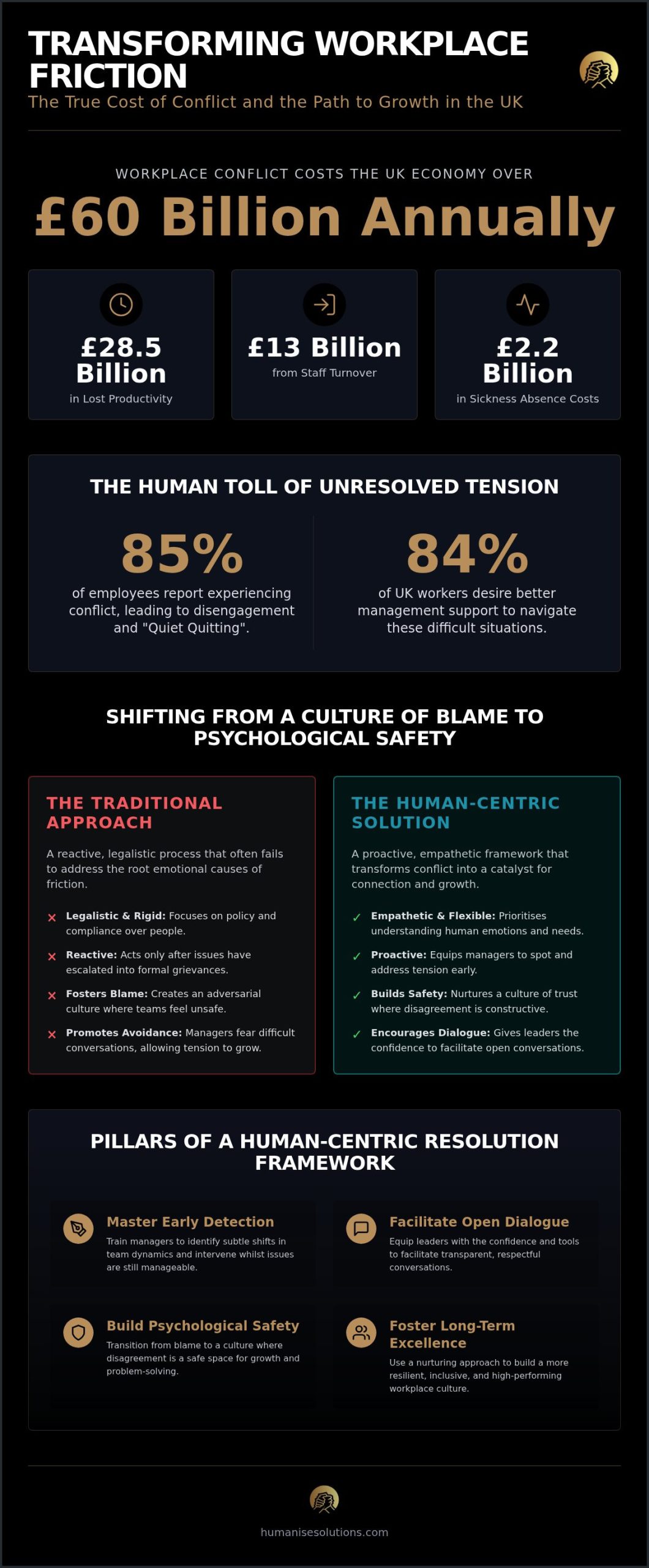
Workplace conflict isn’t just an interpersonal hurdle; it’s a significant drain on the UK economy, costing over £60 billion annually. This staggering figure includes approximately £28.5 billion in lost productivity and £13 billion stemming from staff turnover. For UK SMEs and corporate firms alike, these numbers represent more than just data on a spreadsheet. They reflect the quiet erosion of team morale and the high price of replacing talented individuals who no longer feel supported. When tension is left to simmer, it doesn’t simply disappear. It manifests as missed deadlines, stifled innovation, and a palpable sense of unease that ripples through the entire organisation.
Viewing conflict resolution as a mere box-ticking exercise is a mistake that many businesses can’t afford to make. Instead, forward-thinking leaders recognise that bespoke conflict resolution training for managers UK is a strategic investment in human capital. By equipping your leadership team with the tools to navigate disagreement, you’re not just fixing a problem; you’re cultivating an environment where people feel safe to be authentic. This shift from a blame-heavy culture to one of nurturing leadership is the foundation of sustainable growth and long-term team excellence.
The rise of “Quiet Quitting” amongst UK staff is often a direct result of poorly managed disputes. When 85% of employees report experiencing conflict, and many feel their managers aren’t equipped to help, they don’t always shout about their frustration. They simply disengage. They do the bare minimum, stop contributing ideas, and eventually look for the exit. This lack of psychological safety means that instead of using friction as a catalyst for improvement, teams become stagnant. Investing in conflict resolution training for managers UK ensures that your leaders can spot these early warning signs and intervene with empathy before a minor misunderstanding turns into a resignation letter.
Beyond the Bottom Line: Impact on Wellbeing
Persistent friction erodes the mental health of everyone involved. In the UK, workplace disputes contribute to over £2.2 billion in costs related to sick days. When managers avoid difficult conversations out of fear, the stress doesn’t vanish; it intensifies. This leads to long-term sickness absence and a culture of anxiety. Choosing to ignore conflict is the most expensive strategy a manager can adopt, as it prioritises short-term comfort over the long-term flourishing of the team.
The Gen Z Perspective on Workplace Harmony
Younger talent enters the workforce with a different set of expectations. For Gen Z, workplace harmony isn’t about avoiding disagreement; it’s about inclusive growth and emotional intelligence. They expect leaders to facilitate transparent, respectful dialogue. By bridging the gap between traditional management and modern, human-centric approaches, organisations can use conflict as a tool for social mobility. When managed well, diverse perspectives become a source of strength rather than a point of contention, allowing every generation to thrive together.
Why Traditional Conflict Management Fails: The Role of Psychological Safety
Traditional approaches to workplace friction often lean heavily on “dispute resolution,” a term that suggests a legalistic, reactive process focused on compliance and policy. Whilst following the Acas Code of Practice is essential for remaining within UK employment law, it rarely addresses the emotional fractures that cause conflict in the first place. This is where many leaders feel stuck. They find themselves navigating a maze of grievances and formal meetings that feel sterile and detached, leaving the underlying human tension untouched. To truly build a resilient culture, we must move towards conflict transformation, a human-centric approach that views disagreement as a path to deeper understanding rather than a problem to be suppressed. This shift is the cornerstone of effective conflict resolution training for managers UK, moving beyond surface-level fixes to address the core of human interaction.
The reason 84% of UK workers desire better management support is that most managers don’t feel equipped to handle the heavy emotional lifting required. When a leader lacks the tools to manage these dynamics, they often default to avoidance, which only allows the blame culture to grow. By choosing nurturing leadership, you can shift the narrative. This style of management focuses on building trust and social connection, ensuring that friction is caught early. Acas research on informal resolution confirms that early, human-led interventions are far more successful than waiting for a situation to reach a formal tribunal stage.
The Science of Safety and Performance
When a workplace feels unsafe, the human brain enters a biological state of fight, flight, or freeze. This “amygdala hijack” shuts down the prefrontal cortex, the area responsible for logic and collaboration. In this state, even a small critique feels like a personal attack. Psychological safety is the belief that one will not be punished for speaking up with ideas or concerns. When this safety exists, teams can engage in “healthy dissent,” where they challenge ideas vigorously without the fear of damaging their professional relationships or personal wellbeing.
Emotional Intelligence: The Manager’s Toolkit
Empathy isn’t a “soft skill”; it’s a critical hard skill for modern UK management. It requires the evidence-based confidence to sit with discomfort and listen to what isn’t being said. Effective conflict resolution training for managers UK focuses on active listening as a primary de-escalation tool. By validating a colleague’s experience before jumping to solutions, a manager can lower the emotional temperature of a room, paving the way for logical problem-solving. This approach doesn’t just resolve the immediate issue; it cultivates the long-term internal qualities of resilience and confidence across the entire team.
Choosing the Right Conflict Resolution Training for Your Managers
Selecting the right conflict resolution training for managers UK requires a shift in perspective. It’s not just about learning a set of rules; it’s about cultivating a mindset. A successful programme should integrate seamlessly into your broader organisational wellbeing strategy. When training is isolated, it often fails to take root. Instead, look for development that views conflict as a component of Learning & Development, ensuring that managers see these skills as essential for their daily leadership rather than an occasional emergency tool. This holistic approach ensures that the investment contributes to a wider culture of support and growth.
Many providers offer off-the-shelf digital modules that promise quick results for a low fee. Whilst these might cover the basics of UK employment law, they often lack the depth required to change long-standing behaviours. Human dynamics are complex and fluid. They require a human-led environment where managers can practice difficult conversations in a safe, guided space. Ongoing support and coaching after the initial workshop are equally vital. Real change happens in the weeks following training, when a manager tries a new approach and needs a mentor to help refine their technique and build lasting confidence.
Bespoke Workshops vs. Digital Modules
Conflict is rarely a linear process. It involves subtle cues, emotional triggers, and historical team dynamics that a pre-recorded video simply cannot address. Bespoke workshops allow for role-play using real-world UK case studies that reflect your specific industry challenges. This is particularly effective for teams navigating multi-generational friction, where our expertise in Young Adult Programmes helps bridge the gap between different workplace expectations. By focusing on the human behind the manager, we ensure that leaders develop the internal resilience needed to stay calm whilst others are reacting.
Measuring the ROI of Management Training
Investing in high-quality training provides a measurable return through improved employee retention and reduced HR intervention. When managers handle disputes internally with confidence, the time spent on formal grievance procedures drops significantly. You can track success by monitoring team engagement scores and the reduction in “presenteeism” mentioned earlier. Ultimately, the goal is to foster Team Excellence, where the reputation of your leadership attracts and keeps the best talent in the UK market. This sustainable growth is the true hallmark of a successful conflict resolution training for managers UK programme.
How to Implement a Human-Centric Resolution Framework
Implementing a framework for harmony isn’t about following a rigid, one-size-fits-all checklist. It’s about developing a rhythmic awareness of your team’s needs and having the courage to act before a situation spirals out of control. Whilst traditional mediation often waits for a formal grievance to be filed, a human-centric approach prioritises early intervention. This proactive stance is a core element of effective conflict resolution training for managers UK, focusing on the subtle shifts in atmosphere that precede a formal dispute. By following these five steps, you can turn friction into a foundation for growth.
- Step 1: Recognise the early warning signs. Look for “micro-conflicts” such as a sudden shift in communication tone, withdrawal from meetings, or a drop in collaborative spirit. Spotting these whilst they are small prevents them from hardening into resentment.
- Step 2: Create a neutral space. Facilitate a conversation in an environment where everyone feels safe. Given that 73% of workplace conflict stems from a lack of trust, your role is to act as a grounded guide, ensuring mutual respect is the baseline for all dialogue.
- Step 3: Focus on shared interests. Move the conversation away from individual “positions” or egos. Ask questions that uncover common goals, such as the desire for a peaceful work environment or the successful completion of a project.
- Step 4: Co-create a sustainable path. Don’t dictate the solution. Instead, invite the parties to design their own way forward. This fosters a sense of ownership and ensures the resolution supports long-term wellbeing.
- Step 5: Reflect and integrate. Once the immediate tension has passed, take time to reflect on what the conflict revealed about your team’s culture. Use these insights to strengthen your Learning & Development strategy and prevent similar issues from reoccurring.
If you’re ready to move beyond rigid checklists and empower your team, explore how our programmes support nurturing leadership.
Mastering the Art of Difficult Conversations
Initiating a “nurturing” intervention requires a delicate balance of objectivity and care. You might start with a script as simple as: “I’ve noticed a shift in our dynamic lately, and I’d like to understand your perspective on how we can improve things.” This shows you are paying attention without being accusatory. Managing your own emotional state is equally important; if you remain calm and present, you provide a steady anchor for others who may be feeling overwhelmed by the high stakes of the meeting.
Inclusion and Diversity in Conflict
A truly human-centric process must be fair and inclusive for all team members. It’s vital to address unconscious bias, particularly in how managers might perceive “difficult” behaviour from certain groups. Conflict often arises from misunderstood cultural or generational differences. By using these moments to facilitate deeper understanding, you can strengthen the bonds of a diverse workforce. This approach ensures that every voice is heard and valued, turning potential division into a catalyst for Team Excellence.
Cultivating Long-term Team Excellence with Humanise Solutions
At Humanise Solutions, we believe that leadership is much more than a set of administrative tasks; it is a profound path to human flourishing. When we work with UK firms, we don’t just see a workforce; we see a community of individuals with the potential for immense growth and social connection. Our philosophy is rooted in the idea that every interaction, including disagreement, is an opportunity to strengthen the internal qualities of resilience and confidence. By shifting the focus from mere compliance to genuine wellbeing, we help you build a culture where people feel truly seen and valued.
Our approach to conflict resolution training for managers UK is never treated as a standalone fix. Instead, we integrate these vital skills into a wider growth journey that prioritises Learning & Development and Fostering Wellbeing. We understand that a manager’s ability to navigate friction is inextricably linked to their overall leadership style. By embedding these techniques within a broader framework of Team Excellence, we ensure that the progress made during our workshops is sustainable and becomes a natural part of your organisation’s DNA.
We recognise that different teams face unique challenges, which is why we offer specialised tracks to address specific demographic needs. Our Women in Leadership focus empowers female leaders to navigate systemic hurdles with grace and authority, whilst our Young Adult Programmes help bridge the generational gap that often triggers friction in modern offices. These tailored pathways ensure that the resolution process is inclusive and sensitive to the diverse experiences of your staff, turning potential points of contention into foundations for mutual respect.
Our Bespoke Training Methodology
Every workshop we deliver is meticulously tailored to the specific culture and challenges of your firm. We don’t believe in off-the-shelf solutions because human dynamics are too nuanced for a generic approach. Our methodology strikes a sophisticated balance between evidence-based confidence and empathetic warmth. We partner with you for the long term, acting as a wise mentor and guide as you transition from a reactive state to a future where your team thrives on psychological safety and collaboration.
Your Next Steps Towards a Humanised Workplace
Beginning your partnership with Humanise Solutions starts with a deliberate and reassuring consultation. We take the time to listen to your specific pains, from high turnover to a stagnant blame culture, before proposing a methodical plan for development. You can expect a relationship built on trust, transparency, and a shared commitment to human values. If you’re ready to transform workplace friction into a catalyst for growth, we invite you to take the first step today.
Transforming Team Tension into Sustainable Growth
Workplace friction doesn’t have to be a drain on your productivity or a threat to your team’s wellbeing. Transformation starts with empathy. By prioritising psychological safety and adopting a nurturing leadership style, you create an environment where healthy dissent is welcomed and resolved with genuine care. We’ve explored how moving beyond rigid, legalistic procedures allows for a more human-centric approach that protects your bottom line whilst fostering genuine flourishing.
Choosing the right conflict resolution training for managers UK is the first step towards this cultural evolution. Our bespoke programmes are rooted in an evidence-based methodology that tailors every workshop to your firm’s unique challenges. We’re here to help. Whether you’re navigating multi-generational dynamics or seeking to enhance team excellence, we’ll guide your leaders with confidence and warmth. It’s time to replace the fear of difficult conversations with the resilience of a truly connected workforce.
Discover how our bespoke training can transform your management team and help your people thrive together.
Frequently Asked Questions
What is conflict resolution training for managers UK?
It’s a specialised development programme designed to equip leaders with the interpersonal and psychological tools needed to navigate workplace disagreement. Unlike traditional corporate training that focuses solely on policy, a human-centric approach prioritises emotional intelligence and trust building. This training empowers managers to transform friction into a catalyst for team excellence and long-term growth.
How much does bespoke conflict resolution training cost for UK companies?
The investment for management training varies significantly across the UK market depending on the delivery format and the level of customisation required. Whilst self-paced digital modules can be found for as little as £25 per person, bespoke workshops that include role-play and ongoing coaching reflect a higher level of specialist expertise. We recommend discussing your specific organisational needs with a consultant to receive an accurate, tailored proposal.
Can conflict resolution training be delivered online or must it be in-person?
Training is available in both formats, though the choice should align with your team’s specific culture. Online sessions offer flexibility for hybrid workforces, whilst in-person workshops provide a high-touch environment that’s particularly effective for practicing difficult conversations. Many UK firms now opt for hybrid models that combine the convenience of digital learning with the deep emotional resonance of face-to-face interaction.
Is this training suitable for new managers or just experienced leaders?
This training is vital for leaders at every stage of their career. New managers often need help building the foundational confidence to address tension early, whilst experienced leaders benefit from refining their empathy and adapting to the shifting expectations of a multi-generational workforce. It’s a core component of any robust Learning & Development strategy, ensuring that leadership remains nurturing and effective regardless of tenure.
How does conflict resolution training improve employee retention?
It improves retention by creating a culture of psychological safety where staff feel their concerns are handled with respect and fairness. When leaders possess the skills to de-escalate tension, employees are less likely to experience the burnout or disengagement that leads to “Quiet Quitting.” UK workers who feel supported by their managers during disputes report higher levels of loyalty and a stronger sense of belonging.
What is the difference between mediation and conflict resolution training?
Mediation is generally a reactive process where a neutral third party intervenes to resolve a specific, existing dispute. In contrast, conflict resolution training for managers UK is a proactive investment in skill-building. It equips your internal leadership team with the confidence to handle daily friction independently, often preventing misunderstandings from ever reaching the stage where formal mediation or grievance procedures are required.
How do you measure the success of a management training programme?
Success is measured through a blend of qualitative feedback and measurable organisational shifts. You might track improvements in team engagement scores, a reduction in the time HR spends on formal disputes, or an increase in staff retention rates. On a daily level, the success of the programme is evident when managers initiate difficult conversations with empathy and teams demonstrate a higher capacity for collaborative problem-solving.
Does this training cover UK employment law and ACAS guidelines?
Yes, effective training ensures that all human-centric interventions remain grounded in the Acas Code of Practice. Whilst the focus is on nurturing leadership and emotional intelligence, it’s essential that managers understand the legal benchmarks for fair procedure in the UK. This dual approach protects the organisation from tribunal risks whilst ensuring that every team member is treated with the dignity and respect they deserve.
