Article by
Scott Ward MBA CCMI
Scott Ward is the founder and CEO of Humanise Solutions, which he established three years ago to help organisations elevate their people, leadership and culture through a human-centric, evidence-based approach. Before moving into business and academia, Scott spent seven years as a professional footballer, playing for Luton Town, Crawley Town and Coventry City FC until injury brought his playing career to a close — a turning point that shaped both his research interests and his approach to leadership.
Scott holds an MBA from Warwick Business School, where his research explored the causal relationship between trauma and decision-making — work that continues to inform how he supports young adults, leaders and teams under pressure. Recognised as a Companion of the Chartered Management Institute (CCMI), its highest grade of membership, he combines academic rigour with the discipline, resilience and team-first mindset of the professional game. At the heart of everything he does is a simple belief: that people perform at their best when they are led, developed and valued as human beings first.
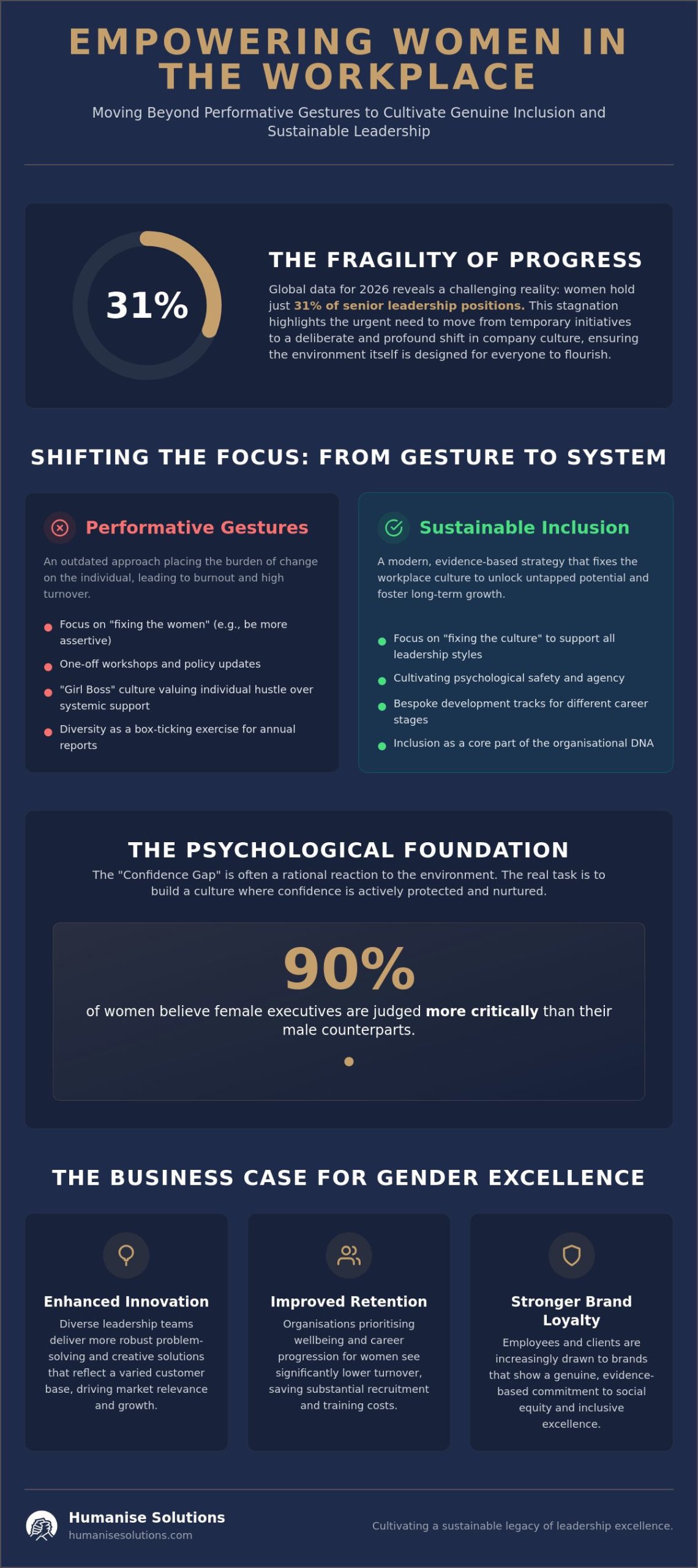
Why is it that despite years of diversity initiatives, the number of women in senior leadership roles has actually begun to stall or even decline? In 2026, global data shows women hold just 31% of senior positions, a figure that reminds us how fragile progress can be. It’s a frustrating reality for many UK organisations that find their brightest female talent leaving whilst they are reaching their professional peak. Truly empowering women in the workplace requires more than a policy update or a one-off workshop; it demands a deliberate shift in the very soil of your company culture.
You likely recognise that performative gestures aren’t enough to bridge the gap between entry-level representation and C-suite reality. It’s exhausting to watch high-potential leaders walk away because the environment doesn’t support their flourishing. This guide will show you how to move beyond surface-level changes to cultivate a psychological environment where women lead with genuine confidence. We’ll explore the evidence-based strategies needed to dismantle unconscious bias amongst your teams, build sustainable leadership pipelines, and nurture a culture of inclusive excellence that prioritises long-term wellbeing.
Key Takeaways
- Learn to distinguish between performative gestures and sustainable inclusion to foster genuine agency and voice amongst your female talent.
- Understand how cultivating psychological safety can bridge the “Confidence Gap” and encourage women to lead with conviction and authenticity.
- Discover how to organise transparent career pathways using bespoke learning and development modules tailored to different professional stages.
- Identify the invisible structural hurdles in your organisation and move from simple bias awareness to meaningful, lasting behaviour change.
- Explore the vital link between wellbeing and professional growth when empowering women in the workplace to ensure long-term leadership excellence.
What Does Empowering Women in the Workplace Truly Mean?
Empowerment is often reduced to a corporate buzzword, yet its true essence is far more profound. At its heart, What Does Empowering Women Truly Mean? It involves the deliberate cultivation of agency, voice, and opportunity. It isn’t about granting permission or “allowing” someone to succeed; it’s about removing the structural and psychological barriers that prevent women from stepping into their full potential. In 2026, with data showing women hold just 31% of senior leadership roles, the need for a deeper approach is clear. We’re moving away from performative diversity where organisations merely tick boxes for an annual report. Sustainable inclusion requires a shift in the very soil of the workplace, ensuring that the environment itself is designed for human flourishing.
Historically, professional development often focused on “fixing the women”-teaching them to be more assertive or to “lean in.” This approach is fundamentally flawed. It places the burden of change on the individual rather than the system. Empowerment today means fixing the workplace culture. It’s about creating a space where different leadership styles are valued and where the unique perspectives women bring are seen as essential assets for organisational growth. When we stop trying to mould women into traditional, often masculine, leadership archetypes, we unlock a wealth of untapped talent.
Beyond the Slogans: Moving to Authentic Action
The era of “Girl Boss” culture, with its focus on individualistic hustle and superficial aesthetics, has largely faded. It failed because it didn’t address the systemic issues that cause burnout and high turnover amongst female talent. What’s replacing it is a focus on human value and nurturing leadership. This style of leadership prioritises empathy and psychological safety, recognising that when people feel safe, they take the risks necessary for growth. Empowering women in the workplace now involves creating bespoke development tracks that acknowledge the specific challenges women face at different career stages, from entry-level hurdles to the “glass cliff” of senior appointments.
The Business Case for Gender Excellence
Investing in female talent isn’t just a moral imperative; it’s a strategic necessity. Diverse leadership teams are proven to be more resilient and innovative, especially in the volatile market conditions of 2026. When women are supported to lead with confidence, it elevates the entire team’s performance. This isn’t just about representation; it’s about the bottom line.
- Innovation: Varied perspectives lead to more robust problem-solving and creative solutions that reflect a diverse customer base.
- Retention: Organisations that prioritise wellbeing and career progression for women see significantly lower turnover rates, saving on the high costs of recruitment.
- Brand Loyalty: In the UK, employees and clients alike are increasingly drawn to brands that demonstrate a genuine, evidence-based commitment to social equity.
By fostering wellbeing alongside performance, companies build a sustainable pipeline of talent. This approach ensures that empowering women in the workplace becomes a permanent part of the organisational DNA rather than a temporary initiative. It’s about building a legacy of excellence that benefits everyone.
The Psychological Foundation: Cultivating Inner Confidence
Confidence is rarely a fixed personality trait; rather, it’s a psychological response to one’s environment. Many organisations frequently discuss the “Confidence Gap,” yet this conversation often misses the underlying cause. Why do women sometimes hesitate to claim their space? A 2026 survey revealed that 90% of women believe female executives are judged more critically than their male counterparts. This indicates that what we perceive as a lack of confidence is often a rational reaction to a high-pressure, high-scrutiny landscape. Truly empowering women in the workplace means creating a culture where confidence is not just expected, but actively protected and nurtured.
We must dismantle the outdated myth of female rivalry, which suggests that there is only room for one woman at the top. When organisations foster a culture of collective flourishing, the success of one leader becomes a roadmap for others. This systemic shift is supported by The Women’s Empowerment Principles, a globally recognised framework that emphasises gender equality as a holistic organisational commitment. By adopting a style of nurturing leadership, managers can validate diverse perspectives, ensuring that “speaking up” is viewed as a celebrated contribution rather than a professional risk.
Nurturing Resilience and Self-Belief
Leadership training shouldn’t be confined to managing budgets or projects. It must also address the internal strengths that allow a leader to remain grounded during periods of turbulence. Many talented women struggle with imposter syndrome, not because they lack competence, but because they are operating in systems that weren’t originally designed with them in mind. Psychological safety is the bedrock of female career progression, providing the essential security needed to innovate without fear of disproportionate criticism. Evidence-based development modules help leaders reframe internal narratives, turning self-doubt into a catalyst for self-awareness and growth.
Fostering Wellbeing as a Growth Catalyst
Professional confidence cannot exist in a vacuum of exhaustion. When women are pushed towards burnout, their capacity for resilience and strategic thinking inevitably diminishes. This remains a primary leak in the leadership pipeline. Organisations must organise work patterns that respect human limits, recognising that rest is a performance requirement rather than a luxury. By prioritising wellbeing, you are doing more than just supporting staff; you are protecting your most valuable leadership assets. Empowering women in the workplace requires a commitment to sustainable growth, ensuring that every individual has the physical and emotional energy to lead with genuine conviction.
Practical Strategies to Organise for Equality
Creating a culture of excellence requires moving beyond intentions into the realm of structural design. When we talk about empowering women in the workplace, we must look at the mechanics of how people move through an organisation. It’s not enough to hope that talent rises to the top; we must build the ladders. This starts with implementing bespoke learning and development programmes that address the specific needs of women at various career stages. Whether it’s a young professional finding her feet or a seasoned executive facing the “glass cliff,” tailored support ensures that growth is both sustainable and measurable.
Transparency is the antidote to bias. Organisations often fail their female talent because the path to promotion feels opaque or inconsistent. By defining clear, evidence-based criteria for progression, you remove the guesswork and the “old boys’ club” dynamics that often hinder diverse talent. Integrating strategies to support women in the workforce involves more than just policy; it requires a commitment to pay equity and flexible work structures that don’t carry a “career penalty.” Flexibility should be viewed as a strategic tool for performance, allowing for a better integration of professional goals and personal wellbeing.
Mentorship vs. Sponsorship: Which Does Your Firm Need?
Whilst mentorship provides essential advice and a listening ear, sponsorship provides a seat at the table. Mentors talk to you; sponsors talk about you in the rooms where decisions are made. To truly foster women leadership, senior leaders must be trained to move beyond being advisors to becoming active advocates. This involves identifying high-potential women and putting their names forward for high-stakes projects and roles. Building cross-gender advocacy networks ensures that sponsorship isn’t confined to existing social circles, but is instead a deliberate part of your team excellence strategy.
Inclusive Leadership Training for All Levels
Middle management is often where cultural intentions meet daily reality. Educating managers on the nuances of gender-inclusive leadership is vital for maintaining a healthy pipeline. This includes practical skills like meeting facilitation, ensuring that every voice is heard and that credit for ideas is correctly attributed. Inclusive leadership programmes UK-wide are evolving to focus on empathy, recognising that emotional intelligence is a core requirement for modern, high-performing teams. By equipping leaders at every level with these tools, you ensure that the values of inclusion are lived in every interaction, not just discussed in boardrooms.
Navigating Systemic Barriers and Unconscious Biases
Systemic barriers are often the “ghosts in the machine” of an organisation. They aren’t always loud or obvious; instead, they exist in the silent assumptions and historical structures that dictate who gets noticed and who gets promoted. Identifying these invisible hurdles requires a level of radical honesty from leadership. For instance, recent data from 2026 shows a slight widening of the uncontrolled gender pay gap, with women earning £0.82 for every £1 earned by men. This regression suggests that whilst we’ve focused on awareness, we haven’t yet mastered the art of behaviour change. Empowering women in the workplace means moving beyond simple bias training and into the realm of data-driven equity reviews.
One of the most persistent hurdles is the “motherhood penalty,” a systemic bias that views a commitment to family as a lack of professional ambition. Addressing this requires more than just a maternity policy; it needs strategic support that integrates wellbeing into the career arc. We must move away from the idea that career paths are linear and uninterrupted. By normalising breaks and providing clear “re-entry” pathways, organisations can protect their leadership pipelines and ensure that talent isn’t lost during life’s transitions. You can begin this transformation today by exploring our bespoke Women leadership development tracks, designed to navigate these very complexities.
De-biasing the Recruitment and Promotion Process
Traditional recruitment often rewards extroversion and “loud” confidence, frequently overlooking what we call “quiet brilliance.” This bias can inadvertently sideline women who lead with empathy and collaboration rather than dominance. To counter this, organisations should implement objective, evidence-based criteria for every stage of the promotion cycle. When performance is measured through clear metrics rather than “cultural fit,” you create a fairer environment where diverse styles of leadership can flourish. Normalising flexible working for all genders is equally vital, as it removes the stigma often attached to women who utilise these arrangements.
Supporting the Next Generation: Young Adult Development
The transition from education to the professional world is a critical window for young women, particularly those from underrepresented backgrounds. Bridging the social mobility gap requires targeted professional development that builds confidence from day one. Gen Z talent prioritises belonging and purpose; they aren’t just looking for a job, they’re looking for a culture that aligns with their values. Our Young Adult Programmes focus on equipping early-career women with the resilience and agency needed to navigate corporate structures. By investing in these foundational stages, you aren’t just filling entry-level roles; you’re cultivating the inclusive excellence of your future boardroom.
Cultivating a Sustainable Legacy: The Humanise Solutions Approach
Sustainable change isn’t a destination; it’s a legacy built through deliberate, daily actions. At Humanise Solutions, we believe that empowering women in the workplace requires more than a standard curriculum. It requires a methodology that acknowledges the intricate dance between professional ambition and personal flourishing. Traditional corporate training often feels detached, focusing on skills in a vacuum. Our approach is different. We view leadership as a holistic endeavour, rooted in the cultivation of internal resilience and the nurturing of social connections. By shifting the focus from sterile metrics to human potential, we help organisations move from performative gestures to authentic, lasting transformation.
This human-centric philosophy outlasts traditional methods because it addresses the person behind the professional. When a culture prioritises psychological well-being, it creates a foundation where high performance is a natural byproduct rather than a forced outcome. Empowering women in the workplace becomes a shared journey of development, where the organisation and the individual grow in tandem. This steady, methodical pace of change ensures that progress is not just a temporary spike in diversity data, but a permanent evolution of your organisational DNA.
Bespoke Women in Leadership Tracks
One-size-fits-all programmes rarely address the nuanced realities of a woman’s career path. This is why our development tracks are bespoke, designed to meet individuals exactly where they are. Whether a leader is navigating the early challenges of management or preparing for a board-level appointment, the growth journey must be personalised to be effective. We utilise cohort-based learning to create powerful peer support networks, ensuring that progress isn’t a solitary pursuit. These cohorts provide a safe space for open dialogue and collective problem-solving, allowing women to build the confidence and connections necessary to lead with genuine agency. Our programmes focus on nurturing the whole person, recognising that professional excellence is inseparable from personal wellbeing.
Partnering for Human Flourishing
Driving cultural change is a collaborative process. As your partner, we help you build inclusive team excellence by addressing the underlying human dynamics that drive performance. This involves identifying the specific levers within your culture that will accelerate growth and foster a sense of belonging for everyone. We don’t dictate from a distance; instead, we position ourselves as guides in your journey of development, providing the evidence-based logic and empathetic support needed to navigate complex social dynamics. The first step towards this sustainable legacy is a clear-eyed assessment of your current organisational climate. By understanding your starting point, you can begin to build a culture where every leader has the opportunity to thrive. Discover how our Women in Leadership programmes can transform your organisation.
Building a Legacy of Inclusive Excellence
Truly transforming an organisation requires a shift from surface-level policies to a deep-rooted commitment to human flourishing. We’ve explored how moving beyond performative gestures and addressing the psychological bedrock of confidence can dismantle the systemic barriers that frequently hold talent back. By prioritising wellbeing as a performance catalyst and organising transparent pathways for progression, you create an environment where every individual can lead with authenticity and purpose.
The journey of empowering women in the workplace is a continuous process of cultivation and care. It’s about building a sustainable pipeline of talent through expert-led bespoke development tracks and an evidence-based nurturing leadership methodology. This approach doesn’t just improve retention; it fosters a culture of team excellence that benefits your entire organisation. When you choose to invest in the whole person, you aren’t just meeting a diversity quota; you’re future-proofing your business for a volatile world.
Begin your journey towards inclusive excellence with Humanise Solutions. Your commitment to this evolution today is the foundation for a more resilient, vibrant, and innovative boardroom tomorrow. Let’s work together to build a workplace where everyone has the psychological safety to thrive.
Frequently Asked Questions
How can I empower women in my workplace without making others feel excluded?
Empowering women in the workplace is about expanding the pie, not redividing it. By focusing on inclusive excellence, you create a culture where every individual’s unique strengths are recognised and valued. This isn’t about giving one group an unfair advantage; it’s about removing the specific, often invisible barriers that have historically hindered female talent. When the workplace becomes more equitable and psychologically safe for women, it often becomes a more supportive and productive environment for everyone.
What are the most effective leadership training programmes for women in the UK?
The most effective programmes are those that move beyond generic skills to offer bespoke, evidence-based development tracks tailored to different career stages. In the UK, forward-thinking organisations are moving towards cohort-based learning that focuses on nurturing leadership and psychological safety. These programmes should provide the specific tools needed for sustainable growth whilst fostering peer support. Humanise Solutions offers specialised modules that prioritise human flourishing, ensuring that leadership development feels grounded and relevant to modern professional challenges.
Why is psychological safety particularly important for female employees?
Psychological safety is the essential bedrock that allows female employees to take risks and voice opinions without fear of disproportionate criticism. Given that women often face higher levels of scrutiny in professional environments, having a safe space to innovate is vital for their career progression. Without this foundation, even the most talented women may hesitate to step into leadership roles or share creative ideas. It’s about creating a culture where “speaking up” is consistently validated and rewarded across the board.
How does flexible working actually contribute to female empowerment?
Flexible working is a strategic tool that allows women to integrate their professional ambitions with personal responsibilities without facing a “career penalty.” By normalising flexible work patterns for all genders, organisations can dismantle the motherhood penalty and protect their leadership pipelines. This isn’t just an HR benefit; it’s a way to organise for equality. When work respects human limits, it drives better performance and ensures that talented women can remain in the workforce and progress for the long term.
What is the difference between mentorship and sponsorship for women leaders?
Mentorship provides the advice and guidance needed to navigate a career, whilst sponsorship involves active advocacy in rooms where decisions are made. Whilst both are valuable, sponsorship is often the missing link for women reaching senior roles. A sponsor uses their own professional capital to open doors and suggest a woman’s name for high-stakes projects or promotions. To truly foster women leadership, organisations must train senior executives to move from being passive advisors to active, vocal sponsors.
How can small organisations with limited budgets empower their female staff?
Small organisations can empower female staff by prioritising cultural transparency and fostering peer-to-peer support networks. You don’t need a massive budget to define clear, objective criteria for promotion or to create a culture of psychological safety. Simple actions, like ensuring every voice is heard in meetings and acknowledging “quiet brilliance,” can make a significant impact. By focusing on nurturing leadership at every level, small firms can build a resilient and inclusive team culture naturally and sustainably.
What are the key benefits of women in leadership training for a firm?
Investing in female leadership training drives innovation and enhances organisational resilience by bringing varied perspectives to the boardroom. Diverse leadership teams are better equipped to solve complex problems and reflect a diverse customer base, which is a strategic necessity in 2026. Beyond the bottom line, these programmes significantly improve staff retention and reduce the high costs associated with turnover. When women feel supported to lead with confidence, the entire team’s excellence is elevated, building stronger brand loyalty amongst employees.
How can we support young women entering the workforce for the first time?
Supporting young women requires targeted development that focuses on building resilience and a sense of belonging from day one. Early-career programmes should bridge the gap between education and the professional world, helping Gen Z talent navigate corporate structures with agency. By providing specific mentorship and early-career growth tracks, you help them cultivate the internal strengths needed for long-term success. This foundational support ensures that the next generation of leaders feels empowered to contribute their full potential to the organisation immediately.