

Article by
Scott Ward MBA CCMI
Scott Ward is the founder and CEO of Humanise Solutions, which he established three years ago to help organisations elevate their people, leadership and culture through a human-centric, evidence-based approach. Before moving into business and academia, Scott spent seven years as a professional footballer, playing for Luton Town, Crawley Town and Coventry City FC until injury brought his playing career to a close — a turning point that shaped both his research interests and his approach to leadership.
Scott holds an MBA from Warwick Business School, where his research explored the causal relationship between trauma and decision-making — work that continues to inform how he supports young adults, leaders and teams under pressure. Recognised as a Companion of the Chartered Management Institute (CCMI), its highest grade of membership, he combines academic rigour with the discipline, resilience and team-first mindset of the professional game. At the heart of everything he does is a simple belief: that people perform at their best when they are led, developed and valued as human beings first.
Your office fruit bowl and Friday yoga sessions aren’t failing because they lack heart; they’re failing because they lack evidence. For many leaders, the frustration of watching high staff turnover persist despite a suite of modern perks is a heavy burden to carry. You’ve likely felt the sting of disengaged Gen Z talent and the quiet exhaustion of middle management, wondering why your investment in evidence based wellbeing at work isn’t translating into resilience or growth. It’s a common challenge, but it’s one that can be solved by shifting from reactive benefits to a deliberate, scientific architecture.
We agree that human flourishing shouldn’t be a guessing game. This guide shows you how to move beyond surface-level fixes by nurturing leadership that truly lasts. We will examine how 12 years of research into trauma prevention and decision-making provides a roadmap to fostering wellbeing and securing the measurable ROI your strategy deserves.
Key Takeaways
- Learn how to transition from surface-level perks to a strategic architecture that integrates psychological science with organisational data.
- Discover the “Nurturing Leadership” model, where empathy and high performance coexist to drive sustainable team excellence and growth.
- Master a structured framework for implementing evidence based wellbeing at work, ensuring your strategy is grounded in logic and board-level alignment.
- Understand the measurable ROI of fostering wellbeing, from reducing absenteeism to bridging the social mobility gap for disengaged young talent.
- Explore how ILM-certified leadership and human-centric innovation can prevent change fatigue and cultivate a resilient, future-ready culture.
What is Evidence-Based Wellbeing at Work in 2026?
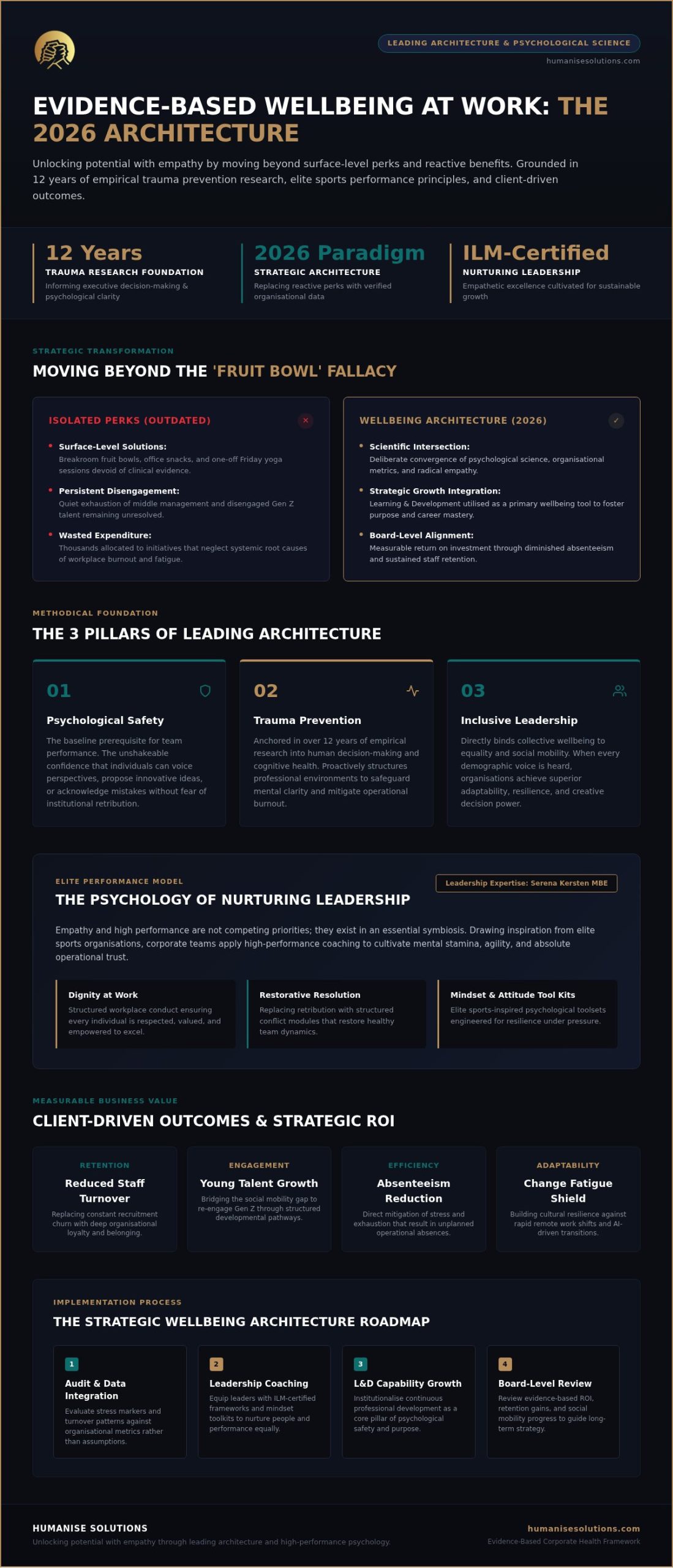
By 2026, the definition of corporate wellness has undergone a radical transformation. It’s no longer enough to offer isolated benefits; true evidence based wellbeing at work is now understood as the deliberate intersection of psychological science, organisational data, and deep human empathy. This approach moves away from the “wellbeing perks” of previous decades, such as gym memberships or office snacks, and towards a robust “wellbeing architecture.” This architecture is designed to support the human experience within a professional context, ensuring that every initiative is grounded in logic rather than trends.
The integration of AI and the permanence of remote work have created a more complex emotional landscape for employees. Isolation and digital fatigue are real risks that require a sophisticated response. At Humanise Solutions, our philosophy centres on elevating people through a human-centric, scientific approach. We believe in fostering wellbeing by addressing the fundamental psychological needs of your workforce, turning potential into performance through methodical care.
The Core Pillars of Scientific Wellbeing
Effective wellbeing strategies are built on three essential pillars that ensure long-term sustainability. Psychological safety is the primary foundation; it’s the belief that one can speak up or make mistakes without fear of retribution. Without this safety, high-performing teams simply cannot exist. We also prioritise trauma prevention, drawing on over 12 years of research into decision-making processes and psychological health to create environments that protect mental clarity. Finally, inclusive leadership ensures that collective health is tied to equality. When every voice is heard and valued, the organisation becomes more resilient and adaptable to change.
Moving Beyond the ‘Fruit Bowl’ Fallacy
Surface-level initiatives often fail because they ignore the root causes of burnout and disengagement whilst costing organisations thousands in wasted budget. A fruit bowl in the breakroom cannot fix a culture of overwork or a lack of clear communication. To truly support your staff, wellbeing must be integrated into professional growth. We view Learning & Development as a vital wellbeing tool; when people feel they are growing and mastering new skills, their sense of purpose and resilience increases.
By shifting the focus to nurturing leadership, you create a ripple effect of health throughout the entire company. It’s about building a culture where leaders are equipped to manage both performance and people with equal confidence. Explore our services for a deeper look at human-centric growth and discover how to build a strategy that delivers genuine, measurable results for your team.
The Psychology of Nurturing Leadership and Team Excellence
Leadership determines the psychological climate of an organisation. It can either foster a flourishing environment or fracture the very foundations of team stability. The “Nurturing Leadership” model demonstrates that empathy and high performance are not opposing forces; rather, they are symbiotic. Under the expertise of Serena Kersten MBE, we apply workplace psychology to transform team dynamics, ensuring that evidence based wellbeing at work is woven into the fabric of daily operations. This isn’t just about feeling good. It’s about creating a leading architecture where every individual feels empowered to contribute their best work.
Sustaining this excellence requires a commitment to “Dignity at Work.” When conflict arises, it must be met with structured “Conflict Resolution” modules that prioritise restoration over retribution. By aligning these internal policies with workplace stress and employee well-being research, organisations can build a culture that proactively manages the pressures of modern business. It’s about moving from reactive management to a deliberate, scientific approach to human connection.
Leading with Empathy and Evidence
Effective management relies on a sophisticated blend of emotional intelligence and the right “Mindset and Attitude Tool Kits.” We teach leaders how to navigate the nuances of human behaviour whilst maintaining a focus on organisational goals. This approach directly reduces staff turnover. When employees feel nurtured rather than just managed, their loyalty increases and morale improves. It turns a workplace into a community. To see how these principles apply to your specific challenges, you might reach out to us for a consultation on your current leadership strategy.
Elite Performance Behaviours
We draw deep inspiration from elite sports organisations to help corporate teams achieve peak performance. Our High Performance Leads work with your staff to cultivate resilience and maintain belief, even during periods of rapid change. Critical to this is an honest awareness of “Banter & Bullying.” We help teams distinguish between healthy camaraderie and behaviours that undermine psychological safety. By fostering a culture of respect, you ensure that your investment in evidence based wellbeing at work yields a truly high-performing workforce. This methodical care is what separates visionary leaders from the rest. You can find more about our specific Learning & Development programmes to support this transition.
A Strategic Framework for Implementing Evidence-Based Wellbeing
Implementing evidence based wellbeing at work isn’t a one-off event; it’s a methodical journey of cultivation. We centre our approach on Step 1: Audit and Assessment, identifying specific skill gaps and developmental needs through organisational data. This ensures we aren’t guessing what your team needs but are instead responding to their actual experiences. Next, Step 2 involves Leadership Alignment. It’s vital that the board understands the scientific case for these initiatives. Research regarding the business value of belonging and human-centric leadership demonstrates that when employees feel they truly belong, performance peaks. This requires board-level commitment to move from a “perk” mindset to a structural one.
Once aligned, we move to Step 3: Bespoke Programme Design. This isn’t about generic slides; it’s about ILM-certified workshops and e-learning tailored to your unique culture and the specific decision-making challenges your staff face. Step 4 is Integration, where we embed these principles into your Organisational Design and Succession Planning. This ensures that as your company grows, your commitment to human flourishing remains a core pillar. Finally, Step 5 utilises a Continuous Evaluation process. By applying the CPD cycle, we ensure that the strategy evolves alongside your workforce, maintaining long-term sustainability and logic through every transition.
Designing for Human Outcomes
Off-the-shelf wellbeing packages often lack the nuance required to solve deep-seated cultural issues. We prioritise Bespoke Learning because every organisation’s heartbeat is different. By integrating Self-Care and Resilience into daily behaviours, we move beyond theory into practice. You can discover our bespoke L&D programmes which are designed to foster this steady progression and growth within your teams.
Addressing Modern Stressors
The hybrid world has introduced new pressures, from “Email Stress” to the exhaustion of back-to-back remote meetings. A sophisticated strategy must address these whilst also supporting significant life transitions, such as Menopause in the Workplace. We help you navigate these sensitive areas with empathy whilst ensuring full Information Governance and GDPR compliance. It’s about maintaining a human touch in a digital age, ensuring that your evidence based wellbeing at work strategy is both compassionate and pragmatically sound.
The ROI of Wellbeing: Bridging the Social Mobility Gap
Nurturing potential within a workforce requires more than good intentions; it demands a clear-eyed understanding of the economic impact of human flourishing. At Humanise Solutions, we’ve seen first-hand how a scientific approach transforms lives. Our programmes currently deliver a 100% completion rate, with job outcomes ranging from 50-80%. These figures represent more than just successful training; they indicate a significant shift in how organisations can bridge the social mobility gap whilst securing their own future. When you invest in the human experience, the returns are reflected in both your culture and your balance sheet.
As of 2024, approximately 807,000 young people (4.5% of the 18-24-year-old population) are classified as NEET. This represents a staggering loss of talent for the UK economy. When we dig deeper, the data shows that 31% of these individuals cite mental-health barriers as their primary reason for not working. This is where evidence based wellbeing at work becomes a vital recruitment and retention strategy. By addressing these barriers through a leading architecture of support, we can unlock the potential of a generation that feels disengaged from the traditional corporate world. It’s about turning vulnerability into a source of resilient strength.
Positioning Young Adult Development as a central pillar of your organisational strategy is about more than corporate social responsibility. It’s a pragmatic move to future-proof your talent pipeline. When we treat wellbeing as a foundational element rather than a perk, we create a workplace where the next generation doesn’t just survive; they thrive. This steady, methodical care is what builds long-term loyalty and reduces the churn that so often plagues modern firms.
Supporting the Next Generation
Social mobility training is a strategic tool to reduce long-term recruitment costs. By providing structured onboarding and development, you bridge the gap for young adults who might otherwise feel excluded from professional spaces. We focus on cultivating the internal qualities of confidence and resilience from day one. Explore our young adult development initiatives to understand how we turn disengagement into excellence through human-centric innovation.
Quantifying Qualitative Change
Measurement is the bridge between a vision and its realisation. We use our 9.98% feedback rating as a standard for training excellence, ensuring that every session delivers tangible, logical value. When performance improvement and talent management are driven by a deep commitment to growth, the result is a high-performing workforce. To understand the full scope of our methodology, explore our specialist leadership and wellbeing services. If you’re ready to see how these outcomes can transform your organisation, contact us to discuss your wellbeing ROI.
Elevating Culture Through Human-Centric Innovation
Culture is the ultimate expression of an organisation’s health. It’s the invisible thread that connects individual performance to collective success. To elevate this culture, we must move beyond administrative policies and embrace human-centric innovation. Our Women Leadership ILM Programmes play a vital role in this transition, helping to create a more balanced and healthy organisation. By nurturing the specific strengths of women in leadership, we foster an environment where emotional intelligence is integrated into the very fabric of organisational behaviours. This shift ensures that leadership is not just about direction, but about the steady cultivation of a supportive community.
Innovation often requires Change & Transformation, but these processes frequently trigger anxiety and “change fatigue” amongst even the most resilient teams. We humanise these transitions by grounding them in logic and empathy. By preparing leaders to navigate the psychological impact of change, we protect the workforce from burnout whilst maintaining momentum. This approach ensures that your commitment to evidence based wellbeing at work remains visible and effective, even during periods of rapid growth or structural shifts. It’s about building a leading architecture that remains stable regardless of external pressures.
The Humanise Solutions Difference
Our perspective is unique because it’s built on a dual foundation of recruitment excellence and psychological research. As the 5th largest digital recruiter in EMEA, we possess an end-to-end view of the talent lifecycle that few consultancies can match. We understand what draws talent in and what makes them flourish over the long term. We bridge the gap between hiring and retention through 1-1 coaching and the development of Personal Action Plans. This human-centric, scientific approach celebrates all unique abilities, ensuring that every individual has a clear, supported path to success. We don’t just manage people; we unlock their potential with methodical care.
Ready to Humanise Your Workplace?
True transformation requires a partner who is as invested in your people as you are. We invite leaders to move away from sterile consulting models and partner with a team that prioritises nurturing leadership. For those seeking an immediate cultural impact, our Half-Day and Full-Day Certified Workshops provide practical, evidence-based tools that your team can implement straight away. These sessions are designed to spark a sense of momentum and elevation across your entire organisation.
Wellbeing is not a final destination or a tick-box on a checklist. It is a continuous path of elevation and a celebration of the unique skills each person brings to the table. By choosing to implement evidence based wellbeing at work, you are choosing a future where human flourishing and organisational growth are inextricably linked. Contact Humanise Solutions to elevate your people and culture and begin your journey towards a more resilient, human-centric workplace.
Cultivating a Future of Human Flourishing
The transition from surface-level perks to a robust architecture of wellbeing is a strategic necessity for the modern workplace. By integrating over 12 years of research-backed methodology into your organisational design, you move from reactive fixes to a state of sustainable team excellence. We’ve explored how nurturing leadership and structured frameworks can bridge the social mobility gap whilst driving measurable growth. It’s a commitment to a human-centric approach that’s reflected in a 100% completion rate across all initiatives and a 9.98% feedback rating for programme delivery.
Adopting evidence based wellbeing at work ensures your leadership remains resilient and your culture stays inclusive. This journey of development is a partnership that celebrates unique abilities and unlocks the latent potential within every team member. If you’re ready to build a workplace where people truly thrive and grow, we’re here to guide your progress with empathy and logic.
Elevate your leadership and culture with our evidence-based programmes and start your transformation today. The potential for growth is limitless when you prioritise the human experience.
Frequently Asked Questions
What does evidence-based wellbeing actually mean for a business?
Evidence-based wellbeing is the integration of psychological science, organisational data, and human empathy to create a sustainable workplace architecture. Instead of relying on surface-level perks, this approach uses over 12 years of research to address the root causes of stress and disengagement. It’s a shift from reactive benefits to a logical, human-centric strategy that prioritises long-term resilience. By grounding initiatives in methodology, businesses ensure their investment in evidence based wellbeing at work delivers genuine, measurable results.
How can we measure the ROI of our wellbeing programmes?
Measuring ROI involves tracking both qualitative feedback and quantitative outcomes. At Humanise Solutions, our programmes achieve a 100% completion rate and deliver job outcomes between 50% and 80%. We also use our 9.98% feedback rating as a benchmark for training excellence. By monitoring reductions in absenteeism, improved retention rates, and the successful transition of talent into high-performing roles, organisations can clearly see the economic impact of their wellbeing investment.
Is nurturing leadership compatible with high-performance targets?
Nurturing leadership is actually a prerequisite for sustained high performance. Empathy and elite performance behaviours are symbiotic; when leaders provide psychological safety, teams are more likely to innovate and take calculated risks. We draw on experience from elite sport to show that resilience and belief are cultivated through support, not pressure. A nurturing approach creates the stability required to meet ambitious targets whilst preventing the burnout that often fractures high-pressure environments.
What are the most common mental health barriers for young adults entering the workforce?
Many young adults face significant psychological hurdles during their career transition. As of 2024, 31% of the 807,000 young people classified as NEET cite mental-health barriers as their reason for not working. Common issues include imposter syndrome, anxiety regarding remote work, and a lack of resilience in high-pressure settings. Our Young Adult Programmes address these by providing structured onboarding and personal action plans, helping to bridge the social mobility gap with empathy.
How do bespoke L&D programmes differ from standard corporate training?
Standard corporate training often relies on generic, off-the-shelf content that fails to address an organisation’s unique heartbeat. In contrast, bespoke L&D programmes are built on a foundation of leading architecture and data-driven audits. We identify specific skill gaps and developmental needs before designing ILM-certified workshops. This tailored approach ensures that the learning is directly aligned with your organisational goals, celebrating unique abilities rather than applying a one-size-fits-all solution.
Can wellbeing strategies help in reducing staff turnover effectively?
Effective wellbeing strategies are powerful tools for talent management and retention. When employees feel nurtured and psychologically safe, their loyalty to the organisation increases. By integrating evidence based wellbeing at work into your succession planning and organisational design, you create a culture where people want to stay. Our focus on human-centric innovation helps prevent the disengagement that leads to high turnover, particularly amongst Gen Z talent seeking purpose and support.
Why is trauma prevention relevant in a corporate or sporting environment?
Trauma prevention is critical because it protects the decision-making processes of your most valuable assets. With over 12 years of research in this field, we understand how previous experiences and high-stress environments impact current performance. In both corporate and sporting worlds, proactive trauma prevention builds resilience and prevents long-term burnout. It’s about creating a safe environment where individuals can recover from setbacks quickly and maintain their belief during challenging organisational transitions.
How does inclusive leadership impact the overall wellbeing of a team?
Inclusive leadership is the cornerstone of collective health and team excellence. When a leader prioritises equality, diversity, and inclusion, they foster a deep sense of belonging that directly impacts performance. This inclusive approach reduces the stress associated with unconscious bias and disengagement. By celebrating all unique skills for success, inclusive leaders create a resilient culture where every team member feels valued and empowered to contribute their best work.
