

Article by
Scott Ward MBA CCMI
Scott Ward is the founder and CEO of Humanise Solutions, which he established three years ago to help organisations elevate their people, leadership and culture through a human-centric, evidence-based approach. Before moving into business and academia, Scott spent seven years as a professional footballer, playing for Luton Town, Crawley Town and Coventry City FC until injury brought his playing career to a close — a turning point that shaped both his research interests and his approach to leadership.
Scott holds an MBA from Warwick Business School, where his research explored the causal relationship between trauma and decision-making — work that continues to inform how he supports young adults, leaders and teams under pressure. Recognised as a Companion of the Chartered Management Institute (CCMI), its highest grade of membership, he combines academic rigour with the discipline, resilience and team-first mindset of the professional game. At the heart of everything he does is a simple belief: that people perform at their best when they are led, developed and valued as human beings first.
What if the most valuable asset you brought to your first professional role wasn’t your hard-earned degree, but your capacity to deeply understand and connect with the people around you? It’s perfectly natural to feel like an imposter when you transition from the structured world of academia to the fluid, often unpredictable environment of a modern office. You might find yourself caught between the desire to excel and a lingering confusion over whether you’re there to manage tasks or truly lead others, all whilst feeling a quiet anxiety about handling social hierarchies and meeting-room dynamics.
Mastering the essential leadership skills for graduates is the bridge between simply holding a job and building a career of genuine influence. We’re here to help you move beyond academic success into a space of professional flourishing by focusing on the human-centric qualities that modern organisations crave. This guide offers a clear, evidence-based framework for your growth, showing you how to lead with confidence and empathy even without a formal title. You’ll learn how to contribute your voice in high-stakes environments and nurture the internal resilience required to thrive in the long term.
Key Takeaways
- Understand how to transition from academic theory to workplace behaviour by embracing nurturing leadership as a core professional philosophy.
- Identify the five essential leadership skills for graduates that focus on emotional intelligence and active listening to build trust within new teams.
- Learn how to dismantle the ‘authority myth’ and overcome imposter syndrome by contributing your voice effectively without needing a formal title.
- Discover the framework for building a Personal Action Plan that ensures your first year is a period of sustained, human-centric growth.
- Explore how bespoke development programmes and the Matrix system provide the necessary architecture to elevate your career trajectory with confidence.
Why Leadership Skills for Graduates Matter in 2026
The transition from university to the professional world often feels like stepping into a different reality. Whilst academic success relies on individual performance and theoretical knowledge, career longevity depends on something far more nuanced: your ability to influence and uplift others. Organisations in 2026 are shifting their focus. They no longer prioritise technical expertise alone; instead, they seek individuals who possess the human-centric qualities required to foster collaboration. This shift defines the need for leadership skills for graduates who want to do more than just fill a seat; it’s about becoming an architect of your own professional future.
At Humanise Solutions, we define this as Nurturing Leadership. It isn’t about soft-heartedness or avoiding difficult conversations. It is a scientific approach to cultivation, championed by leadership figures like Serena Kersten MBE and Scott Ward MBA. Backed by 12+ years of research into decision-making, this model focuses on the profound difference between managing a checklist and growing a team’s potential.
The Reality of the UK Graduate Market
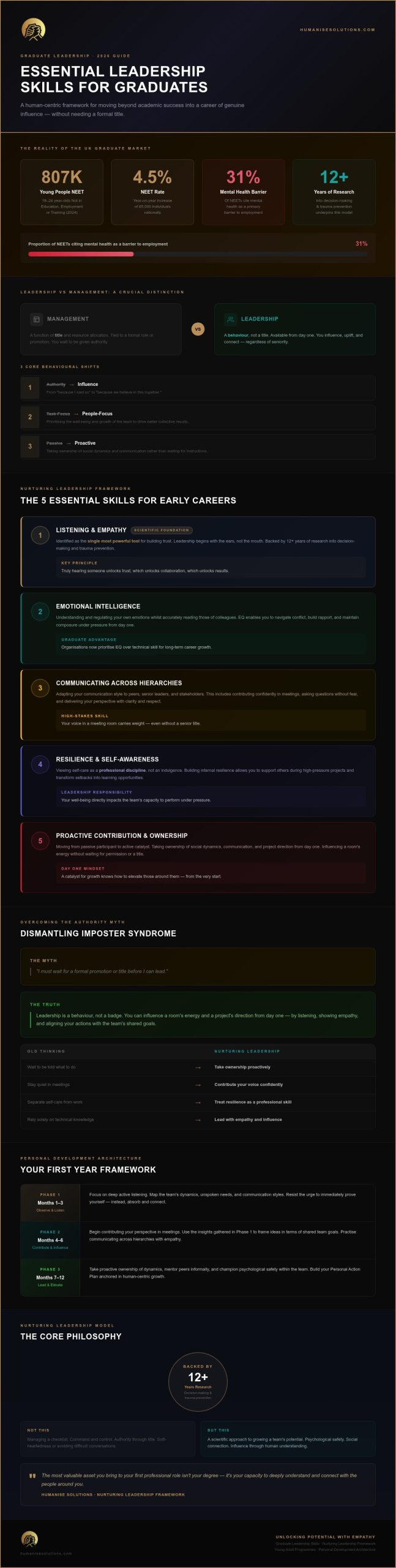
The current climate for young professionals is increasingly complex. As of 2024, 4.5% of 18-24-year-olds, which is approximately 807,000 people, are classified as NEET (Not in Education, Employment, or Training). This figure represents a year-on-year increase of 65,000 individuals, highlighting a growing gap between graduation and meaningful employment. Perhaps most tellingly, 31% of NEETs cite mental-health barriers as a primary hurdle to entering the workforce.
Our Young Adult Programmes serve as the essential bridge here. By developing internal resilience and confidence, graduates can transform these challenges into opportunities for growth. Leadership development isn’t just a career boost; it’s a vital tool for sustainable psychological well-being and professional endurance in a competitive environment.
Leadership vs Management: A Crucial Distinction
Many graduates enter the workforce believing they must wait for a formal promotion before they can lead. This is the “authority myth.” Management is a function of title and resource allocation; leadership is a behaviour. Traditional “command and control” styles are fading as modern organisations prioritise psychological safety and social connection.
We focus on three core shifts in professional behaviour:
- From Authority to Influence: Moving from “because I said so” to “because we believe in this together.”
- From Task-Focus to People-Focus: Prioritising the well-being and growth of the team to drive better collective results.
- From Passive to Proactive: Taking ownership of social dynamics and communication rather than waiting for instructions.
Mastering leadership skills for graduates means understanding that you can influence a room’s energy or a project’s direction from day one. You lead by listening, by showing empathy, and by aligning your actions with the team’s shared goals. This proactive architecture for your career ensures you aren’t just a cog in the machine, but a catalyst for growth who knows how to elevate those around them.
The 5 Essential Nurturing Leadership Skills for Early Careers
Transitioning from the classroom to the boardroom requires more than just a change of attire. It demands a fundamental shift in how you process information and interact with your peers. These aren’t merely “soft skills” that you pick up by accident. They are the architectural foundations of professional influence. To succeed, you must master specific leadership skills for graduates that prioritise human connection over simple task execution.
Our methodology is rooted in the science of human flourishing. We’ve identified five core pillars that allow early-career professionals to contribute meaningfully from day one. These include mastering emotional intelligence, communicating across hierarchies, and viewing self-care as a professional discipline. When you treat your own well-being as a leadership responsibility, you build the resilience needed to support others during high-pressure projects. This isn’t about being perfect; it’s about being present and intentional in every interaction.
Listening and Empathy: The Scientific Foundation
Effective leadership begins with the ears, not the mouth. Based on 12+ years of research into decision-making and trauma prevention, we’ve found that “Listening Effectively” is the single most powerful tool for building trust within a new team. In a graduate scheme, this means moving beyond waiting for your turn to speak. It involves active engagement with the intent behind a colleague’s words. By truly hearing your team, you prevent the misunderstandings that lead to workplace conflict and psychological distress. This empathetic approach creates a grounded environment where logic and emotion coexist productively, allowing you to make better decisions under pressure.
Inclusive Behaviours and Team Excellence
In 2026, Equality, Diversity, and Inclusion (ED&I) is no longer just a HR policy; it’s a vital leadership behaviour. Building Team Excellence requires you to foster psychological safety, even when you’re the most junior person in the room. You can contribute to this culture by asking open-ended questions and ensuring diverse perspectives are acknowledged during meetings. This inclusive architecture allows for high-performing teams to emerge, as every member feels safe to innovate without fear of judgment. If you’re looking to refine these qualities, you might find it helpful to connect with our mentors to explore how these behaviours fit into your specific career path.
Finally, remember that communication across diverse organisational hierarchies isn’t about knowing all the answers. It’s about having the confidence to ask the right questions at the right time. Whether you’re speaking to a fellow graduate or a senior director, your value lies in your ability to bridge gaps through clear, compassionate dialogue. This approach ensures that your professional growth remains rooted in the values of social connection and long-term sustainability.
Overcoming the ‘Authority Myth’ and Imposter Syndrome
One of the most persistent barriers to early-career growth is the belief that leadership is a reward for seniority. This “Authority Myth” suggests that you need a specific job title before your voice carries weight. At Humanise Solutions, we challenge this perspective. True leadership skills for graduates are found in the daily behaviours that foster trust and clarity, regardless of where you sit on the organisational chart. Leadership isn’t something you’re given; it’s something you perform through your interactions and your commitment to the team’s collective success.
It’s entirely natural to feel like an imposter during your first 90 days. You might worry that you’ll be “found out” or that your academic success won’t translate into professional influence. Our toolkit for managing imposter syndrome focuses on reframing this anxiety as a natural symptom of growth. Maintaining your belief during this initial transition is vital. It requires a conscious effort to separate temporary feelings of inadequacy from the reality of your contributions. When you encounter workplace “banter” that crosses the line into bullying, leadership-driven assertiveness becomes your shield. It’s about standing firm in your values whilst remaining professional, ensuring that your boundaries are respected from the very outset.
The Psychology of Professional Confidence
Building resilience isn’t a passive act; it’s a structured process. We use specific Mindset and Attitude Tool Kits to help young professionals navigate the complexities of office life with composure. A core part of this is mastering the art of giving and receiving feedback. When you view feedback as an architectural tool for growth rather than a personal critique, your inner resilience strengthens. Equally important is the power of saying “no.” Setting professional boundaries isn’t a sign of weakness. It is a fundamental leadership discipline that prevents burnout and ensures you can deliver high-quality work consistently without sacrificing your well-being.
Transitioning into Elite Professional Environments
Elite performance in business often mirrors the world of high-level sport. Serena Kersten MBE, a figurehead in our leadership community, emphasises that performance behaviours are the foundation of any successful career. Whether you’re looking to impress at interviews or aiming to make an impact in your first board meeting, you must demonstrate your leadership potential through your actions. This involves building a personal brand that reflects your unique strengths and your commitment to human-centric values. By aligning your personal identity with professional excellence, you create a narrative of growth that resonates with mentors and peers alike, positioning you as a future-ready leader from day one.
Designing Your Personal Development Architecture
Success in your first professional role isn’t a result of chance; it’s a product of intentional design. Whilst university provides the knowledge, the workplace demands a robust architecture for your growth. Creating a Personal Action Plan during your first year is vital. This document helps you identify skill gaps and developmental needs early, ensuring that your transition into the workforce is both steady and sustainable. By focusing on leadership skills for graduates as a core pillar of this plan, you transform your daily tasks into opportunities for long-term influence.
Continuing Professional Development (CPD) shouldn’t be viewed as a box-ticking exercise. It’s the mechanism that allows you to adapt as your environment changes. When you commit to lifelong learning, you’re not just improving your CV; you’re nurturing the internal resilience required to lead others through uncertainty. This methodical approach to growth ensures that your value to an organisation increases alongside your confidence.
Wellbeing as a Performance Driver
We believe that fostering wellbeing is a non-negotiable part of any leadership strategy. It’s impossible to elevate others if you’re operating from a state of exhaustion. Managing your time effectively is the first step in avoiding burnout. It is a professional discipline that protects your cognitive performance. Research indicates a clear link between healthy living awareness and the ability to make logical decisions under pressure. Our programmes integrate these wellbeing tracks into leadership development, ensuring you have the energy to match your professional ambitions.
Building Your Professional Network
A strong network is more than a list of contacts; it’s a support system for your evolution. Developing leadership skills for graduates should always include the cultivation of a diverse professional circle. Finding a mentor who has walked your path can accelerate your growth, providing insights that aren’t found in textbooks. As you progress, remember to pay it forward by supporting those who follow you. This cycle of social connection is what builds truly elite professional communities.
If you’re looking for a structured way to build these foundations, you can explore our Young Adult Programmes which use our unique Matrix system to guide your onboarding. To start building your bespoke career roadmap with the help of our mentors, speak to our development experts today.
Elevating Your Career with Humanise Solutions
Bridging the gap between university and elite professional performance requires more than just a job board; it demands a dedicated partner who understands the nuances of human flourishing. Whilst many focus solely on the recruitment phase, we believe that the true journey begins after you’ve secured your role. As the 5th largest digital recruiter in EMEA, we don’t just place participants into a UK talent pool; we curate an environment where they can thrive through sustainable career transitions. Our Young Adult Development programmes are designed to be that essential bridge, providing the structure you need to master leadership skills for graduates in a real-world context.
The success of our approach is reflected in our 100% completion rates for HS programmes. We utilise a unique Matrix system during onboarding to ensure that every participant has a clear, logical path forward. This isn’t a one-size-fits-all model. It is a bespoke architecture tailored to your specific needs and goals. By focusing on the human experience within the professional sphere, we help you build the confidence and resilience required to lead with impact from day one.
Our Human-Centric, Scientific Methodology
The foundation of our work is built on 12+ years of research into decision-making and trauma prevention. Scott Ward MBA and our team of experts apply these scientific insights to your personal growth, ensuring that every workshop is grounded in logic and methodology. This commitment to excellence has earned us a 9.98% feedback rating for programme delivery. Whether you’re attending a bespoke workshop on conflict resolution or refining your presentation skills, you’re engaging with a learning experience that is as rigorous as it is empathetic. We don’t just teach theory; we cultivate the behaviours that drive team excellence.
Next Steps: Unlocking Your Potential
Your transformation begins with a structured three-day onboarding process designed to align your personal action plan with your professional ambitions. From there, you can access our certified workshops and ILM programmes, which provide the formal recognition of your developing leadership skills for graduates. We invite you to view our full range of services to see how we can support your specific journey. Unlocking your potential is a methodical process that takes time and care, and we’re here to guide you every step of the way. When you’re ready to move from academic success to professional influence, our mentors are standing by to help you take that first bold step.
Architecting Your Path to Professional Influence
Your transition from the lecture theatre to the workplace is a pivotal moment to define your personal brand. By deconstructing the authority myth and mastering the human-centric leadership skills for graduates, you shift from being a passive participant to a proactive architect of team excellence. This journey isn’t just about technical proficiency; it’s about the social connection and psychological resilience that allow you to contribute meaningfully from your very first day. You have the capacity to influence your environment by leading with empathy and clarity.
Led by visionary experts like Serena Kersten MBE and Scott Ward MBA, our programmes are grounded in over a decade of research into human flourishing. With a 9.98% feedback rating for delivery and a 100% programme completion rate, we provide the evidence-based structure you need to thrive. Whether you’re navigating those first 90 days or designing a long-term development plan, you don’t have to walk this path alone. We’re here to partner with you as you unlock your full potential.
Elevate your career with our human-centric Young Adult Programmes and start building your future today. The professional world is ready for your unique contribution.
Frequently Asked Questions
What are the most important leadership skills for graduates to learn first?
The most vital leadership skills for graduates involve mastering active listening, emotional intelligence, and effective communication across hierarchies. These foundational behaviours allow you to build trust and psychological safety within your team from the outset. By prioritising the human experience over simple task execution, you establish yourself as a catalyst for growth. Integrating self-care as a professional discipline is equally important to ensure long-term resilience and cognitive performance in high-pressure environments.
Can I develop leadership skills if I don’t have a management role?
You can absolutely develop leadership qualities without a formal management title. We deconstruct the “Authority Myth” by teaching that leadership is a behaviour, not a position. You lead by influencing social dynamics, contributing your voice in meetings, and supporting your peers. True leadership involves taking ownership of your actions and aligning them with your team’s collective goals. This proactive architecture for your career ensures you make a significant impact regardless of your organisational rank.
How does Humanise Solutions support young adults entering the workforce?
Humanise Solutions bridges the gap between university and elite performance through our Young Adult Programmes. We provide a structured three-day onboarding process that includes creating Personal Action Plans and setting you up in our job network. Our unique Matrix system then begins searching for applicable opportunities within our UK talent pool. This end-to-end support is designed to unlock your potential whilst ensuring you have the necessary architecture for a sustainable and successful career transition.
What is the ‘human-centric’ approach to leadership development?
Our human-centric approach is grounded in over 12 years of scientific research into decision-making and trauma prevention. Instead of using sterile corporate jargon, we focus on the psychological well-being and social connection that drive high performance. This methodology, championed by Scott Ward MBA, prioritises the cultivation of internal qualities like confidence and empathy. By understanding the human experience within a professional context, we help you build sustainable leadership behaviours that benefit both individuals and organisations.
How can I overcome imposter syndrome in my first graduate job?
Overcoming imposter syndrome requires reframing early-career anxiety as a natural symptom of professional growth. We provide Mindset and Attitude Tool Kits to help you navigate these feelings with logic and composure. By mastering the art of giving and receiving feedback, you build the inner resilience needed to trust your own contributions. It’s about separating temporary feelings of inadequacy from your actual achievements whilst maintaining a steady focus on your personal development architecture.
Does leadership training help with mental health and wellbeing at work?
Leadership training is a powerful tool for supporting mental health, especially since 31% of NEETs cite mental-health barriers as a hurdle to employment. Our programmes treat wellbeing as a non-negotiable performance driver rather than an optional extra. By learning to manage your time effectively and setting professional boundaries, you protect your cognitive health. This approach fosters a culture of psychological safety where you can thrive without the risk of burnout or excessive stress.
What makes the Humanise Solutions Young Adult Programme unique?
Our Young Adult Programme is unique because it combines a scientific, human-centric methodology with a 100% completion rate. Led by experts like Serena Kersten MBE and Scott Ward MBA, the programme has earned a 9.98% feedback rating for delivery. We offer an end-to-end talent pipeline as the 5th largest digital recruiter in EMEA, placing participants into a national talent pool. This blend of elite performance coaching and practical job outcomes provides an unmatched foundation for growth.
How do I build a professional network as a new graduate?
Building a professional network starts with finding a mentor and embracing the philosophy of “paying it forward.” You should focus on creating genuine social connections rather than just collecting contacts. Our programmes provide access to a national talent pool and a job network that supports your evolution. By demonstrating leadership skills for graduates like active listening and inclusive behaviour, you naturally attract the right peers and mentors to support your long-term career trajectory.
