

Article by
Scott Ward MBA CCMI
Scott Ward is the founder and CEO of Humanise Solutions, which he established three years ago to help organisations elevate their people, leadership and culture through a human-centric, evidence-based approach. Before moving into business and academia, Scott spent seven years as a professional footballer, playing for Luton Town, Crawley Town and Coventry City FC until injury brought his playing career to a close — a turning point that shaped both his research interests and his approach to leadership.
Scott holds an MBA from Warwick Business School, where his research explored the causal relationship between trauma and decision-making — work that continues to inform how he supports young adults, leaders and teams under pressure. Recognised as a Companion of the Chartered Management Institute (CCMI), its highest grade of membership, he combines academic rigour with the discipline, resilience and team-first mindset of the professional game. At the heart of everything he does is a simple belief: that people perform at their best when they are led, developed and valued as human beings first.
What helps a wellbeing programme gain lasting support? A clear connection between people’s needs, the organisation’s priorities and the changes the programme aims to support. If you’re considering how to get buy-in for a wellbeing programme, you may already know the challenge: senior stakeholders need a credible case, while employees and managers need to see that their experiences have shaped the approach.
It’s reasonable to want evidence of value without overstating what a programme can achieve. Wellbeing can be dismissed as a perk when it sits apart from everyday work, leadership and team culture. A stronger case starts with a specific workplace need and shows how the proposed learning could respond to it.
This guide takes you through practical steps to build that case: understand employee needs, involve decision-makers and managers, explain potential value responsibly, and choose an approach that can be reviewed and adapted. Buy-in isn’t a one-off approval. It grows through shared ownership, useful learning and sustained attention to what helps people and organisations develop.
Key Takeaways
- Map employee needs alongside organisational priorities to shape a relevant, grounded wellbeing proposal.
- Build a credible case using available feedback and insight, and connect intended outcomes to priorities without promising guaranteed returns.
- Compare tailored learning, facilitated workshops and digital learning by considering who each approach serves and how participation and progress could be reviewed.
- Use a practical sequence to learn how to get buy-in for a wellbeing programme, adapting the conversation for senior leaders, managers and employees.
- Sustain support through regular feedback and by connecting wellbeing with leadership behaviour, learning and team culture.
Why getting buy-in for a wellbeing programme starts with understanding the organisation
A carefully designed wellbeing programme can still struggle to gain support if people don’t understand why it matters or how it relates to their work. Building agreement means bringing organisational priorities and people’s experiences into the same conversation. Senior leaders may ask for evidence of value, while employees want to know whether the initiative addresses something that affects their working lives.
Framing wellbeing as a perk can widen that gap. If an initiative appears separate from how work is organised, how managers lead or what employees say they need, decision-makers may see it as an optional extra. Start instead by asking what the organisation wants to strengthen and what would help people contribute and develop.
Wellbeing programme buy-in is shared understanding, active participation and sustained support, shaped by the needs of both people and the organisation.
What does organisational buy-in for wellbeing mean?
Approval gives an initiative permission to begin; buy-in involves people helping it take root. Senior leaders can agree the direction and make space for the work. Managers influence how it fits into team life, and employees can show whether its focus feels relevant. Their input can help shape the programme as it develops, rather than being requested only at launch.
Shared ownership connects the programme’s original purpose with people’s experience of it. It doesn’t guarantee a particular outcome, but it creates opportunities to listen, make adjustments and sustain attention over time. Wellbeing learning can sit alongside leadership and team development, connecting individual growth with how people work together. Humanise Solutions’ Fostering Wellbeing and Nurturing Leadership programmes support this joined-up approach.
Whose needs should the programme respond to?
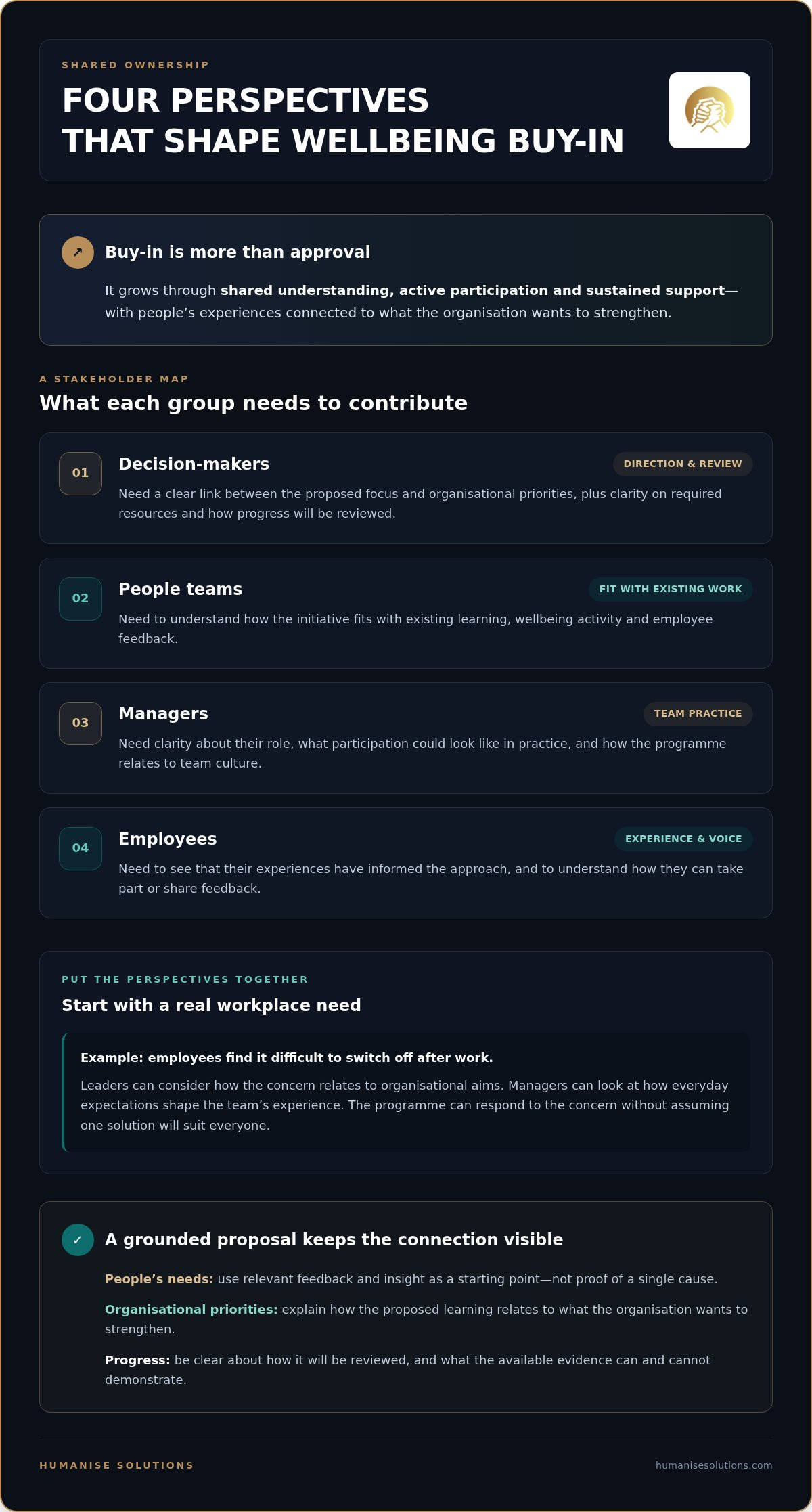
Stakeholders need different information to take part with confidence. Map the groups involved, then consider what each needs to understand and contribute:
- Decision-makers need a clear link between the proposed focus, organisational priorities, required resources and how progress will be reviewed.
- People teams need to understand how the initiative fits with existing learning, wellbeing activity and employee feedback.
- Managers need clarity about their role, what participation could look like in practice and how the programme relates to team culture.
- Employees need to see that their experiences have informed the approach and understand how they can take part or share feedback.
For example, if employees describe difficulty switching off after work, leaders may want to understand how that concern relates to organisational aims. Managers can consider how everyday expectations shape the team’s experience. The programme can then respond to a real concern without assuming one solution will suit everyone.
This balance between individual experience and the wider conditions that support growth is central to Fostering Wellbeing. A clear understanding of those connections gives advocates a practical foundation for building a case around needs, priorities and evidence.
Build a credible wellbeing business case around needs, priorities and evidence
A persuasive proposal starts with a specific workplace need, not a preselected activity or a sweeping promise. Gather relevant insight already available, such as employee feedback, themes from team conversations or organisational information that helps describe the current experience. Treat this information as a starting point, not proof of a single cause. If people report difficulty managing competing demands, for example, that tells you what they’re experiencing. Further listening may be needed to understand what sits behind it.
A credible wellbeing case connects what employees need with what the organisation is working to achieve, then explains how progress will be understood. This gives decision-makers a reasoned basis for discussion without relying on generic claims about productivity or savings. Make the case specific: describe the need, show how the proposed response relates to organisational priorities and be transparent about what the available evidence can and can’t demonstrate.
Translate wellbeing needs into outcomes decision-makers recognise
Move from the observed need to an intended change without assuming you already know the cause. A proposal might identify a need for managers to feel more confident in constructive conversations, or for teams to develop shared practices around wellbeing. These are practical areas for development, not guarantees that every underlying challenge will be resolved.
Next, connect the intended change to a priority leaders recognise. If the organisation wants to strengthen leadership capability, explain how the proposed learning could support that aim. If continuity matters, describe how a more supportive team environment may contribute, without claiming a particular financial return. Humanise Solutions’ learning and wellbeing development brings these areas together and can be shaped around organisational needs.
Choose evidence and measures that can support the case
Before delivery, establish a baseline: a clear picture of the starting point using relevant, proportionate information. Choose a small set of indicators that reflect the programme’s intended outcomes, rather than collecting data simply because it is available. Depending on the focus, this might include a short employee confidence check, participation records or qualitative feedback about what people found useful. Don’t invent benchmarks or imply that one measure captures the whole experience.
Agree in advance how and when findings will be reviewed, who will interpret them and what decisions they may inform. Comparing a baseline with follow-up feedback can help reveal what appears to be changing, where engagement is strong and what may need adapting. It doesn’t prove, by itself, that the programme caused every change. A tailored learning approach can be shaped around the needs you’ve identified. This evidence-led, people-centred process supports how to get buy-in for a wellbeing programme without overstating what the evidence can show.
Compare wellbeing programme approaches and address common objections
Once the workplace need is clear, decide how best to support it. There’s no single format for every organisation, team or learning goal. Compare options by considering who needs to take part, what change you hope to encourage and what time and attention are available. This also helps answer a familiar concern: if wellbeing is seen as a perk, show how the proposed approach responds to an identified need and fits into working life.
Which delivery format fits the need and audience?
Facilitated sessions can make room for shared discussion, practice and reflection, especially when people need to explore a topic together. Digital learning can provide flexible access to material, but completing a module is not the same as feeling engaged or supported. Tailored learning can combine formats when that better reflects the organisation’s context, rather than treating one delivery method as a universal solution.
| Format | Audience and needs | Participation and evaluation |
|---|---|---|
| Tailored learning | Groups with distinct needs or goals, where content should reflect their organisational context. | Consider how participants can shape or apply the learning; review feedback and progress against the intended outcomes. |
| Facilitated workshops | Teams or managers who could benefit from discussion, shared reflection or practising new approaches. | Consider attendance, contribution and relevance; gather feedback on what participants found useful and what they may apply. |
| Digital learning | People who need access to learning material in a digital format. | Consider access and engagement, not just completion; use feedback to understand whether the material meets the need. |
Use the comparison as a starting point, not a ranking. A tailored combination may suit people who need both shared conversation and individual learning. Humanise Solutions’ learning and wellbeing development brings these areas together around organisational needs.
How can you respond to scepticism without overstating the case?
Budget and time concerns deserve a considered response. Acknowledge practical limits, then explain what the proposed scope includes, what it doesn’t and how you’ll assess whether it remains relevant. Don’t promise a return on investment or assume positive feedback alone proves impact. Separate what you know from what you hope the programme may support.
Invite questions early. If someone views wellbeing as a perk, explain the connection between the identified workplace need, the learning approach and the outcomes you intend to review. A focused scope can help keep a proposal manageable, as long as you’re clear about what it is designed to address.
Be clear about boundaries, too. Developmental programmes can build awareness, skills and supportive workplace practices; they are distinct from clinical mental health treatment. This distinction helps decision-makers understand the proposal and employees know what kind of support it is designed to provide. A considered comparison makes it easier to discuss how to get buy-in for a wellbeing programme with care, honesty and a focus on fit.
How to get buy-in for a wellbeing programme: a practical sequence
Move from initial interest to shared commitment in clear stages. A thoughtful process gives people room to shape the proposal, helps decision-makers understand what they’re agreeing to and makes review part of the plan from the outset.
- Listen for the need. Bring together relevant employee feedback and existing organisational insight. Look for themes, but don’t assume one comment represents everyone or that you already know the cause. Note what remains uncertain and where further input would help.
- Map the stakeholders. Identify who approves resources, who may coordinate or deliver the programme, which managers influence participation and which employees will experience it. Consider what each group needs to contribute, not just what they need to hear.
- Shape the proposal together. Share emerging priorities with relevant stakeholders before choosing a format. Ask whether the focus feels relevant and practical. Make assumptions visible, and explain intended outcomes and resource requirements plainly.
- Present the case. Lead with the workplace need, then outline the proposed response, intended outcomes and how you’ll review progress. Explain why the approach fits the audience, what it requires and what the evidence can and can’t tell you.
- Agree ownership and review. Confirm who will oversee next steps, how people will hear about the programme and when stakeholders will review feedback. Explain how learning from participation can inform adjustments without promising specific results.
Adapt the conversation to the people in the room. Senior leaders may need a concise account of the organisational need, intended outcomes, resources and review arrangements. Managers may want clarity on their role and how the programme can fit team routines. Employees need to understand why this focus was chosen, what taking part involves and how their feedback can influence the approach. Keep the proposal consistent, while making the information useful to each group.
Before sharing the proposal, check that it covers:
- Need: What workplace experience or challenge is informing the proposal?
- Intended outcomes: What observable changes do you hope to support?
- Audience: Who is the programme for, and who else needs to be involved?
- Approach: Why does the proposed format fit the need?
- Resources: What time, capacity and other support will be needed?
- Evaluation: What feedback or indicators will help guide review?
Agreement is more useful when it includes a shared understanding of what happens next. Record decisions, clarify who will communicate with each stakeholder group and schedule a time to review what’s working, what people find difficult and what may need to change. This turns approval into ongoing learning rather than a single sign-off.
To explore a proposal shaped around your organisation’s needs, discuss your organisation’s wellbeing needs.
Sustain support by making wellbeing part of ongoing organisational development
Approval creates an opening; lasting support grows through what happens next. A programme stays relevant when people can share feedback and the organisation responds thoughtfully as needs change. Build regular review into development conversations, rather than treating evaluation as a final report. Ask what participants find useful, what feels difficult to apply and what new needs are emerging. Share what you’ve heard and explain how it will shape next steps.
This visible cycle of listening, learning and adjustment can help maintain trust. If feedback suggests an activity doesn’t fit a team’s working patterns, consider whether its format or timing needs to change. If people find a useful idea difficult to put into practice, explore what support managers or teams need. Not every suggestion will lead to a change, but acknowledging feedback and explaining decisions helps people see that their participation matters.
Embed learning in leadership, teams and workplace culture
Wellbeing learning is more likely to become part of working life when leaders and managers reinforce it through everyday behaviour. This could mean making space for respectful discussion, responding thoughtfully to concerns or showing consistency between stated values and daily expectations. These actions don’t replace a well-designed programme; they help create an environment where people can use what they learn.
Teams also shape whether wellbeing feels like a shared responsibility. Invite colleagues to consider how they work together, whose perspectives are heard and what helps people contribute. Shared reflection can support inclusion and strengthen relationships while recognising differences in experience. Nurturing leadership development can complement this work by helping leaders reflect on the behaviours that shape trust, connection and team culture.
Explore a tailored wellbeing and learning approach
Humanise Solutions provides Fostering Wellbeing and Bespoke Learning to support organisational development. Its human-centred approach combines empathy with a scientific perspective, informed by over 12 years of research into decision-making processes and trauma prevention. This provides a basis for considering wellbeing alongside leadership, learning and team development, with an approach shaped around an organisation’s needs rather than a one-size-fits-all template.
Keep the conversation open as the work develops. Agree who will gather feedback, how insights will be shared and when stakeholders will revisit the programme’s relevance. This helps sustain involvement without assuming continued support or promising outcomes that can’t be guaranteed. The aim is to build the capacity to learn and adapt together.
To explore a tailored approach, talk with Humanise Solutions about your wellbeing programme.
Turn shared commitment into meaningful progress
Lasting change doesn’t need to begin with a perfect plan. It can start with an honest conversation about what would help people and the organisation move forward, followed by a willingness to listen, learn and adapt. That openness turns how to get buy-in for a wellbeing programme from a question of approval into an opportunity to shape a more supportive way of working.
Keep the people affected by the programme at the centre of the process. A considered approach makes room for individual experience while supporting the organisation’s wider development. Humanise Solutions brings a human-centred perspective to wellbeing, learning and leadership, helping organisations explore approaches that reflect their needs.
Talk to Humanise Solutions about a human-centred wellbeing approach for your organisation and take the next step towards a programme people can shape and sustain together.
Frequently Asked Questions
How do you get senior leaders to support a wellbeing programme?
To get buy-in for a wellbeing programme, show senior leaders how it responds to a clearly identified organisational need and what changes it aims to support. For example, if new managers say they lack confidence in difficult conversations, explain how development could address that capability and how you’ll gather feedback afterwards. Be open about what’s known and what’s still an assumption. Present evaluation as a way to guide decisions, not as a promise of guaranteed returns.
How can you get employees involved in a wellbeing programme?
Involve employees before deciding what the programme will look like. Offer ways to share experiences that suit different teams, such as a facilitated conversation, a short feedback form or an existing staff forum. Explain why you’re gathering input, how it will inform the design and what participation may involve. After launch, offer appropriate opportunities to comment on what feels relevant or difficult to apply, and let people know how their feedback is being considered.
What should a wellbeing programme proposal include?
A useful proposal sets out the workplace need, intended outcomes, audience, proposed format, resource considerations and evaluation approach. Include enough context to explain why the response fits, such as the insight that informed the focus and any assumptions still to test. Clarify who will coordinate the work and how participants will be informed. A concise proposal makes it easier to discuss the decision required and raise questions before plans are finalised.
How long does it take to get buy-in for a wellbeing programme?
There’s no standard timeframe for gaining support; it depends on how decisions are made in your organisation and the scope of the proposed programme. A focused request with a clear decision-maker may progress differently from a proposal needing input across several teams or planning cycles. Allow time for people to understand the case, raise questions and shape the approach. Rather than setting an arbitrary deadline, agree the next decision point and what information is needed by then.
Can a wellbeing programme be introduced without a large budget?
The programme’s scope and format can be shaped around available resources, but delivery still needs appropriate time, planning and support. Start by identifying the most pressing need and consider whether a focused learning activity or a narrower audience is a practical first step. Be clear about what that scope can address and what it cannot. This helps decision-makers compare options realistically without implying that meaningful development can be delivered at no cost.
How can you measure whether a wellbeing programme is working?
Choose measures that reflect the programme’s purpose before it begins, then review them alongside participant feedback. If the programme aims to strengthen manager confidence, for example, ask participants how prepared they feel to use a specific skill and invite examples of where they’ve applied it. Compare findings with the intended outcome and the starting picture, while considering other factors that may have influenced change. Use what you learn to decide whether to adapt the approach.
Is a workplace wellbeing programme the same as mental health treatment?
No. Workplace wellbeing programmes focused on learning and development aim to build knowledge, skills or supportive ways of working; they aren’t the same as clinical mental health treatment. For instance, a learning session might explore how teams communicate about wellbeing or help managers develop supportive leadership practices. Make the programme’s purpose and boundaries clear so employees understand its focus. If someone needs clinical care, a workplace development activity isn’t a substitute for that treatment.
