

Article by
Scott Ward MBA CCMI
Scott Ward is the founder and CEO of Humanise Solutions, which he established three years ago to help organisations elevate their people, leadership and culture through a human-centric, evidence-based approach. Before moving into business and academia, Scott spent seven years as a professional footballer, playing for Luton Town, Crawley Town and Coventry City FC until injury brought his playing career to a close — a turning point that shaped both his research interests and his approach to leadership.
Scott holds an MBA from Warwick Business School, where his research explored the causal relationship between trauma and decision-making — work that continues to inform how he supports young adults, leaders and teams under pressure. Recognised as a Companion of the Chartered Management Institute (CCMI), its highest grade of membership, he combines academic rigour with the discipline, resilience and team-first mindset of the professional game. At the heart of everything he does is a simple belief: that people perform at their best when they are led, developed and valued as human beings first.
What if the very conversation you’re currently dreading is actually the most powerful tool you have for unlocking your team’s potential? It’s common to feel a sense of unease when searching for how to handle difficult conversations with employees, especially if you’re worried about emotional outbursts or being perceived as unfair. These anxieties are human; they often stem from a fear that a necessary dialogue might escalate into a formal grievance or damage a vital professional relationship.
We believe that navigating these moments is not about mastering conflict, but about mastering the art of human connection. This guide transforms your approach by replacing apprehension with a scientific, empathetic framework rooted in over 12 years of research into trauma prevention and decision-making. You’ll gain the confidence to stay grounded when faced with defensive behaviours and learn to lead with a nurturing hand that prioritises psychological well-being and long-term resilience.
We’ll provide a clear, actionable plan for your next meeting. From preparing your opening words to ensuring a resolution that fosters improved performance, we’ll walk through the methodology required to turn high-stakes dialogue into an opportunity for sustained growth. You’ll soon see these challenges not as obstacles, but as the primary vehicle for nurturing excellence within your team.
Key Takeaways
- Recognise that avoiding high-stakes dialogue erodes trust and stalls growth, whilst addressing issues directly fosters a culture of transparency and team excellence.
- Master how to handle difficult conversations with employees by grounding your approach in psychological safety and objective evidence rather than emotional reaction.
- Utilise a human-centred feedback framework that focuses on the impact of specific behaviours to reduce defensiveness and maintain professional dignity.
- De-escalate intense emotional reactions by applying trauma-prevention principles and acknowledging the personal transitions that may influence workplace performance.
- Ensure lasting success by viewing the conversation as a starting point for bespoke learning and development rather than a one-off disciplinary event.
The Emotional Landscape: Why We Avoid Difficult Conversations
A difficult conversation is any interaction where the stakes are high, opinions vary, and emotions run strong. It’s an essential tool for addressing performance, behaviour, or significant personal change. Yet, many leaders find themselves searching for how to handle difficult conversations with employees whilst simultaneously looking for ways to avoid them. This hesitation is deeply human. Our biology is hardwired to seek social cohesion; our brains often interpret workplace conflict as a threat to our belonging, triggering a primitive stress response that makes silence feel safer than speech.
Avoiding these moments carries a heavy human cost that far outweighs the temporary comfort of silence. When we stay quiet, trust begins to erode and toxic dynamics can take root, ultimately stalling organisational growth. At Humanise Solutions, our philosophy is built on over 12 years of research into decision-making and trauma prevention. We see these interactions as opportunities to elevate culture through scientific, human-centric interactions that prioritise flourishing over friction.
The Cost of Procrastination in Leadership
Delaying necessary feedback creates a “feedback debt” that becomes increasingly difficult to repay. As issues escalate in the dark, the emotional energy required to resolve them multiplies. This procrastination doesn’t just affect the individual; it impacts the entire team’s pursuit of Team Excellence. Unresolved conflict shatters psychological safety, as employees lose confidence in a leader’s ability to maintain a fair and supportive environment. Early intervention is a hallmark of nurturing leadership, ensuring that small misalignments don’t grow into systemic failures.
Shifting from Conflict to Nurturing Dialogue
To truly master how to handle difficult conversations with employees, you must reframe the meeting itself. It isn’t a confrontation to be survived, but a developmental milestone to be embraced. Inclusive leadership demands the courage to speak truth with deep empathy, ensuring that every person feels valued even when their current performance is being questioned. Nurturing leadership is a commitment to unlocking potential even during challenging moments. By viewing these dialogues as a core part of your Learning & Development strategy, you move from a state of apprehension to one of visionary guidance.
Scientific Preparation: Building Psychological Safety First
Preparation is the silent architect of a successful dialogue. It requires more than just a list of grievances; it demands a grounding in both evidence and empathy. At Humanise Solutions, our methodology is built upon over 12 years of research into decision-making processes, ensuring that every interaction is rooted in logic and psychological well-being. When you’re considering how to handle difficult conversations with employees, the “pre-work” is your most valuable asset. It allows you to move away from a prosecutorial atmosphere and towards a collaborative discovery of facts.
Gathering information through a human-centric lens means looking for the context behind the data. Instead of building a case against an individual, you’re seeking to understand the barriers they face. This approach preserves the employee’s dignity and sets a professional “centre” for the meeting. By choosing a private, neutral space and preparing your own emotional state, you ensure the conversation remains a safe container for growth rather than a source of trauma.
Understanding the Brain’s Threat Response
The human brain is exquisitely sensitive to social rejection. When an employee feels judged or cornered, they may experience an “Amygdala Hijack.” This biological response floods the system with stress hormones, effectively shutting down the prefrontal cortex where logical thinking and problem-solving occur. To bypass this fight or flight reaction, you must lead with warmth and clarity. High emotional intelligence allows you to recognise early signs of distress, such as shallow breathing or avoidant eye contact. If you notice these signals, slowing the pace or offering a brief pause can help the individual regain their cognitive balance.
Setting the Scene for Inclusive Communication
Equality, diversity, and inclusion (ED&I) principles must be woven into the very fabric of your preparation. This involves using neutral, non-judgmental language that describes specific behaviours rather than making character judgements. Our concept of Leading Architecture involves structuring the meeting around employee-driven outcomes, ensuring the value provided aligns with their specific needs for development. If you’re looking to refine your internal processes and foster a more resilient culture, speak with our specialists about our approach to nurturing leadership. By focusing on impact rather than intent, you create a space where truth can be spoken without triggering unnecessary defensiveness. Mastering how to handle difficult conversations with employees starts with this commitment to psychological safety, turning a potential conflict into a shared journey toward excellence.
A Step-by-Step Framework for Human-Centred Feedback
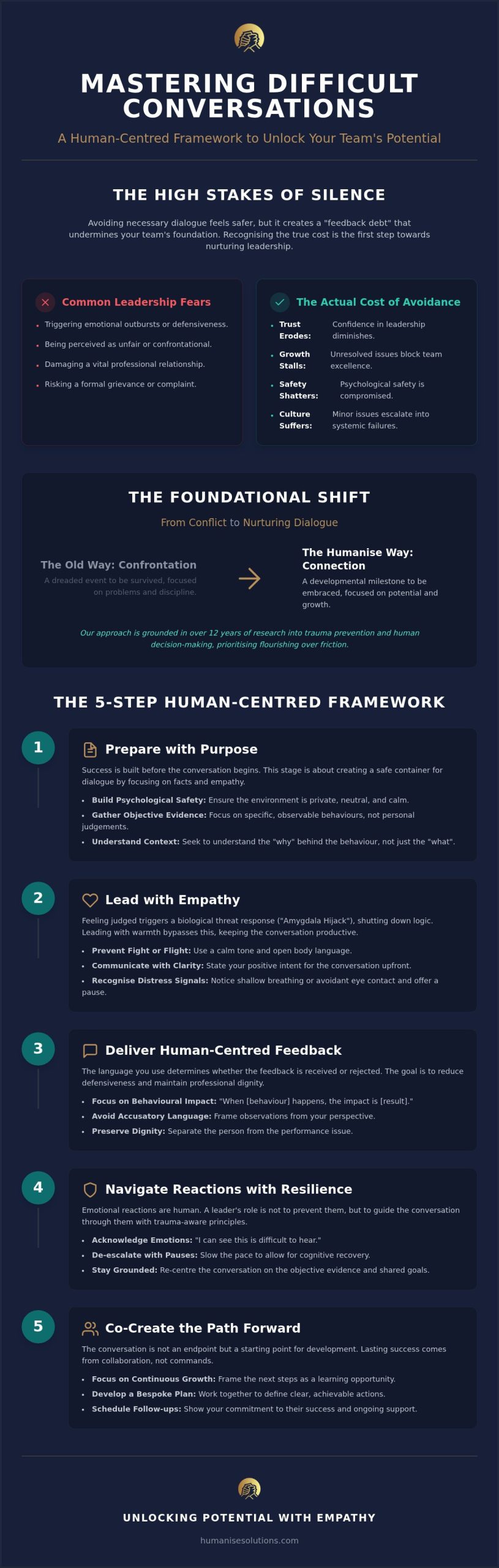
Moving from preparation to practice requires a structured path. When you’re learning how to handle difficult conversations with employees, a repeatable framework provides the psychological safety needed for both parties to remain present. This isn’t about following a script; it’s about using a human-centric architecture to guide the dialogue toward a productive outcome. By following these five steps, you ensure the conversation remains rooted in our core philosophy of unlocking potential through empathy.
- Step 1: State the purpose with empathetic clarity. This reduces initial anxiety by removing the “mystery” of the meeting and establishing a supportive tone.
- Step 2: Present the evidence whilst focusing on the impact, not the person. Use objective observations to describe the behaviour and how it affects the team’s collective goals.
- Step 3: Invite the employee’s perspective. This fosters a sense of belonging and ensures they feel the process is fair, inclusive, and grounded in truth.
- Step 4: Collaborate on a solution. Ensure the outcome aligns with a bespoke learning and development programme that empowers the individual to grow.
- Step 5: Agree on next steps. Define the support mechanisms, such as 1-1 coaching, that will help them reach their future potential and sustain their performance.
Opening with Empathetic Clarity
The “Humanise” way rejects the traditional “sandwich method,” where feedback is hidden between layers of praise. This approach often feels disingenuous and creates confusion for the recipient. Instead, we advocate for honest, kind directness. Start by signalling that the room is a supportive space. You might say, “I’ve noticed some challenges recently, and I’m here to explore how we can work together to get things back on track.” This immediately establishes the goal as personal resilience and performance improvement rather than punishment. It’s about being a partner in their journey of development.
The Power of Active Listening and Inquiry
Mastering how to handle difficult conversations with employees requires a shift from talking at someone to listening with someone. During the discovery phase, a leader should aim to speak only 30% of the time. Your role is to be a visionary guide, not a prosecutor. Use open-ended questions to uncover the root causes of the issue, whether they are wellbeing concerns or specific skill gaps. Active listening validates the human experience in professional environments by showing that the individual’s perspective is integral to the solution. When employees feel heard, their resistance drops, and they become more open to the nurturing leadership required to foster Team Excellence.
Handling Reactions with Resilience and Trauma Awareness
Performance issues rarely exist in a vacuum. Under the guidance of Serena Kersten (MBE), our Head of People & Performance, we recognise that workplace behaviours are often outward expressions of internal life transitions or mental health barriers. When you are learning how to handle difficult conversations with employees, it’s vital to adopt a trauma-informed lens. This means understanding that a defensive reaction isn’t an attack on your authority, but a survival mechanism triggered by a perceived threat to an individual’s security or identity. By approaching these moments with evidence-based confidence, you can de-escalate tension and maintain a focus on human flourishing.
Managing Defensive Behaviours Calmly
High-stakes dialogue can trigger a range of intense responses, from anger and tears to a heavy, protective silence. Maintaining your own emotional centre is essential to keep the meeting on track. If you encounter an emotional outburst, resist the urge to meet fire with fire. Instead, acknowledge the emotion without judgment. There is always a “threshold of productivity” in every meeting; if an employee is no longer able to process information logically, offer a “human break” to allow the nervous system to settle. This pause isn’t a sign of weakness, but a strategic application of nurturing leadership that prioritises the person over the process. Once calm is restored, pivot back to your developmental goals, ensuring the individual feels supported whilst they process the feedback.
Protecting Wellbeing During High-Stakes Talk
Distinguishing between a skill gap and a wellbeing concern is a critical skill for the modern leader. Our research into young adult development shows that 31% of NEETs cite mental-health barriers as a primary obstacle to progress. This insight applies across the entire workforce; performance dips are frequently symptoms of burnout or personal trauma. Adhering to HS trauma prevention standards ensures that your feedback does not inflict further psychological harm. By fostering wellbeing during these talks, you create a foundation for long-term resilience and sustained Team Excellence.
Supporting others shouldn’t come at the cost of your own mental health. Leaders must also prioritise their own self-care and resilience to remain effective mentors. If you feel ill-equipped to master how to handle difficult conversations with employees, reach out to our expert team for bespoke guidance on nurturing leadership. By managing your own state, you provide the steady presence required to guide others through their most challenging professional moments, ensuring that every interaction remains a catalyst for growth.
Beyond the Meeting: Cultivating a Culture of Continuous Growth
The true measure of how to handle difficult conversations with employees is found in the weeks and months that follow. A corrective dialogue is merely the first step in a longer journey of transformation. Without a structured follow-up, the initial meeting remains an isolated event rather than a catalyst for change. At Humanise Solutions, our programmes achieve 100% completions because we prioritise this sustained engagement. By providing a clear roadmap for what happens next, we help individuals transition from a state of uncertainty to one of focused development.
This commitment to the long-term pays dividends. Our approach has led to 50-80% job outcomes, demonstrating that even the most challenging performance issues can be resolved through nurturing leadership. When a manager follows up with consistent support, they reinforce the employee’s value and build the resilience needed for future excellence. It’s about moving beyond “managing” a situation and towards cultivating a thriving talent pipeline where every individual feels seen and supported.
Integrating Feedback into Learning and Development
Every difficult conversation should serve as a diagnostic tool for identifying specific skill gaps. Once these gaps are clear, the focus must shift to a bespoke learning and development programme. This transition from a “difficult talk” to a “personal action plan” is essential for effective Talent Management and Succession Planning. As the 5th largest digital recruiter in EMEA, we understand how vital it is to nurture internal talent rather than simply seeking external replacements. By investing in the person sitting in front of you, you protect your organisation’s future potential whilst fostering a culture of loyalty and inclusive growth.
Developing Leadership Excellence as a Habit
Mastering how to handle difficult conversations with employees isn’t a one-time achievement; it’s a habit that requires ongoing refinement. Leaders benefit immensely from structured Leadership ILM Programmes that provide the tools to navigate complex human dynamics with evidence-based confidence. This is particularly important when supporting younger staff or Gen Z talent, who often prioritise psychological safety and purpose-driven work. Our young adult programmes are designed to bridge these generational gaps, ensuring that every interaction feels inclusive and empowering.
If your organisation is ready to move away from sterile corporate processes and towards a human-centric leadership culture, we’re here to partner with you. Let’s transform your high-stakes dialogues into opportunities for nurturing excellence and unlocking the true potential of your people. By making empathy and growth the cornerstone of your communication, you create a workplace where everyone has the opportunity to flourish.
Transforming Conflict into Nurturing Leadership
Mastering how to handle difficult conversations with employees is a journey from apprehension to visionary guidance. By grounding your approach in psychological safety and using a structured, human-centric framework, you turn potential friction into a catalyst for team excellence. We’ve seen that when leaders prioritise empathy and evidence, they don’t just solve problems; they unlock future potential.
Our methodology is led by industry experts Serena Kersten MBE and Scott Ward MBA, rooted in over 12 years of trauma prevention research. This scientific foundation ensures that your leadership remains both compassionate and pragmatic. With a 9.98% feedback rating for programme delivery, we pride ourselves on helping organisations move towards sustainable growth and human flourishing. Every high-stakes dialogue is an invitation to cultivate resilience and trust within your team.
If you’re ready to evolve your approach and foster a culture of empowerment, elevate your leadership culture with our bespoke development programmes. You have the power to transform every challenge into a developmental milestone. Let’s begin the journey of unlocking your team’s true excellence together.
Frequently Asked Questions
What is the best way to start a difficult conversation with an employee?
The most effective way to start is by combining kindness with honest directness. When learning how to handle difficult conversations with employees, state the purpose immediately to eliminate the anxiety of the unknown. Avoid burying the lead or using disingenuous praise. Instead, signal that the room is a supportive container for growth. This clarity allows the individual to engage their logical brain rather than staying trapped in a defensive threat response.
How do I handle an employee who becomes angry or defensive during a meeting?
When an employee becomes defensive, your role is to remain a steady, non-judgemental presence. Acknowledge their feelings by saying, ‘I can see this is difficult to hear,’ without retracting your feedback. If the emotional intensity crosses a threshold where logic is lost, offer a brief pause. This ‘human break’ allows the nervous system to settle, ensuring the dialogue remains a productive tool for nurturing leadership rather than a source of conflict.
Can I have a difficult conversation with a remote employee over a video call?
You can certainly conduct these meetings via video call, though it requires extra care to maintain psychological safety. Ensure both parties are in a private, quiet space where they won’t be interrupted. Keep your camera on to provide vital non-verbal cues and allow for longer silences to accommodate digital lag. Remote settings demand even greater empathetic warmth to bridge the physical distance and maintain a sense of human connection.
What should I do if an employee starts crying during a performance review?
If an employee cries, the best response is to offer a tissue and a moment of quiet. Don’t feel the need to apologise for the feedback or try to ‘fix’ their distress immediately. Recognise that tears are often a release of tension. Once they’ve regained their composure, gently ask if they’d like to continue or take a short break, ensuring they feel supported throughout the process.
How do I ensure a difficult conversation doesn’t damage our working relationship?
Focusing on how to handle difficult conversations with employees without damaging trust requires a shift in perspective. You must separate the individual’s identity from their specific behaviours. Frame the discussion as a collaborative effort to unlock their future potential rather than a punitive measure. When you position yourself as a partner in their development, the conversation becomes a bridge to a stronger, more resilient working relationship built on mutual respect.
When should I involve HR in a difficult conversation with a staff member?
HR should be involved if the conversation relates to serious misconduct, potential legal breaches, or if you anticipate a formal grievance. It’s also wise to consult them if previous informal coaching hasn’t led to improvement. Whilst most nurturing leadership happens in 1-1 settings, HR provides the necessary framework to ensure the process remains fair, inclusive, and aligned with organisational standards for both the manager and the employee.
How can I prepare myself emotionally for a challenging talk with my team?
Emotional preparation starts with grounding yourself in the facts and your intent to help. Visualise a positive outcome where the employee feels empowered to grow. Practise your opening sentences to ensure they sound supportive rather than accusatory. By focusing on the scientific evidence of the situation, you can bypass your own ‘fight or flight’ response, allowing you to lead the meeting with a sophisticated blend of warmth and confidence.
What are the most common mistakes managers make during difficult conversations?
Many managers fail by being too vague or waiting too long to speak up, which allows unresolved tension to escalate. Another common error is talking too much; remember that the discovery phase requires deep listening to uncover root causes. Failing to prepare an actionable follow-up is also a major pitfall. Without a clear path toward learning and development, the conversation loses its transformative power and can leave the employee feeling discouraged rather than motivated.
