

Article by
Scott Ward MBA CCMI
Scott Ward is the founder and CEO of Humanise Solutions, which he established three years ago to help organisations elevate their people, leadership and culture through a human-centric, evidence-based approach. Before moving into business and academia, Scott spent seven years as a professional footballer, playing for Luton Town, Crawley Town and Coventry City FC until injury brought his playing career to a close — a turning point that shaped both his research interests and his approach to leadership.
Scott holds an MBA from Warwick Business School, where his research explored the causal relationship between trauma and decision-making — work that continues to inform how he supports young adults, leaders and teams under pressure. Recognised as a Companion of the Chartered Management Institute (CCMI), its highest grade of membership, he combines academic rigour with the discipline, resilience and team-first mindset of the professional game. At the heart of everything he does is a simple belief: that people perform at their best when they are led, developed and valued as human beings first.
Underperformance is rarely a character flaw; it is almost always a diagnostic signal of misaligned expectations, depleted wellbeing, or systemic ambiguity. If you lead a team, you likely recognise the quiet dread that precedes these critical moments: the uncomfortable feedback meetings that threaten to devolve into conflict, the friction dragging down high-performing peers, and the lingering fear that addressing capability issues will trigger immediate stress leave. Learning how to manage underperforming employees shouldn’t feel like gathering evidence for an inevitable dismissal.
You shouldn’t have to choose between empathetic leadership and high operational standards. In this guide, you’ll discover how to transform chronic workplace underperformance into sustained excellence through psychological safety, open communication, and structured developmental architecture. We’ll examine the root causes behind capability dips, explain why punitive processes backfire, and provide a clear, restorative capability roadmap designed to unlock individual potential whilst protecting collective culture.
Key Takeaways
- Master how to manage underperforming employees by shifting your diagnostic lens from perceived personal deficits to root causes like cognitive overload, systemic friction, and skill gaps.
- Conduct restorative feedback sessions using a five-stage conversational framework that establishes psychological safety whilst maintaining uncompromising standards.
- Replace adversarial, tick-box improvement plans with purposeful developmental architecture that rebuilds confidence and genuine accountability.
- Implement a structured 30-60-90 day capability recovery plan anchored in deliberate support, clear milestones, and measurable outcomes.
- Navigate exits with empathy, professional integrity, and dignity when comprehensive developmental interventions show that a role realignment is necessary.
Diagnosing Root Causes: Why Capable Employees Underperform
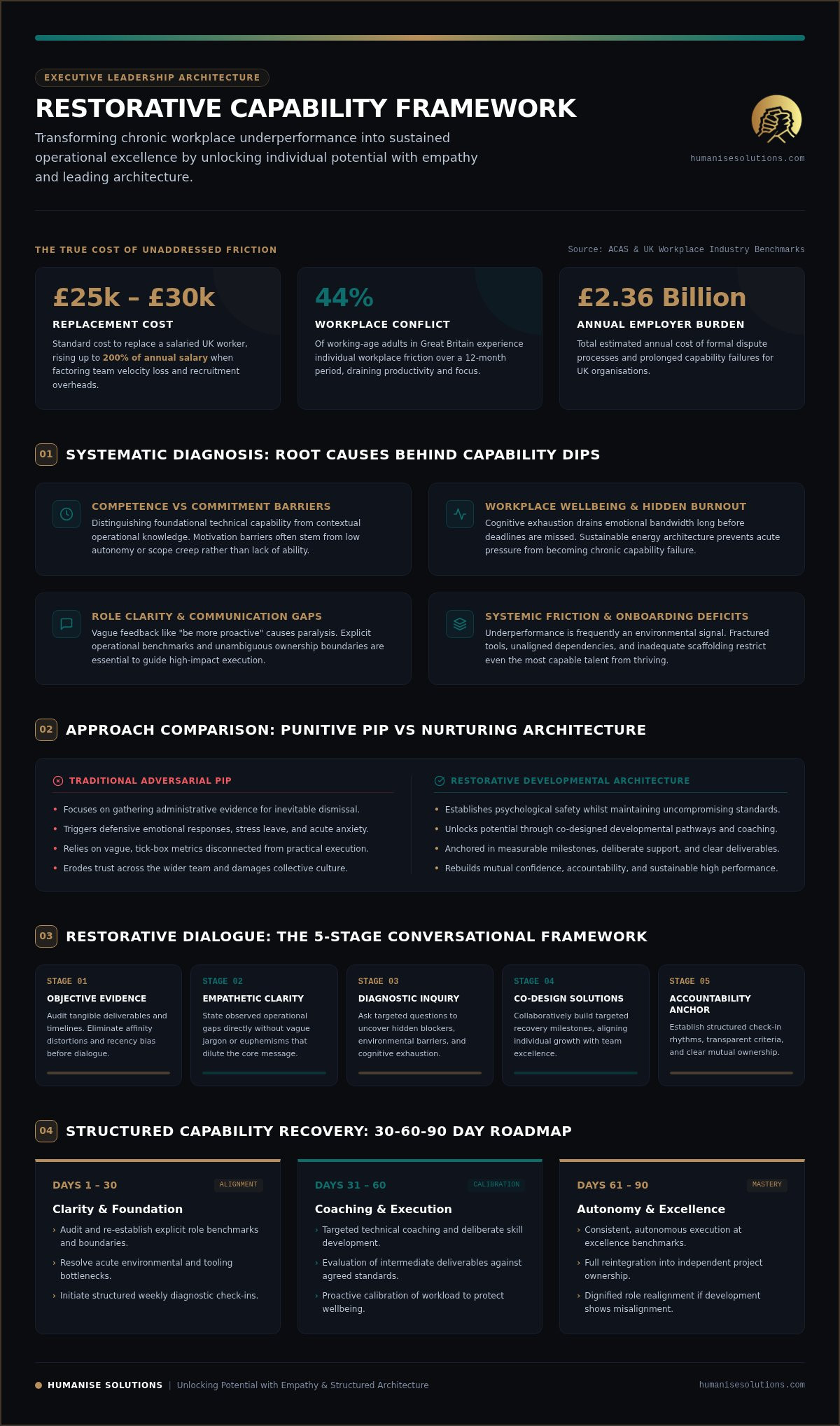
Underperformance is rarely an innate deficit; it is an observed gap between agreed capability expectations and delivered workplace outcomes. When leaders encounter capability dips, the instinct is often to rush towards formal administrative processes or quietly prepare for dismissal. Yet replacing a salaried worker in the UK typically costs between £25,000 and £30,000, and can reach up to 200% of annual salary when factoring in disrupted team velocity and recruitment overheads. Understanding how to manage underperforming employees begins not with censure, but with systematic diagnosis. Underperformance rarely indicates a lack of ability; it reflects fractured clarity, misaligned support, or depleted individual resilience.
Distinguishing Skill Deficits from Motivation Barriers
Pinpointing the exact nature of a performance gap requires separating competence from commitment. An employee might possess foundational technical capability but lack the contextual operational knowledge needed to execute under shifting priorities. Alternatively, motivation barriers often surface when an individual experiences low autonomy, isolated decision-making, or an eroded sense of purpose. Inadequate onboarding and uncommunicated scope creep frequently leave capable individuals floundering. Integrating structured performance improvement mechanisms helps leaders discern whether an employee requires technical coaching or an environmental re-alignment.
The Impact of Workplace Wellbeing and Hidden Burnout
Cognitive exhaustion manifests quietly long before an employee misses a critical deadline. Chronic stress, unreasonable workloads, and boundary erosion steadily drain emotional bandwidth, forcing team members into self-protective withdrawal. When personal strain intersects with unyielding workplace demands, focus fractures and daily output declines. Leaders committed to high standards must recognise that cultivating resilience involves active care. Embedding frameworks for fostering wellbeing within the operational architecture ensures that energy levels remain sustainable, preventing acute pressure from evolving into prolonged capability failure.
Auditing Role Clarity and Leadership Communication Gaps
Ambiguity is the quiet architect of poor performance. Leaders must candidly assess whether performance benchmarks, ownership boundaries, and core deliverables were ever outlined with absolute clarity. Vague feedback such as “be more proactive” generates acute anxiety and cognitive paralysis rather than positive momentum. When leadership communication lacks precision, employees waste significant effort guessing priorities instead of executing them. Rebuilding performance demands explicit expectations that tie daily deliverables directly to broader team excellence benchmarks.
A Step-by-Step Framework for Difficult Performance Conversations
Navigating capability discussions often feels fraught because traditional management treats them as adversarial interrogations. True developmental leadership replaces confrontation with structured dialogue. According to research from ACAS, 44% of working-age adults in Great Britain experienced individual workplace conflict over a recent 12-month period, with formal disputes costing UK employers an estimated £2.36 billion annually. Resolving friction early and informally avoids these devastating costs. When discovering how to manage underperforming employees, your goal isn’t to build a case for dismissal, but to establish psychological safety, lower defensive emotional responses, and co-design a viable path toward excellence.
Preparation: Gathering Objective Evidence and Removing Bias
Effective conversations require rigorous grounding in verifiable facts. Before scheduling a meeting, audit the tangible deliverables, project timelines, and operational outcomes rather than subjective impressions. Check yourself for recency bias, affinity distortions, and untested assumptions. When leaders step into a meeting rooted in verifiable patterns rather than emotional reactions, the dialogue shifts naturally from accusation to collaborative problem-solving.
Delivering Clear, Empathetic, and Direct Feedback
Clarity is kindness. State observed operational gaps directly without retreat into vague corporate jargon or softening euphemisms that dilute the message. Once you have laid out the gap, create room for dialogue by asking diagnostic questions:
- “How are you experiencing the pace and demands of this deliverable?”
- “Where do you feel your progress is being blocked by our internal workflows?”
- “What specific support or tools do you need to meet this standard consistently?”
Maintain calm authority. Actively listen to their perspective so you can uncover hidden operational blockers, interpersonal tensions, or resource deficits that may be obstructing their performance.
Co-Designing Immediate, Actionable Performance Milestones
A restorative conversation concludes with shared ownership. Rather than handing down unilateral mandates, collaborate on two or three unambiguous, short-term targets achievable within the next month. Professional guidance on structuring an effective performance improvement plan highlights the necessity of concrete indicators for successful execution. Establish a regular weekly check-in cadence to review practical progress, offer targeted coaching, and adjust operational support in real time. If your leadership team needs tailored developmental architecture to master these high-stakes dialogues, you can speak with our team to explore evidence-based frameworks built on years of research into decision-making and human flourishing.
Comparing Performance Turnaround Approaches: PIPs vs Nurturing Architecture
Traditional corporate playbooks treat capability dips as procedural breaches requiring defensive legal documentation. When organisations place struggling workers on conventional Performance Improvement Plans (PIPs), the process frequently acts as a prolonged administrative prelude to termination. Gallup’s State of the Global Workplace: 2026 Report reveals that only 20% of employees worldwide are engaged at work, with disengagement costing the global economy roughly $10 trillion in lost productivity. Weaponising bureaucratic oversight deepens this alienation. If you want to transform how to manage underperforming employees, you must replace adversarial compliance with purposeful, human-centred developmental architecture.
| Focus Dimension | Traditional Corporate PIP | Nurturing Leadership Architecture |
|---|---|---|
| Primary Objective | Risk mitigation and termination evidence | Capability recovery and potential unlocking |
| Psychological Dynamic | Fear, surveillance, and quiet panic | Psychological safety and shared agency |
| Managerial Posture | Administrative auditor logging faults | Developmental coach diagnosing friction |
| Operational Impact | Malicious compliance or talent flight | Restored competence and team trust |
The Hidden Pitfalls of the Traditional Corporate PIP
Punitive surveillance inevitably triggers survival mechanisms. When an employee feels systematically scrutinised, their cognitive bandwidth narrows, suffocating creativity and problem-solving capacity. Line managers spend hours maintaining paper trails instead of delivering practical coaching. This adversarial dynamic damages broader team morale, as colleagues witness a peer being methodically pushed out rather than supported back to competence.
Building an Evidence-Based Developmental Action Roadmap
Nurturing architecture centres on deliberate capability scaffolding. Backed by over 12 years of research into decision-making processes and trauma prevention, effective intervention diagnoses structural friction rather than labelling people as fundamentally flawed. Leaders introduce targeted behavioural modules, such as Giving and Receiving Feedback and Identifying Skill Gaps & Developmental Needs, to dismantle specific operational barriers. Organisations unlock sustained performance recovery by embedding these initiatives within cohesive learning & development programmes.
Balancing Empathetic Support with Transparent Accountability
Empathetic leadership does not compromise high standards. Nurturing architecture rejects lax expectations, establishing transparent boundaries and clear operational milestones. When psychological safety exists, individuals stop making fear-based excuses and take genuine personal accountability for their progress. True developmental support makes clear that whilst capability failure will lead to role realignment, the process remains grounded in fairness, dignity, and mutual respect.
Designing a Structured 30-60-90 Day Capability Recovery Plan
True capability recovery demands clear structure. Leaving an employee to drift across generic monthly checkpoints invites failure; sustainable turnaround requires an intentional cadence of support, evaluation, and developmental feedback. When you rethink how to manage underperforming employees through deliberate leading architecture, you transform a potentially punitive timeline into a progressive journey of empowerment.
Phase 1 (Days 1–30): Stabilisation, Clarity, and Foundational Alignment
The first month focuses entirely on establishing baseline stability and eliminating operational ambiguity. Leaders must strip away competing priorities, defining two or three non-negotiable deliverables. Weekly one-to-one operational catch-ups replace distant monthly appraisals, providing immediate feedback loops where minor missteps are corrected before compounding. Pairing the employee with an experienced mentor helps resolve specific workflow bottlenecks without managerial micro-scrutiny, restoring initial competence and workplace psychological safety.
Phase 2 (Days 31–60): Consistent Application and Skill Development
With foundational clarity established, the second phase expands autonomy. Direct managerial intervention intentionally scales back, allowing the employee room to exercise independent problem-solving and demonstrate daily competence. During this window, introduce targeted learning modules centred on emotional intelligence and managing expectations. At the sixty-day mark, conduct a collaborative mid-point review to evaluate measurable output, celebrate incremental progress, and refine support where friction persists.
Phase 3 (Days 61–90): Autonomy, Excellence, and Future Growth
The final month cements long-term operational self-governance. By day ninety, the employee should reliably deliver high-calibre results that meet core team excellence standards without exceptional oversight. Acknowledge and celebrate their turnaround to reinforce positive neurological associations with accountability and achievement. Rather than closing the folder and returning to passive oversight, convert the completed recovery plan into a long-term development roadmap.
If your organisation is ready to replace disjointed performance processes with restorative development frameworks, get in touch with our specialists to build your bespoke leadership architecture.
When Development Reaches Its Limit: Handling Transitions with Dignity
Even with thorough developmental architecture and empathetic leadership, some capability gaps cannot be bridged. Recognising when genuine intervention has reached its natural limit is an essential element of knowing how to manage underperforming employees. A human-centred philosophy does not demand perpetual accommodation at the expense of team integrity. Instead, it asks leaders to approach the conclusion of a developmental pathway with profound empathy, absolute fairness, and uncompromised dignity.
Recognising the Threshold Between Recoverable Gaps and Fundamental Mismatch
Differentiating between a solvable capability hurdle and an irreconcilable role mismatch requires disciplined objectivity. Before concluding that a transition is necessary, leaders must audit whether reasonable workplace adjustments, targeted mentoring, and deliberate coaching were genuinely exhausted. The final decision must rest on verifiable operational evidence rather than managerial frustration or fatigue. When an employee’s natural strengths simply do not align with the core requirements of a role, sustaining the mismatch harms both the individual’s mental wellbeing and the wider team’s operational health.
Conducting Dignified and Respectful Exit Conversations
A transition meeting should never feel like an ambush or an exercise in corporate humiliation. Guided by trauma prevention principles, conversations must remain clear, calm, and supportive:
- Deliver the outcome directly in the opening moments, removing agonizing preamble.
- Acknowledge the individual’s earnest engagement throughout the developmental plan.
- Avoid re-litigating granular faults, framing the decision around role alignment rather than personal worth.
- Provide transparent transition terms that honour their contribution and facilitate their next career steps.
Treating exiting colleagues with unreserved dignity protects their professional self-esteem whilst ensuring your leadership practices remain grounded in integrity.
Re-Engaging the Wider Team and Rebuilding Momentum
Departures inevitably ripple across remaining colleagues. Team members watch how leadership treats an outgoing peer, using that observation to judge their own psychological safety. Once an exit concludes, gather the remaining team to offer steady reassurance whilst strictly guarding the departed colleague’s personal privacy. Rebalance project workloads thoughtfully to avoid placing secondary burnout onto high-performing colleagues who absorb outstanding deliverables. By anchoring everyday team interactions in nurturing leadership, you reinforce a high-performance culture that balances uncompromising operational excellence with profound human care.
Cultivating High Performance Through Restorative Leadership
Mastering how to manage underperforming employees isn’t about perfecting disciplinary paperwork; it’s about building deliberate developmental architecture. When you replace fear-driven scrutiny with psychological safety, accurate root-cause diagnosis, and transparent 30-60-90 day milestones, you transform capability dips into sustained individual flourishing whilst safeguarding team trust and momentum.
Meaningful change requires an intentional, evidence-based approach. Backed by over 12 years of research into decision-making processes and trauma prevention, our methodologies deliver real human transformation. Humanise Solutions programmes achieve 100% completions and 50-80% job outcomes, earning a 9.98% feedback rating for programme delivery across UK organisations. We believe every capability challenge offers a genuine opportunity to unlock latent potential with empathy.
Ready to elevate your workplace culture? Explore our bespoke leadership development programmes to discover how nurturing leadership architecture can restore clarity, confidence, and enduring excellence across your teams.
Frequently Asked Questions
How quickly should a manager address underperformance once it is noticed?
Address capability dips immediately through informal dialogue rather than waiting for scheduled quarterly or annual reviews. Early intervention prevents minor operational misunderstandings from hardening into persistent habits. By scheduling a private, restorative conversation within days of noticing a pattern, you signal care and clarity. This proactive approach gives the employee the best opportunity to correct course quickly without the emotional weight of formal procedures.
What is the difference between poor performance due to capability versus conduct?
Capability relates to an employee’s skills, knowledge, or capacity to meet expectations, representing a “can’t do” challenge that requires coaching and support. Conduct involves deliberate behaviour, attitude, or non-compliance, representing a “won’t do” situation subject to disciplinary policies. In understanding how to manage underperforming employees, diagnosing this boundary correctly is essential so leaders don’t mistakenly discipline someone who simply needs structured developmental architecture.
Can workplace mental health challenges or stress be considered underperformance?
Mental health struggles and chronic stress frequently trigger output drops, but they shouldn’t be treated as standard capability failures. Instead, they signal depleted psychological wellbeing requiring reasonable workplace adjustments, supportive dialogue, and workload realignment. Addressing personal strain through empathetic leadership helps remove acute pressures before they result in prolonged disengagement or capability breakdown, preserving individual dignity and team health.
How do you handle an employee who becomes defensive during a performance review?
Defensiveness is usually a physiological threat response triggered by fear or perceived vulnerability. De-escalate the tension by slowing your pacing, validating their feelings, and restating that the meeting’s purpose is mutual support rather than censure. Anchor the discussion in observable, objective operational outcomes rather than subjective character critiques. If emotional intensity spikes, offer a brief pause to allow everyone to regain composure and perspective.
How often should you hold check-in meetings during a performance recovery period?
Hold weekly check-ins throughout the initial thirty to sixty days of a capability recovery plan. Monthly meetings leave too much room for drift and anxiety, while daily scrutiny feels suffocating. A focused thirty-minute weekly rhythm provides a predictable cadence for micro-coaching, allowing you to celebrate minor wins, address immediate operational blockers, and reinforce progress before small misalignments become significant setbacks.
What should a line manager do if an underperforming employee refuses to acknowledge gaps?
Ground the conversation strictly in agreed deliverables and verifiable output data rather than debating opinions or subjective impressions. Ask diagnostic questions to understand their alternate perspective, but remain firm regarding expected operational benchmarks. If denial persists despite clear evidence, calmly outline the operational consequences of continued non-engagement, demonstrating that personal accountability is an essential requirement of the collaborative recovery process.
How can leaders maintain team morale whilst managing an underperforming colleague?
Protecting team morale requires transparent standards combined with strict confidentiality. Colleagues often suffer secondary fatigue when carrying uncompleted workloads, so redistribute critical tasks deliberately rather than letting them fall on top performers. Demonstrating how to manage underperforming employees with fairness and visible action reassures the wider group that capability standards matter, whilst respectful handling of their peer reinforces an overarching culture of psychological safety.
