

Article by
Scott Ward MBA CCMI
Scott Ward is the founder and CEO of Humanise Solutions, which he established three years ago to help organisations elevate their people, leadership and culture through a human-centric, evidence-based approach. Before moving into business and academia, Scott spent seven years as a professional footballer, playing for Luton Town, Crawley Town and Coventry City FC until injury brought his playing career to a close — a turning point that shaped both his research interests and his approach to leadership.
Scott holds an MBA from Warwick Business School, where his research explored the causal relationship between trauma and decision-making — work that continues to inform how he supports young adults, leaders and teams under pressure. Recognised as a Companion of the Chartered Management Institute (CCMI), its highest grade of membership, he combines academic rigour with the discipline, resilience and team-first mindset of the professional game. At the heart of everything he does is a simple belief: that people perform at their best when they are led, developed and valued as human beings first.
The perceived skills gap in our modern offices isn’t a deficit of talent, but a breakdown in human connection. If you’ve struggled with high attrition rates or wondered how to support young adults entering workforce more effectively, you aren’t alone. It’s disheartening to watch promising early-career staff struggle with professional resilience whilst your recruitment costs continue to climb. We believe the solution lies in leadership evolution, not just a mental health intervention.
This guide promises to show you how to cultivate an environment rooted in psychological safety and bespoke development. You’ll discover how nurturing leadership can transform a nervous cohort into a loyal, high-performing team that feels deeply invested in your organisation’s future. We will examine the shift from traditional management to empathetic mentorship, ensuring your youngest employees don’t just survive their first years, but truly flourish through intentional growth and social connection.
Key Takeaways
- Understand why the first 90 days are the most critical window for securing long-term loyalty and reducing recruitment costs within your organisation.
- Learn how to dismantle the fear of failure and imposter syndrome by fostering a culture of psychological safety where early-career talent can thrive.
- Discover how to support young adults entering workforce through bespoke, milestone-based development journeys instead of generic induction programmes.
- Transition from traditional management to Nurturing Leadership, adopting the role of a developmental mentor to cultivate long-term team excellence.
- Explore how a philosophy of human flourishing can transform early-career support into a sustainable competitive advantage for your business.
Why Supporting Young Adults Entering the Workforce is a Strategic Priority
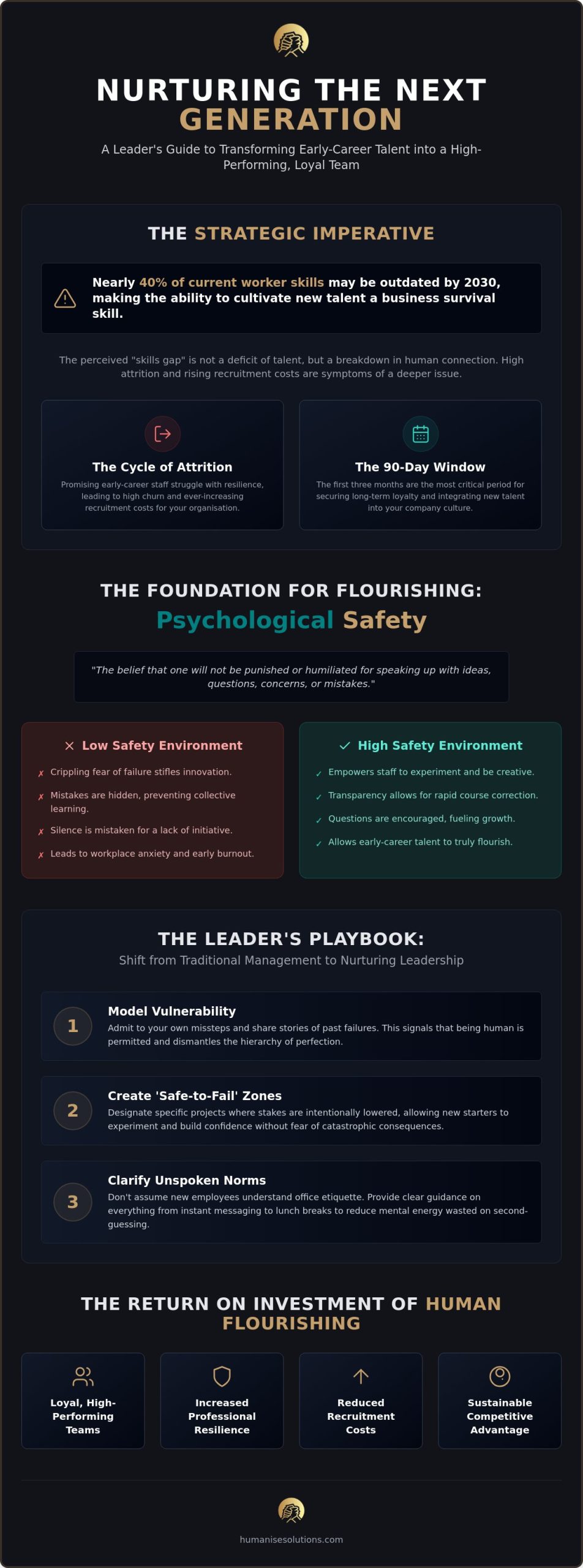
The UK workforce landscape in 2026 demands a radical shift in how we perceive entry-level talent. It’s no longer enough to offer a desk and a login. As we face a future where nearly 40% of current worker skills may be outdated by 2030, the ability to cultivate new talent is a survival skill for businesses. If you’re looking for how to support young adults entering workforce environments today, you must prioritise the first 90 days. This period is the critical threshold for long-term retention. When we get this right, we don’t just reduce churn; we actively contribute to social mobility by opening doors for a diverse talent pipeline that might otherwise be shut by invisible barriers.
We must look beyond the simplified labels often attached to the newest generation of workers. These individuals are navigating a phase known as Emerging Adulthood and Early Adulthood, a time of profound identity formation and cognitive growth. Rather than dismissing them through stereotypes, we should recognise their immense human potential. By treating them as individuals with unique aspirations, we move away from transactional management and towards a model of partnership that fosters genuine loyalty and long-term flourishing.
The Transition from Education to Professional Life
For many young people, the jump from university to the modern office is a jarring culture shock. Those entering the workforce in 2026 often missed out on traditional professional socialisation due to the prevalence of remote learning during their studies. They haven’t had the chance to observe office etiquette or workplace dynamics in person. This is where the employer must step in as a developmental partner. It’s about providing the scaffolding they need to understand the unwritten rules of the professional world whilst they build their technical expertise.
Identifying the Skills Gap and Confidence Deficit
What we often label as a “skills gap” is frequently just a lack of confidence in essential human capabilities. These “soft skills” like effective communication and emotional intelligence are the bedrock of team excellence. When a young adult feels unsure, their performance suffers, not because they can’t do the job, but because they are afraid to make a mistake. We must address this confidence deficit head-on by creating a space where questions are welcomed. Professional readiness is a combination of technical competence and deep-seated psychological security.
Cultivating Psychological Safety for Early Career Success
Psychological safety is the belief that one will not be punished or humiliated for speaking up with ideas, questions, concerns, or mistakes. For those just starting their careers, this isn’t merely a nice-to-have; it’s the oxygen required for professional growth. Young adults often arrive in the office with a heavy burden of imposter syndrome. Without years of professional evidence to lean on, they frequently feel like frauds waiting to be discovered. This internal pressure creates a crippling fear of failure that can stifle the very innovation you hired them for.
When you establish a high-safety environment, you change the narrative. Instead of hiding errors to protect their ego, early-career staff feel empowered to report mistakes immediately. This transparency is vital for organisational resilience. It allows for rapid course correction and collective learning. Understanding how to support young adults entering workforce dynamics means recognising that their silence is often a symptom of fear, not a lack of initiative. By removing the threat of social rejection, you reduce workplace anxiety and the early onset of burnout, allowing talent to flourish.
Building an Environment Where Questions are Encouraged
Leaders must actively model vulnerability to dismantle the hierarchy of perfection. When a senior manager admits to a misstep or shares a story of a past failure, it signals that being human is permitted. You can further support this by creating safe-to-fail zones. These are specific projects or tasks where the stakes are intentionally lowered, allowing new starters to experiment without the weight of catastrophic consequences. It’s also helpful to explicitly clarify unspoken office norms. Don’t assume they know the etiquette for instant messaging or lunch breaks; clear guidance eliminates the mental energy wasted on second-guessing.
Reducing the Stigma Around Wellbeing
Genuine support goes far beyond the superficiality of office perks like fruit bowls or table football. It requires normalising difficult conversations about workload and mental fatigue. We encourage managers to move from reactive crisis management to proactive fostering wellbeing as a core business value. This involves training line managers to spot subtle signs of withdrawal, such as a sudden drop in engagement or a change in communication style. By addressing these early indicators with empathy, you create a culture where flourishing is the standard, not the exception.
Designing a Bespoke Professional Development Journey
Generic induction programmes often fail because they treat young adults as uniform components to be fitted into a rigid machine. These sterile processes often ignore the specific anxieties and aspirations of the individual, leading to early disengagement and a sense of being “just another number”. If you want to know how to support young adults entering workforce environments, start by moving away from the one-size-fits-all tick-box exercise. Bespoke journeys foster a deep sense of belonging by showing the individual that their specific growth is seen and valued. When a young person sees their personal values mirrored in organisational goals, they don’t just complete tasks; they flourish with a genuine sense of purpose.
Momentum is the primary antidote to the early-career “slump” that often contributes to high attrition rates amongst those in their first professional roles. By designing development that is intentionally milestone-based, you provide a visible roadmap that maintains engagement through the first critical year. These milestones shouldn’t be viewed merely as technical hurdles to clear. Instead, they are celebrated markers of human progress that validate the young adult’s contribution to the wider team and build their internal bank of evidence for professional confidence.
Setting Clear Expectations and Milestone-Based Growth
We encourage the use of a ‘Contract of Growth’. This is a mutual agreement that aligns the employee’s personal aspirations with the business’s strategic needs, ensuring they feel like a partner in their journey rather than a passenger. Break down intimidating long-term objectives into achievable weekly wins. This creates a positive feedback loop that builds resilience and keeps motivation high. Move away from the dread associated with annual reviews. Instead, implement frequent, low-stakes feedback loops. A five-minute check-in on a Friday afternoon is often more transformative than a formal document produced once a year. It allows for real-time course correction whilst maintaining a supportive, nurturing atmosphere.
Balancing Technical Training with Soft Skill Cultivation
Whilst technical proficiency is necessary for the role, soft skills are the essential human capabilities that drive long-term team excellence. Prioritise the cultivation of qualities like empathetic communication, time management, and emotional intelligence. Developing these skills is a central part of how to support young adults entering workforce roles, as it equips them with the resilience needed for the modern office. Many young adults have the theoretical knowledge from their education but lack the practical experience to apply it. Use interactive workshops to bridge this gap, allowing them to rehearse difficult conversations or project planning in a safe, supportive environment. Encourage self-reflection as a daily habit. When a young adult learns to assess their own progress, they become the architects of their own development, leading to a more autonomous and high-performing team.
Implementing Effective Mentorship and Nurturing Leadership
Traditional management styles often focus on output at the expense of the individual. However, when we consider how to support young adults entering workforce environments, we must pivot towards Nurturing Leadership. This approach acts as a powerful catalyst for team excellence by prioritising the human experience alongside professional deliverables. Whilst a traditional manager might focus solely on deadlines and task completion, a developmental mentor looks at the person’s trajectory. They identify how current challenges can be transformed into future strengths, ensuring the transition from education to employment is a journey of steady progression rather than a series of obstacles.
Effective mentorship facilitates more than just knowledge transfer. It builds the social connection that is often missing in a hybrid or remote-first world. By pairing a new starter with an experienced guide, you create a dedicated space for growth that exists outside the pressure of formal reporting lines. We also advocate for reverse mentoring. This allows senior leaders to learn from the fresh perspectives and digital fluency of their youngest staff, creating a culture of mutual respect and lifelong learning. It’s a reciprocal relationship that benefits the entire organisation.
The Role of the Nurturing Leader in Early Careers
A Nurturing Leader uses active listening as their primary tool. It’s about hearing the unspoken anxieties behind a request for help and responding with empathy rather than frustration. Providing constructive feedback is a delicate art. You must maintain high standards whilst ensuring the young person’s confidence remains intact. This is achieved by framing feedback as a collaborative problem-solving session rather than a top-down critique. It’s about saying, “I see your potential, and here is how we can refine this work to meet it.” To truly transform your management culture, explore our specialised training in nurturing leadership to build a more resilient and inclusive team.
Creating Peer Support Networks
Horizontal social connection is just as vital as vertical mentorship. New starters often feel more comfortable asking “silly” questions to their peers than to their supervisors. By organising informal lunch and learn sessions, you create a community where knowledge is shared organically and unwritten rules are demystified. Peer-to-peer coaching allows young adults to solve daily challenges together, building collective resilience. This network acts as a social safety net, ensuring no one feels isolated as they navigate the complexities of professional life. It turns a group of individuals into a cohesive, high-performing cohort that supports one another’s flourishing.
Sustaining Growth with Humanise Solutions’ Young Adult Programmes
At Humanise Solutions, we don’t view early-career support as a temporary onboarding phase. We see it as a strategic investment in the very fabric of your company. Our philosophy is rooted in Human Flourishing, a belief that when individuals feel seen, supported, and challenged, they don’t just meet expectations; they exceed them. By choosing our evidence-based approach, you learn exactly how to support young adults entering workforce roles in a way that turns their initial potential into long-term team excellence.
Our methodology shifts the focus from mere survival to genuine thriving. It’s common for new starters to feel overwhelmed by the end of their first six months, but our programmes provide the steady scaffolding needed to maintain momentum. We move beyond the sterile language of traditional consulting to offer a visionary guide for development. This ensures that while your goals are high-reaching, the foundation remains rooted in logic and human connection.
Beyond the Induction: Long-term Development Strategies
We understand that growth isn’t a linear event but a continuous process of cultivation. Our programmes evolve as the young adult progresses, moving from foundational professional socialisation to advanced leadership capabilities. This allows you to build a robust pipeline of future leaders from within your own ranks, reducing the need for expensive external hires at more senior levels. Our bespoke consultancy also helps you identify organisational blind spots, uncovering the subtle cultural barriers that might be preventing your young staff from reaching their full potential. By addressing these hidden issues, we help you create a more inclusive and empathetic team culture that benefits everyone.
Measuring the Impact on Retention and Team Excellence
The success of our initiatives is visible in the data. Tracking the ROI of professional development through reduced staff turnover rates provides a clear picture of the value we bring. When young adults feel a deep sense of belonging and purpose, they stay. This “Humanise Effect” leads to improved wellbeing and performance across the whole team, as the energy of a thriving cohort is infectious. Implementing a structured framework for how to support young adults entering workforce environments isn’t just about being a compassionate employer; it’s about being a bold innovator who understands that human values are the ultimate driver of sustainable growth.
Discover our bespoke Young Adult Programmes
Cultivating a Future of Human Flourishing
Building a workplace where early-career talent thrives requires more than a standard induction. It’s about dismantling the fear of failure through psychological safety and replacing generic training with bespoke development journeys that honour individual values. When you embrace nurturing leadership, you aren’t just managing staff; you’re cultivating a resilient community of future leaders. Mastering how to support young adults entering workforce roles is a strategic evolution that transforms your organisation into a beacon of team excellence and inclusivity.
Our evidence-led leadership consultancy provides specialised tracks for early-career growth, ensuring that psychological wellbeing remains at the heart of your professional strategy. We invite you to Explore our Young Adult Development Programmes to see how we can partner with you in this journey of transformation. By investing in the human experience today, you’re securing a high-performing, loyal cohort for tomorrow. Together, we can move beyond traditional corporate boundaries to create a culture where every individual has the space to truly flourish.
Frequently Asked Questions
What are the biggest challenges young adults face when entering the workforce?
Young adults primarily face a significant culture shock when transitioning from education to the modern office. This is often compounded by a lack of traditional professional socialisation, as many spent their formative university years in remote learning environments. They also struggle with imposter syndrome and a perceived skills gap in professional etiquette. Providing a developmental partner rather than just a manager helps ease this jarring transition and builds early confidence.
How can I improve Gen Z employee engagement in my team?
Engagement improves when you align an individual’s personal values with your company’s strategic goals. Gen Z employees seek purpose and clear evidence of their contribution to the wider team. By breaking down long-term objectives into achievable weekly wins, you maintain their momentum and enthusiasm. They value authenticity and social connection, so creating a culture of open dialogue and mutual respect is essential for long-term loyalty.
What is the difference between a mentor and a line manager?
A line manager is responsible for your daily output, deadlines, and task completion within the business structure. In contrast, a mentor acts as a visionary guide focused on your long-term flourishing and identity formation. Whilst the manager ensures the work gets done, the mentor helps you understand the unwritten rules of the office and your future potential. Both roles are vital, but mentorship provides the psychological security needed for sustainable development.
Why is psychological safety important for early-career staff?
Psychological safety is the bedrock of professional growth because it removes the crippling fear of failure. For early-career staff, knowing they won’t be punished for asking questions or making mistakes is vital for their resilience. It’s a core component of how to support young adults entering workforce environments effectively. When fear is removed, workplace anxiety drops, allowing young talent to focus on innovation and genuine team excellence.
How do I give feedback to a young employee without damaging their confidence?
Deliver feedback as a collaborative problem-solving session rather than a top-down critique. Start by acknowledging their strengths and then frame the refinement as a way to reach their full potential. It’s about saying, “I see your talent, let’s polish this specific area together.” Frequent, low-stakes feedback loops are much more effective than annual reviews. This steady pace builds trust and ensures the young person feels supported rather than judged.
How can professional development programmes improve staff retention?
Bespoke development programmes significantly reduce attrition by showing employees that their growth is a strategic priority. When you understand how to support young adults entering workforce roles through milestone-based journeys, you create a clear roadmap for their future. This fosters a deep sense of belonging and purpose. Employees who see a visible path for their advancement within your ranks are far more likely to stay, reducing recruitment costs.
What role does social mobility play in modern recruitment?
Social mobility is a catalyst for building a diverse and resilient talent pipeline in the modern UK market. By removing invisible barriers to entry, you open your doors to a wider range of perspectives and experiences. This inclusivity enriches your team culture and drives innovation. Supporting young people from all backgrounds ensures your organisation isn’t just hiring for current competence, but for future potential and human flourishing.
Can nurturing leadership actually improve business performance?
Nurturing leadership directly improves business performance by creating a culture of sustainable growth and high engagement. When leaders prioritise the human experience, they see a reduction in staff turnover and the early onset of burnout. This approach isn’t just about being a compassionate employer; it’s a pragmatic strategy for team excellence. A loyal, high-performing cohort that feels psychologically secure will always outperform a team managed through pressure and detachment.
