

Article by
Scott Ward MBA CCMI
Scott Ward is the founder and CEO of Humanise Solutions, which he established three years ago to help organisations elevate their people, leadership and culture through a human-centric, evidence-based approach. Before moving into business and academia, Scott spent seven years as a professional footballer, playing for Luton Town, Crawley Town and Coventry City FC until injury brought his playing career to a close — a turning point that shaped both his research interests and his approach to leadership.
Scott holds an MBA from Warwick Business School, where his research explored the causal relationship between trauma and decision-making — work that continues to inform how he supports young adults, leaders and teams under pressure. Recognised as a Companion of the Chartered Management Institute (CCMI), its highest grade of membership, he combines academic rigour with the discipline, resilience and team-first mindset of the professional game. At the heart of everything he does is a simple belief: that people perform at their best when they are led, developed and valued as human beings first.
A new manager’s first leadership challenge isn’t proving they have all the answers. It’s learning how to help others thrive. The shift from individual contribution to supporting and developing a team can feel unfamiliar, which is why leadership coaching for new managers should start with the realities of the role, not a generic model of leadership.
If you’re weighing up coaching, training or another form of support, begin with what the manager needs to do differently at work. They may need to build confidence in giving feedback, managing others effectively or resolving conflict. Development becomes more useful when these priorities connect with observable behaviours and the organisation’s goals.
This guide will help you assess coaching options, match support to a new manager’s transition and define outcomes that matter. You’ll also explore how one-to-one coaching and structured learning can work with the manager’s workplace context, so growth feels relevant and sustainable. Humanise Solutions brings a human-centric, scientific approach to leadership development, informed by over 12 years of research into decision-making processes and trauma prevention. The aim is steady progress: nurturing the confidence and behaviours that help managers support their teams and contribute to shared organisational outcomes.
Key Takeaways
- Choose leadership coaching for new managers around the situations and responsibilities they’re facing, rather than relying on a one-size-fits-all approach.
- Compare coaching, structured training and mentoring by the kind of support each provides, then match it to the manager’s priorities.
- Turn reflection into practice by exploring real workplace situations and reviewing what the manager wants to try next.
- Agree development priorities with the manager and relevant organisational stakeholders, linking growth to observable behaviour and shared goals.
- Explore how 1-1 Coaching, Nurturing Leadership and Bespoke Learning can support relevant, human-centred leadership development.
Why leadership coaching for new managers matters during the role transition
Becoming a manager changes the focus of work. Success is no longer measured only by what one person completes; it also depends on how effectively they help colleagues contribute, develop and work together. That shift can be rewarding, but it brings new responsibilities and relationships to navigate. Leadership coaching for new managers offers developmental support rooted in the manager’s real work and people responsibilities, rather than generic advice detached from the demands of the role.
The Business and executive coaching overview describes coaching as a form of development that can support management and leadership effectiveness. In practice, the most useful focus depends on the manager, their team and the organisation’s priorities.
What changes when someone becomes a manager?
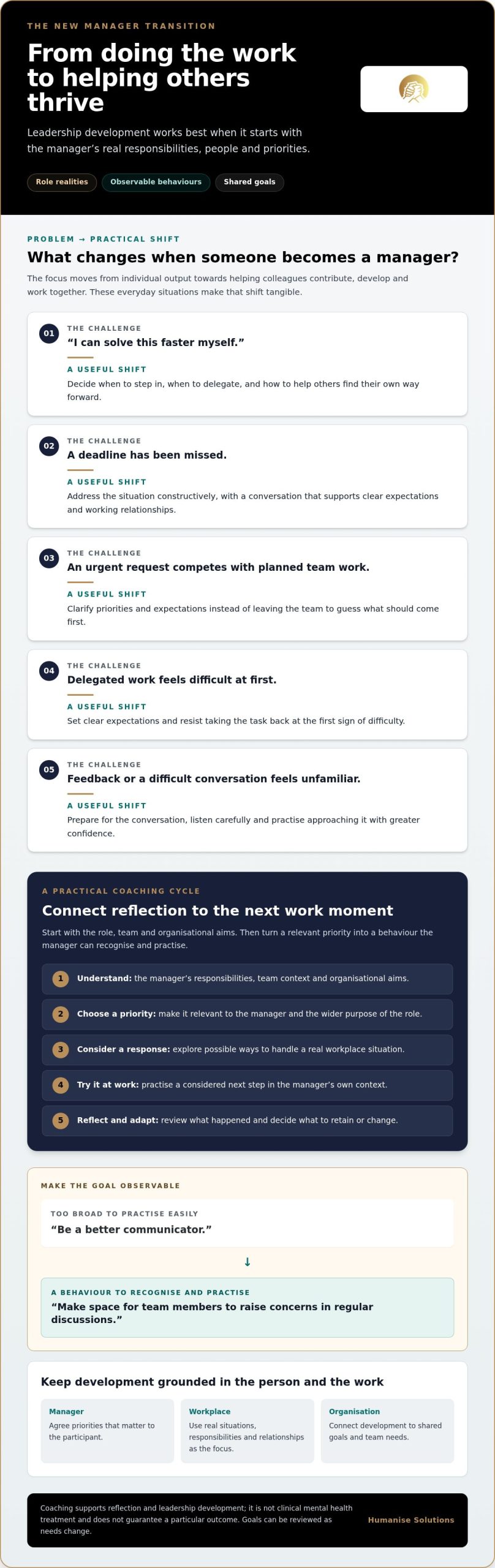
A capable individual contributor may be used to solving problems directly. As a manager, they need to decide when to step in, when to delegate and how to help others find their own way forward. Relationships change too: former peers may now look to them for direction, decisions and feedback.
Everyday situations make the shift tangible. A manager might need to address missed deadlines constructively, balance an urgent request against planned team work or delegate a task without taking it back at the first sign of difficulty. Communication, feedback, delegation and managing others effectively can all become important development priorities. The right mix depends on the manager’s experience, team and role.
What does leadership coaching for a new manager involve?
Coaching creates space to examine real workplace situations, consider possible responses and identify what the manager wants to practise. A conversation might explore how to prepare for a feedback discussion, clarify expectations when priorities compete or build trust with a newly formed team. Rather than prescribing one answer, the coach supports reflection so the manager can choose a considered next step in their own context.
Useful goals focus on observable behaviours and working relationships, such as listening before deciding, delegating with clearer expectations or approaching difficult conversations with greater confidence. The manager and relevant organisational stakeholders can connect these aims to team needs and wider goals, giving development a clear direction without reducing it to a generic checklist.
This is professional learning and leadership development, not clinical mental health treatment. Its purpose is to help a manager reflect on their work, strengthen relevant skills and develop their approach over time. The process and progress depend on the person and circumstances; coaching doesn’t guarantee a particular outcome. A supportive, tailored focus can help new managers build leadership habits that feel practical, human and sustainable.
How leadership coaching helps new managers turn reflection into practice
Reflection is most useful when it connects to what a manager needs to do next. A practical coaching cycle begins with understanding the role, team and organisational aims, then identifies a relevant development priority. The manager considers how they might respond to a real situation, tries an approach at work and reflects on what happened. A later review can help them decide what to retain or adapt as circumstances change.
Reflective coaching can help a manager turn insight into considered workplace practice, while leaving room for learning and different outcomes. It offers a way to explore choices, not a script that guarantees a particular result. This distinction matters: an approach that helps in one team or conversation may need adapting in another.
From development needs to useful coaching goals
Begin with the manager’s immediate responsibilities and the organisation’s intended outcomes. “Be a better communicator” is difficult to act on. “Make space for team members to raise concerns in regular discussions” gives the manager a behaviour they can recognise and practise. The goal should matter to the participant and support the wider purpose of the role.
Priorities can evolve. As the manager settles into the work, a focus on clarifying ownership might give way to building trust across the team. Review coaching goals regularly so they remain useful, rather than becoming a fixed checklist disconnected from current needs.
Practising leadership behaviours in the workplace
A coaching conversation might help a manager prepare to listen carefully when a colleague raises a concern, explain expectations more clearly or approach a difficult conversation with curiosity instead of rushing to a conclusion. Afterwards, they can reflect: What did I notice? How did the other person respond? What might I try differently next time?
This supports learning from everyday interactions. It also reflects the shift towards becoming a coach in the way managers support colleagues: asking thoughtful questions and helping others develop, rather than relying only on instruction. Communication, giving and receiving feedback, and managing others effectively are practical areas for development that can be shaped around the manager’s responsibilities.
For organisations connecting individual development with broader priorities, Humanise Solutions’ leadership development services include 1-1 Coaching and Bespoke Learning. These options help shape development around the manager’s context and the outcomes the organisation wants to support.
Coaching, training or mentoring: which support fits a new manager?
There isn’t one right format for every new manager. The best fit depends on what they need to learn, how individual their situation is and whether the priority is personal reflection, shared knowledge or insight from experience. Leadership coaching for new managers can be part of the answer, but it isn’t automatically preferable to training or mentoring. Each approach offers a different kind of support.
| Audience need | Support format | Learning emphasis | Workplace application |
|---|---|---|---|
| Space to explore a personal challenge or development priority | One-to-one coaching | Reflection, choices and individual behaviours | Consider how to handle a specific team or communication situation |
| Shared knowledge or practice of a defined skill | Structured training | Common concepts, tools and guided practice | Apply learning to tasks such as giving feedback or clarifying expectations |
| Perspective informed by relevant experience | Mentoring | Guidance, examples and professional learning | Draw on an experienced colleague’s insight when considering a work challenge |
When is one-to-one coaching a stronger fit?
Coaching may suit a manager who wants focused space to explore how they lead, especially when a challenge involves their habits, confidence or working relationships. The conversation can centre on their role and circumstances, helping them consider possible responses instead of being handed a single prescribed solution. This individual focus can be valuable, though coaching isn’t the best choice for every need.
To keep coaching practical, agree a work-related aim. For instance, a manager might want to listen more fully in one-to-ones or set clearer expectations when delegating. They can then reflect on what they tried and noticed. Linking a goal to daily responsibilities helps prevent development from feeling abstract.
When might training or mentoring complement coaching?
Training can help when a manager needs to build shared understanding or practise a defined skill, such as giving and receiving feedback. Mentoring may be useful when they would value a more experienced colleague’s perspective on navigating a familiar workplace situation. These approaches can complement coaching when they serve distinct priorities: training develops knowledge and skills, mentoring brings experience into the discussion, and coaching makes room to examine the manager’s own choices and practice.
Choose by starting with the outcome. Is the need to learn a skill together, explore an individual leadership challenge or gain insight from experience? A clear answer can guide support that feels relevant to the manager and useful to the organisation.
How to choose and introduce leadership coaching for new managers
A thoughtful coaching brief starts with the manager’s actual role, not a generic description of leadership. Clarify what has changed, which responsibilities feel most demanding and what the organisation hopes to support. Then agree development priorities with the manager and relevant stakeholders, so the aims reflect both the participant’s needs and the team’s wider context.
Questions to shape a coaching brief
Use a few focused questions to create a useful starting point:
- What has changed? Identify new responsibilities, relationships or decisions the manager now holds.
- Which situations matter most? Pinpoint the work moments where the manager wants to build confidence or develop a different approach.
- What outcomes does the organisation value? Connect personal development with relevant team or organisational priorities.
- How will learning be reviewed? Agree how the manager and organisation will reflect on progress, while respecting the participant’s role in the process.
These conversations keep leadership coaching for new managers grounded in shared purpose. Priorities may change as the manager gains experience or team needs shift, so the brief should provide direction without locking development into a rigid plan.
Ways to recognise a suitable coaching approach
A useful approach starts by understanding the manager’s context, then shapes reflection around specific development priorities. It should help the participant connect ideas with day-to-day leadership while making expectations clear: what the manager is working towards, how they can apply learning and how progress will be reviewed.
Review can be practical without relying on invented scores or promises. The manager might reflect on a relevant conversation, consider how they responded to a team situation or discuss observations with an appropriate organisational stakeholder. The focus is on learning and workplace behaviour, not on treating every complex human interaction as a simple measure.
Before introducing coaching, explain its purpose to the manager and make space for their perspective. Agree which priorities are shared, what information may be discussed with stakeholders and how reviews will support development. This clarity helps establish trust and keeps the work aligned with outcomes that matter to both the individual and organisation.
Humanise Solutions takes a human-centric approach to leadership development, with support shaped around participant and organisational needs. To explore how coaching can align with your manager’s role and development priorities, discuss your leadership development needs.
Humanise Solutions: nurturing leadership potential in new managers
A new manager’s development should support both the person stepping into leadership and the outcomes their organisation wants to achieve. Humanise Solutions takes a human-centric, scientific approach to nurturing people, leadership and culture. Development is most relevant when it starts with the manager’s context and builds towards priorities that matter in their role and workplace.
A human-centric foundation for leadership development
Empathy gives a manager space to reflect honestly on what feels new, where they would like to grow and how their actions affect others. A scientific approach adds structure to that reflection, connecting individual development with the needs of teams and organisations. Humanise Solutions’ approach is informed by over 12 years of research into decision-making processes and trauma prevention.
Here, coaching is professional development: a supportive opportunity to explore leadership practice and consider how to apply learning at work. It is not clinical treatment, nor does it promise a fixed outcome for every participant. The focus is on nurturing potential through development that responds to the individual and their circumstances.
Connect individual growth with organisational needs
Development can begin by bringing together the manager’s experience, responsibilities and the organisation’s intended outcomes. A new manager might want to build confidence in giving feedback, while the organisation is looking to strengthen communication across a team. Bringing these priorities into the same conversation makes learning purposeful without losing sight of the person behind the role.
Humanise Solutions offers 1-1 Coaching, Nurturing Leadership and Bespoke Learning. These options provide different ways to shape development around participant and organisational needs. Relevant themes may include communication, giving and receiving feedback, managing others effectively and conflict resolution. The right emphasis depends on what the manager and organisation are working towards.
For a broader perspective, explore Nurturing Leadership Skills: The Human-Centric Path to Organisational Excellence. Organisations can also explore bespoke learning and development programmes shaped around their needs. Together, these perspectives help connect leadership growth with a considered approach to organisational development.
To explore how leadership coaching for new managers could align with your people and organisational priorities, discuss coaching and leadership development with Humanise Solutions.
Build a confident start to leadership
Choosing the right support begins with the new manager’s real responsibilities and the outcomes the organisation wants to nurture. Coaching creates space to reflect on individual challenges and practise relevant behaviours, while training can build shared skills and mentoring can offer perspective from experience. The formats need not compete; they can complement one another when each has a clear purpose.
Effective leadership coaching for new managers connects personal development with day-to-day work, making progress easier to reflect on through learning and workplace observations. Humanise Solutions brings a human-centric, scientific approach informed by over 12 years of research into decision-making processes and trauma prevention, with development options including 1-1 Coaching, Nurturing Leadership and Leadership ILM Programmes.
Every manager’s path is different, but thoughtful support can help them grow into the role with greater confidence and care for the people they lead. Discuss leadership coaching for your new managers and explore development shaped around your organisation’s priorities.
Frequently Asked Questions
Is leadership coaching suitable for a first-time manager?
Yes, leadership coaching can give a first-time manager structured space to explore the shift into managing people and identify useful development priorities. Suitability depends on their role, needs and goals. Start by discussing which workplace situations they want to handle with greater confidence, then connect those priorities with the organisation’s aims. Coaching supports professional learning and reflection, but it can’t promise a particular outcome.
What does leadership coaching for new managers cover?
Leadership coaching for new managers can focus on the responsibilities and development needs of the individual. Relevant themes might include communication, giving and receiving feedback, setting expectations, managing others effectively or resolving conflict. Current workplace situations can provide a starting point for reflection and practice. Agree priorities with the manager and connect them to the organisational outcomes the development is intended to support.
How is coaching different from leadership training or mentoring?
Coaching typically centres on an individual’s context, reflection and development priorities. Leadership training can build shared knowledge or help managers practise defined skills, such as giving feedback. Mentoring draws on another person’s relevant experience and perspective. These approaches serve different purposes and may complement one another. Choose by considering the manager’s needs, organisational goals and the kind of learning that will be useful in their role.
How long does leadership coaching for a new manager take?
There’s no single timetable that suits every manager or organisation. The appropriate structure depends on the development priorities, workplace context and agreed programme design. A useful starting discussion clarifies what the manager wants to develop, how that connects with organisational outcomes and when learning will be reviewed. A fixed duration shouldn’t be treated as a guarantee of readiness or lasting behaviour change.
How much does leadership coaching for new managers cost?
The investment depends on the scope of coaching and the development needs the organisation wants to address. Rather than assuming one standard format or fee applies, begin with a clear brief covering the manager’s role, intended outcomes and support required. This helps shape programme design around the needs involved and keeps the decision focused on fit and value, without relying on an arbitrary comparison.
Can coaching help a new manager handle difficult conversations?
Yes, coaching can help a new manager prepare for difficult conversations by creating space to reflect on the situation and consider how they want to approach it. They might explore how to listen carefully, give clear feedback, manage expectations or address conflict. The discussion should reflect their responsibilities and workplace context. Coaching can support preparation and learning from experience, but it can’t guarantee how colleagues will respond.
