

Article by
Scott Ward MBA CCMI
Scott Ward is the founder and CEO of Humanise Solutions, which he established three years ago to help organisations elevate their people, leadership and culture through a human-centric, evidence-based approach. Before moving into business and academia, Scott spent seven years as a professional footballer, playing for Luton Town, Crawley Town and Coventry City FC until injury brought his playing career to a close — a turning point that shaped both his research interests and his approach to leadership.
Scott holds an MBA from Warwick Business School, where his research explored the causal relationship between trauma and decision-making — work that continues to inform how he supports young adults, leaders and teams under pressure. Recognised as a Companion of the Chartered Management Institute (CCMI), its highest grade of membership, he combines academic rigour with the discipline, resilience and team-first mindset of the professional game. At the heart of everything he does is a simple belief: that people perform at their best when they are led, developed and valued as human beings first.
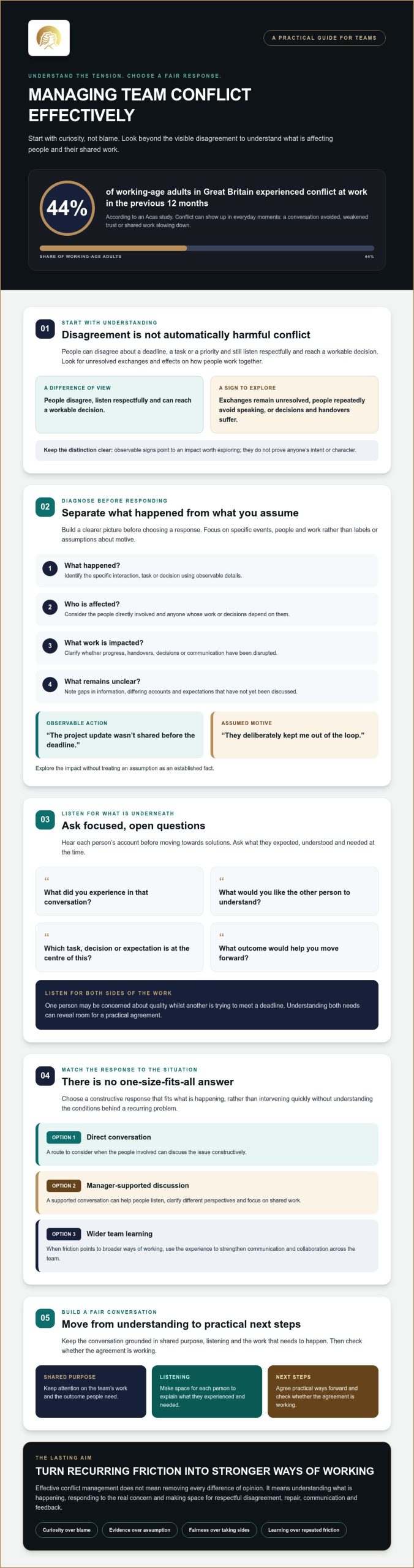
44% of working-age adults in Great Britain experienced conflict at work in the previous 12 months, according to an Acas study published in November 2025. The effects are often felt in everyday moments: a conversation avoided, trust weakened or shared work slowing down. Managing team conflict effectively starts with looking beyond the disagreement to understand what is driving it.
If conflict is affecting communication or relationships in your team, it’s understandable to want to step in and restore calm. Yet a quick intervention may not address the conditions behind a recurring problem, and managers can feel unsure how to act fairly without taking sides.
This guide will help you identify the source of tension, choose a constructive response suited to the situation and build habits that make respectful disagreement and repair part of how your team works. We’ll consider when to intervene, how to approach conflict in remote and hybrid teams, and how listening, communication and feedback can support better ways of working together.
Key Takeaways
- Managing team conflict effectively begins with separating what you observed from what you assume, so you can respond to the issue rather than the story around it.
- Use focused questions to uncover who is affected, what work is at stake and where perspectives differ.
- Choose between a direct conversation, manager-supported discussion or wider team learning according to the situation, rather than following a one-size-fits-all rule.
- Build a fair conversation around shared purpose, listening and practical next steps, then check whether the agreement is working.
- Turn recurring friction into an opportunity to strengthen communication, feedback and collaborative ways of working.
Managing team conflict effectively starts with understanding what is happening
Disagreement can feel unsettling, particularly when people need to keep working together. But tension doesn’t have to define a team or its future. A thoughtful response is possible, and it begins with curiosity rather than blame.
Team conflict is a perceived clash between people’s views, needs, expectations or ways of working. The word “perceived” matters: people may understand the same exchange differently, and the visible disagreement may not reveal what is contributing to it. Conflict management is commonly understood as an effort to address differences constructively and support group outcomes; this overview of conflict management offers a useful starting point.
For a manager, the first task isn’t to decide who’s right. It’s to establish what happened, how it is affecting shared work and what each person understands about the situation. That creates a fairer foundation for choosing what to do next.
What is the difference between disagreement and harmful conflict?
People can disagree about a deadline, how to complete a task or which priority comes first, whilst still listening respectfully and reaching a workable decision. Disagreement becomes more concerning when exchanges remain unresolved, people repeatedly avoid speaking to one another, or decisions and handovers start to suffer.
Focus on what you can observe. For example, a colleague may be left out of project updates, or a discussion may end without clear agreement. These signs point to an impact worth exploring, not proof of anyone’s intent or character.
What may be beneath a team disagreement?
Before forming a view, hear each person’s account. Ask what they expected, what they understood and what they needed at the time. Could people be working to different priorities? Are responsibilities or decision-making expectations unclear? Has a communication style or missing information affected how an exchange was received? Treat these as questions to investigate, not conclusions.
Listen for both the immediate issue and its effect on the work. One person may be concerned about quality, whilst another is trying to meet a deadline. Understanding both needs can reveal room for a practical agreement. Skills covered in Humanise Solutions’ Listening Effectively, Communication and Conflict Resolution modules can help teams handle these moments more constructively.
Managing team conflict effectively doesn’t mean removing every difference of opinion. It means making space to understand what is happening, so the response addresses the real concern and gives people a better chance of working well together.
Diagnose the source of team conflict before choosing how to respond
Once a disagreement has surfaced, pause before deciding what will resolve it. A rushed answer may address the most visible exchange whilst missing differences in expectations, responsibilities, communication or access to a decision. Diagnose the situation before trying to resolve it, so your response addresses what is actually affecting the people and their work.
Use this short sequence to build a clearer picture:
- What happened? Identify the specific interaction, task or decision, using observable details rather than labels such as “uncooperative”.
- Who is affected? Consider the people directly involved and anyone whose work or decisions depend on them.
- What work is impacted? Clarify whether progress, handovers, decisions or communication have been disrupted.
- What remains unclear? Note gaps in information, differing accounts and expectations that haven’t yet been discussed.
For example, “the project update wasn’t shared before the deadline” describes an action. “They deliberately kept me out of the loop” interprets its motive. Keep the two separate. You can explore the impact without treating an assumption as established fact.
Which questions help uncover the real issue?
Speak with each person and invite a specific account before moving towards solutions. Open questions can help reveal what the disagreement is really about:
- “What did you experience in that conversation?”
- “What would you like the other person to understand?”
- “Which task, decision or expectation is at the centre of this?”
- “What outcome would help you move forward?”
Listen without rushing to judge, then summarise each account neutrally: “I’m hearing that you expected the decision to be shared before work began. Have I understood that correctly?” Check your summary with the speaker. This gives them a chance to clarify and helps you identify where the accounts differ, rather than relying on your first impression.
When should a manager consider power and inclusion?
Consider whether differences in status, influence or access to decision-making could affect how freely people contribute. Don’t assume that someone feels unable to speak, or infer intent from identity or role. Ask what would help each person take part comfortably. If a joint conversation doesn’t feel suitable, offer separate discussions first and establish what, if anything, they’re willing to bring into a shared conversation.
These diagnostic skills can be strengthened through team development focused on communication, listening and conflict resolution. If your team would benefit from developing these capabilities, you can discuss your team’s development needs with Humanise Solutions.
Compare conflict responses: when to talk, facilitate or seek further support
Choosing how to respond depends on what you’ve learned, whether the people involved can take part and what outcome the team needs. Managers may worry that stepping in will intensify tension. Preparation can reduce avoidable escalation: clarify the issue, set a constructive purpose and ask impartial questions rather than deciding who is at fault.
No single response fits every disagreement. Use the options below as a guide, then reassess if new concerns emerge.
| Response | Suitable conditions | Potential benefits | Limitations and next step |
|---|---|---|---|
| Direct conversation | People can speak respectfully, and the issue is suitable for a straightforward discussion. | Those involved can explain their perspectives directly and agree a practical way forward. | It may not be suitable if someone feels unable to participate freely. Focus on a specific behaviour or work issue, then check whether the agreement resolves the concern. |
| Manager-supported discussion | Communication has stalled, accounts differ or participants would value a neutral structure. | A manager can help each person speak, clarify needs and identify shared next steps. | The manager’s impartiality may be questioned, or the discussion may not feel safe or appropriate. Speak with participants separately first and consider another suitable source of support. |
| Structured team learning | Similar friction recurs, or the team wants to strengthen how it communicates and works together. | Learning can build shared skills and expectations beyond resolving one incident. | It won’t replace addressing a specific unresolved concern. Identify the pattern the team wants to change and agree how to practise and review new ways of working. |
| Organisational procedures or qualified support | Concerns are serious, persistent or relate to safety, or the matter falls outside the manager’s role. | Appropriate channels can provide a more suitable process or expertise. | Informal discussion or team learning may not be appropriate. Check relevant organisational procedures and seek qualified support where needed. |
When is a direct conversation a reasonable first step?
A direct conversation may help when both people are willing and able to take part. Encourage them to describe a specific action and its effect on the work, rather than making accusations about character. For example, they might discuss a missed handover, explain how it affected a task and agree how future handovers will be handled. If either person feels pressured or unable to speak openly, pause and reconsider the approach.
When can facilitated discussion or team development help?
A facilitated discussion gives a particular disagreement a neutral structure for listening, clarifying needs and agreeing practical actions. Team development has a broader purpose: building communication and collaborative behaviours over time, rather than resolving one incident alone. For context on strengthening how a team works together, explore team development services. Managing team conflict effectively means matching the response to the people and the work, then checking whether it has helped.
How to manage a team conflict effectively: a fair, practical conversation
A constructive conversation needs more than good intentions. It needs preparation, a clear purpose and enough structure for everyone to contribute. The aim isn’t to force agreement or settle every concern in one meeting. It’s to understand the impact, identify workable next steps and know when to review or seek further support.
Prepare, set a shared purpose, hear each perspective, clarify needs, agree practical actions and review progress. This sequence gives a manager a steady path whilst leaving room to adapt to the people and circumstances involved.
How can a manager prepare without taking sides?
Before bringing people together, gather specific examples and distinguish confirmed observations from assumptions. Consider who needs to participate and whether a joint conversation is appropriate. If someone may not be able to speak freely, find another way to hear their perspective first. Set a balanced purpose, such as understanding how a handover broke down and agreeing how future updates will be shared.
Guide the conversation step by step
- Set a shared purpose. Explain that the discussion is to understand the issue and support the work, not to assign blame. Ask: “What would make this conversation useful for both of you?”
- Hear each perspective. Give people space to speak without interruption. Try: “What happened from your point of view?” and “What do you most want understood?”
- Explore impact and needs. Ask: “How has this affected the task or team?” and “What do you need in order to move forward?” Reflect back what you’ve heard and check your understanding before discussing solutions.
- Agree actions. Turn the discussion towards specific, achievable steps: “What will each of us do differently next time?” Clarify who is responsible for each action.
- Review progress. Agree when to check how the plan is working and what would indicate that further support is needed.
If people disagree about what was said, return to what can be confirmed and acknowledge different accounts without forcing a shared version. Keep the focus on understanding the effect and improving how the work gets done.
How should the conversation end and be followed up?
Summarise the decisions, responsibilities and next steps in plain language. Record only what’s useful to support the agreed actions, and handle any notes in line with relevant organisational processes and appropriate confidentiality. Don’t treat an informal conversation as a substitute for a procedure that may be needed.
Listening and feedback are skills teams can develop. Humanise Solutions’ Conflict Resolution and Giving and Receiving Feedback modules reflect these capabilities. If you’re considering development tailored to your team’s needs, discuss your team’s development needs with Humanise Solutions. Managing team conflict effectively is an ongoing practice: follow up, learn from what happens and adjust the approach where needed.
Make effective conflict management part of team development
A resolved disagreement can still offer useful information about how a team works. If similar friction keeps returning, look beyond the individual incident: clarify which expectations, communication habits or coordination practices may need attention. Managing team conflict effectively includes making space for teams to learn, not simply putting out the same fire each time.
What team habits can help prevent recurring conflict?
Agree practical expectations together, such as how decisions are shared, how colleagues raise concerns and what to do when a message or instruction is unclear. These agreements work best when they fit the team’s actual tasks and are revisited as those tasks change.
Short, regular check-ins can help the team notice small issues before they become harder to discuss. Ask what is helping people coordinate and where work is getting stuck. Keep the conversation specific and forward-looking:
- Clarify early: invite people to check assumptions when expectations or responsibilities are unclear.
- Challenge respectfully: make room for different views whilst keeping discussion focused on the work and its impact.
- Learn through feedback: discuss what could be done differently next time, rather than searching for someone to blame.
- Return to unresolved concerns: agree how and when the team will revisit an issue that hasn’t been settled.
These habits support everyday collaboration, but they aren’t a replacement for relevant organisational procedures when a concern calls for them.
How can tailored learning support a team’s next steps?
Where recurring friction points to skills the team wants to strengthen, relevant development can connect communication, conflict resolution, feedback and team performance. Humanise Solutions describes its approach as human-centric and offers bespoke programmes. Its confirmed modules include Conflict Resolution, Communication, Giving and Receiving Feedback and Optimising Team Performance. The focus can be shaped around the team’s development needs, without assuming that one learning approach or outcome suits every organisation.
Explore Humanise Solutions’ services to learn about its leadership, Team Excellence and Learning & Development areas. If you’re considering how development could support your team’s specific goals, you can start a conversation with Humanise Solutions.
Build a team that can work through differences
Managing team conflict effectively begins with understanding what’s driving the disagreement, then choosing a response that fits the people and the work. A fair conversation can help colleagues clarify impact, needs and practical next steps, whilst regular team habits can make it easier to raise concerns and learn from recurring friction.
Conflict skills can grow through relevant development. Humanise Solutions offers a Conflict Resolution module, alongside confirmed service areas in Team Excellence and High Performing Teams. Its approach is human-centric and informed by over 12 years of research into decision-making processes and trauma prevention. This provides a foundation for considering how conflict resolution, communication and team performance development might connect with your organisation’s priorities.
You don’t need to have every answer before taking a next step. Discuss a human-centred approach to your team’s development and explore what would best support your people and shared goals. With curiosity, care and a willingness to keep learning, teams can build stronger ways of working together.
Frequently Asked Questions
What is the best way to manage team conflict effectively?
The best approach is to understand the cause before choosing how to respond. Clarify what happened, who is affected and what work is being disrupted, then hear each person’s perspective without treating assumptions as facts. Depending on the situation, a direct conversation or manager-supported discussion may help. Agree practical next steps and check whether they’re working. If the issue is serious or persistent, consider appropriate organisational procedures or further support.
Should a manager intervene in every team disagreement?
No. A respectful difference of opinion about a task or priority may not need intervention if colleagues can discuss it and keep work moving. Stay attentive, though. Repeated avoidance, unresolved exchanges or difficulties coordinating work may signal a need to check in. Ask what support would be useful rather than assuming there’s a problem. If you do step in, focus on observable behaviour and its impact, not on judging character.
How can I resolve conflict between two team members fairly?
Fairness starts with hearing both accounts before deciding on a response. Ask each person what they experienced, what they need understood and what outcome could help the work move forward. Summarise their perspectives neutrally and check your understanding. If a joint conversation is appropriate, agree a shared purpose and give both people space to contribute. Record practical actions proportionately, then follow up to see whether the agreement is helping.
What should I say in a team conflict conversation?
Use open, non-accusatory questions that focus on events, impact and next steps. You might say, “Can you talk me through what happened from your perspective?”, “How has this affected the work?” or “What would help us move forward?” Reflect back what you’ve heard and ask whether you’ve understood correctly. Avoid language that assumes motive or assigns blame. Keep the discussion focused on specific actions and workable agreements.
Can team conflict ever be positive?
Yes, disagreement can help a team examine assumptions, consider different ideas and clarify priorities, provided people can contribute respectfully and the discussion remains connected to the work. It becomes less constructive if exchanges stay unresolved or collaboration is affected. A manager can encourage respectful challenge by inviting different views, listening carefully and helping the group agree how to proceed. The aim isn’t to eliminate difference, but to work with it constructively.
When should a manager seek help with workplace conflict?
Seek further support when a concern is serious, persistent, relates to safety or falls outside your role or experience. Check the organisation’s relevant procedures and consider whether qualified support is appropriate. Don’t rely on team development or an informal discussion as a substitute for a process that may be needed. If a conversation feels unsuitable or someone can’t participate freely, pause and consider a safer, more appropriate way to address the concern.
