
Article by
Scott Ward MBA CCMI
Scott Ward is the founder and CEO of Humanise Solutions, which he established three years ago to help organisations elevate their people, leadership and culture through a human-centric, evidence-based approach. Before moving into business and academia, Scott spent seven years as a professional footballer, playing for Luton Town, Crawley Town and Coventry City FC until injury brought his playing career to a close — a turning point that shaped both his research interests and his approach to leadership.
Scott holds an MBA from Warwick Business School, where his research explored the causal relationship between trauma and decision-making — work that continues to inform how he supports young adults, leaders and teams under pressure. Recognised as a Companion of the Chartered Management Institute (CCMI), its highest grade of membership, he combines academic rigour with the discipline, resilience and team-first mindset of the professional game. At the heart of everything he does is a simple belief: that people perform at their best when they are led, developed and valued as human beings first.
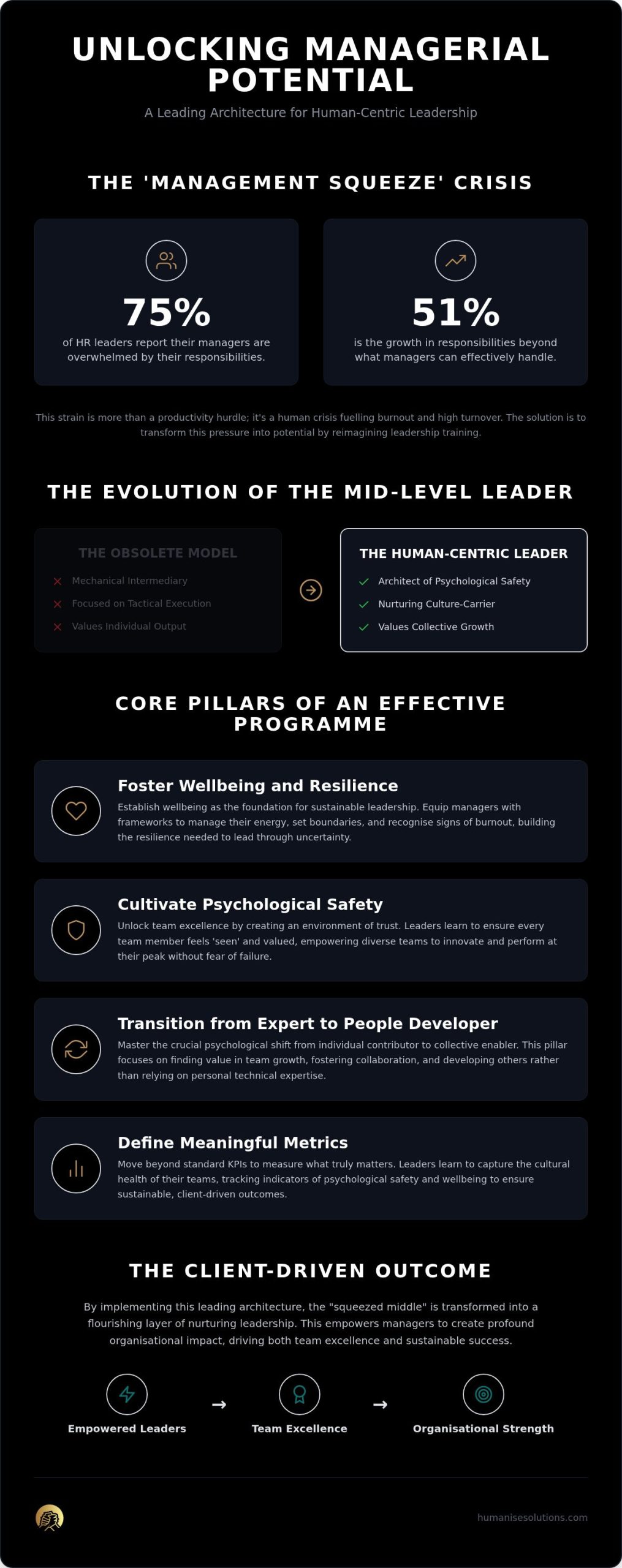
Did you know that 75% of HR leaders now report their managers are overwhelmed by responsibilities that have grown 51% more than they can effectively handle? This “management squeeze” is more than a productivity hurdle; it’s a human crisis that fuels burnout and high turnover. You likely feel this strain daily, whilst your middle managers struggle to balance executive strategy with the immediate needs of their teams. It’s a difficult position that requires more than just a tactical checklist to navigate successfully.
This article promises to show you how to transform that pressure into potential. By reimagining middle management leadership training as a nurturing process rather than a corporate formality, you can cultivate a culture of psychological safety and team excellence. We will explore a leading architecture for development that focuses on the human experience, providing evidence-based strategies designed for client driven outcomes that align your entire organisation toward a shared, vibrant future.
Key Takeaways
- Learn why effective middle management leadership training must move beyond tactical execution to focus on the human bridge between vision and reality.
- Discover how to establish wellbeing as the structural foundation for sustainable leadership behaviours and fostering team excellence.
- Master the psychological transition from technical expert to people developer by finding value in collective growth rather than individual output.
- Understand how to define metrics that look beyond standard KPIs to capture the true cultural health and psychological safety of your organisation.
- Explore a leading architecture for development that transforms the “squeezed middle” into a flourishing layer of nurturing leadership focused on client driven outcomes.
What is Middle Management Leadership Training in a Human-Centric Context?
Effective middle management leadership training is far more than a suite of tactical workshops designed to sharpen administrative efficiency. Instead, it is the deliberate cultivation of leaders who serve as the vital bridge between executive vision and front-line execution. To understand the depth of this role, one might ask: What is middle management? beyond its placement in a hierarchy? It is the layer where strategy becomes reality through the power of human connection. It’s about people, not just processes.
Traditional training often fails because it treats managers as mechanical intermediaries. This sterile approach leads to the “squeezed middle” phenomenon, where individuals feel constant pressure from above to deliver results and from below to provide support, yet they lack the emotional tools to manage either effectively. We believe the antidote is nurturing leadership. This philosophy shifts the focus from merely managing tasks to fostering an environment where every team member can flourish. It ensures that the middle layer becomes a source of organisational strength rather than a point of failure.
The Evolution of the Mid-Level Leader
The role of the mid-level leader has undergone a profound transformation. In modern UK organisations, the old supervisor model is obsolete. By 2026, the most successful leaders have moved beyond technical expertise, embracing their roles as culture-carriers who prioritise social and emotional intelligence. This shift is essential for unlocking potential within teams. It requires a leading architecture for development that values human flourishing as much as commercial output, recognising that sustainable success is built on the well-being of the people driving it. Leaders must now be architects of psychological safety.
Why “The Squeeze” is a Leadership Opportunity
Whilst the pressure of leading up, down, and across can be daunting, it also presents a unique opportunity for influence. Middle managers occupy the most strategic vantage point in any company, possessing the ability to drive meaningful organisational change from the centre. Effective leadership development programmes help reduce the inherent loneliness of these roles by building resilience and confidence. When managers are equipped with the right frameworks, they stop feeling squeezed and start feeling empowered to create client driven outcomes through team excellence. This transformation turns a position of stress into one of profound impact.
The Core Pillars of an Effective Leadership Development Programme
A robust middle management leadership training programme requires a leading architecture that prioritises foundational excellence. We must move away from sterile, off-the-shelf corporate modules that offer generic advice without addressing the unique cultural heartbeat of your organisation. Truly effective development is bespoke; it is a tailored journey that aligns individual growth with client driven outcomes. By treating inclusive leadership as a core requirement rather than an optional extra, organisations can ensure their managers are equipped to handle the complexities of modern social dynamics whilst maintaining a focus on sustainable results. This approach focuses on unlocking potential with empathy, ensuring that the “middle” becomes a place of strength and clarity.
Fostering Wellbeing and Resilience
Wellbeing-led leadership acts as a primary driver for talent retention by creating an environment where individuals feel supported rather than spent. Managers must first learn to recognise the subtle signals of burnout within themselves before they can effectively safeguard their teams. With 75% of HR leaders reporting that managers are currently overwhelmed by responsibilities (according to 2026 industry research), the ability to maintain an emotional steady-state during organisational turbulence is a vital skill. Training should provide practical frameworks for managing energy and setting boundaries, ensuring that the transition from current states to future potential is both healthy and sustainable. When we foster wellbeing, we create the resilience necessary to lead through uncertainty with confidence.
Cultivating Psychological Safety
Psychological safety is the essential tool for achieving team excellence and driving innovation. People need to feel “seen” and valued to perform at their peak; without this foundation, even the most technically gifted teams will stagnate. Middle managers can build this trust within diverse, multi-generational teams by modelling vulnerability and encouraging open dialogue. This approach doesn’t just improve performance; it also impacts social mobility and inclusive growth by removing the fear of judgement that often silences underrepresented voices. When safety is woven into the leadership fabric, it unlocks the potential of every individual, regardless of their background or tenure. Investing in bespoke Learning & Development that prioritises these human connections is the surest way to transform your leadership layer into a flourishing community.
Transitioning from Technical Expert to People Developer
The transition from technical expert to people developer is often the most significant identity shift a professional will ever face. Most middle managers are promoted because they were exceptional at a specific craft, yet they frequently arrive at their new desks without the foundational “people” training required to thrive. This creates a unique sense of professional loneliness; the familiar comfort of individual output is gone, replaced by the complex, often messy responsibility of human development. Success is no longer about what you produce. It’s about what you enable others to achieve through a leading architecture of support and guidance.
This shift is vital because the manager is the primary architect of the employee experience. Research indicates that relationships with management are responsible for 86% of an employee’s job satisfaction. Therefore, middle management leadership training must focus on coaching as a primary style. Moving away from a “command and control” mindset allows managers to become the human link that translates executive strategy into meaningful, daily work. It is here, in the daily interactions, where the potential of an entire team is either unlocked or stifled by the quality of leadership provided.
The Art of Nurturing Talent
Unlocking potential requires a move from “directing” to “developing.” It’s about providing feedback that feels like a gift of growth rather than a critique that triggers defensive behaviours. To foster team excellence, managers must learn to spot latent potential, particularly when working with young adults who are just beginning their professional journeys. You can identify this potential by looking for three key traits: curiosity in the face of failure, a natural inclination toward collaboration, and the resilience to iterate on ideas. By focusing on these internal qualities, managers cultivate a flourishing leadership layer from the ground up, ensuring long-term sustainability for the organisation.
Managing Upwards with Evidence and Empathy
The human bridge doesn’t just span downwards; it reaches upwards to the executive suite. A sophisticated leader acts as a visionary guide, using human-centric logic to help senior leaders understand the reality of the front line. This involves advocating for team wellbeing whilst remaining firmly committed to strategic organisational goals. It isn’t about choosing people over profit; it’s about proving that people are the only sustainable source of profit. By presenting evidence-based insights with empathy, middle managers can challenge the status quo and drive client driven outcomes that benefit the entire ecosystem. This balanced approach ensures that the “middle” is a position of influence rather than a point of pressure.
How to Organise a Successful Middle Management Training Initiative
Organising effective middle management leadership training requires a methodical approach that respects the complexity of human change. It isn’t a quick fix or a checkbox exercise. To build a leading architecture for development, you must follow a structured path that prioritises client driven outcomes whilst remaining deeply empathetic to the manager’s experience. Success is found when we stop treating training as an event and start treating it as a journey of cultivation.
- Step 1: Audit the climate. Identify the specific human pain points your managers face. Are they struggling with “the squeeze” or a lack of strategic clarity?
- Step 2: Define excellence. Create metrics for success that go beyond simple KPIs. Focus on team cohesion, psychological safety scores, and resilience levels.
- Step 3: Secure buy-in. Demonstrate to executives that leadership wellbeing is a primary driver of organisational ROI and talent retention.
- Step 4: Implement rhythm. Use bespoke learning paths that allow for reflection and real-world application over time rather than a single intensive burst.
- Step 5: Measure success. Track long-term shifts in employee engagement and retention rates to validate the transformation of your leadership layer.
Designing for Long-Term Sustainability
Meaningful behavioural change doesn’t happen in a single afternoon. One-day workshops often fail because they ignore the natural pace of human growth. Sustainable development must be rhythmic, involving regular, smaller interventions that allow managers to test new behaviours in real-time. By creating peer-support networks amongst middle managers, you foster a sense of belonging that combats the professional loneliness discussed earlier. This collective growth builds a more resilient organisation where everyone feels supported to reach their full potential. It creates a community of practice that sustains itself long after the formal programme ends.
Measuring the Impact on Organisational Growth
To assess real cultural shifts, you must move beyond “happy sheets” collected at the end of a session. These reactive forms rarely capture the depth of transformation or the shift in mindset. Instead, track the correlation between your training initiatives and reduced staff turnover. High-quality programmes don’t just improve performance; they directly support social mobility and diversity goals by ensuring every manager is equipped to champion inclusive growth. If you are ready to transform your leadership layer, explore our bespoke Team Excellence programmes to begin your journey toward sustainable growth.
Cultivating Excellence with Humanise Solutions
At Humanise Solutions, we believe that the most effective middle management leadership training isn’t delivered from a distance. It’s grown from within. Our “Nurturing Leadership” framework moves beyond the sterile metrics of traditional corporate consulting to focus on the whole human being. We understand that for a manager to lead others effectively, they must first feel supported, seen, and empowered. This empathetic approach is the cornerstone of our methodology, ensuring that every intervention is designed to unlock the latent potential within your leadership layer and foster a culture where everyone can thrive.
We don’t believe in “quick-fix” solutions that offer temporary results. Instead, we provide a leading architecture for development that respects the unique social dynamics of your organisation. Whether you are looking to strengthen your internal culture or drive specific client driven outcomes, our bespoke programmes are tailored to meet your precise needs. Our approach to middle management leadership training ensures that the “squeezed middle” becomes a flourishing engine for organisational success. We act as a visionary guide, helping your managers transition from current challenges to a future state of sustainable confidence and resilience.
Bespoke Programmes for UK Organisations
Our commitment to evidence-based confidence ensures that every strategy we implement is rooted in logic whilst remaining deeply invested in psychological well-being. We focus on sustainable, positive change, moving away from the repetitive cycles of traditional corporate training. By tailoring every initiative to the specific social dynamics of your firm, we ensure that the growth achieved is both authentic and long-lasting. This bespoke nature allows us to address the root causes of friction, replacing them with a foundation of trust and psychological safety that supports long-term organisational health.
Start Your Journey Toward Human-Centric Growth
Our specialised tracks address the nuanced needs of diverse talent pools across the UK. From Women leadership initiatives designed to break down internal barriers to Young Adult Programmes that cultivate the next generation of leaders, we provide the tools for sustainable growth. By focusing on Fostering Wellbeing and Team Excellence, we help you build a resilient “human bridge” that can withstand the pressures of modern business. This isn’t just about training; it’s about creating a culture where people feel safe to innovate and grow together, unlocking the true potential of your entire workforce.
The long-term benefits of investing in your middle management are profound. When you nurture the human bridge, you secure the foundation of your entire organisation and ensure a vibrant, collaborative future. We invite you to explore a more empathetic and effective way to lead. Discover our bespoke learning and development programmes and start your journey toward human-centric growth today.
Empower Your People to Lead with Purpose
The transition from being a technical expert to a nurturing people developer is the most vital shift a leader can make. By prioritising wellbeing and psychological safety, you transform the “squeezed middle” into a resilient, human bridge that connects executive vision with front-line excellence. Effective middle management leadership training is not a tactical fix but a rhythmic process of cultivation that unlocks the latent potential within your organisation. It requires a leading architecture that values human flourishing as much as commercial output; ensuring every manager feels empowered to lead with empathy and confidence.
When you invest in your managers, you invest in the long-term sustainability of your entire firm. Our expert-led workshops and specialised tracks for women and early-career talent provide the evidence-based confidence needed to drive client driven outcomes. Partner with Humanise Solutions for bespoke leadership development and begin the journey toward a more empathetic, effective workplace. The possibilities for your teams are limitless when the bridge they cross is built on a foundation of trust and genuine care.
Frequently Asked Questions
What are the most important leadership skills for middle managers in 2026?
Emotional intelligence, coaching, and the ability to create psychological safety are the most critical skills for modern leaders. In 2026, managers must act as culture-carriers who prioritise human flourishing over simple output. This shift requires a move from directive supervision to a developmental mindset that unlocks the potential of every team member. By focusing on active listening, leaders can bridge the gap between executive strategy and front-line reality whilst maintaining a focus on sustainable growth.
How long does an effective middle management training programme take?
An effective programme typically spans several months to ensure sustainable behavioural change and meaningful growth. Whilst a five-day intensive provides a strong start, true transformation happens through rhythmic, blended learning over three to six months. This timeframe allows for reflection, real-world application, and the development of peer-support networks. These networks sustain the leader’s growth long after the formal training ends, ensuring the leading architecture of the programme delivers long-term results for the organisation.
What is the difference between management training and leadership development?
Management training focuses on tactical execution and administrative efficiency, whilst leadership development cultivates the internal qualities required to inspire and nurture others. Management is about processes; leadership is about people. By investing in middle management leadership training, organisations move beyond simply organising work to building a sophisticated framework where managers act as visionary guides. This approach ensures that the focus remains on unlocking potential and achieving client driven outcomes through human connection.
How can middle management training improve employee retention?
Training improves retention by strengthening the relationship between managers and their teams, which is responsible for 86% of an employee’s job satisfaction. When managers are equipped with the skills to foster wellbeing and team excellence, employees feel seen and valued. This human-centric approach reduces turnover by creating a culture of belonging where individuals are encouraged to reach their full potential. It turns the workplace into an environment that people don’t want to leave.
Why is psychological safety important for mid-level leaders?
Psychological safety is the essential foundation for innovation and achieving team excellence in any modern organisation. Mid-level leaders must create an environment where team members feel safe to take risks and speak up without fear of judgement. This safety is vital for social mobility and inclusive growth, as it ensures that diverse voices are heard and valued. It allows the “squeezed middle” to flourish by reducing the friction caused by silence, fear, and detached corporate language.
How do you measure the ROI of leadership development programmes?
ROI is measured through a combination of cultural shifts and commercial metrics, such as reduced staff turnover and improved engagement scores. We look for client driven outcomes like increased productivity and lower absenteeism to validate the programme’s success. By moving beyond simple feedback forms to track long-term performance data, organisations can see the direct correlation between leadership wellbeing and sustainable growth. This evidence-based approach builds trust and confidence in the development journey.
Can leadership training help with middle manager burnout?
Yes, bespoke middle management leadership training addresses burnout by providing managers with the tools to manage their own energy and resilience. With 75% of HR leaders reporting that managers are currently overwhelmed, training that focuses on wellbeing and boundary-setting is essential. It helps leaders move from a state of constant pressure to one of confidence and clarity. This ensures they can support their teams effectively without sacrificing their own mental health or professional flourishing.
