

Article by
Scott Ward MBA CCMI
Scott Ward is the founder and CEO of Humanise Solutions, which he established three years ago to help organisations elevate their people, leadership and culture through a human-centric, evidence-based approach. Before moving into business and academia, Scott spent seven years as a professional footballer, playing for Luton Town, Crawley Town and Coventry City FC until injury brought his playing career to a close — a turning point that shaped both his research interests and his approach to leadership.
Scott holds an MBA from Warwick Business School, where his research explored the causal relationship between trauma and decision-making — work that continues to inform how he supports young adults, leaders and teams under pressure. Recognised as a Companion of the Chartered Management Institute (CCMI), its highest grade of membership, he combines academic rigour with the discipline, resilience and team-first mindset of the professional game. At the heart of everything he does is a simple belief: that people perform at their best when they are led, developed and valued as human beings first.
What if leadership development strengthened organisational performance by starting with what people need to grow? Development can feel generic or disconnected from the pressures leaders face each day. People focused leadership development offers a more considered approach: it recognises individual strengths, wellbeing and inclusion while keeping organisational priorities in view.
If you’ve found it difficult to connect personal growth with business goals, you’re not alone. A single training course can introduce useful ideas, but lasting development needs more than isolated learning. It calls for an architecture that connects learning, leadership and wellbeing to the outcomes your organisation is working towards, and gives people practical ways to apply what they learn in their roles.
This article explores the principles behind a human-centred approach and how to shape a connected development architecture around your people and priorities. You’ll find practical ways to support leaders’ growth, make development relevant to day-to-day work and assess what to look for in a partner. The aim is not to choose between people and performance, but to build an approach in which both can develop together.
Key Takeaways
- People focused leadership development links leaders’ growth and human needs with the outcomes your organisation wants to achieve.
- Build a connected leadership architecture that brings learning, workplace practice and review together, rather than relying on isolated courses.
- Use organisational behaviours and culture to help shape what leaders practise in their day-to-day roles.
- Assess progress through a mix of activity, learning and longer-term organisational indicators, choosing measures that reflect your goals.
- Design development around shared priorities while recognising that participants bring different strengths, needs and starting points.
What Is People-Focused Leadership Development, and What Does It Change?
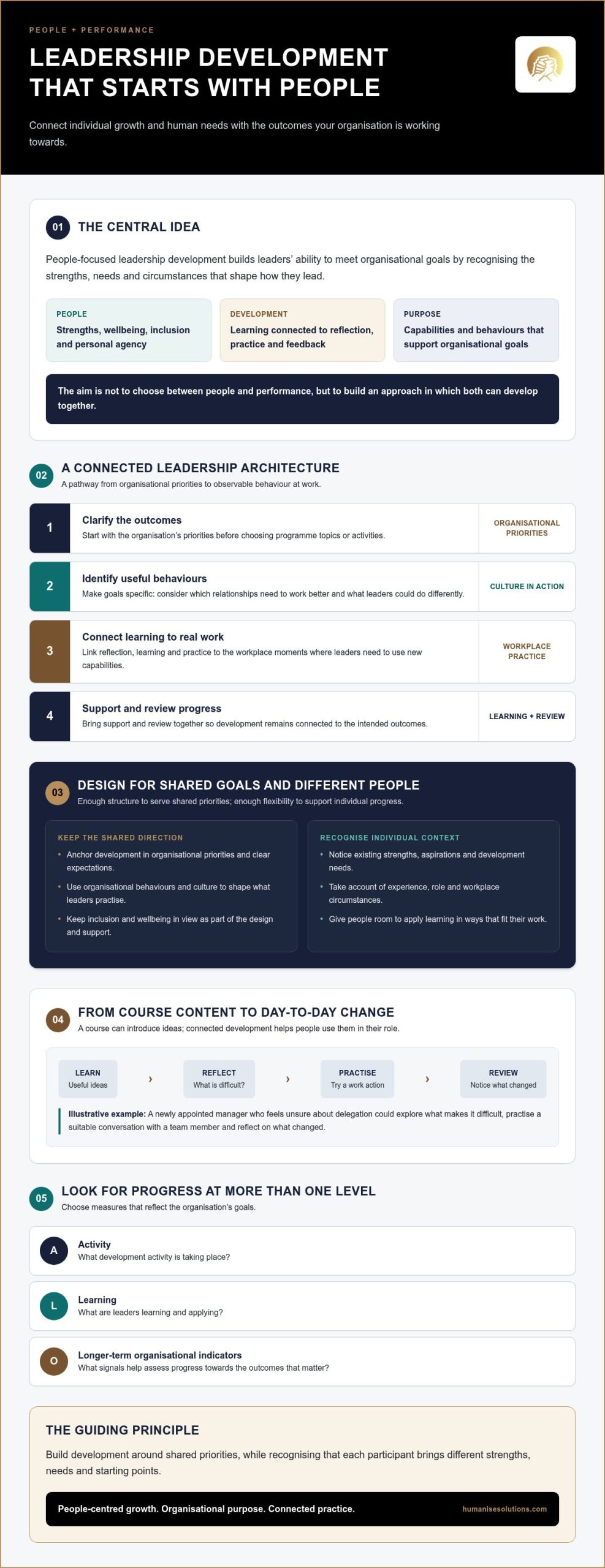
People-focused leadership development builds leaders’ ability to meet organisational goals by recognising the human needs, strengths and circumstances that shape how they lead. It treats development as part of a wider leadership architecture: the outcomes an organisation seeks, the capabilities people can build and the support that helps them apply those capabilities at work.
People-focused leadership development connects individual growth with organisational purpose, so leaders can develop in ways that respect people and respond to the work that needs to be done.
This is more than a course catalogue or a generic list of competencies. A checklist may identify skills to practise, and a course can introduce useful ideas, but neither necessarily shows whether those skills fit a leader’s role, team or working environment. A human-centred approach asks what is already working, where someone wants to grow and what conditions will help them put that growth into practice. Personal agency matters: leaders need room to build on their strengths, alongside clear priorities and shared expectations.
How is people-focused leadership development different from standard training?
Standard training can be useful for sharing information, but learning may fade if it isn’t connected to everyday decisions and relationships. Ongoing development links reflection, practice and feedback to real work. It can also draw on ideas such as Servant leadership, which places service to the team at the centre of a leader’s role while keeping organisational outcomes in view.
Illustrative example: A newly appointed manager might understand the importance of delegation but feel unsure about letting go of familiar tasks. Rather than simply repeating a delegation model, development could help them identify what makes delegation difficult, practise a suitable conversation with a team member and reflect on what changed. The organisation’s priority still guides the work; the manager’s context shapes how they learn to meet it.
Who benefits from a human-centred leadership approach?
Emerging leaders may need confidence and opportunities to practise. Experienced managers may be working through team dynamics or changing responsibilities. Teams benefit when leaders pay attention to how people collaborate, communicate and contribute. Organisational decision-makers can use a clearer understanding of capability and development needs to shape priorities.
These needs won’t be identical. A leader’s experience, role, strengths and workplace circumstances all influence what support will be useful. The aim isn’t to create a completely separate journey for every person or impose one programme across every organisation. It’s to provide enough structure to serve shared goals and enough flexibility to help people make meaningful progress from where they are.
How a Leadership Architecture Connects People, Learning, and Organisational Goals
A leadership architecture is the connected design behind development. It links the outcomes an organisation needs with the learning, support and review that help leaders work towards them. Rather than treating development as a series of separate activities, it creates a pathway from organisational priorities to observable behaviour at work.
A thoughtful leadership architecture helps people grow in ways that strengthen the organisation’s ability to meet its goals.
Culture shapes whether learning can take root. If an organisation values collaboration, for example, leaders need opportunities to practise listening, sharing decisions and responding constructively to different perspectives. Inclusion and wellbeing belong in the design because people’s ability to contribute is shaped by how they experience the workplace. They inform how development is designed and supported, without replacing the business outcomes it needs to serve.
Start with the outcomes the organisation needs
Clarify the organisation’s priorities before choosing programme topics or activities. A goal such as improving cross-team collaboration needs to be made specific: which relationships need to work better, and what would leaders do differently in the situations that matter?
Identify behaviours that could support the goal, then pinpoint the workplace moments where leaders need to use them. These might include setting expectations, handling a difficult conversation or involving colleagues in a decision. Keep desired outcomes distinct from assumptions about training. A learning session can introduce approaches, but practice, organisational context and ongoing support all influence whether leaders can apply them.
Connect learning with everyday leadership practice
Communication, feedback and managing change become more meaningful learning themes when they’re grounded in real responsibilities. Leaders can explore an approach, try it in an appropriate workplace situation, then reflect on what they noticed and what they might adapt next time. Regular feedback and opportunities to discuss challenges help bridge the gap between formal learning and day-to-day leadership.
For instance, if clearer feedback is a priority, leaders might prepare for an upcoming conversation, consider how to make it specific and respectful, then reflect afterwards on the response and next steps. The aim isn’t to prescribe identical behaviour, but to help leaders practise in ways that fit shared expectations and their own strengths.
These connections are central to people focused leadership development: outcomes guide the architecture, while people’s needs and workplace realities shape how they move through it. Organisations exploring how leadership and learning can align may find it useful to review leadership and learning services as they consider what fits their priorities.
How to Judge Whether People-Focused Leadership Development Is Working
People-focused development isn’t separate from organisational performance. Its value lies in helping leaders grow in ways that support agreed priorities, while recognising that people need relevant learning and opportunities to apply it. Evaluation should look beyond whether a programme ran smoothly. Ask what participants learned, what they did differently and whether that change relates to the outcomes the organisation set.
No single measure tells the whole story. Choose indicators that fit the programme’s purpose and workplace context, and treat them as evidence to explore rather than proof of guaranteed results.
| Measure type | What to review | Example question |
|---|---|---|
| Activity | Participation, attendance and completion | Did the planned learning take place? |
| Learning | Participant reflections, confidence and understanding | What can leaders explain or approach differently? |
| Application | Observed behaviour, feedback and use of learning at work | Where are leaders applying what they practised? |
| Organisational indicators | Progress against relevant team or organisational goals | Are there signs of movement in the outcome this development was designed to support? |
Which signs can indicate useful leadership development?
Start with the behaviours and outcomes agreed during programme design. If the purpose is to strengthen feedback, for example, look for relevant changes in how leaders prepare for and hold conversations. Consider participants’ reflections on what they’re learning as well. Gather feedback at suitable points, such as during development and after participants have had opportunities to apply it. Attendance matters, but it shows participation, not whether learning has transferred into practice.
Keep the indicators proportionate and meaningful. A programme focused on team communication may call for different evidence from one designed to support leaders through organisational change. People’s perspectives can add important context to observed behaviours and goal-related measures.
How can organisations avoid mistaking activity for impact?
Agree evaluation questions before delivery begins. Decide what you’ll review, who can provide relevant feedback and when you’ll consider the evidence. This makes it easier to distinguish a completed course from applied learning, and applied learning from wider organisational change.
Take care with attribution. If a team outcome shifts after a leadership programme, other factors may have contributed too. Use the evidence to understand what appears to be helping, where progress remains difficult and what support may be needed next. This reflective approach keeps evaluation honest and gives the leadership architecture a way to adapt as organisational needs develop.
How to Design a People-Focused Leadership Development Journey
A useful development journey starts with the outcomes an organisation needs, then builds a route that helps leaders work towards them. The steps below offer a practical structure without assuming everyone begins with the same strengths, experience or support needs.
- 1. Discover the need. Bring together organisational priorities, participant perspectives and relevant workplace context. Explore existing strengths as well as development needs, so the design builds on what people already do well.
- 2. Agree the brief. Define the intended outcomes and the leadership behaviours that could support them. Be clear about what the programme can influence, what depends on wider workplace conditions and how progress will be reviewed.
- 3. Shape the learning. Select themes that connect directly to the brief. These might include communication, inclusive leadership, wellbeing or decision-making, depending on the organisation’s goals and participants’ needs.
- 4. Make room for practice. Give leaders opportunities to try relevant approaches in their roles, reflect on what happens and learn from feedback. Use realistic workplace situations while allowing individuals to adapt their approach to their strengths and responsibilities.
- 5. Review and adapt. Return to the agreed outcomes and consider participant reflections, observed practice and other relevant indicators. Use what emerges to recognise progress, identify barriers and adjust the next stage of development.
Discover needs and define a clear brief
Listen to people while reviewing organisational priorities. A leadership group may share an objective, such as improving collaboration, while individuals describe different challenges. One may need to build confidence in difficult conversations; another may be learning to involve colleagues earlier in decisions. The brief can hold both levels together, setting shared outcomes without erasing those differences.
Agree how you’ll assess progress before choosing content or activities. Keep the approach proportionate to its purpose, and avoid treating attendance or course completion as proof that workplace change has happened.
Build learning, practice and review into the journey
Connect formal learning with opportunities to apply it, reflect and receive feedback. For example, after exploring a communication approach, a leader might use it in a relevant team discussion and consider what helped or hindered the exchange. Reflection can inform what they practise next, keeping the journey responsive rather than fixed.
This is the value of people focused leadership development: a clear architecture for shared outcomes, with enough flexibility to make learning relevant to each participant. For organisations considering a tailored approach, explore Humanise Solutions’ leadership and learning services as a starting point for aligning development with organisational needs.
How Humanise Solutions Can Support People-Focused Leadership Development
Humanise Solutions designs bespoke leadership and learning programmes using a human-centric, scientific approach. Its work includes Nurturing Leadership and Learning & Development, with attention to how people’s needs, strengths and workplace circumstances shape their development. The company also reports over 12 years of research into decision-making processes and trauma prevention.
This perspective can help organisations shape people focused leadership development around a connected architecture: clarify the outcomes the organisation is working towards, design relevant learning and support, then agree how progress will be reviewed. The programme should respond to the brief rather than assume a fixed package suits every organisation or participant. Development can support growth, but results depend on context and shouldn’t be treated as guaranteed.
What support can a bespoke leadership programme include?
Depending on the organisation’s goals, development may bring together Nurturing Leadership and Learning & Development, with space to practise inclusive leadership behaviours. Humanise Solutions also offers services including Women Leadership ILM Programme, Bespoke Learning, Fostering Wellbeing and High Performing Teams. The right balance depends on the needs identified, whether leaders are strengthening communication, building trust or responding to change. Participants can connect new learning with their roles and reflect on how their approach is working.
To explore the areas Humanise Solutions works across, see its leadership and learning services. Use the organisation’s priorities and participants’ perspectives to shape the design, rather than selecting activities first and searching for a purpose afterwards.
What should organisations discuss before getting started?
A useful conversation can begin with a few grounded questions:
- What organisational outcomes are you working towards?
- What do leaders and participants need to grow, and what strengths can the programme build on?
- Which workplace situations would benefit from different leadership behaviours?
- How might you review learning, its application and progress towards agreed outcomes?
Clear answers help establish a development brief that holds organisational goals and human needs together. They also create a basis for considering what learning, practice and review could look like, without assuming that every participant needs the same journey.
If you’re exploring leadership development for your organisation, you’re welcome to learn more about Humanise Solutions’ services and discuss your development needs with the team. A conversation about your priorities, participants and intended outcomes can help clarify what a considered approach might involve.
Build a Leadership Approach That Grows With Your People
People focused leadership development works best as a connected architecture: organisational outcomes guide the design, while people’s strengths, needs and day-to-day realities shape how they learn and grow. Review more than attendance. Look for signs that learning is being applied and consider progress against the goals the development was designed to support, without assuming one programme alone caused wider change.
Humanise Solutions takes a human-centric, scientific approach and reports over 12 years of research into decision-making processes and trauma prevention. The company lists a 9.98% feedback rating for programme delivery.
Take the next step by discussing the outcomes you’re working towards, the people involved and the support that may help them develop. Contact Humanise Solutions to discuss your leadership development needs and begin shaping an approach around what matters to your organisation.
Frequently Asked Questions
What does people-focused leadership development mean?
People-focused leadership development connects leaders’ growth with human needs and organisational outcomes. It considers the strengths, experience and working circumstances people bring, then shapes relevant learning and support around agreed priorities. Rather than relying only on generic competencies or isolated courses, it treats development as a connected journey where leaders can practise new approaches and reflect on how they apply them in their roles.
Why is people-focused leadership development important?
It helps organisations pursue their goals without overlooking the people responsible for achieving them. Development that recognises individual strengths and needs can make learning more relevant to leaders’ day-to-day work, while attention to inclusion and wellbeing can inform how support is designed. It isn’t a guarantee of improved performance; its value depends on the goals, workplace context and opportunities leaders have to apply what they learn.
How do you create a people-focused leadership development programme?
Start by clarifying organisational goals and gathering perspectives from the people who will take part. Identify relevant leadership behaviours, existing strengths and development needs before selecting learning content. Then design opportunities to practise in real workplace situations, reflect and receive feedback. Agree how progress will be reviewed from the outset, using indicators that fit the programme’s purpose rather than assuming attendance alone demonstrates development.
How can you measure leadership development effectively?
Use a combination of measures that show activity, learning, application and relevant organisational progress. Course attendance or completion confirms participation, while reflections can indicate what participants understood and observed behaviours can help show how learning is being applied. Choose evaluation questions before delivery begins and review evidence in context. Organisational outcomes may have multiple influences, so avoid attributing change to one programme without supporting evidence.
Is people-focused leadership development suitable for emerging leaders?
Yes, it can support emerging leaders as they build confidence, practise leadership behaviours and learn to work with others. Begin with their responsibilities, strengths and development needs rather than assuming they all need the same content. A clear architecture can connect their learning to organisational priorities while allowing room for different starting points and experiences. Practical opportunities to reflect and apply learning can help make development relevant to their roles.
Can leadership development support organisational change?
Leadership development can help leaders practise behaviours that support change, such as communicating clearly, listening to concerns and responding constructively to feedback. Its design should connect these behaviours to the organisation’s specific change priorities and the situations leaders face. Development is one part of the wider effort, not a replacement for clear organisational direction, and it can’t guarantee that change will succeed.
How is bespoke leadership development different from a standard course?
A standard course can offer a useful foundation in a shared topic, while bespoke development is shaped around an organisation’s goals, workplace context and participants’ needs. It may connect learning with opportunities to practise, reflect and review progress, rather than ending with information delivery alone. Bespoke doesn’t mean every participant follows a completely separate programme; it means the overall design is relevant to the intended outcomes and allows for individual differences.
