

Article by
Scott Ward MBA CCMI
Scott Ward is the founder and CEO of Humanise Solutions, which he established three years ago to help organisations elevate their people, leadership and culture through a human-centric, evidence-based approach. Before moving into business and academia, Scott spent seven years as a professional footballer, playing for Luton Town, Crawley Town and Coventry City FC until injury brought his playing career to a close — a turning point that shaped both his research interests and his approach to leadership.
Scott holds an MBA from Warwick Business School, where his research explored the causal relationship between trauma and decision-making — work that continues to inform how he supports young adults, leaders and teams under pressure. Recognised as a Companion of the Chartered Management Institute (CCMI), its highest grade of membership, he combines academic rigour with the discipline, resilience and team-first mindset of the professional game. At the heart of everything he does is a simple belief: that people perform at their best when they are led, developed and valued as human beings first.
Superficial wellness perks won’t rescue your best people from an organisational design built on chronic overwhelm. You likely already recognise that occasional yoga sessions and wellness apps cannot heal the persistent exhaustion quietly draining your most dedicated talent, particularly amongst middle managers caught between commercial delivery and team distress. Real change begins when we examine the structural environment rather than expecting individuals to silently endure systemic pressure. That is why embedding proactive preventing employee burnout strategies has become an urgent priority for leadership teams committed to cultivating sustainable, long-term resilience.
In this guide, you will discover evidence-based, human-centred strategies to identify, prevent, and reverse employee burnout across your organisation. Grounded in the philosophy of unlocking potential with empathy, we examine how to equip leaders with nurturing management skills, foster authentic psychological safety, and establish a robust cultural architecture that defends staff retention whilst sustaining high-performance outcomes. It is time to move beyond temporary remedies and build a workplace where both your people and your business genuinely flourish.
Key Takeaways
- Distinguish acute workplace pressure from systemic exhaustion to tackle the operational root causes undermining team vitality.
- Discover why superficial wellness perks fail, and how aligning performance metrics with human capacity drives genuine organisational renewal.
- Implement evidence-based, sequential preventing employee burnout strategies that foster authentic psychological safety across your teams.
- Tailor supportive interventions to unique workforce groups, including early-career talent facing intense corporate demands.
- Embed nurturing leadership practices as a commercial capability, unlocking potential with empathy to sustain team excellence.
Understanding Employee Burnout: Root Causes Beyond Surface Symptoms
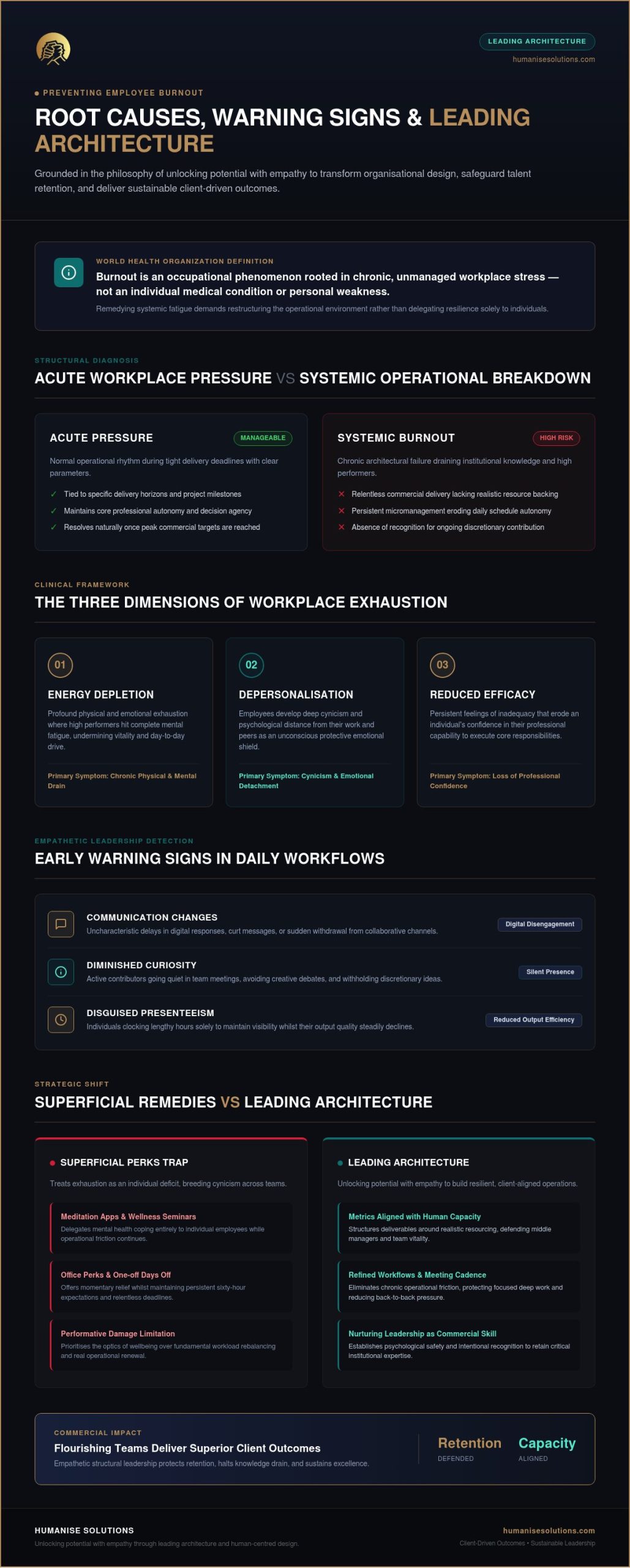
Workplace exhaustion isn’t a sign of personal weakness. Too often, organisations view fatigue as an individual inability to manage stress, responding with superficial wellness seminars rather than examining internal operational design. According to the World Health Organization, occupational burnout is an occupational phenomenon rooted in chronic, unmanaged workplace stress rather than a medical condition. Treating it requires an architectural shift. By viewing team capacity through the lens of unlocking potential with empathy, leadership teams can move away from reactive blame and implement lasting, evidence-based solutions.
Acute pressure is normal during tight deadlines. Systemic burnout, however, is a persistent operational breakdown. It stems from predictable organisational failures:
- Relentless workload demands: Consistently asking teams to deliver commercial results without adequate resources or realistic time horizons.
- Erosion of autonomy: Micromanagement that strips professionals of control over their daily schedules and decision-making processes.
- Absence of recognition: Failing to acknowledge discretionary effort, which leaves individuals feeling disconnected from corporate purpose.
When unaddressed, the commercial toll escalates quickly through presenteeism, rising absenteeism, and the quiet departure of high performers who take irreplaceable institutional knowledge with them. Cultivating effective preventing employee burnout strategies starts with understanding the structural patterns driving this drain.
The Three Dimensions of Workplace Exhaustion
Clinical definitions outline three distinct dimensions of burnout that erode performance over time. The first is profound physical and emotional energy depletion, where high performers hit complete mental fatigue. Next comes depersonalisation; employees develop cynicism and mental distance from their work to protect themselves emotionally. Finally, feelings of reduced professional efficacy emerge, destroying confidence in their ability to execute core responsibilities.
Early Warning Signs Leaders Must Notice
Long before an employee resigns, subtle behavioral indicators appear across daily workflows. Empathetic managers trained in proactive preventing employee burnout strategies should watch for these early shifts:
- Communication changes: Uncharacteristic delays in digital responses, curt messages, or sudden withdrawal from collaborative channels.
- Diminished curiosity: Active contributors going quiet in team meetings, avoiding creative debates, and withholding discretionary ideas.
- Disguised presenteeism: Individuals putting in lengthy hours to maintain visibility whilst output quality steadily declines.
Catching these signals early protects team retention and establishes the psychological safety required for sustainable high performance.
Why Traditional Wellness Initiatives Fail to Prevent Burnout
Handing an exhausted professional a subscription to a meditation app does nothing to fix a broken operational model. When organisations delegate the entire responsibility for mental health to individual coping strategies, they breed deep cynicism. An employee juggling back-to-back video calls, shifting deadlines, and ambiguous performance targets doesn’t need breathing exercises to survive the week. They need an environment where workloads match human capacity. Extensive workplace analysis reveals that tackling the root causes of employee burnout demands systemic reform rather than isolated cosmetic gestures.
Sustainable performance relies on building a robust leading architecture. This methodology reconfigures workflows, refines meeting cadence, and prioritises empathy across team interactions. Without addressing the underlying operational friction, conventional wellness programmes simply function as performative damage limitation.
The Superficial Perks Trap
One-off mental health days and free office fruit provide brief moments of relief, but they fail to resolve unsustainable working patterns. Providing perks whilst expecting sixty-hour weeks creates an uncomfortable paradox. Professionals quickly realise that company leadership cares about the optics of wellbeing rather than genuine workload management. Meaningful preventing employee burnout strategies require establishing clear operational boundaries, simplifying internal approvals, and eliminating the administrative burdens that fuel daily frustration.
Cultural Friction and Mixed Organisational Signals
Organisational rhetoric often collapses when tested by day-to-day managerial behaviour. A business might champion work-life harmony in HR town halls, yet tacitly celebrate executives who reply to emails at midnight or praise teams for sacrificing weekends. These mixed signals create persistent psychological anxiety, pressuring team members to match hyperconnected habits regardless of official policy.
Overcoming this disconnect calls for a coherent cultural architecture that aligns daily leadership behaviours with declared values. Exploring our bespoke programmes for fostering wellbeing at work allows senior teams to replace contradictory signals with structured, empathetic practices that actively safeguard staff retention. If your organisation wants to audit its cultural design and implement actionable, human-centred systems, you can connect with our leadership specialists to begin shaping a resilient workplace.
Core Strategies for Preventing Employee Burnout in Modern Teams
Preventing burnout requires methodical design rather than good intentions. When leadership teams treat wellbeing as an architectural discipline, they build operating systems where excellence and sustainable energy co-exist naturally. By focusing on unlocking potential with empathy, organisations can deploy actionable preventing employee burnout strategies that dismantle operational bottlenecks before they exhaust capable talent. Evidence documented in Gallup’s core strategies to prevent burnout reinforces that active manager intervention, workload clarity, and autonomy form the foundation of high-retention cultures.
To establish durable safeguards, organisations should embed a sequential five-step operational framework:
- Audit baseline strain: Map recurring workflows, administrative overhead, and non-essential meetings to uncover hidden productivity drains.
- Calibrate team capacity: Match forthcoming project commitments to verified headcount and technical capability before agreeing delivery dates.
- Formalise digital charters: Enforce transparent guidelines covering out-of-hours messaging, calendar blocks, and response expectations.
- Equip nurturing leadership: Train frontline managers in empathetic inquiry, developmental coaching, and workload roadmapping.
- Implement feedback loops: Run regular reviews focused on operational friction and team vitality, adjusting processes continuously.
Fostering Psychological Safety and Open Dialogue
Genuine safety exists only when employees speak openly about capacity limits without fearing reputational damage. Leaders cultivate this trust by structuring one-to-one check-ins around workload distribution rather than mere status updates. Normalising frank discussions about deadline adjustments protects psychological bandwidth, particularly when senior executives openly demonstrate healthy work-life boundaries themselves.
Workload Auditing and Realistic Resource Architecture
Unmanaged project intake quickly fractures team focus. Executive teams must review operational tasks every quarter to eliminate redundant reporting structures and poorly attended status meetings. Aligning resource allocation directly with real commercial scope prevents structural overloading. Exploring bespoke development modules in building team excellence equips departments to collaborate effectively whilst preserving individual mental bandwidth.
Digital Boundaries and Communication Etiquette
Continuous connectivity quietly destroys cognitive recovery. High-performing organisations counter this by establishing firm boundaries: prohibiting routine weekend internal messages, setting standard daytime response windows, and promoting asynchronous workflows. Introducing company-wide blocks for deep work protects undivided attention, turning preventing employee burnout strategies into reliable daily habits.
Tailoring Burnout Prevention Across Diverse Workforce Demographics
Workplace pressure rarely affects every team member in the same way. Blanket wellbeing policies often fail because they assume a single, uniform experience of stress across an entire organisation. In reality, early-career recruits, mid-level team managers, and senior women leaders face radically different operational hurdles. Crafting effective preventing employee burnout strategies requires an adaptive leading architecture that acknowledges these distinct challenges, providing targeted capability building rather than generic corporate guidelines.
When leadership teams look beneath high-level attrition data, demographic vulnerabilities become clear:
- Early-career talent: Grappling with professional etiquette, severe imposter syndrome, and the pressure to prove competence quickly.
- Mid-level managers: Bearing the emotional weight of team anxiety whilst remaining accountable for stringent commercial delivery targets.
- Female professionals: Navigating systemic bias, career progression hurdles, and disproportionate loads of unrecognised emotional labour.
Unlocking potential with empathy means moving away from one-size-fits-all training. Instead, organisations need bespoke developmental tracks that meet people precisely where they stand.
Supporting Young Adults and Early Career Professionals
Entering the modern corporate workplace can feel overwhelming. Many young professionals internalise routine operational setbacks as personal shortcomings, driving workplace anxiety and silent exhaustion. Rather than leaving them to navigate corporate ambiguity alone, businesses should provide structured mentorship and clear developmental frameworks. Engaging with dedicated young adult programmes helps emerging talent master professional boundaries, develop communication confidence, and build foundational resilience early in their careers.
Retaining and Empowering Women in Leadership
Women in senior roles often carry substantial invisible labour, from mentoring struggling colleagues to managing cross-functional interpersonal friction, all on top of demanding core commercial responsibilities. Without deliberate structural support, this chronic cognitive burden accelerates exhaustion and prompts top performers to step down. Organisations can counter this drain by building dedicated peer development networks and psychological support tracks. Review our insights in this empowering women in the workplace guide to understand how tailored leadership spaces cultivate sustainable growth.
If you are ready to design bespoke developmental initiatives tailored to your organisation’s unique talent profile, speak with our leadership development specialists to explore bespoke programmes that elevate retention and safeguard team vitality.
Embedding Nurturing Leadership: The Sustainable Path to Team Excellence
A leader’s temperament sets the biological tone for the entire room. When managers operate from chronic stress, their teams mirror that anxiety, triggering defensive posturing and cognitive paralysis. Conversely, leaders who embody calm stability regulate collective team focus, unlocking discretionary creativity and intellectual risk-taking. Viewing nurturing leadership as a commercial strategy rather than a soft luxury bridges the gap between commercial delivery and human vitality. Organisations that commit to this human-centred architecture secure exceptional retention whilst maintaining rigorous standards of operational performance.
Preventing burnout does not require clinical mental health treatments inside the workplace. It requires skilled, empathetic managers who understand workload design, human motivation, and psychological safety. When businesses invest in behavioural science to equip their leadership tier, preventing employee burnout strategies transition from theoretical policies into active, daily managerial behaviours.
The Core Attributes of a Nurturing Leader
Nurturing leaders do not soften commercial targets; they empower their people to hit them sustainably. They combine clear accountability with emotional intelligence, diagnosing operational roadblocks long before structural exhaustion sets in. Key behaviours define this practice:
- Empathetic inquiry: Conducting regular check-ins that probe beneath surface status updates to gauge realistic human bandwidth.
- Active diagnosis: Identifying unnecessary friction, overlapping mandates, and convoluted decision loops that waste mental energy.
- Protective boundary setting: Shielding direct reports from reactive executive demands to preserve focused deep-work time.
To cultivate these essential capabilities across your management cohort, explore our dedicated framework on developing nurturing leadership skills.
Transforming Organisational Culture with Humanise Solutions
Meaningful cultural transformation requires deep experiential learning. As a privately owned UK consultancy led by experienced leadership practitioners and executive coaches, Humanise Solutions applies a scientific approach grounded in over 12 years of research into decision-making processes and trauma prevention. This rigorous foundation enables leadership teams to cultivate resilient, high-trust working environments.
Boasting a 9.98% feedback rating for programme delivery, our end-to-end bespoke learning solutions deliver measurable behavioural change. We guide management cohorts through targeted, high-impact modules, including Avoiding Burnout, Stress Awareness, Managing Expectations, and Leading Remote Teams. By aligning operational processes with human needs, our bespoke learning journeys equip managers with practical conversational tools that prevent chronic fatigue. Discover our complete suite of transformational programmes across our services, and build a lasting culture where commercial excellence and employee wellbeing thrive together.
Transforming Workplace Vitality Through Nurturing Architecture
Sustainable performance doesn’t happen by accident; it requires deliberate organisational intention. By moving past cosmetic perks and embedding empathetic management into daily workflows, forward-thinking organisations protect their people from chronic exhaustion. Implementing proven preventing employee burnout strategies safeguards commercial output whilst cultivating a culture where every contributor feels valued, understood, and supported.
Backed by over 12 years of research into decision-making and trauma prevention, Humanise Solutions empowers leadership teams to dismantle systemic stress. We hold an exceptional 9.98% feedback rating across our bespoke leadership and wellbeing programmes, delivering measurable behavioural change tailored to your business goals. You can partner with Humanise Solutions to cultivate nurturing leadership and protect your team, establishing a flourishing workplace where retention soars and commercial delivery thrives.
Frequently Asked Questions
What are the most effective preventing employee burnout strategies for hybrid teams?
The most effective approach focuses on rigorous digital boundary management and deliberate asynchronous communication. Leadership must establish clear core collaboration hours whilst granting full autonomy over how independent work gets completed. Regularly auditing communication channels to eliminate unnecessary digital status meetings prevents screen fatigue. Equipping team leaders with empathetic check-in techniques ensures remote contributors feel noticed and supported rather than isolated behind continuous notifications.
How can managers distinguish between high workplace stress and actual employee burnout?
Workplace stress usually manifests as hyper-arousal, urgency, and temporary anxiety around specific project deadlines, resolving once the deliverable concludes. Burnout, conversely, presents as persistent emotional detachment, chronic cynicism, and profound energy depletion that persists regardless of workload lulls. When high achievers show sudden indifference to work quality and withdraw socially from team discussions, systemic exhaustion has taken hold.
Why do superficial corporate wellness programmes often fail to reduce workforce exhaustion?
Superficial initiatives fail because they treat an organisational design defect as a personal coping shortfall. Offering free fruit, meditation app subscriptions, or isolated wellness afternoons doesn’t resolve conflicting commercial deadlines, excessive reporting requirements, or chronic understaffing. Employees quickly develop cynicism towards wellbeing gestures when leadership expects sixty-hour working weeks to continue behind the scenes.
Can an organisation prevent employee burnout without lowering high-performance targets?
Yes, protecting wellbeing elevates commercial performance rather than diminishing it. Modern preventing employee burnout strategies focus on removing procedural bottlenecks, reducing context switching, and clarifying ambiguous priorities. By designing lean, human-centred workflows and unlocking potential with empathy, organisations protect cognitive stamina. This allows teams to deliver exceptional, high-precision results consistently without depleting their nervous systems.
What specific role does leadership development play in mitigating employee exhaustion?
Leadership development shifts managerial behaviour from transactional policing to active, nurturing coaching. Frontline managers directly influence team workloads, daily communication tone, and psychological safety. Targeted programmes equip them to spot early signs of distress, lead supportive capacity conversations, and shield contributors from conflicting organisational demands. This behavioural capability builds resilient operating cultures that defend staff retention.
How does employee burnout uniquely impact young adults and early-career talent?
Early-career talent often experiences exhaustion through acute imposter anxiety, unclear professional boundaries, and reluctance to decline additional work. Lacking institutional experience, young adults frequently equate continuous availability with competence, silently absorbing unmanageable workloads until physical fatigue sets in. Tailored development programmes provide structured mentorship and professional boundary frameworks, helping them establish sustainable working rhythms from their first corporate roles.
What immediate steps can leadership take this week to alleviate team overwhelm?
Senior leaders should instantly audit meeting schedules, cancelling redundant recurring calls to restore uninterrupted focus blocks. Instituting a firm policy restricting internal emails outside standard business hours grants immediate cognitive relief. Finally, managers can conduct transparent check-ins dedicated entirely to identifying operational roadblocks and reprioritising non-urgent tasks across all ongoing projects.
