Article by
Scott Ward MBA CCMI
Scott Ward is the founder and CEO of Humanise Solutions, which he established three years ago to help organisations elevate their people, leadership and culture through a human-centric, evidence-based approach. Before moving into business and academia, Scott spent seven years as a professional footballer, playing for Luton Town, Crawley Town and Coventry City FC until injury brought his playing career to a close — a turning point that shaped both his research interests and his approach to leadership.
Scott holds an MBA from Warwick Business School, where his research explored the causal relationship between trauma and decision-making — work that continues to inform how he supports young adults, leaders and teams under pressure. Recognised as a Companion of the Chartered Management Institute (CCMI), its highest grade of membership, he combines academic rigour with the discipline, resilience and team-first mindset of the professional game. At the heart of everything he does is a simple belief: that people perform at their best when they are led, developed and valued as human beings first.
What if the reason your Gen Z recruits are leaving isn’t a lack of loyalty, but a lack of psychological safety and human-centric cultivation? Many firms across the country are finding that traditional onboarding methods simply don’t bridge the gap between academic success and professional readiness. You’ve likely noticed that a standard early careers development programme UK often fails to address the unique anxieties of a generation entering a market redefined by AI and shifting economic pressures. It’s a frustrating cycle that leaves both the business and the individual feeling depleted.
We understand that you want more than just a temporary headcount; you’re looking to foster a sustainable pipeline of future leaders who feel deeply invested in your firm’s mission. This article provides a strategic roadmap for 2026, showing you how to design a programme that prioritises employee wellbeing and social mobility whilst delivering measurable ROI. We’ll examine how to adapt to the latest apprenticeship levy changes and use evidence-based mentoring to transform raw talent into resilient, confident professionals who stay for the long term.
Key Takeaways
- Shift from traditional onboarding to a holistic professional development model that prepares young talent for the unique demands of the 2026 workplace.
- Discover why embedding psychological safety and wellbeing into the core curriculum is essential for building resilience and reducing early-career burnout.
- Learn how a bespoke early careers development programme UK can bridge the “soft skills” gap and secure long-term retention through human-centric cultivation.
- Move beyond basic feedback forms to measure the true ROI of your initiatives by tracking behavioural growth and leadership potential.
- Explore the transition from off-the-shelf training to tailored growth paths that support social mobility and create a sustainable pipeline of future leaders.
What defines an Early Careers Development Programme in the UK?
Understanding what defines an early careers development programme in the current UK market requires looking far beyond the traditional induction week. In 2026, the landscape is more competitive and complex than it has been in over a decade. With vacancies at top employers reaching their lowest levels since 2012, the focus has shifted from mass recruitment to deep, intentional cultivation. Whether you’re welcoming graduates, apprentices, or school leavers, a modern early careers development programme UK must act as a transformational bridge between academic life and professional excellence.
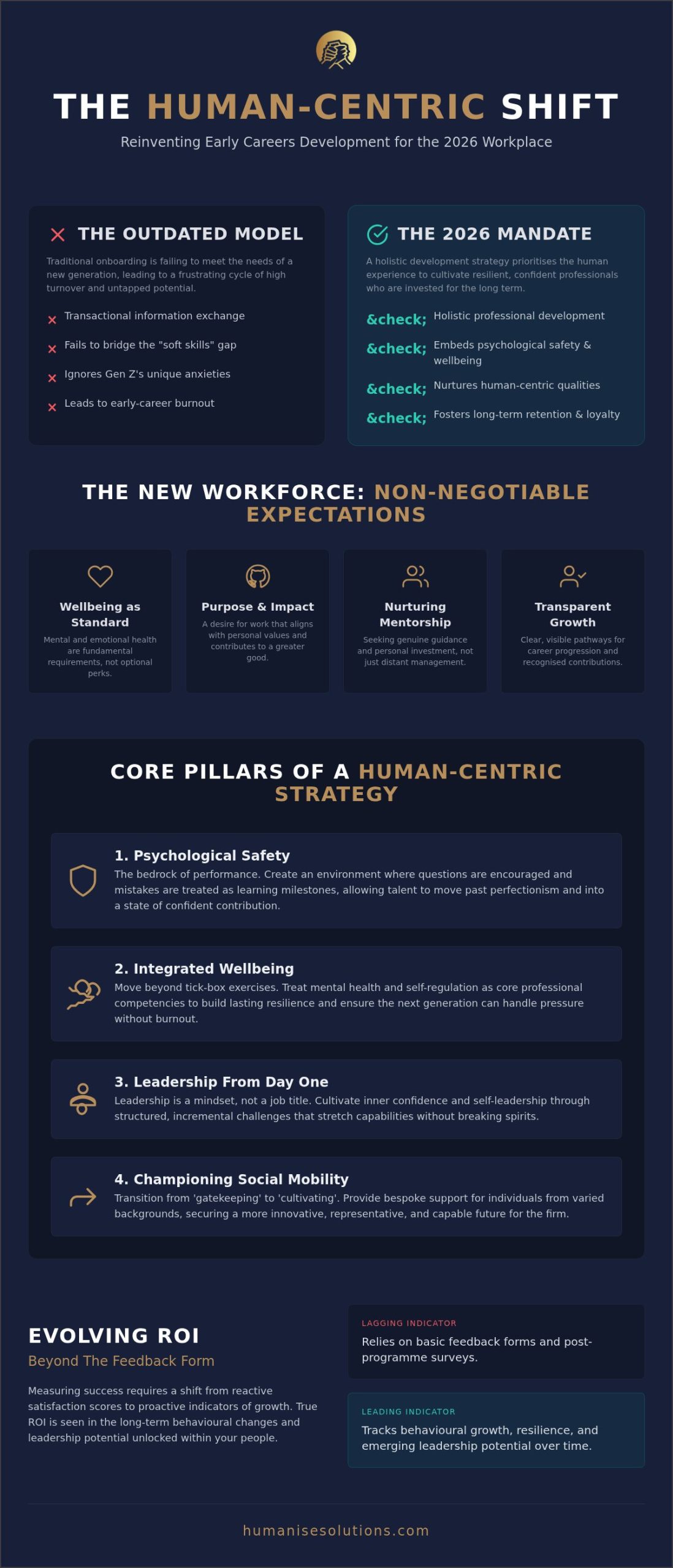
Traditional “onboarding” often feels like a transaction, a simple exchange of information for productivity. We see a different path. Holistic professional development prioritises the human experience, recognising that technical skills are secondary to psychological readiness. As AI continues to reshape entry-level roles, UK firms are increasingly valuing human-centric qualities like empathy, collaboration, and resilience. This isn’t just about filling a role; it’s about nurturing a future leader who can navigate ambiguity with grace.
Social mobility is no longer a peripheral concern for HR departments; it’s now a central pillar of talent acquisition. By opening doors to individuals from varied backgrounds and providing them with the bespoke support they need to thrive, firms aren’t just doing the right thing. They’re securing a more innovative and representative future. This transition from “gatekeeping” to “cultivating” is what sets leading programmes apart.
The shifting expectations of Gen Z and Gen Alpha
The newest members of our workforce bring a fresh perspective on what work should be. For Gen Z and the emerging Gen Alpha, purpose and wellbeing aren’t just perks; they’re non-negotiable requirements. They don’t want a distant boss; they want a nurturing mentor. Since the shifts of 2024, the “staying power” of young talent has become directly linked to how much a company invests in their personal growth. They seek transparent pathways where their contributions are recognised and their mental health is protected. If they don’t find it, they won’t hesitate to move on.
Bridging the professional readiness gap
There’s a growing “professional readiness gap” that academic qualifications alone cannot fill. New starters often arrive with impressive degrees but lack the “soft skills” required for high-pressure environments. Emotional intelligence, self-regulation, and the ability to manage complex social dynamics are frequently missing from modern education. A bespoke early careers development programme UK provides the necessary scaffolding. It creates a safe space for young adults to practise these skills, moving from theory to workplace reality with confidence and poise.
Core pillars of a human-centric development strategy
Building a resilient workforce begins with a fundamental shift in perspective. Instead of viewing new starters as assets to be optimised, we must see them as individuals to be cultivated. Psychological safety serves as the bedrock of this transition. When an early careers development programme UK fosters an environment where questions are encouraged and mistakes are treated as learning milestones, talent thrives. Safety is the catalyst. It allows young professionals to move past the paralysis of perfectionism and into a state of active, confident contribution.
Integrating wellbeing into the curriculum is equally vital. It can’t remain a peripheral “add-on” or a tick-box exercise. True flourishing occurs when mental health and self-regulation are treated as professional competencies. By aligning with the core pillars of a human-centric development strategy, firms can move beyond superficial perks. We focus on evidence-based methodologies that build resilience, ensuring the next generation of leaders can handle the pressures of 2026 without succumbing to burnout. At Humanise Solutions, we believe in nurturing leadership by providing the tools for long-term emotional and professional stability.
Nurturing leadership from day one
Leadership isn’t a destination reached after a decade; it’s a mindset that begins on day one. We encourage young adults to master the art of leading themselves before they ever manage a team. This involves developing inner confidence through structured, incremental challenges that stretch their capabilities without breaking their spirit. Peer-to-peer mentoring plays a crucial role here. By fostering collaborative learning environments, you create a sense of collective growth where cohorts support one another, sharing insights and navigating the workplace culture as a unified team.
Inclusive environments and social mobility
A human-centric early careers development programme UK must be inherently inclusive. Removing barriers for talent from underrepresented backgrounds is essential for bridging the social mobility gap. This isn’t just about recruitment; it’s about what happens after they walk through the door. Inclusive leadership training benefits the entire organisation, teaching every employee how to foster a sense of belonging. When young adults feel they truly belong, their engagement levels soar, and the firm benefits from a richer, more diverse perspective that drives innovation and excellence.
Case Study: Transforming retention through bespoke L&D
Consider the impact of losing nearly a third of your fresh talent within just twelve months. One prominent UK firm faced this exact reality, watching 30% of their graduate intake depart before their first anniversary. The financial cost of recruitment was high, but the loss of potential and the dent in team morale were even more significant. They realised that their existing early careers development programme UK was technically sound but humanly hollow. It focused on systems and processes whilst neglecting the psychological transition from university to the high-stakes corporate world.
Our intervention shifted the focus from a standard technical induction to a bespoke growth path. We moved away from off-the-shelf training modules, opting instead for a methodology rooted in Team Excellence and personal wellbeing. By prioritising the human experience, the firm saw a remarkable transformation. Retention rates didn’t just improve; they surged by 50%. Furthermore, the quality of internal promotions rose as these young professionals arrived at their next career milestones with greater confidence and emotional maturity.
From isolation to team excellence
The transition into a first “proper” job can be deeply isolating. Many new starters feel they must compete to prove their worth, which inadvertently creates silos and heightens anxiety. Our workshops dismantled this competitive friction by encouraging shared vulnerability. When young adults realise that their peers share the same fears and uncertainties, the atmosphere shifts from competition to collaboration. This collective growth builds lasting professional bonds that act as a safety net during challenging periods, ensuring that no individual feels they are navigating the journey alone.
Long-term impact on organisational culture
Success stories in early careers have a powerful ripple effect that reaches far beyond the intake itself. When middle managers see their juniors thriving, it shifts their own approach to leadership. They begin to adopt the same nurturing behaviours, creating a more empathetic and supportive environment across all departments. This cultural shift is the foundation of true longevity. Sustainable growth is the intentional cultivation of a young person’s internal resilience and professional capability, ensuring they flourish alongside the organisation rather than being consumed by it. By investing deeply at the start, the firm didn’t just fix a retention problem; they began to reshape their entire leadership legacy.
Measuring the ROI of your early careers programme
Measuring the success of an early careers development programme UK requires a lens that extends far beyond the final day of induction. Whilst “happy sheets” provide a snapshot of immediate engagement, they rarely predict long-term flourishing. True ROI is found in the steady progression of a cohort over years, not weeks. We look for behavioural shifts that indicate a deep integration into the firm’s culture and a growing capacity for complex problem-solving. This isn’t just about satisfaction; it’s about the tangible evolution of a novice into a future leader.
The financial argument is compelling. Consider that the median starting salary for graduates at top UK employers in 2026 is £35,000. When a new starter leaves within their first year, the cost to the business often exceeds double that figure once recruitment fees, training hours, and lost productivity are accounted for. In contrast, investing in a bespoke development path is a fraction of that cost. It’s a preventative strategy that secures your talent pipeline whilst significantly reducing the hidden expenses of high turnover and the disruption of constant re-hiring.
Beyond the balance sheet, human-centric development directly impacts operational efficiency. Wellbeing initiatives are not merely “perks”; they are essential tools for reducing absenteeism and the quiet drain of presenteeism. When young adults feel psychologically safe and supported, they’re less likely to succumb to the burnout that often plagues the first 24 months of a career. This stability fosters a culture of innovation. By prioritising social mobility and diverse perspectives, you invite fresh thinking that challenges the status quo and drives long-term growth.
Key performance indicators for talent development
To truly understand the impact of your early careers development programme UK, you must track metrics that reflect long-term commitment. We recommend monitoring retention rates at the 12, 24, and 36-month marks to identify where support might be wavering. Internal promotion speed is another vital indicator; successful programmes accelerate the journey to mid-level roles. Finally, don’t overlook qualitative data. Regular surveys on workplace belonging and individual confidence levels provide early warning signs of disengagement before they manifest as resignations.
The “Humanise” approach to evidence-based growth
Our methodology relies on more than just intuition. We use psychological assessments to track the development of resilience and emotional intelligence over time. This data allows us to create meaningful feedback loops, ensuring that every young adult understands their progress and feels seen as an individual. By aligning personal growth with your firm’s specific organisational goals, we ensure that development is never a generic exercise. If you’re ready to move beyond surface-level metrics, explore how our Learning & Development initiatives can transform your firm’s retention strategy.
Implementing your bespoke programme with Humanise Solutions
Implementing a truly effective early careers development programme UK requires moving beyond the convenience of off-the-shelf modules. While generic training might tick a compliance box, it rarely touches the heart of what a young professional needs to flourish. We believe that every organisation has a unique heartbeat. A bespoke approach allows us to weave your specific values and cultural nuances into the very fabric of the learning journey. This ensures that the development feels relevant, authentic, and deeply personal to every new starter. It transforms a standard induction into a meaningful rite of passage.
The Humanise process is a steady, methodical journey. It begins with strategic consultancy where we listen to your specific challenges, from high turnover amongst Gen Z to a perceived lack of professional readiness in new starters. We then move into the design phase, creating a roadmap that integrates nurturing leadership into your existing HR framework. Our expert-led workshops are the final step, delivered with a focus on psychological safety and evidence-based growth. This isn’t a fast-paced or high-pressure intervention. It’s a deliberate, thoughtful investment in the long-term sustainability of your workforce.
Tailored young adult programmes
Customisation is the key to bridging the talent gap and fostering social mobility. Whether you’re navigating the impact of AI on entry-level roles or looking to improve diversity within your senior ranks, your programme must reflect these priorities. We focus on the unique challenges of your specific cohort, providing them with the self-regulation tools and emotional intelligence required for your specific industry. This tailored roadmap ensures that professional development isn’t just a series of isolated events, but a continuous journey of cultivation and growth that aligns with the 2026 market landscape.
Partnering for a more human workplace
We don’t aim to replace your internal L&D teams; we strive to empower them. Partnering with external experts like Humanise Solutions provides a safe container for growth that’s often difficult to achieve within the internal hierarchy of a firm. We act as a visionary guide, helping you transition from traditional onboarding to a future-proof strategy that prioritises human flourishing. By providing a neutral, supportive environment, we allow young adults to explore their potential and build resilience without the fear of judgment. If you’re ready to secure your firm’s future and cultivate the next generation of leaders, we invite you to Enquire about our Early Careers Development Programmes today.
Cultivating your future leadership legacy
The journey toward a resilient workforce requires a move away from the sterile, technical inductions of the past. By prioritising psychological safety and inclusive leadership, you don’t just fill roles; you nurture a generation that feels seen and supported. A truly effective early careers development programme UK acts as a catalyst for long-term retention and social mobility, ensuring that every young adult has the tools to thrive in an AI-driven market. We’ve seen that when wellbeing is treated as a core competency rather than a peripheral add-on, the ROI manifests in a more innovative, stable, and loyal team.
At Humanise Solutions, we specialise in creating bespoke programmes designed specifically for the 2026 UK workforce. Our evidence-based methodology for psychological wellbeing ensures that your newest recruits transition from academic theory to professional excellence with confidence. As specialists in social mobility and inclusive leadership, we’re ready to help you bridge the talent gap. Discover how our Young Adult Programmes can transform your talent strategy. We’re here to help you build a workplace where human flourishing and business success grow together in perfect harmony.
Frequently Asked Questions
What is the ideal length for an early careers development programme?
The most effective programmes typically span between 18 and 24 months. This duration provides enough time for a young professional to move past the initial “survival” phase and into a period of deep, intentional growth. Shorter schemes often fail to embed the behavioural changes required for long-term success, whilst a two-year cycle allows for meaningful mentorship and the development of true resilience.
How does social mobility training impact a UK business?
Social mobility initiatives broaden your talent pool and introduce fresh perspectives that drive innovation. By removing hidden barriers for those from underrepresented backgrounds, your firm gains access to a wider range of problem-solving styles. It’s a strategic move that helps bridge the “talent gap” whilst ensuring your leadership pipeline reflects the diversity of the modern UK market and your client base.
Can wellbeing training really improve employee retention?
Yes, integrating wellbeing into an early careers development programme UK directly reduces turnover by addressing the root causes of burnout. When new starters learn self-regulation and emotional intelligence early on, they’re better equipped to handle the pressures of a high-stakes environment. This support fosters a sense of loyalty and stability, making them significantly more likely to stay beyond the first two years.
What are the most important leadership skills for young adults today?
The modern workplace demands high levels of emotional intelligence and the ability to lead oneself through ambiguity. Beyond technical competence, young adults must master active listening, empathy, and self-regulation. These human-centric skills allow them to collaborate effectively in diverse teams and navigate the complex social dynamics of a professional world that is increasingly redefined by AI and remote collaboration.
How do bespoke programmes differ from standard graduate schemes?
Bespoke programmes are designed to align perfectly with your firm’s unique culture and specific industry challenges. Unlike standard, off-the-shelf schemes that rely on generic modules, a tailored approach ensures the content feels authentic and relevant to the recruits. This specificity increases engagement and ensures that the skills being developed are exactly what your organisation needs to flourish in the long term.
What is the typical ROI on leadership development for new starters?
ROI is most visible in the dramatic reduction of recruitment and re-hiring costs. When you consider that the cost of replacing a graduate can exceed double their annual salary, the savings from improved retention are substantial. Effective development also accelerates the journey to mid-level roles, meaning your new starters become high-value contributors and future leaders much faster than those on traditional, unguided paths.
How can we support young talent from diverse backgrounds in the UK?
Support begins with fostering an environment of genuine belonging through inclusive leadership training for the entire team. Providing dedicated mentors who understand the specific barriers faced by diverse talent is also essential. By creating clear, transparent pathways for progression and offering bespoke support, you ensure that individuals from all backgrounds don’t just enter your firm but have the confidence to stay and lead.
What role does psychological safety play in early careers training?
Psychological safety is the essential foundation for all meaningful learning and innovation. Without it, new starters are often too paralysed by the fear of making mistakes to ask questions or take creative risks. An early careers development programme UK that prioritises safety allows young professionals to be vulnerable and curious. This accelerates their growth and builds the inner confidence required for resilient, long-term professional success.