

Article by
Scott Ward MBA CCMI
Scott Ward is the founder and CEO of Humanise Solutions, which he established three years ago to help organisations elevate their people, leadership and culture through a human-centric, evidence-based approach. Before moving into business and academia, Scott spent seven years as a professional footballer, playing for Luton Town, Crawley Town and Coventry City FC until injury brought his playing career to a close — a turning point that shaped both his research interests and his approach to leadership.
Scott holds an MBA from Warwick Business School, where his research explored the causal relationship between trauma and decision-making — work that continues to inform how he supports young adults, leaders and teams under pressure. Recognised as a Companion of the Chartered Management Institute (CCMI), its highest grade of membership, he combines academic rigour with the discipline, resilience and team-first mindset of the professional game. At the heart of everything he does is a simple belief: that people perform at their best when they are led, developed and valued as human beings first.
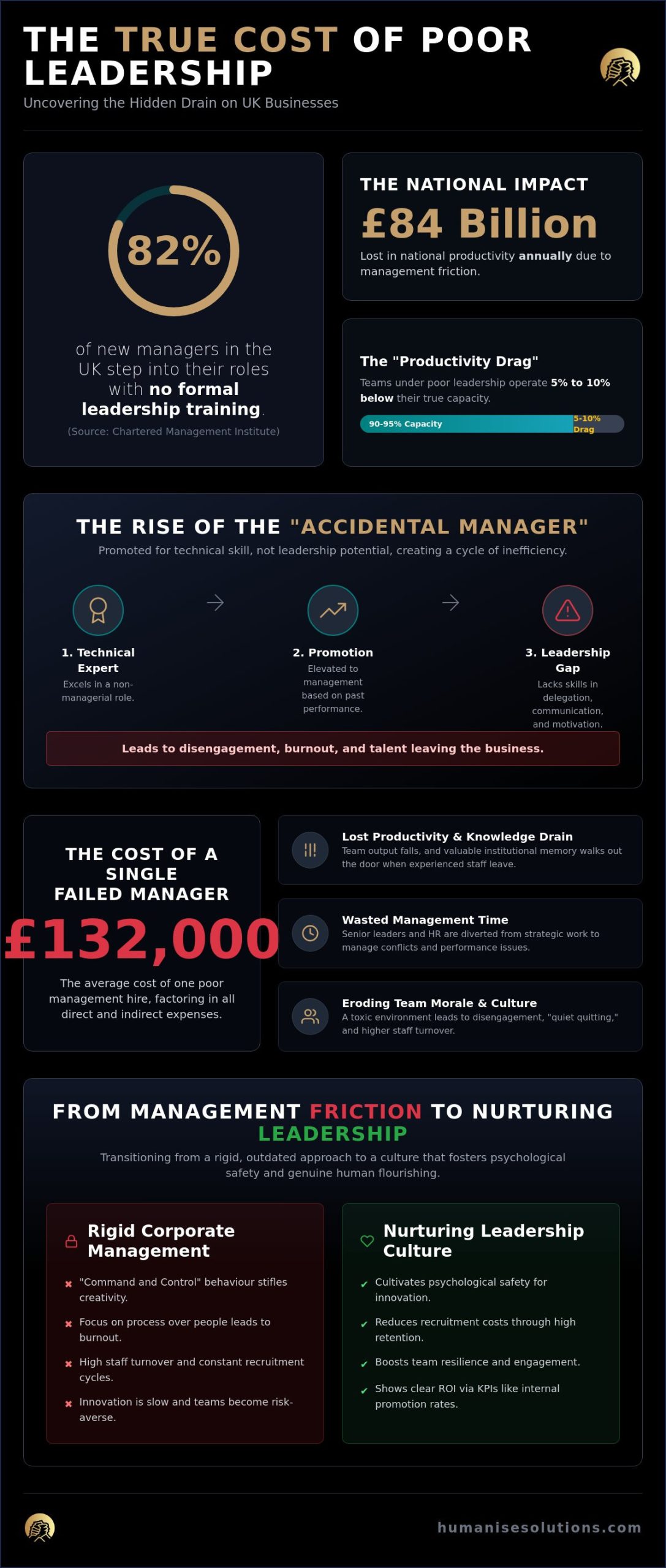
Did you know that 82% of new managers in the UK step into their roles without any formal training? This “accidental manager” syndrome is far more than a simple oversight; it’s a systemic crisis contributing to a staggering £84 billion annual loss in national productivity. You’ve likely felt the ripple effects of this in your own organisation, perhaps through the palpable tension of a low-morale team or the eye-watering £132,000 bill that follows a single failed management hire. It’s deeply frustrating to see productivity remain stagnant whilst your investment in systems continues to climb.
We understand that the true cost of poor leadership UK businesses experience isn’t just found on a balance sheet; it’s felt in the burnout of your best people and the erosion of your culture. This article explores the financial and human price of inadequate management, including how the 15% employer National Insurance rate makes staff turnover more expensive than ever. You’ll discover a framework to transition from rigid corporate management to a style of nurturing leadership that reduces recruitment costs and restores psychological wellbeing for the long term.
Key Takeaways
- Quantify the “productivity drag” and understand how management friction keeps UK firms operating well below their true capacity.
- Discover why the prevalence of “accidental managers” is a primary contributor to the staggering cost of poor leadership UK organisations encounter through talent leakage.
- Learn how to cultivate psychological safety and wellbeing as foundational pillars for team innovation and resilience.
- Identify the specific KPIs, from retention to internal promotion rates, that demonstrate the clear ROI of a nurturing leadership approach.
- Explore a framework for moving beyond off-the-shelf training towards bespoke development that supports genuine human flourishing.
The Hidden Financial and Cultural Price of Poor Leadership in the UK
Leadership is more than a title on a glass door. It’s the active, daily commitment to organise, inspire, and nurture the human potential within an organisation. When this commitment falters, the result is a pervasive management friction that quietly erodes your bottom line. The cost of poor leadership UK firms face is often estimated at a staggering £84 billion to £85 billion annually in lost productivity. This isn’t just a abstract economic figure; it represents the real, daily struggle of teams operating at 5% to 10% below their true capacity because their leaders lack the tools to guide them effectively.
Poor leadership manifests as a failure to create a cohesive vision. Instead of a flourishing environment, employees experience a “productivity drag” where energy is wasted on navigating internal politics or correcting avoidable errors. This leads directly to the “quiet quitting” phenomenon. Disengaged staff don’t always leave immediately. Instead, they remain in their roles, performing the bare minimum whilst their enthusiasm and innovation evaporate. By 2026, it’s clear that culture is no longer a “soft” asset. It’s the primary engine of sustainable revenue. A healthy culture, rooted in understanding leadership styles that suit your specific team, acts as a shield against market volatility and talent loss.
The Direct Financial Impact: Recruitment and Redundancy
The financial drain of inadequate management is most visible when a leader fails. Replacing a senior professional in the UK often costs between 1.5 and 2 times their annual salary. For a mid-level manager, the average cost of a poor hire is approximately £132,000 once you account for lost productivity, management time, and the impact on team morale. Beyond the direct fees, there’s the devastating “knowledge drain.” When experienced staff quit because they don’t feel supported, they take years of institutional memory and client relationships with them. Relying on recruitment services to fill these gaps is merely a sticking plaster for a deep-seated leadership wound; it treats the symptom rather than the cause.
The UK Productivity Gap: A Leadership Crisis
British firms have long struggled with a productivity gap compared to G7 peers, and research consistently points to management quality as the culprit. Poor delegation and a lack of clarity stifle the very innovation required to thrive in a volatile 2026 market. When leaders cannot pivot or provide clear direction, the entire organisation becomes sluggish. High-performing teams require leaders who can foster psychological safety, allowing for the rapid exchange of ideas. Without this, your investment in systems and technology will never yield a full return, as the human element remains the bottleneck in your growth journey.
The Rise of the ‘Accidental Manager’: Why UK Firms are Leaking Talent
Promotion should be a celebration of potential, yet for many in the UK, it marks the beginning of a quiet struggle. The Chartered Management Institute (CMI) reveals a startling reality: 82% of managers in the UK are “accidental managers.” These are individuals promoted because they were exceptional at their technical tasks, whether in accounting, engineering, or sales, rather than for their ability to lead people. This phenomenon often leads to the “Peter Principle,” where talented professionals rise to their level of incompetence. They find themselves equipped with technical expertise but lacking the emotional intelligence to cultivate a thriving team.
These managers don’t set out to be difficult. Most are trying their best whilst feeling profoundly overwhelmed. Without proper training, they often fall back on “command and control” behaviours or micromanagement to maintain a sense of order. This inadvertent creation of a high-pressure or toxic environment is a primary driver of the cost of poor leadership UK businesses experience today. When managers lack the tools to inspire, they unknowingly contribute to the management friction that helps cost the UK £84bn in lost productivity through disengagement and talent leakage.
The Broken Pipeline for Women in Leadership
Poor leadership creates a particularly steep barrier for women. When management styles remain rigid and non-nurturing, firms lose exceptional female talent at the mid-to-senior level. The cost of this exit is immense, both in terms of diverse perspectives and the financial burden of replacing experienced leaders. Inclusive leadership isn’t just a checkbox; it’s a prerequisite for retention. By failing to provide the specific support and psychological safety women require to flourish, organisations inadvertently dismantle their own leadership pipelines before they can reach maturity.
Gen Z and the Future of Work
The newest generation entering the workforce has a zero-tolerance policy for outdated management. Gen Z professionals don’t just work for a salary; they work for purpose and growth. They require a shift in leadership behaviour from “boss” to “coach.” When they encounter “command and control” styles, they simply leave. With the cost of a failed junior hire ranging from £8,000 to £12,000, firms cannot afford this high turnover. Transitioning to a model of nurturing leadership is the only way to build loyalty and ensure social mobility amongst early-career talent.
Beyond the Balance Sheet: The Psychological and Social Cost
The impact of a manager extends far beyond the four walls of an office. Every interaction, every critique, and every silence casts what we call the “Shadow of the Leader.” This shadow defines the psychological climate of your organisation. When leadership is critical rather than nurturing, psychological safety evaporates. Teams stop sharing ideas because the perceived risk of being judged outweighs the benefit of innovation. This silence is a hidden part of the cost of poor leadership UK businesses often overlook, as it quietly kills the creative spark necessary for growth.
The social cost is equally profound. Workplace stress doesn’t stay at the desk; it follows people home to their families and communities across the country. It’s a heavy burden that ripples through society, affecting mental health and social cohesion. When we fail to lead with empathy, we aren’t just damaging a business; we’re impacting the human flourishing of the people who make that business possible. Recognising this human element is the first step in moving from a state of friction to one of genuine excellence.
The Burnout Epidemic in UK Organisations
Poor management is a primary driver of the burnout epidemic currently sweeping through British firms. Recent data from the Centre for Mental Health indicates that poor mental health costs UK employers up to £45 billion every year through absenteeism and staff turnover. A significant portion of this is linked to “presenteeism,” where employees are physically present but unable to function effectively due to the weight of an unsupportive culture. By fostering wellbeing and psychological safety, leaders can create a protective factor that guards against long-term sickness absence and fuels sustainable organisational growth.
Eroding Trust and Team Excellence
Trust is the fundamental currency of any high-performing team. Insecure or ill-equipped managers often bankrupt this currency by creating silos and withholding information to maintain control. This breakdown of collaboration is a clear warning sign of a culture in decline. When trust vanishes, so does the ability for teams to work in unison towards a shared goal. To identify these early warning signs, look for a lack of healthy debate, a rise in internal politics, or a sudden drop in the internal promotion rates we discussed previously. Rebuilding this trust requires a shift towards a more transparent and nurturing leadership behaviour that values the person as much as the output.
Measuring the ROI of Nurturing Leadership: A Framework for UK Leaders
For many UK boards, leadership development is often filed under “discretionary spending” rather than “strategic investment.” This perspective overlooks the profound financial impact of a high-performing culture. Shifting the narrative in the boardroom requires moving away from abstract concepts and focusing on the “Engagement Premium.” Research consistently shows that teams led by nurturing leaders outperform their peers by up to 20% in terms of productivity and profitability. When you consider that the cost of poor leadership UK businesses face is rooted in friction and disengagement, the business case for change becomes undeniable.
To move the needle, we suggest a methodical four-step framework for evaluating the return on your leadership initiatives. First, audit your baseline by identifying existing turnover and “quiet quitting” costs. Second, deploy targeted development tracks that focus on the human element of management. Third, monitor shifts in internal promotion rates and team engagement scores over a six-month period. Finally, review the reduction in recruitment spend and the narrowing of the productivity drag we discussed earlier. This logical sequence builds trust with stakeholders by grounding high-reaching goals in clear, evidence-based methodology.
Quantifying Retention and Recruitment Savings
Calculating the “avoided cost” of turnover is the most direct way to justify your leadership budget. With the average cost of replacing a mid-level manager sitting at £132,000, even a modest improvement in retention yields significant savings. Your leadership reputation also acts as a magnet for top UK talent, reducing the need for expensive contingency recruitment fees that typically range from 15% to 25% of a first-year salary. Improving staff retention by 10% directly preserves thousands of pounds in recruitment fees and prevents the 15% employer National Insurance rate from being wasted on constant onboarding and training of new hires.
The Innovation and Agility Dividend
Innovation isn’t a happy accident; it’s a measurable outcome of psychological safety. Nurturing leadership reduces the time-to-market for new initiatives because teams feel safe to experiment and fail fast without fear of retribution. You can measure this dividend by tracking the frequency of new collaborative projects and the speed at which ideas move from conception to execution. High levels of trust also reduce organisational risk, as employees are more likely to speak up about potential issues before they escalate into costly crises. Transitioning your culture begins with investing in nurturing leadership that transforms your managers into visionary guides.
Cultivating Excellence: How Humanise Solutions Transforms Leadership Culture
At Humanise Solutions, we believe leadership is a journey of cultivation rather than a series of administrative tasks. Our philosophy centres on the idea that when people flourish, businesses thrive. We move away from the sterile, detached language of traditional consulting to focus on psychological wellbeing and social connection. By addressing the cost of poor leadership UK firms face, we help you transition from a culture of management friction to one of sustainable excellence. We don’t just provide answers; we act as a partner in your development, ensuring that the foundation of your growth remains rooted in logic and human empathy.
Off-the-shelf training often fails because it ignores the unique social dynamics of your specific organisation. These generic programmes are frequently seen as a tick-box exercise, providing temporary motivation that quickly evaporates once the daily pressure returns. In contrast, our bespoke Learning & Development initiatives are designed to address the “accidental manager” syndrome directly. We guide your technical experts through a transformation, helping them develop the emotional intelligence required to become nurturing leaders who inspire loyalty rather than just compliance.
Our Bespoke Leadership and Team Development Programmes
We tailor every initiative to the specific challenges of your organisational culture. Whether your team is struggling with stagnant productivity or the silent drain of disengagement, our expert-led workshops provide the tools to foster wellbeing and inclusive environments. This isn’t a fast-paced or high-pressure fix; it’s a methodical process that builds trust and resilience over time. By focusing on Team Excellence as a core pillar, we ensure that your investment leads to long-term change rather than a brief spike in morale.
Securing the Future Talent Pipeline
Securing your firm’s future requires a deep investment in the next generation and a commitment to diverse leadership. Our Young Adult Programmes are specifically designed to bridge the gap for early-career professionals, ensuring workforce readiness and reducing the high turnover costs we explored earlier. Simultaneously, we empower your future senior leaders through dedicated tracks for Women leadership. These programmes focus on building internal qualities like confidence and resilience, creating a robust pipeline of talent that is ready to lead with empathy and vision. Discover how Humanise Solutions can transform your leadership culture and help your organisation reach its full potential.
Leading the Transition to a Flourishing Future
We’ve explored how technical brilliance alone cannot bridge the productivity gap and why the “accidental manager” model is no longer sustainable in a market that demands agility and empathy. By shifting focus from sterile management to nurturing leadership, organisations can reclaim lost revenue and build a culture where innovation becomes a daily occurrence rather than a rare event. Addressing the cost of poor leadership UK businesses experience requires a deliberate move towards human-centric development that values the person behind the professional output.
Humanise Solutions is here to act as your partner in this vital transformation. Our evidence-based leadership frameworks focus on human flourishing, offering bespoke programmes designed for sustainable organisational growth. With specialised expertise in women’s leadership and young adult development, we help you secure your talent pipeline for the years ahead. Start your journey towards nurturing leadership excellence with Humanise Solutions. The potential within your teams is vast. You have the power to transform your workplace into a centre of excellence where every individual truly thrives.
Frequently Asked Questions
How much does poor leadership cost the UK economy annually?
Poor leadership costs the UK economy between £84 billion and £85 billion every year in lost productivity. This staggering figure reflects the cumulative impact of employee disengagement, inefficient processes, and management friction across various sectors. Beyond the macro-economic scale, individual firms often operate well below their potential capacity because their internal structures lack the nurturing qualities required to inspire peak performance and sustainable growth.
What are the main signs of poor leadership in an organisation?
High staff turnover and a palpable sense of low morale are the most visible indicators of leadership failure. Other signs include a lack of psychological safety, where team members feel unable to voice concerns or share innovative ideas without fear of criticism. When you notice silos forming between departments or a consistent failure to meet strategic goals despite high investment in systems, it often points to a breakdown in leadership behaviour.
How do you calculate the ROI of leadership development programmes?
You calculate ROI by measuring the reduction in recruitment spend and the increase in employee retention rates over a set period. By comparing the cost of the programme against the avoided costs of failed hires and senior leadership turnover, the financial benefit becomes clear. Tracking improvements in engagement scores and internal promotion rates provides additional data to support the long-term business case for human-centric investment.
What is an “accidental manager” and why is it a problem in the UK?
An accidental manager is a professional promoted for their technical expertise rather than their trained ability to lead people. This is a significant issue in the UK because 82% of managers fall into this category, often lacking the support needed to transition from expert to leader. This skills gap is a primary driver of the cost of poor leadership UK businesses face, as it inadvertently creates high-pressure work environments.
Can poor leadership be fixed with training, or is it a personality trait?
Poor leadership is almost always a result of inadequate development rather than a fixed personality flaw. Whilst some individuals possess natural empathy, the skills required for nurturing leadership can be cultivated through bespoke learning and development programmes. With the right guidance and a commitment to growth, most accidental managers can successfully transition into visionary leaders who foster psychological wellbeing and team excellence within their organisations.
What is the link between leadership and employee wellbeing?
Leadership is the primary determinant of workplace wellbeing, as a manager’s behaviour directly influences the stress levels and resilience of their team. Supportive, nurturing leaders create environments that act as a protective factor against burnout and long-term sickness absence. Conversely, critical or insecure management styles often lead to high rates of presenteeism, where employees are physically present but psychologically disengaged and unable to function at their best.
How does poor leadership specifically affect Gen Z retention?
Gen Z professionals prioritise purpose, growth, and psychological safety over traditional corporate hierarchies. When they encounter “command and control” management styles, they are significantly more likely to leave an organisation within their first year. Failing to adapt to these expectations leads to high recruitment costs, as this generation views leadership as a coaching partnership rather than a top-down directive focused solely on output.
Why should UK firms prioritise “nurturing leadership” over traditional management?
Nurturing leadership builds sustainable excellence by focusing on human flourishing rather than just short-term metrics. This approach reduces the cost of poor leadership UK firms encounter by improving retention and fostering a culture of genuine innovation. In a volatile 2026 market, firms that prioritise wellbeing and inclusive environments are better equipped to pivot and adapt, securing a competitive advantage through the strength of their people.
