

Article by
Scott Ward MBA CCMI
Scott Ward is the founder and CEO of Humanise Solutions, which he established three years ago to help organisations elevate their people, leadership and culture through a human-centric, evidence-based approach. Before moving into business and academia, Scott spent seven years as a professional footballer, playing for Luton Town, Crawley Town and Coventry City FC until injury brought his playing career to a close — a turning point that shaped both his research interests and his approach to leadership.
Scott holds an MBA from Warwick Business School, where his research explored the causal relationship between trauma and decision-making — work that continues to inform how he supports young adults, leaders and teams under pressure. Recognised as a Companion of the Chartered Management Institute (CCMI), its highest grade of membership, he combines academic rigour with the discipline, resilience and team-first mindset of the professional game. At the heart of everything he does is a simple belief: that people perform at their best when they are led, developed and valued as human beings first.
What if the rigid hierarchy that’s been the backbone of your business for decades is actually the very thing stifling its future? Many UK businesses are currently grappling with the reality that traditional, top-down management styles are no longer enough to retain talent or inspire innovation. If you’re searching for how to improve leadership in an organisation, the solution doesn’t lie in more sterile metrics or stricter oversight. Instead, it’s found in the intentional cultivation of a human-centric ecosystem where psychological safety is the foundation of every interaction.
It’s likely you already recognise that your people are your most vital asset, yet translating that sentiment into a cohesive strategy can feel like an uphill climb. We understand the delicate balance required to drive commercial results whilst ensuring your team feels genuinely supported and valued. This guide will show you how to move beyond basic management to foster a culture of nurturing leadership that prioritises wellbeing and drives team excellence. We’ll examine the practical steps to build diverse leadership pipelines, engage disengaged Gen Z talent, and create a sustainable environment where both your people and your profits can flourish together.
Key Takeaways
- Understand why the traditional command and control model is failing and how a shift towards nurturing leadership creates a more resilient workforce.
- Discover how to improve leadership in an organisation by establishing psychological safety as a prerequisite for innovation and team excellence.
- Learn to identify hidden friction within your management behaviours using a 360-degree feedback framework that prioritises human connection.
- Implement a methodical, five-step approach to transition your leadership culture from its current state to its full future potential.
- Explore why bespoke learning and development programmes outshine generic corporate training in delivering long-term, sustainable growth.
Defining Nurturing Leadership in the Modern Workplace
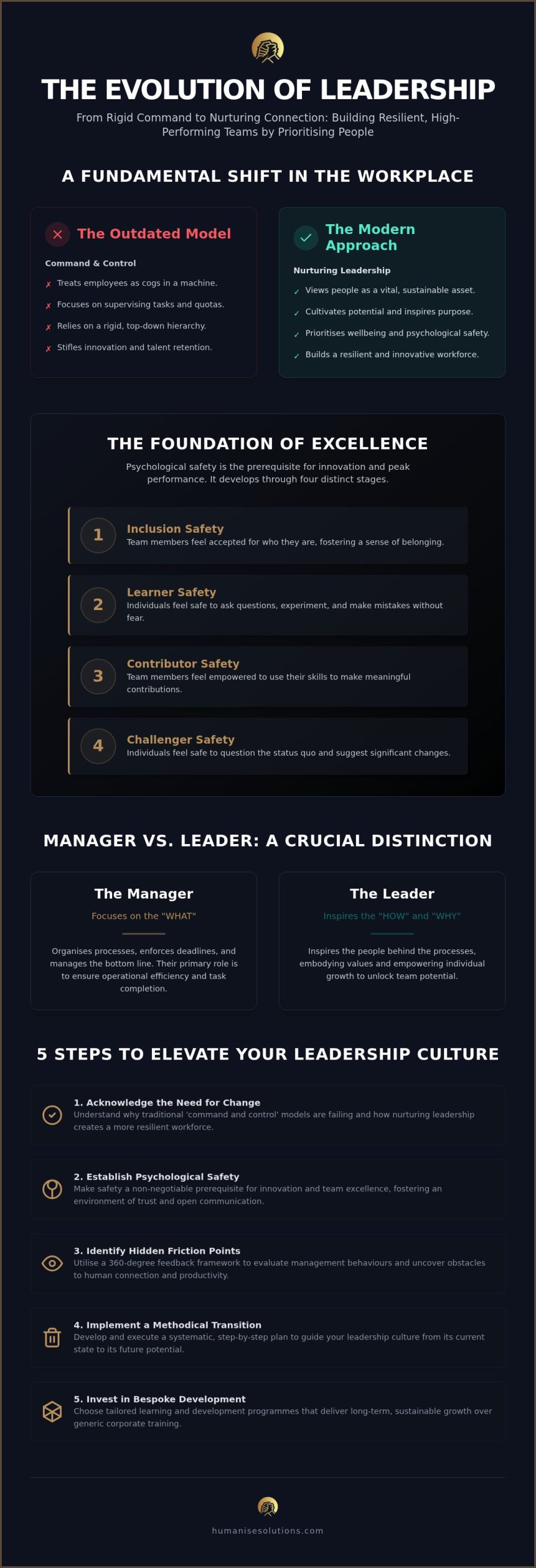
The concept of leadership is undergoing a profound metamorphosis. For decades, the “command and control” model reigned supreme, treating employees as cogs in a machine designed for output. However, as we approach the 2026 talent market, this rigid approach has become entirely obsolete. Modern professionals demand more than just a payslip; they seek purpose, psychological safety, and a commitment to their personal flourishing.
Nurturing leadership represents a shift from traditional management to a more visionary, empathetic form of guidance. It’s no longer about supervising tasks, but about cultivating a sustainable organisational asset. When you consider how to improve leadership in an organisation, you must view it as an investment in human potential rather than a fixed hierarchy of job titles. By moving away from detached corporate jargon and embracing a voice invested in wellbeing, businesses can begin to build resilience from the inside out.
The Difference Between Managing Tasks and Leading People
Management often focuses on the “what”: the deadlines, the quotas, and the bottom line. Leadership, conversely, is deeply concerned with the “how” and the “why”. Whilst management organises processes, relational leadership inspires the people behind those processes. This distinction is vital for team morale. Leaders who embody organisational values whilst empowering individual growth create a ripple effect of productivity. By studying different leadership styles, it becomes clear that those rooted in connection and empathy yield the most consistent long-term results.
Why Human-Centric Leadership is Non-Negotiable
Employee expectations have shifted significantly. Inclusion and empathy are no longer “nice-to-have” perks; they’re fundamental requirements for a thriving workplace. A human-centric approach is the only way to ensure long-term organisational resilience in an era of rapid change. It’s about recognising that when people feel safe and seen, they perform at their peak.
To understand how to improve leadership in an organisation, one must recognise that the foundation is psychological safety. Nurturing leadership is the act of creating environments where potential is systematically unlocked. This isn’t a quick fix, but a methodical commitment to growth that ensures talent flourishes and turnover remains low.
Cultivating Psychological Safety and Wellbeing as Foundations
Innovation requires more than just high-calibre talent; it requires an environment where that talent feels safe to take risks. Establishing psychological safety is the primary prerequisite for achieving team excellence and sustainable growth. When you’re exploring how to improve leadership in an organisation, you must look closely at the invisible social dynamics that either stifle or stimulate creativity. Leaders who prioritise these foundations create a resilient culture where employees don’t just show up, but truly contribute.
Creating a Culture of Psychological Safety
Psychological safety isn’t a binary state. It’s a progression that typically moves through four distinct stages: inclusion safety, learner safety, contributor safety, and challenger safety. In the first stage, team members feel accepted for who they are. As they move towards challenger safety, they feel empowered to question the status quo without fear of retribution. Leaders who excel here demonstrate specific, repeatable behaviours. They admit their own mistakes openly and show curiosity rather than judgement when a project doesn’t go to plan. By reframing errors as collective learning opportunities amongst the team, you remove the paralysing fear that usually prevents breakthrough thinking. This transparency ensures that diverse voices are not only present but actively invited to the conversation.
Leadership’s Role in Fostering Wellbeing
Modern leadership must move beyond superficial office perks like free fruit or Friday drinks. Truly effective wellbeing strategies are science-driven, focusing on autonomy, social support, and the reduction of cognitive load. Nurturing leaders act as early detectors for their teams. They use high levels of emotional intelligence to identify subtle signs of disengagement or stress before they escalate into burnout or absenteeism. Whilst traditional essential management skills remain important for day-to-day operations, the ability to navigate complex social dynamics is what sustains a team over years rather than months.
The impact of this approach on the bottom line is significant. In the UK, work-related stress and burnout account for a substantial portion of lost productivity. By actively fostering wellbeing, leaders directly improve staff retention rates, particularly amongst Gen Z and diverse talent pools who prioritise values and mental health. This human-centric approach transforms leadership from a series of tasks into a powerful engine for retention. If you’re ready to start this transformation, adopting a dedicated nurturing leadership framework can provide the logic and methodology your managers need to build truly thriving teams.
Evaluating Your Current Organisational Leadership Culture
True transformation begins with a mirror. To understand how to improve leadership in an organisation, you must first be willing to conduct a rigorous audit of the current state. This isn’t about assigning blame; it’s about identifying the friction points that prevent your people from flourishing. Many businesses rely solely on financial KPIs to judge management success, but these are lagging indicators that often mask a crumbling internal culture. A human-centric evaluation looks deeper, seeking to understand the emotional and social reality of the workplace.
One of the most effective tools for this is 360-degree feedback. When implemented with care, it reveals the gap between how leaders perceive themselves and how they are experienced by their teams. This process often unearths “toxic” traits, such as micro-management or emotional volatility, that directly undermine team excellence. By referencing evidence-based frameworks like the ten simple rules for good leadership, organisations can move away from subjective opinions and towards a grounded, logical methodology for development.
Structural vs. Relational Leadership Audit
It’s helpful to categorise leadership behaviours into two distinct camps: structural and relational. Whilst structural leadership ensures the “trains run on time”, relational leadership ensures there are people on the train who actually want to be there. Most UK organisations are over-indexed on structure and under-indexed on connection.
| Feature | Structural Leadership | Relational Leadership |
|---|---|---|
| Primary Focus | Compliance and processes | Commitment and people |
| Communication | Top-down mandates | Multi-directional dialogue |
| Success Metric | Output and efficiency | Wellbeing and growth |
| Consequence | Short-term gains; high burnout | Long-term sustainability; high retention |
Identifying the Gaps in Your Leadership Pipeline
A critical part of knowing how to improve leadership in an organisation is looking at who is being prepared for the future. The “frozen middle” is a common phenomenon in British businesses, where mid-level managers are stuck executing tasks without receiving the nurturing they need to evolve. This layer often lacks the psychological safety to innovate, which trickles down to the rest of the workforce.
Assess your pipeline with a focus on diversity and inclusion. Are your current programmes effectively supporting women leadership and young adult development? Often, high-potential individuals are overlooked because they don’t fit a traditional, aggressive corporate profile. By spotting these non-traditional leaders early, you can build a more inclusive environment where talent flourishes regardless of background. This intentional cultivation is what separates thriving organisations from those merely surviving. A comprehensive approach to organisational leadership development ensures these high-potential individuals receive the structured support they need to rise.
Five Practical Steps to Improve Leadership at Every Level
Transitioning from a traditional management style to a human-centric model requires more than good intentions. It demands a methodical approach that moves your team from their current state towards their future potential. When considering how to improve leadership in an organisation, you must move beyond the allure of the “quick fix” workshop. Sustainable growth is cultivated through consistent, intentional actions that are woven into the very fabric of your daily operations. This journey isn’t about changing people; it’s about changing the environment in which they work.
Step 1: Define Your Nurturing Leadership Competencies
Growth isn’t accidental. It begins by collaborating with your teams to identify what “good” looks like in your specific culture. This shouldn’t be a list of generic corporate buzzwords. Instead, focus on tangible competencies such as empathy, inclusive communication, and resilience. By involving employees in this process, you ensure the standards are grounded in reality rather than dictated from a boardroom. Bespoke competencies are the blueprint for cultural transformation, providing a clear map for every manager to follow.
Step 2: Implement Mentorship and Peer Learning
Knowledge shouldn’t be siloed at the top. Structured mentorship is particularly vital for our Young Adult Programmes, where early-career professionals need more than just technical training; they need a guide to navigate the social complexities of the workplace. Peer-to-peer coaching amongst middle management is equally powerful. It creates a space for leaders to share challenges and successes, fostering a sense of collective responsibility for team excellence. This collaborative growth ensures that wisdom flows in all directions, not just downwards.
Step 3: Invest in Specialised Tracks for Diverse Talent
A one-size-fits-all approach to development often leaves high-potential talent behind. Dedicated tracks for women leadership are essential because they address the unique systemic hurdles these professionals often face. Similarly, Gen Z talent requires a different style of engagement, one that prioritises purpose and immediate feedback. Framing diversity as a strategic advantage rather than a compliance box ensures your leadership pipeline is as varied and resilient as the market you serve.
Step 4: Tailor Development to Your Specific Context
Generic training often fails because it ignores the unique pressures of your specific industry or company size. Effective leadership development must be bespoke, reflecting the actual challenges your managers face on a Tuesday afternoon, not just in a theoretical case study. This methodical approach is the most sustainable way to understand how to improve leadership in an organisation whilst building internal resilience.
Step 5: Partner for Fresh Perspectives
Sometimes, being too close to a problem makes it impossible to see the solution. External partners bring a grounded expertise and a visionary perspective that can break through long-standing cultural rifts. They provide the logic and methodology needed to transition from sterile consulting to genuine human flourishing. Knowing how to identify the right leadership development consultant for your organisation is itself a critical skill, one that ensures your investment translates into lasting cultural change. Our bespoke Learning & Development programmes are designed to facilitate this transition, ensuring your leadership strategy is both high-reaching and pragmatically sound.
Sustaining Growth Through Bespoke Development Programmes
Off-the-shelf training programmes often fail because they treat leadership as a static skill set rather than a living, breathing behaviour. These generic models might offer a community of directors, but they don’t understand the specific friction points within your office or the unique aspirations of your staff. When you’re determining how to improve leadership in an organisation, you need a strategy that acknowledges your past challenges whilst illuminating your future potential. Sustainable change requires a deep dive into the human elements of your business. It demands care. At Humanise Solutions, we act as your visionary guide, providing the logic and methodology required to transition from sterile corporate structures to vibrant, human-centric ecosystems.
The Power of Bespoke Design
Tailored programmes allow us to address the exact pain points that hinder your progress. Instead of broad theories, bespoke design focuses on the integration of fostering wellbeing and team excellence into the core of your management training. This methodical transition moves beyond surface-level fixes to create a logical sequence of development. By focusing on your specific culture, we can design workshops that tackle everything from disengaged talent to the lack of diverse leadership pipelines. Ongoing coaching ensures that these shifts in behaviour become a permanent part of your organisational DNA, rather than a fleeting memory of a training day.
Building a Legacy of Leadership
Leadership development shouldn’t be a one-off event; it’s a continuous, rhythmic process that sustains growth over decades. When you invest in the long-term nurturing of your people, you build a legacy that transcends quarterly reports. This commitment significantly strengthens your employer branding, making your organisation a magnet for top-tier talent who value social mobility and personal flourishing. It’s about creating a thriving environment where every individual feels supported in their journey. This steady pace of development ensures that the improvements you make today become the foundation for a resilient future. Ready to transform your culture? Explore our bespoke leadership programmes to start your journey towards human-centric excellence.
Cultivating a Future of Human-Centric Excellence
The transition from a rigid, process-driven hierarchy to a fluid, human-centric ecosystem is the most significant investment your business can make. We’ve explored how prioritising psychological safety and wellbeing creates the necessary foundation for team excellence, moving far beyond the obsolete command and control models of the past. By auditing your current culture and implementing methodical, practical steps, you can bridge the gap between your current challenges and your future potential.
Understanding how to improve leadership in an organisation isn’t about finding a universal template; it’s about nurturing the unique qualities of your people. Whether it’s through specialised young adult professional development, expert-led team excellence workshops, or bespoke programmes for women in leadership, the goal remains the same: sustainable growth built on human flourishing. This journey requires patience and a commitment to long-term resilience rather than quick fixes.
Ready to begin your transformation? Nurture your next generation of leaders with Humanise Solutions and build a culture where every individual has the confidence to thrive. The future of your organisation is waiting to be unlocked.
Frequently Asked Questions
What is the most effective way to improve leadership in a large organisation?
Decentralising development and focusing on cultural consistency across every department is the most effective strategy. In large UK firms, the most impactful way to understand how to improve leadership in an organisation is to move away from top-down mandates. Instead, empower middle managers with the autonomy to nurture their specific teams. This ensures that human-centric values are lived daily rather than just appearing as aspirational text on a corporate website.
How can we develop leadership skills in employees who are not currently managers?
Focus on “self-leadership” and peer-to-peer influence through structured mentorship programmes. By investing in specialised Young Adult Programmes, you can cultivate leadership behaviours like active listening and emotional intelligence long before a formal title is granted. This approach builds a robust pipeline of talent who are already aligned with your organisation’s values of empathy and inclusive communication, ensuring a seamless transition into future management roles.
What are the common mistakes organisations make when implementing leadership training?
Relying on generic, one-size-fits-all workshops is the most frequent error we observe. These “quick fix” sessions often fail because they don’t address the specific cultural friction points unique to your business. Without ongoing coaching and a methodical transition plan, the lessons learned in a single day are rarely integrated into long-term behaviour. This leads to a poor return on investment and a disengaged workforce who feel their needs aren’t truly understood.
How do you measure the ROI of leadership development and wellbeing programmes?
Track leading indicators like staff retention rates, absenteeism, and internal promotion percentages. Whilst financial performance is a lagging indicator, the ROI of fostering wellbeing is seen in reduced recruitment costs and higher employee engagement scores. Measuring the shift in psychological safety through regular 360-degree feedback provides a concrete logic for how leadership health directly impacts your commercial bottom line, turning human flourishing into a measurable business asset.
Can leadership skills truly be taught, or are people born leaders?
Leadership is a set of observable behaviours that can be nurtured and refined through deliberate practice and expert guidance. Whilst some individuals possess a natural inclination towards social connection, the ability to inspire a team or navigate complex dynamics is a learned competency. When exploring how to improve leadership in an organisation, it’s more productive to view it as a journey of development rather than an innate, unchangeable personality trait. For a deeper understanding of how this applies in practice, our guide to organisational leadership development for 2026 outlines the specific behaviours and frameworks that can be cultivated over time.
How do we support women in leadership without creating a ‘tick-box’ culture?
Move beyond quotas to address the systemic barriers that prevent women leadership from flourishing naturally. This involves creating bespoke development tracks that offer genuine mentorship and psychological safety rather than superficial visibility. By focusing on the unique challenges and strengths of female leaders, you build an inclusive environment where diversity is a strategic driver for innovation. This shifts the focus from compliance to the genuine cultivation of varied perspectives.
What specific leadership traits does Gen Z look for in an employer?
Authenticity, empathy, and a clear commitment to social purpose are non-negotiable for Gen Z talent entering the UK workforce. They seek leaders who act as mentors rather than supervisors and who prioritise mental health and work-life balance. Providing a roadmap for Learning & Development that aligns with their personal values is essential for retaining this demographic. They are quick to leave environments that feel sterile, detached, or lacking in human connection.
How does psychological safety impact the bottom line of a business?
Psychological safety reduces the “silence tax” that occurs when employees are too afraid to speak up about risks or errors. When teams feel safe to challenge the status quo, innovation cycles shorten and costly mistakes are identified earlier. This environment of trust directly correlates with higher productivity and lower staff turnover. It ensures that the human experience and commercial success grow in tandem, creating a more resilient and profitable organisation.
