

Article by
Scott Ward MBA CCMI
Scott Ward is the founder and CEO of Humanise Solutions, which he established three years ago to help organisations elevate their people, leadership and culture through a human-centric, evidence-based approach. Before moving into business and academia, Scott spent seven years as a professional footballer, playing for Luton Town, Crawley Town and Coventry City FC until injury brought his playing career to a close — a turning point that shaped both his research interests and his approach to leadership.
Scott holds an MBA from Warwick Business School, where his research explored the causal relationship between trauma and decision-making — work that continues to inform how he supports young adults, leaders and teams under pressure. Recognised as a Companion of the Chartered Management Institute (CCMI), its highest grade of membership, he combines academic rigour with the discipline, resilience and team-first mindset of the professional game. At the heart of everything he does is a simple belief: that people perform at their best when they are led, developed and valued as human beings first.
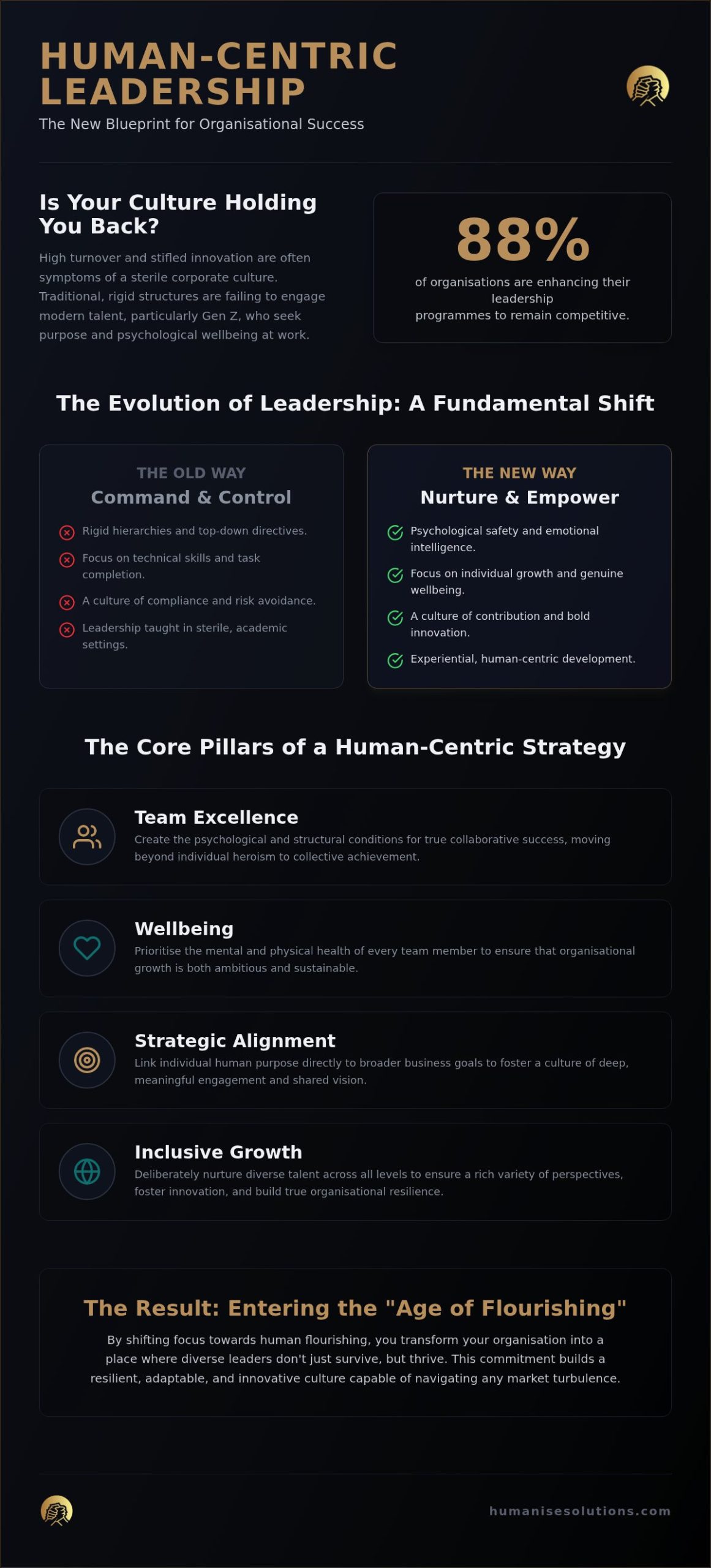
What if the high turnover amongst your middle management isn’t actually a recruitment problem, but a quiet plea for a more human approach to work? Many leaders today find themselves trapped in a sterile corporate culture that inadvertently stifles innovation and fails to resonate with the values of Gen Z talent. You aren’t alone in feeling that traditional, rigid structures are no longer fit for purpose. It’s the reason 88% of organisations are now planning to enhance their internal programmes to remain competitive. Genuine organisational leadership development must move beyond the purely academic, focusing instead on the psychological wellbeing and emotional intelligence required to lead with heart.
We believe that when you invest in the person, the performance naturally follows. This guide will help you discover how to cultivate a leadership culture that prioritises wellbeing, team excellence, and sustainable growth within your unique environment. We will provide a clear roadmap for nurturing future talent from within, ensuring you build a resilient and inclusive leadership team. By shifting your focus toward human flourishing, you’ll transform your organisation into a place where diverse leaders don’t just survive, but truly thrive.
Key Takeaways
- Learn why shifting from “command and control” to a “nurture and empower” philosophy is essential for the modern UK workplace.
- Understand how a strategic approach to organisational leadership development builds the psychological safety required to retain middle management and engage Gen Z talent.
- Discover the core pillars of team excellence and how to create the specific conditions that allow for collaborative, sustainable success.
- Follow a practical framework to audit your current corporate culture and identify the “human” gaps that might be stifling innovation.
- Explore the benefits of bespoke programmes that prioritise long-term sustainability and the genuine wellbeing of your people.
The Evolution of Organisational Leadership Development in 2026
The landscape of British business is undergoing a profound transformation. We’ve moved past the era where rigid hierarchies and “command and control” tactics could sustain a company. In 2026, the most successful organisations are those that have traded old-school management for a philosophy of “nurture and empower.” This shift isn’t just a trend; it’s a necessary response to a workforce that demands more than just a payslip. Modern organisational leadership development now centres on creating environments where people feel seen, heard, and valued. When leaders move away from sterile corporate classrooms and toward experiential, human-centric learning, they build the resilience needed for long-term staff retention.
Traditional models often treated leadership as a set of technical skills to be checked off a list. However, the complexity of 2026 requires something deeper. Leaders now need high levels of emotional intelligence to foster psychological safety. Without this safety, innovation withers and talent walks out the door. With 88% of companies now planning to enhance their leadership programmes to stay competitive, the focus has shifted firmly toward the human experience. It’s about moving from a culture of compliance to one of genuine contribution.
From Management to Nurturing Leadership
Managing is about ticking boxes and ensuring tasks are completed on time. Nurturing leadership, however, is about the growth of the individual. It recognises that a team’s output is limited by the collective wellbeing of its members. When leaders use empathy to understand the unique drivers of their staff, they unlock a higher level of performance behaviour. This human element has become the ultimate competitive advantage. It’s especially vital when engaging Gen Z professionals who prioritise purpose and psychological support over traditional corporate prestige.
Leading in the “Age of Flourishing”
Whilst some view 2026 as an age of market turbulence, we see it as the “Age of Flourishing.” Uncertainty is a constant; the variable is how we support our people through it. Inclusive leadership is no longer an optional extra but a core pillar of organisational resilience. By fostering a culture of continuous organisational leadership development, you ensure your team remains adaptable and confident. This isn’t a burden to be carried by senior executives alone. Instead, it’s a shared journey toward collective excellence that begins with a commitment to nurturing the potential within every individual.
Defining the Core Pillars of a Human-Centric Leadership Strategy
Organisational leadership development is a strategic, human-centric process that aligns individual potential with collective purpose to drive sustainable success. It moves away from the mechanical “architecture” of business and focuses instead on the organic growth of people. To build a resilient organisation, we must anchor our strategy in four essential pillars:
- Team Excellence: Creating the psychological and structural conditions that allow for true collaborative success.
- Wellbeing: Ensuring that growth is sustainable by prioritising the mental and physical health of every team member.
- Strategic Alignment: Linking individual human purpose directly to the broader business goals to foster deep engagement.
- Inclusive Growth: Deliberately nurturing diverse talent across all levels to ensure a rich variety of perspectives and leadership styles.
The Role of Team Excellence in Leadership
High-performing teams don’t emerge by accident. They’re the result of intentional organisational leadership development that prioritises collective achievement over individual heroism. When we move away from the “lone genius” model, we create space for collaborative leadership. This approach encourages every member to take ownership of the shared vision, fostering a sense of belonging and responsibility. It’s about building a culture where trust is the foundation, allowing teams to navigate challenges with agility and shared confidence. By focusing on team excellence, you transform a group of talented individuals into a unified force capable of extraordinary results.
Integrating Wellbeing into the Leadership Framework
Wellbeing is often mischaracterised as a soft HR perk, but it’s actually a vital strategic priority. There’s a direct correlation between a leader’s wellbeing and the performance of their entire team. When leaders are burnt out, their decision-making suffers and their emotional intelligence drops, creating a ripple effect of stress throughout the department. Embedding wellbeing into the daily rhythm of your organisation means more than just offering occasional workshops. It involves setting clear boundaries, encouraging rest, and modelling healthy behaviours from the top down. True sustainability happens when we recognise that human flourishing is the engine of professional productivity. It’s about creating a pace that allows for consistent excellence without the heavy cost of exhaustion.
Why Traditional Management Models Often Fail Modern Teams
Many UK businesses still cling to top-down, rigid management structures, unaware of the quiet damage they cause to the bottom line. These traditional models often result in a “sterile” leadership style that prioritises process over people, leading to high staff turnover and the rise of quiet quitting. When employees feel like cogs in a machine, their engagement withers. This isn’t just a cultural issue; it’s a financial one. Organisations with high employee engagement report 23% higher profitability, according to recent industry data. Continuing with outdated methods isn’t just inefficient; it’s expensive.
Rigid hierarchies are particularly poorly suited to the expectations of Gen Z and younger professionals. This demographic values flexibility, psychological support, and a sense of purpose over traditional corporate prestige. When innovation is stifled by layers of approval and a lack of autonomy, your most creative talent will look elsewhere. There is also a persistent misconception that leadership is reserved for those with C-suite titles. In reality, organisational leadership development should be a thread that runs through every level of the business, empowering individuals to lead from wherever they are.
The most common objection to this human-centred shift is a perceived lack of time for “soft skills.” However, these are actually essential power skills. Investing time in emotional intelligence and active listening prevents the misunderstandings and conflicts that drain productivity later. It’s not about adding more to a manager’s plate; it’s about changing the way they work to make the entire team more efficient. If you’re looking for practical strategies on how to improve leadership in an organisation, moving beyond rigid oversight toward a culture of psychological safety is the essential first step.
The “Sterility Gap” in Corporate Training
Off-the-shelf training programmes often fail because they lack the nuance of your specific organisational culture. These generic courses might tick a compliance box, but they rarely inspire lasting behavioural change. True growth requires bespoke solutions that mirror the unique challenges your team faces. By moving from compliance-based training to growth-based organisational leadership development, you create a learning environment that feels relevant and deeply invested in the individual’s future potential.
Breaking the Cycle of Middle Management Burnout
Traditional models place immense pressure on the “frozen middle,” expecting managers to be gatekeepers of policy whilst also driving performance. This is a recipe for burnout. We must support these leaders to transition into facilitators of growth. When managers are equipped to nurture their teams through evidence-based nurturing leadership skills rather than just monitor them, they foster a genuine sense of belonging. This shift naturally reduces turnover and creates a resilient leadership pipeline that can sustain the organisation for years to come.
Designing a Sustainable Leadership Development Framework
Building a resilient leadership culture isn’t a project with a fixed end date. It’s an ongoing commitment to the growth of your people. To create a framework that truly lasts, you must move beyond the transactional and design a journey that reflects your organisation’s unique pulse. Effective organisational leadership development follows a deliberate, methodical path that prioritises human connection over mere compliance.
- Audit your culture: Pinpoint where the “human” element is missing. Identify the gaps where staff feel managed rather than nurtured.
- Define core behaviours: Clearly outline the values you want to see in action. What does empathy look like in your specific professional context?
- Implement bespoke tracks: Create tailored learning paths that meet people exactly where they are in their career journey.
- Measure qualitative impact: Track success through wellbeing and engagement data. Listen to the stories behind the statistics.
- Iterate and evolve: Regularly update the programme to ensure it remains relevant to the shifting needs of your workforce.
If you’re ready to move away from sterile training and toward genuine transformation, you can explore our nurturing leadership programmes designed for long-term sustainability and impact.
Nurturing Women in Leadership
Specialised tracks for women are essential for achieving true organisational balance. Systemic barriers often remain invisible until they’re intentionally addressed through confidence-building and mentorship. By nurturing diverse leadership perspectives, you don’t just fill quotas; you enrich the decision-making process with a wider range of emotional intelligence and lived experience. This inclusive approach is a cornerstone of sustainable growth, ensuring that every voice has the opportunity to lead with confidence and resilience.
Early Careers and Social Mobility
The transition from education to the professional world is a pivotal moment for young adults. Early career development programmes that include social mobility training help bridge the talent gap and foster a sense of loyalty from day one. When you invest in young talent from diverse backgrounds, you build a resilient future talent pipe that’s deeply aligned with your organisational values. This isn’t just about recruitment. It’s about fostering excellence at every level of the journey and ensuring that potential isn’t limited by a person’s starting point.
Cultivating Excellence: The Humanise Solutions Approach to Growth
We believe that true transformation isn’t found in a textbook or a rigid academic syllabus. Whilst traditional diplomas offer rigor, they often lack the immediate cultural impact required to shift the needle on employee wellbeing and performance. Our approach to organisational leadership development is rooted in the belief that people are the heart of every successful enterprise. We don’t just provide training; we facilitate a deep transition from your current challenges to a future filled with human potential. By focusing on psychological safety and team excellence, we create the conditions where innovation and resilience become the natural output of your culture.
Every organisation has a unique pulse. That’s why we reject off-the-shelf courses in favour of bespoke programmes that address your specific human gaps. Whether you’re struggling with middle management burnout or looking to engage Gen Z talent, our methodology is designed for long-term sustainability. We strike a balance between being a visionary guide and a grounded expert, ensuring that every step we take together is supported by logic and evidence-based confidence. This steady pace mirrors our commitment to sustainable growth, ensuring your team feels supported rather than overwhelmed by new demands.
Nurturing Leadership as a Partnership
We don’t dictate from a distance. Instead, we work alongside your team as a partner in a journey of development. This partnership allows us to co-create a growth-orientated culture that feels authentic to your people. Our commitment combines empathetic warmth with a methodical approach, ensuring that change is deep-seated rather than superficial. Choosing a human-centric development partner means investing in the flourishing of your entire leadership pipeline, from your entry-level talent to your senior executives. It’s about building a foundation of confidence and resilience that will carry the organisation forward for years to come.
Next Steps: Starting Your Leadership Journey
Identifying the right starting point for your organisation is the first step toward lasting change. It requires an honest look at your current dynamics and a willingness to embrace a steady, methodical pace. Meaningful transformation takes time and care; it’s not a high-pressure sprint but a deliberate progression toward excellence. We invite you to enquire about our bespoke leadership development programmes to see how we can support your specific goals. Let’s begin the work of nurturing a leadership culture that is as resilient as it is compassionate, ensuring your organisation is ready for the challenges of 2026 and beyond.
Embracing a Future of Human Flourishing
The transition from rigid management to nurturing leadership is no longer a choice; it’s a necessity for the modern UK workplace. We’ve explored how moving away from sterile, off-the-shelf training toward a bespoke organisational leadership development framework can transform your culture. By anchoring your strategy in psychological safety and team excellence, you don’t just retain talent. You create an environment where diverse voices and young professionals can truly thrive. It’s about building a foundation of resilience that supports long-term sustainability rather than short-term compliance.
As an expert-led consultancy, we’re dedicated to helping you navigate this journey with empathetic warmth and evidence-based confidence. Whether you need specialised tracks for women leaders or early career development programmes, we provide the partnership required to co-create a growth-orientated culture. You have the power to turn current challenges into future potential. We invite you to discover our human-centric leadership programmes and take the first step toward a more vibrant, inclusive organisation. The path to excellence is a steady one, and we’re here to walk it with you.
Frequently Asked Questions
What is the difference between leadership and organisational development?
Leadership development focuses on the individual’s capacity to lead, whilst organisational development looks at the systemic health, culture, and structures of the entire business. Think of leadership development as nurturing the gardener and organisational development as preparing the soil. Both are essential for growth. In our approach, we blend these paths, ensuring that personal growth directly informs and strengthens the wider organisational culture for long-term success.
How long does a typical organisational leadership development programme take?
A typical programme varies based on your goals, but meaningful change usually requires a commitment of six to twelve months. Sustainable transformation isn’t a fast-paced sprint; it’s a methodical progression. We believe in a steady rhythm that allows leaders to integrate new behaviours into their daily work. This timeframe ensures that the shift from current states to future potential is deeply rooted and long-lasting rather than superficial.
Can leadership skills really be taught, or are leaders born?
Leadership is a set of behaviours and mindsets that can absolutely be cultivated through deliberate practice and expert guidance. Whilst some individuals possess natural predispositions, the most effective leaders are those who commit to continuous learning and development. Our programmes focus on nurturing qualities like emotional intelligence and resilience. We don’t believe leaders are simply born; they’re made through a dedicated journey of self-awareness and human-centred growth.
How do you measure the ROI of leadership development programmes?
ROI is measured through a blend of qualitative engagement data and quantitative business metrics like staff turnover rates and productivity levels. Organisations with high employee engagement often report 23% higher profitability, providing a clear link between human flourishing and financial health. We track shifts in team dynamics and psychological safety to ensure your investment in organisational leadership development delivers a tangible return on both human and commercial capital.
Why is wellbeing included in leadership training?
Wellbeing is included because it’s the engine of sustainable performance; a burnt-out leader cannot foster an innovative or resilient team. We treat psychological health as a strategic priority rather than a soft perk. When leaders prioritise their own wellbeing, they model healthy behaviours that ripple through the organisation. This reduces the risk of middle management burnout and ensures that high-reaching goals are achieved without a heavy human cost.
How can we support young adults entering the workforce for the first time?
Supporting young adults involves creating specialised tracks that bridge the gap between education and the professional world. We focus on building confidence and social mobility, helping Gen Z talent align their personal values with organisational goals. By providing mentorship and a clear roadmap for growth, you foster loyalty from the start. This approach ensures that your future leadership pipeline is diverse, resilient, and deeply invested in the company’s long-term success.
What are the benefits of a bespoke programme over a standard course?
Bespoke programmes offer the advantage of being tailored to your specific organisational needs and unique cultural challenges. Standard courses often provide generic theory that fails to address the “human” gaps within your particular team. A bespoke approach allows for a deeper transition, focusing on the real-world dynamics of your workplace. It ensures that the learning is relevant, immediately applicable, and designed for the long-term sustainability of your specific business.
How does organisational leadership impact staff retention?
Effective organisational leadership development significantly improves staff retention by fostering a culture of belonging and psychological safety. When employees feel nurtured and supported by their leaders, they’re much less likely to seek opportunities elsewhere. High turnover often stems from a sterile corporate culture where innovation is stifled. By investing in human-centric leadership, you create a workplace that people don’t want to leave, naturally reducing recruitment costs and preserving institutional knowledge.
