

Article by
Scott Ward MBA CCMI
Scott Ward is the founder and CEO of Humanise Solutions, which he established three years ago to help organisations elevate their people, leadership and culture through a human-centric, evidence-based approach. Before moving into business and academia, Scott spent seven years as a professional footballer, playing for Luton Town, Crawley Town and Coventry City FC until injury brought his playing career to a close — a turning point that shaped both his research interests and his approach to leadership.
Scott holds an MBA from Warwick Business School, where his research explored the causal relationship between trauma and decision-making — work that continues to inform how he supports young adults, leaders and teams under pressure. Recognised as a Companion of the Chartered Management Institute (CCMI), its highest grade of membership, he combines academic rigour with the discipline, resilience and team-first mindset of the professional game. At the heart of everything he does is a simple belief: that people perform at their best when they are led, developed and valued as human beings first.
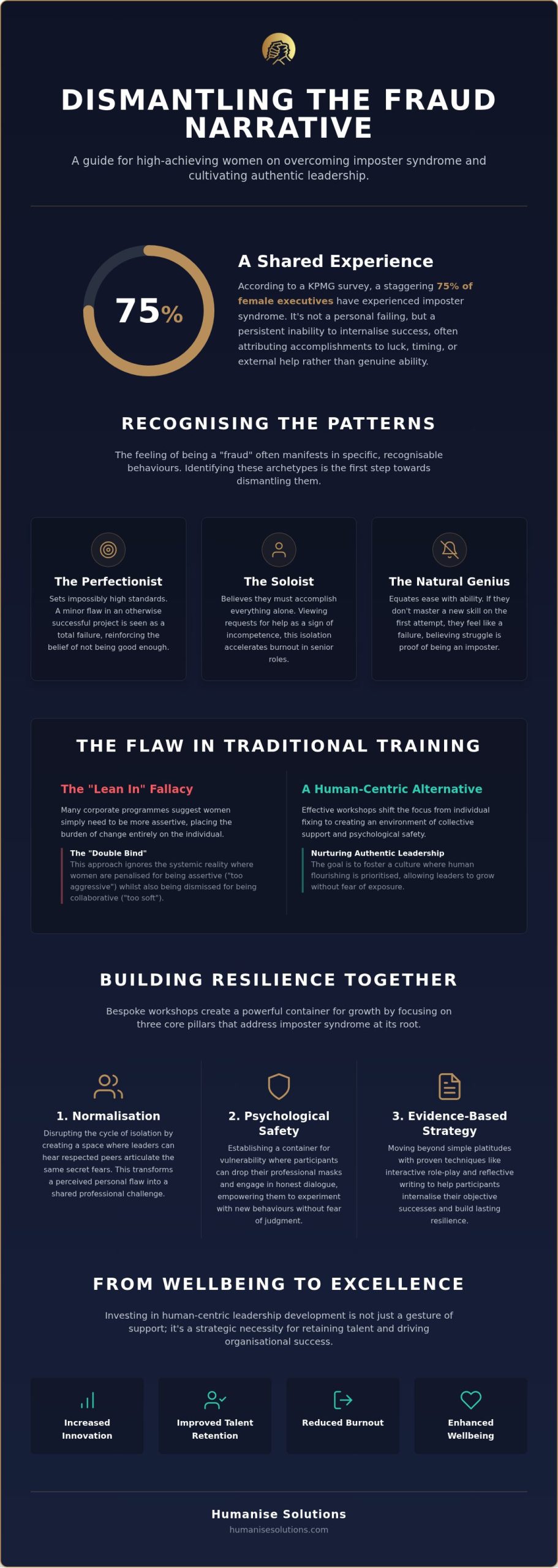
According to a KPMG survey, 75% of female executives have experienced imposter syndrome at some point in their careers. It’s a startling figure that reveals how even the most accomplished professionals often feel they’re just one mistake away from being exposed as a fraud. You likely recognise the exhausting cycle of over-preparing to avoid scrutiny and the quiet isolation that frequently haunts senior roles. When generic corporate training fails to reach the heart of these challenges, bespoke imposter syndrome workshops for women leaders provide a necessary, human-centric alternative.
We believe that your success shouldn’t come at the cost of your psychological wellbeing. You deserve a professional space where vulnerability is met with evidence-based strategy rather than simple platitudes. In this article, you’ll discover how to dismantle the fraud narrative and cultivate authentic leadership through workshops that prioritise human flourishing. We will explore how to move beyond individual fixes to address systemic triggers, providing a clear roadmap for fostering long-term resilience and team excellence within your organisation.
Key Takeaways
- Understand how systemic biases and external pressures contribute to the persistent feeling of being a fraud amongst high-achieving women.
- Learn how to design imposter syndrome workshops for women leaders that prioritise the power of normalisation and collective support over generic corporate advice.
- Identify the core components of evidence-based training, including interactive role-play and reflective writing, to help participants internalise their objective successes.
- Discover practical strategies for securing executive buy-in by linking leadership development to improved employee retention and long-term psychological wellbeing.
- Explore a bespoke approach to nurturing leadership that focuses on human flourishing and authentic growth rather than a rigid checklist of professional traits.
What is Imposter Syndrome in Women Leaders?
Imposter syndrome isn’t merely a lack of confidence; it’s a persistent inability to internalise success. Even when the evidence of achievement is overwhelming, high-achieving women often attribute their accomplishments to luck, timing, or external help. To understand What is Imposter Syndrome, we must look beyond the individual psychological experience and consider the systemic landscape women navigate daily. It’s a heavy burden. Women in leadership often find themselves in environments shaped by historical biases, where their presence is still treated as an exception rather than the rule.
Whilst healthy self-reflection helps us grow, debilitating self-doubt paralyses action. This internal friction creates a significant cost for organisations. When leaders feel like frauds, they’re less likely to innovate, negotiate, or take the bold risks necessary for progress. This leads to a cycle of over-working and eventual burnout. Investing in imposter syndrome workshops for women leaders is not just a gesture of support; it’s a strategic necessity for retaining top-tier talent and fostering team excellence.
The Archetypes of Imposter Syndrome
The experience of feeling like a “fraud” often manifests in specific patterns of behaviour. Recognising these archetypes is the first step toward dismantling them:
- The Perfectionist: They set impossibly high standards for themselves. Even a minor flaw in a successful project feels like a total failure, reinforcing the narrative that they aren’t good enough.
- The Soloist: Driven by the belief that they must accomplish everything alone, they view asking for help as a sign of incompetence. This isolation often accelerates burnout in senior roles.
- The Natural Genius: If they don’t master a new skill or reach a goal on the first attempt, they feel like a failure. They equate ease with ability, assuming that struggle is proof of being an imposter.
Why Traditional Leadership Training Often Fails Women
Many corporate programmes rely on a “lean in” philosophy. This approach suggests that women simply need to be more assertive or confident, effectively placing the burden of change entirely on the individual. It ignores the “Double Bind,” a systemic reality where women are often penalised for being assertive whilst simultaneously being dismissed for being too soft. It’s a lose-lose scenario that generic training rarely addresses.
Traditional skill-based workshops often miss the underlying psychological safety required for genuine growth. We need a shift toward nurturing leadership that centres on the human experience. By choosing imposter syndrome workshops for women leaders that focus on human-centric growth rather than just skill acquisition, organisations can create a culture where authentic leadership is allowed to flourish without the fear of exposure. Truly empowering women in the workplace requires this deliberate shift in organisational culture, moving well beyond surface-level policy updates to address the deeper systemic barriers that hold talented leaders back.
Why Workshops are Essential for Overcoming Leadership Self-Doubt
Isolation is a silent confidence killer. In senior roles, the internal narrative of being a “fraud” is often reinforced by the physical reality of being the only woman in the boardroom. This isolation creates a vacuum where self-doubt thrives, unchecked by reality. Collective workshops disrupt this cycle by introducing the power of normalisation. When leaders hear their peers, women they respect and admire, articulate the same secret fears, the “fraud” narrative begins to crumble. It’s a profound shift from feeling uniquely flawed to recognising a shared professional challenge.
These sessions move beyond individual “cures” and instead focus on collective organisational excellence. By implementing leadership training that addresses these psychological hurdles, companies can foster an environment where talent is fully realised rather than suppressed by anxiety. It’s about creating a culture where excellence and wellbeing coexist naturally.
The Role of Psychological Safety in Learning
Psychological safety is the bedrock of any successful development programme. It’s the belief that one won’t be punished or humiliated for speaking up with ideas, questions, or mistakes. In imposter syndrome workshops for women leaders, we create a deliberate “container” for vulnerability. This safe space allows participants to drop their professional masks and engage in honest dialogue. When safety is established, leaders feel empowered to take calculated risks and experiment with new behaviours, which is the essential spark for innovative leadership and sustainable growth.
Peer Mentoring and Shared Resilience
Peer-to-peer support often carries more weight than top-down instruction because it’s rooted in lived experience. We utilise “action learning sets” within our workshop structures, where leaders work through real-time challenges amongst a trusted circle of colleagues. This process helps develop a shared vocabulary to describe and dismantle imposter feelings. By building this community of practice, organisations can transition toward nurturing leadership that values long-term wellbeing as much as performance. This collective resilience ensures that when self-doubt inevitably whispers, the leader has a community to remind her of her objective worth.
Core Components of Effective Imposter Syndrome Workshops
Effective training isn’t found in a dusty binder or a generic set of slides. It requires a sophisticated blend of psychological research and leadership theory. When designing the Core Components of Effective Imposter Syndrome Workshops, the focus must be on bespoke tailoring. A traditional professional services firm faces different cultural pressures than a dynamic digital enterprise. By rooting the content in the specific challenges of your organisation, the workshop becomes a mirror for growth rather than a detached lecture. This relevance is what allows leaders to truly engage with the material.
Transformation happens through active participation. We move beyond static presentations to incorporate role-play and reflective writing. These interactive elements allow participants to practise new behaviours in real-time within a supportive environment. Every session concludes with action-oriented outcomes. No one leaves without a concrete growth plan. This ensures the insights gained aren’t lost in the Monday morning rush but are instead integrated into daily professional life.
Navigating the Internal Narrative
We all have a voice inside that occasionally questions our worth. In our imposter syndrome workshops for women leaders, we teach techniques to reframe that inner critic into a constructive internal coach. Cognitive reframing is the psychological process of identifying, challenging, and changing negative thought patterns into more balanced and realistic perspectives. Leaders also learn mindfulness and grounding techniques. These tools are vital for managing high-stakes anxiety during board meetings or difficult negotiations, allowing for a calm and centred presence.
Dismantling Systemic Barriers in the Workplace
It’s a mistake to treat imposter syndrome as purely an individual flaw. We must identify how organisational structures, such as opaque promotion criteria or biased feedback loops, reinforce these feelings in women. Leaders are encouraged to advocate for more inclusive team cultures that value diverse perspectives and styles. By championing a model of nurturing leadership, we create a powerful counter-narrative to the aggressive models that often trigger self-doubt. This shift fosters an environment where sustainable growth and team excellence can thrive without the shadow of “fraudulence” looming over high achievers.
How to Implement Leadership Training for Women in Your Organisation
Implementing imposter syndrome workshops for women leaders requires a fundamental shift in perspective. It’s not about remedial training for “broken” individuals; it’s about unlocking the latent power of your high-potential talent. To secure executive buy-in, you must link these initiatives to tangible outcomes like employee retention and overall wellbeing. When leadership feels like a burden of “faking it,” burnout is inevitable. By presenting these workshops as a tool for sustainable growth, you position them as a strategic investment in the firm’s future.
Success depends on how you frame the invitation. Participants should be selected based on their readiness for growth rather than a perceived lack of confidence. Partnering with a specialist consultant ensures the curriculum is bespoke to your firm’s unique culture. Measurement shouldn’t stop at post-session surveys. Instead, look for long-term behaviour changes, such as increased participation in high-stakes projects or a rise in internal promotion applications. If you’re ready to transform your culture, explore how our Women leadership programmes can support your goals.
Step 1: Identifying the Specific Needs of Your Leaders
Start by listening. Conduct anonymous surveys or focus groups to gauge the prevalence of self-doubt within your senior ranks. This data allows you to map workshop goals directly to your firm’s broader leadership development strategy. When training feels relevant to a leader’s daily reality, it quickly becomes a favourite part of the L&D calendar. It should feel like a gift of time and space, not another item on a growing to-do list.
Step 2: Choosing the Right Workshop Format
The format must match your organisational rhythm. One-day intensives provide a powerful catalyst for change, creating immediate momentum. In contrast, modular, long-term programmes allow for deeper reflection and the integration of new habits over several months. Whilst virtual delivery is pragmatic for global teams, in-person sessions often build a deeper sense of psychological safety and connection. Integrating these workshops into existing women in leadership initiatives ensures they aren’t seen as isolated events but as part of a cohesive journey toward authentic excellence.
The Humanise Solutions Approach: Nurturing Authentic Leadership
At Humanise Solutions, we believe that leadership is far more than a checklist of professional traits or a series of tactical skills. It is a profound journey of human flourishing. Our philosophy is rooted in the understanding that when leaders thrive as whole people, their organisations thrive too. This is why our imposter syndrome workshops for women leaders are never off-the-shelf. We reject the sterile, one-size-fits-all approach of traditional consulting in favour of bespoke curriculum design that centres the unique cultural challenges and systemic barriers within your specific organisation. Our bespoke imposter syndrome workshops for women leaders bridge the gap between deep psychological insight and the practical demands of corporate excellence, ensuring that growth is both meaningful and sustainable.
Nurturing Leadership Through Empathy and Evidence
Our commitment to evidence-based methodologies ensures that our programmes deliver a measurable return on investment whilst prioritising the human experience. We don’t just talk about confidence; we use logic and methodology to dismantle the internal narratives that hold talent back. By focusing on Team Excellence and Fostering Wellbeing, we help firms cultivate inclusive environments where every leader feels a genuine sense of belonging. Our specialised Women leadership tracks are designed to transform organisational culture from the inside out, moving away from high-pressure tactics toward a model of nurturing leadership that supports long-term resilience and psychological safety. We believe that a leader’s internal world is just as important as her external performance.
Partnering for Lasting Change
Meaningful change takes time and care. We don’t believe in the “hit and run” style of consulting that leaves a team inspired for a day but unsupported for the year. Instead, we position ourselves as a visionary guide and a grounded expert, acting as a partner in your long-term development journey. Our approach creates a rhythmic flow of growth, providing steady, deliberate support that mirrors our commitment to sustainable progress. We help you move from the current state of isolation and self-doubt to a future of authentic, high-reaching potential. This steady pace ensures that every participant feels supported and informed rather than overwhelmed by demands. If you’re ready to dismantle the fraud narrative and empower your senior talent, Contact Humanise Solutions to start your leadership journey today.
Cultivating the Future of Authentic Leadership
Dismantling the “fraud” narrative is a vital step toward creating a culture of human flourishing within your organisation. We’ve explored how imposter syndrome workshops for women leaders shift the focus from individual pathology to collective resilience, ensuring that success is internalised rather than dismissed as luck. By prioritising psychological safety and evidence-based strategies, you can turn silent self-doubt into a powerful catalyst for authentic growth. It’s about moving beyond generic corporate checklists to embrace a model of nurturing leadership that values vulnerability as much as objective excellence.
Our expert-led consultancy specialises in human flourishing, delivering bespoke programmes specifically designed for the unique landscape of UK firms. We don’t just offer training; we partner with you to ensure sustainable growth and long-term psychological well-being for your senior talent. You don’t have to navigate this cultural transformation alone. Our focus remains rooted in logic and methodology, ensuring that every step toward development is both grounded and aspirational.
Explore our bespoke Women in Leadership programmes to begin nurturing the untapped potential within your senior teams today. Your leaders are ready to flourish, and we’re here to guide the way.
Frequently Asked Questions
Is imposter syndrome a mental health condition?
Imposter syndrome is not a clinical mental health condition or a formal psychiatric diagnosis. It is a psychological phenomenon where high achievers are unable to internalise their successes, often attributing them to luck or timing. Whilst it isn’t a disorder, it frequently correlates with anxiety and burnout, making it a critical area for professional development rather than clinical treatment.
How do imposter syndrome workshops differ from standard leadership training?
Standard leadership training often focuses on external skill acquisition, such as strategic planning or financial literacy. In contrast, imposter syndrome workshops for women leaders address the internal psychological barriers that prevent those skills from being fully utilised. These sessions prioritise psychological safety and cognitive reframing, helping leaders dismantle the “fraud” narrative to foster authentic excellence.
Can men attend imposter syndrome workshops for women leaders?
Whilst imposter syndrome affects all genders, these specific workshops are designed as dedicated safe spaces to address the unique systemic biases women face in the UK workforce. Creating a gender-specific environment allows for deeper vulnerability and shared experience. We also offer broader programmes that help all leaders understand how to support their colleagues and foster inclusive team excellence.
What is the best way to measure the success of a leadership workshop?
Success is best measured through long-term behaviour changes rather than immediate post-session feedback. You should track metrics such as increased participation in high-stakes projects, higher rates of internal promotion applications amongst women, and improved scores in employee engagement surveys. These tangible shifts indicate that the workshop has successfully fostered a culture of sustainable growth and confidence.
How long does it typically take to see changes in leadership behaviour?
You’ll often notice an immediate shift in awareness and vocabulary as leaders begin to name their self-doubt. However, meaningful habit formation and the dismantling of long-standing internal narratives typically take between three to six months of consistent practice. This is why we advocate for a rhythmic flow of development rather than one-off sessions to ensure lasting transformation.
What happens if a leader is reluctant to participate in a vulnerability-focused workshop?
Reluctance is often a symptom of the very self-doubt the workshop aims to address. We manage this by leading with evidence-based logic and methodology to build trust from the outset. By normalising the experience of feeling like a “fraud,” we lower the perceived risk of participation, allowing even the most guarded leaders to engage at their own pace.
Are virtual workshops as effective as in-person sessions for addressing self-doubt?
Virtual imposter syndrome workshops for women leaders are highly effective when they utilise interactive tools and small breakout groups to maintain engagement. Whilst in-person sessions offer a unique depth of physical presence and safety, virtual delivery provides a pragmatic solution for global teams. Both formats successfully bridge the gap between psychological insight and corporate performance when designed with a human-centric focus.
How can we ensure the workshop leads to long-term employee retention?
Long-term retention is secured when the workshop is integrated into a broader commitment to fostering wellbeing. By equipping women with the tools to manage self-doubt, you reduce the exhaustion associated with “masking” and over-working. When leaders feel seen, supported, and psychologically safe, they’re far more likely to remain committed to an organisation that values their human flourishing.
