Article by
Scott Ward MBA CCMI
Scott Ward is the founder and CEO of Humanise Solutions, which he established three years ago to help organisations elevate their people, leadership and culture through a human-centric, evidence-based approach. Before moving into business and academia, Scott spent seven years as a professional footballer, playing for Luton Town, Crawley Town and Coventry City FC until injury brought his playing career to a close — a turning point that shaped both his research interests and his approach to leadership.
Scott holds an MBA from Warwick Business School, where his research explored the causal relationship between trauma and decision-making — work that continues to inform how he supports young adults, leaders and teams under pressure. Recognised as a Companion of the Chartered Management Institute (CCMI), its highest grade of membership, he combines academic rigour with the discipline, resilience and team-first mindset of the professional game. At the heart of everything he does is a simple belief: that people perform at their best when they are led, developed and valued as human beings first.
What if the high turnover rate amongst Gen Z isn’t a sign of a “difficult” generation, but rather a symptom of a corporate world that has forgotten how to mentor? You’ve likely noticed that many new starters arrive with impressive degrees yet struggle with the emotional intelligence and resilience needed for the daily rhythm of professional life. It’s frustrating when traditional training feels sterile and fails to spark genuine engagement in your newest recruits. A bespoke young adult professional development programme offers a different path, focusing on the human elements of growth that technical qualifications often overlook.
We understand that you want more than just a productive employee; you want a future leader who feels deeply connected to your mission. This guide explores how a human-centric approach can bridge the gap between education and career excellence for the next generation of leaders. We’ll look at how nurturing soft skills and psychological safety leads to sustainable organisational growth and an inclusive team culture where every young professional can flourish. By shifting the focus from mere competency to holistic flourishing, you can build a workforce that is both resilient and ready to lead.
Key Takeaways
- Learn why a modern young adult professional development programme must be a continuous journey rooted in psychological safety rather than a sterile, one-off workshop.
- Understand the tangible ROI of prioritising human-centric growth, including improved employee retention and a more innovative, inclusive team culture.
- Discover the essential role of bespoke mentoring and coaching in bridging the gap between academic theory and professional excellence.
- Gain a practical checklist for evaluating providers, focusing on bespoke programme design and meaningful behavioural change over simple completion metrics.
- Explore how nurturing soft skills and emotional intelligence creates a resilient workforce capable of driving long-term organisational sustainability.
What is a Young Adult Professional Development Programme in 2026?
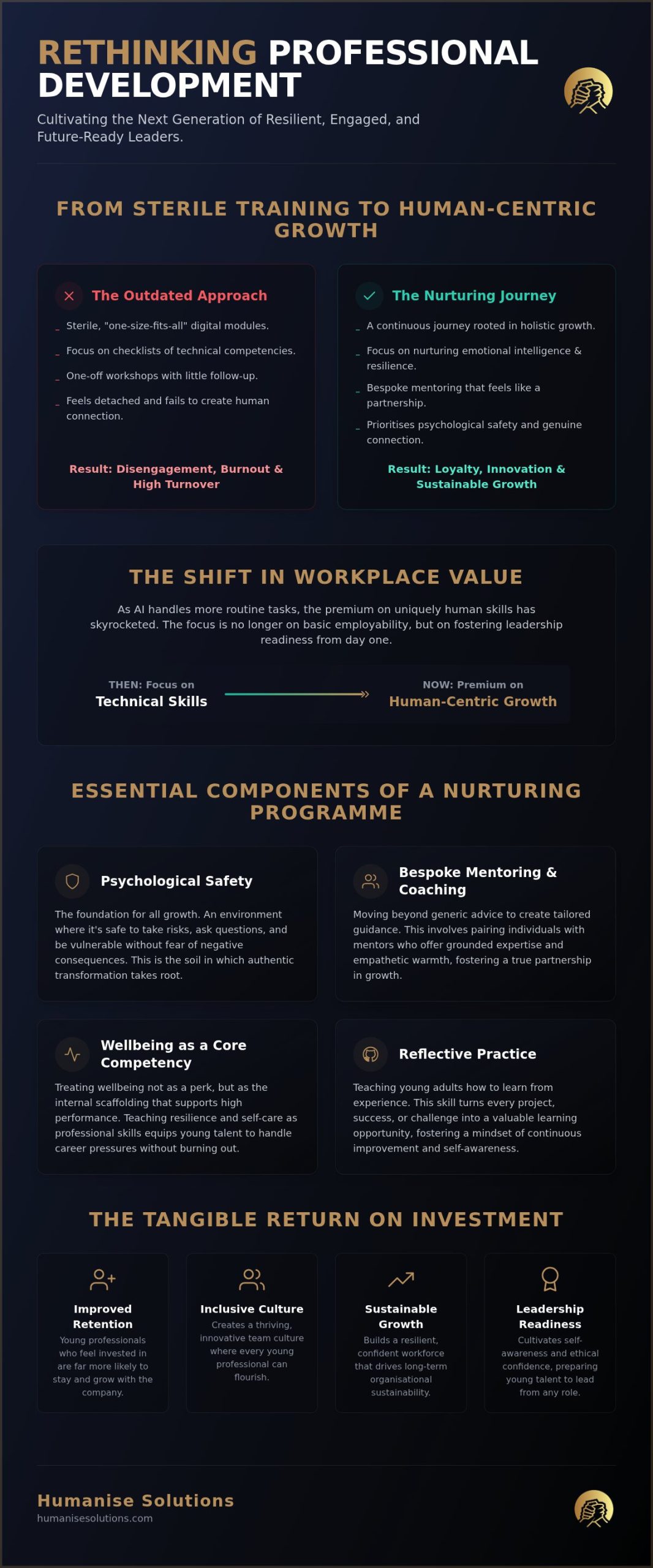
In 2026, the definition of a young adult professional development programme has shifted from a series of tasks to a philosophy of growth. It’s no longer a collection of one-off workshops or a simple checklist of technical competencies. Instead, it has become a holistic journey. This journey focuses on nurturing the internal qualities that allow a person to flourish within a complex, often automated workplace. Whilst technical on-boarding teaches a new starter how to use your systems, human-centric development teaches them how to navigate social dynamics, manage their own wellbeing, and contribute meaningfully to a team culture.
As AI handles more routine tasks, the premium on emotional intelligence has skyrocketed. Organisations that prioritise these programmes see a direct impact on long-term loyalty and organisational health. When a young adult feels that their employer is invested in their personal growth, not just their output, they’re far more likely to stay. This creates a cycle of sustainable growth driven by a resilient, confident workforce that feels valued from day one. It’s about moving beyond “getting the job done” to understanding the human impact of every professional interaction.
The Shift from “Employability” to “Leadership Readiness”
Basic employability skills are now the bare minimum for competitive UK industries. To truly thrive, young professionals need to move from passive learning to active, nurtured participation. This means engaging in bespoke programmes that challenge them to think critically rather than just following instructions. Leadership readiness in a young adult context is the cultivation of self-awareness, emotional resilience, and the ethical confidence to influence others regardless of their formal job title.
Why Traditional Corporate Training Often Fails Gen Z
Many organisations still rely on sterile, “one-size-fits-all” digital modules that feel detached from the reality of the workplace. For Gen Z, these lack the human connection they crave. If a young person feels like a cog in a machine, they’ll quickly disengage and look for opportunities elsewhere. They need to feel “seen” and supported as individuals with unique potentials. Without this personal touch, even the most expensive training software fails to prevent early career burnout or high turnover. A truly effective young adult professional development programme must prioritise psychological safety and genuine human interaction to keep the next generation engaged and inspired.
Essential Components of a Nurturing Development Track
Safety is the soil in which growth takes root. Without psychological safety, even the most sophisticated training remains surface-level, as participants are too guarded to admit what they don’t know. A truly effective young adult professional development programme begins by creating an environment where it’s safe to take risks, ask questions, and fail. When young professionals feel secure, they’re more likely to engage deeply with the material and their colleagues, leading to the kind of authentic transformation that drives long-term success.
Mentoring shouldn’t be a generic “coffee chat” or a tick-box exercise. We believe in bespoke mentoring and coaching structures that are tailored to the individual’s specific career path and personal hurdles. This involves pairing young leaders with mentors who can offer grounded expertise whilst showing empathetic warmth. By focusing on young adult programmes that prioritise these human connections, organisations can ensure that guidance is both relevant and deeply impactful. It’s about building a relationship that feels like a partnership in growth rather than a top-down instruction.
Teaching young adults to learn from experience is a skill that lasts a lifetime. Reflective practice allows individuals to look back at a project or a challenging interaction and extract meaningful lessons. It turns every workday into a learning opportunity. Alongside this, we treat wellbeing as a core competency. It’s not an optional extra or a perks package; it’s the internal scaffolding that supports high performance. When resilience and self-care are taught as professional skills, young employees are better equipped to handle the pressures of a modern career without burning out.
Cultivating Emotional Intelligence and Resilience
The shift from academic life to professional accountability is often jarring. In university, feedback is a grade; in the office, it’s a conversation about impact. We provide tools for navigating workplace conflict and feedback with confidence, helping young adults build the emotional intelligence needed to manage their reactions. This internal development ensures they can maintain steady performance even when faced with the inevitable setbacks of a fast-paced environment.
Fostering Inclusive Leadership from Day One
Inclusive training acts as a powerful catalyst for social mobility. By encouraging diverse voices to lead early in their careers, companies can break down traditional barriers and foster a culture of team excellence. These programmes shouldn’t just talk about inclusion; they should actively empower young people from all backgrounds to see themselves as future leaders. This approach doesn’t just support the individual; it enriches the entire organisation by bringing a wider range of perspectives to the table.
Technical Skills vs. Human-Centric Growth: Finding the Balance
While technical proficiency provides the foundation for any career, the “human element” often proves the most challenging aspect to master in the early years. It’s relatively straightforward to teach someone how to use a CRM or manage a project budget. It’s far more complex to cultivate the self-awareness required to receive difficult feedback or the resilience to bounce back from a public mistake. This is why a modern young adult professional development programme must look beyond the screen and focus on the person behind it.
The return on investment for soft skills is both tangible and profound. Companies that prioritise emotional intelligence see higher retention rates because their young employees feel understood and supported rather than just managed. Innovation also flourishes in these environments. When people feel psychologically safe, they’re more likely to voice unconventional ideas that lead to breakthroughs. We often see that human-centric growth doesn’t just sit alongside technical skill; it actively accelerates it. A professional who knows how to ask the right questions and collaborate effectively will always master new software faster than one who works in a silo of anxiety.
We must also consider the shelf life of our investments. Technical knowledge is often ephemeral; software updates and industry shifts can render hard skills obsolete within a few years. Leadership character, however, is a permanent asset. It’s the internal compass that guides a professional through every promotion and career pivot they will ever make. By investing in the human being, you’re building a foundation that won’t crumble when the next technological disruption arrives.
The Multiplier Effect of Nurturing Leadership
A confident young professional doesn’t just do their own job better; they elevate everyone around them. By communicating clearly and managing their own wellbeing, they reduce the emotional friction that often slows down departments. Psychological safety acts as a high-speed conductor for technical learning, allowing new starters to absorb complex information faster because their brains aren’t stuck in a “fight or flight” response to perceived social threats. This ripple effect ensures that departmental productivity rises as confidence grows.
Bridging the Social Mobility Gap
Many young adults enter the workforce without a map for the “unwritten rules” of the corporate world. They might lack the professional network or the specific social vocabulary that their more privileged peers take for granted. Bespoke programmes level this playing field by explicitly teaching these nuances and building genuine confidence. For UK firms in 2026, social mobility is a significant strategic advantage. It taps into a wider pool of talent and perspective, ensuring that team excellence is built on a foundation of diverse experience rather than just shared backgrounds. Organisations looking to deepen this commitment may also benefit from exploring a graduate leadership development programme UK that places human-centric growth at its core.
Evaluating a Programme: What L&D Leaders Must Look For
Choosing a young adult professional development programme is a high-stakes decision for any L&D leader. It’s not just about filling a training calendar; it’s about setting the cultural tone for your next generation of talent. The first question you should ask is whether the provider offers a bespoke design or merely off-the-shelf content. Generic modules often feel like a box-ticking exercise, lacking the nuance required to address your organisation’s specific challenges. A truly effective programme is built from the ground up, reflecting your unique values and the specific needs of your young professionals.
We must also look at how success is measured. High completion rates on a digital platform don’t necessarily equate to genuine behavioural change. If a programme focuses solely on data points, it misses the human element. You need to look for evidence of increased confidence, better conflict resolution, and a deeper commitment to the team. This requires a clear focus on psychological wellbeing and long-term growth rather than short-term technical gains. Delivery matters too. Automated platforms can’t replace the dynamic energy of expert-led workshops where real human interaction and peer-to-peer learning take place.
Measuring the Impact on Employee Retention
There’s a clear link between thoughtful development and a young person’s desire to stay with a firm. When employees feel nurtured, their loyalty grows naturally. To gauge this success, move beyond quantitative data and use qualitative feedback. Ask your participants how they feel about their future at the company. Are they more resilient? Do they feel supported as individuals? These are the long-term metrics that define early career success and sustainable organisational health.
Selecting a Growth Partner, Not Just a Vendor
You need a partner who understands that meaningful change takes time and care. A specialist Leadership development consultant doesn’t just deliver a curriculum; they become an extension of your team. They should bring an evidence-based methodology that balances idealistic goals with pragmatic steps. This collaborative approach ensures the training remains rooted in logic whilst aspiring to human flourishing. If you’re ready to transform your workforce and foster genuine excellence, we invite you to discover our bespoke young adult programmes today.
The Humanise Solutions Approach: Cultivating Future Leaders
At Humanise Solutions, we don’t believe in simply filling knowledge gaps. We believe in nurturing the whole person. Our young adult professional development programme is designed as a sophisticated partnership that moves beyond the sterile delivery of traditional consulting. We focus on the transition from current states to future potential, ensuring that every workshop and coaching session feels deeply invested in human flourishing. By blending empathetic warmth with evidence-based confidence, we help young leaders find their voice whilst providing the logical framework they need to succeed.
Every track we create is bespoke. We reject the “one-size-fits-all” model because your organisation’s culture is unique. Our expert-led training workshops are built to integrate wellbeing and team excellence into the very fabric of the learning journey. This isn’t just about making people feel better; it’s about creating a sustainable foundation for high performance. When a young professional understands how to manage their internal resilience and contribute to an inclusive culture, they become a long-term asset rather than a flight risk. Our young adult professional development programme ensures that this growth is methodical, thorough, and rooted in human values.
Transforming Young Talent into Organisational Assets
We’ve seen how targeted support can turn a hesitant new starter into a resilient leader. Our programmes build lasting confidence by giving young adults the tools to navigate the complexities of the modern workplace. We place a high premium on creating inclusive environments where every individual feels they can flourish regardless of their background. The Humanise “Signature” is this exact blend of warmth, logic, and evidence-based results. It’s a methodical approach that ensures the growth we cultivate is both profound and permanent.
Start Your Journey of Human-Centric Growth
The 2026 workplace is evolving rapidly, and the cost of disengagement amongst early career talent has never been higher. Now is the time to reinvest in your young professionals, moving away from sterile modules and towards a more humanised approach. Partnering with us means choosing a guide that values psychological wellbeing as much as professional output. We work closely with you to design a journey that supports your strategic goals whilst honouring the individual needs of your team. If you’re ready to foster a culture of excellence and social mobility, enquire about our Young Adult Programmes today to begin the transformation.
Cultivating the Next Generation of Leaders
Nurturing young talent is a profound investment in the long-term vitality of your organisation. We’ve explored how moving away from sterile, traditional training towards a human-centric young adult professional development programme can transform new starters into resilient, confident leaders. By prioritising psychological safety and emotional intelligence, you don’t just improve retention; you foster an inclusive culture where innovation thrives naturally.
Meaningful growth requires a partner who understands the nuance of the human experience within a professional context. Our expert-led training workshops and dedicated tracks for nurturing leadership provide the internal scaffolding your team needs to flourish in a complex workplace. It’s about bridging the gap between education and excellence through steady, methodical care. Discover our bespoke Young Adult Programmes for your organisation and start building a workforce ready for the challenges of tomorrow. Your commitment to their potential today is the foundation of your collective success in the future.
Frequently Asked Questions
What is the ideal length for a young adult professional development programme?
Six to twelve months is generally the ideal duration for a young adult professional development programme to achieve lasting behavioural change. This timeframe allows for learning to happen in the flow of work, moving beyond the short-lived “spark” of a one-off workshop. It provides enough space for participants to practice new skills, reflect on their experiences, and embed resilient habits into their daily professional lives.
How can development programmes improve Gen Z employee retention?
These programmes improve retention by addressing the specific desire for growth and human connection that defines Gen Z. When young professionals feel their employer is invested in their psychological well-being and leadership potential, their loyalty to the organisation increases. By teaching emotional intelligence and conflict resolution, you give them the tools to navigate workplace challenges that might otherwise lead to early resignation.
Do these programmes support social mobility within the workplace?
Yes, inclusive programmes act as a vital bridge for social mobility by decoding the “unwritten rules” of the corporate world. They provide a level playing field where young adults from all backgrounds can develop the confidence and social vocabulary needed for leadership. This ensures that career progression is based on nurtured potential rather than just prior social capital or academic pedigree.
What is the difference between a graduate scheme and a professional development programme?
A graduate scheme typically focuses on technical rotations and vocational work-readiness, whereas a professional development programme prioritises holistic leadership character and emotional resilience. While grad schemes help new starters understand the business, development programmes focus on the human flourishing required to lead within it. It’s the difference between learning how to do a job and learning how to thrive in a career. For a deeper look at how these two approaches can be integrated, explore our guide on the future of the graduate leadership development programme in the UK.
How do you measure the ROI of human-centric leadership training?
You can measure ROI through tangible metrics like reduced recruitment costs and higher internal promotion rates amongst your young talent. However, the most valuable data often comes from qualitative shifts, such as improved scores in team excellence and psychological safety surveys. In 2026, many firms are using these data-driven insights to show how “power skills” like collaboration directly accelerate departmental productivity.
Can professional development programmes be delivered remotely whilst maintaining impact?
Remote delivery is highly effective provided the programme remains interactive and cohort-based rather than relying on sterile, self-paced modules. Impact is maintained through expert-led virtual workshops that prioritise genuine human connection and peer-to-peer dialogue. The key is ensuring that the technology facilitates the relationship rather than becoming a barrier to the empathetic warmth required for growth.
What role does psychological safety play in early career training?
Psychological safety is the essential foundation for all early career learning. Without it, young professionals are often too guarded to admit mistakes or ask the vulnerable questions necessary for growth. When a programme creates a safe environment, it unlocks the ability to take risks and think critically, which are the primary drivers of innovation and leadership readiness.
How do I choose between a bespoke programme and a standard training course?
Choose a bespoke programme if you want to drive long-term cultural change that aligns with your organisation’s unique values. Standard courses often feel detached and fail to address the specific social dynamics of your team. A bespoke approach ensures the content is relevant and deeply resonant, which is far more likely to result in the sustainable growth of your future leaders.