Article by
Scott Ward MBA CCMI
Scott Ward is the founder and CEO of Humanise Solutions, which he established three years ago to help organisations elevate their people, leadership and culture through a human-centric, evidence-based approach. Before moving into business and academia, Scott spent seven years as a professional footballer, playing for Luton Town, Crawley Town and Coventry City FC until injury brought his playing career to a close — a turning point that shaped both his research interests and his approach to leadership.
Scott holds an MBA from Warwick Business School, where his research explored the causal relationship between trauma and decision-making — work that continues to inform how he supports young adults, leaders and teams under pressure. Recognised as a Companion of the Chartered Management Institute (CCMI), its highest grade of membership, he combines academic rigour with the discipline, resilience and team-first mindset of the professional game. At the heart of everything he does is a simple belief: that people perform at their best when they are led, developed and valued as human beings first.
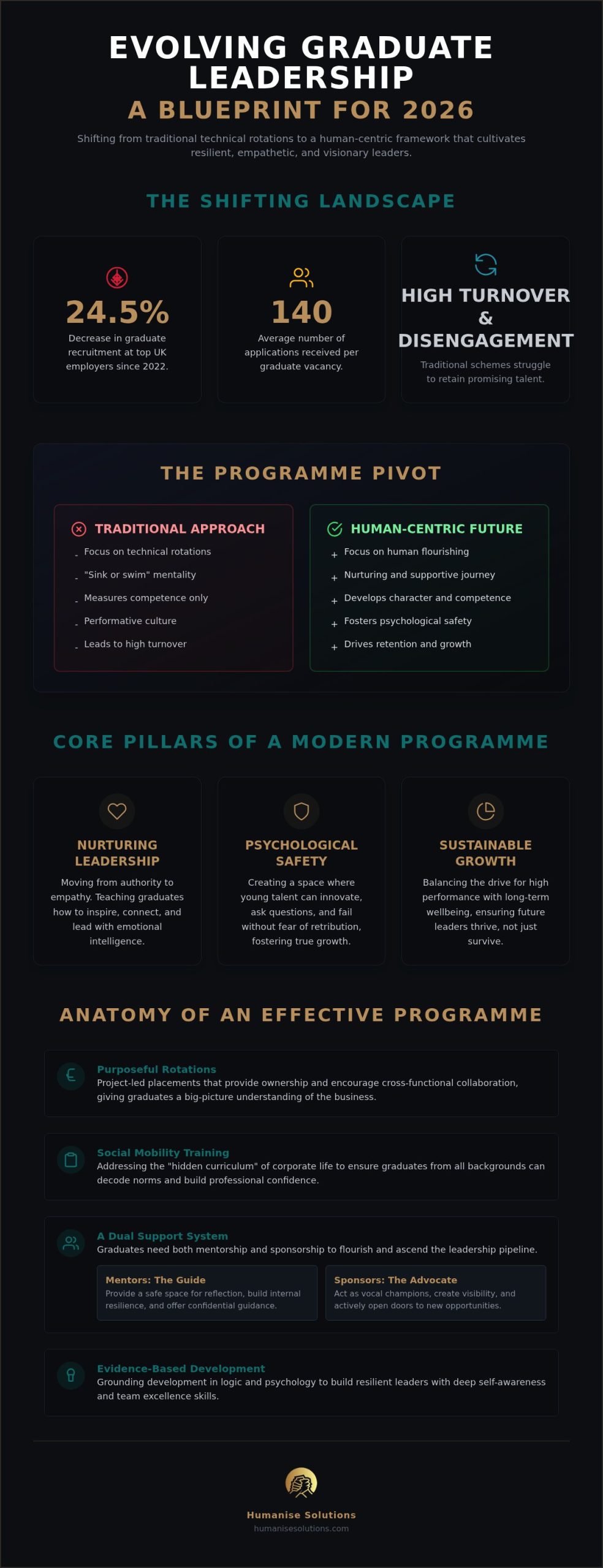
With graduate recruitment at top UK employers falling by 24.5% since 2022, the competition for the brightest minds has reached a fever pitch. Employers now receive an average of 140 applications per vacancy, yet many find that traditional schemes fail to keep new hires engaged. You’ve likely noticed that a standard graduate leadership development programme uk often struggles with high turnover and a lack of diversity in the pipeline. It’s frustrating to watch promising talent drift away because they feel disconnected from the corporate culture or overwhelmed by the pressure of a shifting economic climate.
The most successful organisations in 2026 will be those that pivot from purely technical rotations to a deeply human-centric approach. This guide will show you how to evolve your strategy to prioritise social mobility, psychological wellbeing, and genuine human growth. We’ll explore how to build resilient, empathetic leaders who are equipped for an AI-augmented world whilst ensuring your talent pipeline remains diverse and sustainable for the long term. By focusing on the person behind the professional, you can create a legacy of leadership that truly thrives.
Key Takeaways
- Understand why a modern graduate leadership development programme uk must pivot from technical rotations to a framework that prioritises human flourishing and psychological safety.
- Learn how to bridge the social mobility gap by addressing the “hidden curriculum” of corporate life, ensuring first-generation graduates have the support to navigate and excel.
- Discover how to integrate wellbeing into your curriculum through a structured audit and the implementation of mental health resilience training.
- Recognise the role of evidence-based leadership modules in fostering the self-awareness and team excellence required for sustainable organisational growth.
- Shift your perspective to see leadership development as a nurturing journey that transforms young talent into empathetic, visionary future leaders.
What defines a Graduate Leadership Development Programme in 2026?
In the current UK professional climate, a graduate leadership development programme uk is no longer just a series of departmental rotations. It has evolved into a structured framework designed to transition high-potential graduates into future management roles through a deliberate focus on character as much as competence. A modern graduate programme is the intentional blend of professional technical skill and profound emotional intelligence. This shift reflects a broader understanding that the leaders of tomorrow must be as resilient and empathetic as they are capable in their specific fields.
We’re seeing a profound movement across the UK market. Organisations are moving away from sterile training modules and towards a philosophy of nurturing. This approach recognises that true leadership development principles are rooted in the long-term cultivation of the individual. Instead of merely teaching graduates how to perform tasks, a human-centric programme fosters the internal qualities that allow talent to flourish. It’s about moving beyond the “what” of business and diving into the “how” of human connection, creating a more sustainable foundation for organisational growth.
The evolution of graduate expectations
Gen Z employees are redefining the workplace. They don’t just want a competitive salary; they’re looking for purpose, genuine inclusivity, and a commitment to their wellbeing. The old “sink or swim” mentality that once defined corporate entry is being replaced by a demand for supportive, psychologically safe environments. In 2026, a graduate leadership development programme uk that ignores these needs will struggle to retain talent. Young professionals are savvy. They can spot a performative culture quickly and will choose organisations that offer authentic development over those that simply offer a title.
Core pillars of a human-centric programme
To succeed, a programme must stand on three essential pillars. First, nurturing leadership moves the needle from traditional authority to empathy, teaching graduates how to inspire others rather than just direct them. Second, psychological safety is vital. It creates a space where graduates feel safe to innovate, ask questions, and even fail without fear of retribution. Finally, we must prioritise sustainable growth. This means balancing the drive for high performance with a focus on long-term wellbeing. It ensures that our future leaders don’t burn out before they’ve even begun to lead, fostering a culture of excellence that lasts.
The anatomy of an effective UK Graduate Programme
Designing a high-impact graduate leadership development programme uk requires more than a calendar of events. It demands a skeletal structure where every rotation, workshop, and conversation serves a specific purpose in the individual’s growth. An effective programme provides a holistic view of the organisation, allowing young talent to see how disparate departments connect to form a cohesive whole. This isn’t just about technical exposure. It’s about integrating social mobility training that supports young adults from underrepresented backgrounds as they learn to decode corporate norms and build professional confidence.
One critical distinction often missed is the difference between mentorship and sponsorship. Whilst a mentor provides a safe space for reflection and guidance, a sponsor acts as a vocal advocate within the leadership circle. Graduates need both to flourish. A mentor nurtures their internal resilience; a sponsor opens the physical doors to opportunity. This dual support system ensures that high-potential hires don’t just survive their first few years but actively ascend the pipeline with the backing of the wider business.
Rotational placements with purpose
Rotations should never feel like a “temporary help” service for understaffed departments. To build a big picture understanding, each placement must have clear objectives that develop niche skills whilst contributing to the wider business mission. When graduates are given ownership of meaningful projects, they add real value from day one. This project-led approach encourages cross-functional collaboration, which is the bedrock of building team excellence. It allows them to see the ripple effects of their decisions across the company, fostering a sense of accountability and pride.
Evidence-based leadership development
We believe in grounding development in logic and psychology. Utilising evidence-based frameworks helps build resilient young leaders who can handle the complexities of modern business. This involves moving beyond basic management tasks to focus on self-awareness and active listening. Much like the academic rigour found in postgraduate leadership training, corporate programmes should challenge graduates to think critically about their impact on others.
Soft skills like conflict resolution and empathy are often the hardest to master, yet they’re the most vital for long-term success. By mentoring Gen Z in the workplace with a focus on these human qualities, you prepare them for the emotional demands of leadership. If you’re looking to refine these elements within your own organisation, consider how you might nurture leadership through a more bespoke, person-centred lens.
Social mobility training: The missing link in graduate success
Hiring a diverse cohort is a significant milestone, but recruitment is merely the first step on the journey toward true equity. Many organisations celebrate their intake statistics only to find that retention amongst underrepresented groups remains stubbornly low. For a graduate leadership development programme uk to deliver on its promise, it must bridge the gap between entry and advancement. This requires a dedicated focus on social mobility training that goes beyond standard onboarding to address the systemic barriers that often go unspoken in corporate environments.
First-generation graduates frequently encounter what we call the “hidden curriculum” of professional life. These are the unwritten social codes, networking nuances, and cultural shorthand that peers from more privileged backgrounds may have absorbed since childhood. Without explicit guidance, even the most brilliant young minds can feel like they’re navigating a maze without a map. By demystifying these dynamics, you don’t just help graduates fit in; you empower them to bring their full, authentic selves to the table. This is how we build an equitable leadership pipeline that reflects the real world.
The return on investment for this approach is profound. When an organisation actively supports social mobility, it unlocks a wealth of cognitive diversity that drives innovation. It also slashes staff turnover. Graduates who feel seen, understood, and supported are far more likely to remain loyal to the business, ensuring that your investment in their early career pays dividends for years to come.
Bridging the talent gap
Graduates from lower socio-economic backgrounds often face unique psychological hurdles, such as imposter syndrome or a lack of professional “safety nets”. Creating an inclusive environment isn’t about lowering expectations; it’s about providing the specific scaffolding required to meet them. We focus on fostering a deep sense of belonging through deliberate organisational growth strategies. When young talent feels that their life experience is viewed as an asset rather than an obstacle, they’re more likely to innovate and contribute at their highest level.
Practical social mobility initiatives
Success in this area requires tangible action. We recommend confidence-building workshops that are specifically tailored for young adults entering the professional world for the first time. These sessions should cover everything from public speaking to the mechanics of high-level networking, effectively levelling the playing field. We also encourage senior leaders to act as “human” guides rather than distant figures of authority. When a director shares their own challenges and career pivots, it humanises the path to the top and makes leadership feel attainable for everyone.
Designing for wellbeing and retention
Retention isn’t just a metric; it’s a reflection of how well an organisation nurtures its people. For a graduate leadership development programme uk to be truly sustainable, wellbeing must be woven into its DNA rather than treated as a peripheral benefit. High turnover often stems from a disconnect between high expectations and the support provided to meet them. By following a structured approach, you can transform the graduate experience from a high-pressure gauntlet into a journey of supported growth. It requires a shift. By prioritising the human behind the hire, you build a culture that graduates want to stay in for the long term.
We recommend a five-step integration process to ensure wellbeing is a daily reality:
- Step 1: Conduct a wellbeing audit. Evaluate the current graduate experience to identify specific friction points and hidden stressors in their daily workflows.
- Step 2: Embed mental health resilience training. Make resilience a core part of the curriculum, teaching graduates the psychological tools to manage stress before it escalates.
- Step 3: Train managers to recognise burnout. Equip your leadership team with the emotional intelligence to spot early signs of withdrawal, fatigue, or decreased performance in early-career staff.
- Step 4: Create clear pathways for feedback. Establish a culture where open dialogue is encouraged and graduates feel safe to voice concerns without fear of judgment.
- Step 5: Measure the impact. Use data to track how wellbeing initiatives correlate with long-term retention rates and overall engagement scores.
Fostering wellbeing as a leadership skill
We must teach our future leaders that self-care is a prerequisite for leading others. A leader who is depleted cannot inspire excellence in their team. By framing wellbeing as a professional skill, you encourage a culture of sustainable growth where performance is balanced with health. This shift requires moving beyond “perks” like fruit bowls or gym memberships. True cultural wellbeing is about the quality of relationships, the clarity of expectations, and the permission to be human in a professional setting. It’s about building a foundation that lasts.
Addressing the burnout objection
There is a common misconception that “high-potential” must equal “high-stress”. This is a dangerous fallacy. In a fast-paced rotational environment, graduates often feel they must say “yes” to every demand to prove their worth. Setting healthy boundaries is essential for long-term success. An external perspective from an L&D consultancy can be invaluable here, providing an objective view of staff wellbeing that internal teams might overlook. If you want to build a more resilient workforce, it’s time to foster wellbeing as a core organisational value.
How Humanise Solutions cultivates future leaders
At Humanise Solutions, we believe that leadership is a journey of human flourishing rather than a mere destination reached through a checklist of tasks. When we partner with organisations to refine their graduate leadership development programme uk, we look far beyond the standard curriculum of technical rotations. Our philosophy is rooted in the belief that when individuals are nurtured as whole humans, their professional impact grows exponentially. We don’t offer off-the-shelf solutions because we recognise that every organisational culture has its own unique rhythm, challenges, and social dynamics. Instead, we design bespoke learning and development tracks that resonate with your specific values.
Our work is characterised by a sophisticated blend of evidence-based confidence and empathetic warmth. We specialise in Young Adult Programmes that serve as the gold standard for social mobility training, alongside dedicated tracks for women leadership. These specialised areas ensure that your pipeline is as diverse as it is capable. By creating lasting change through consulting that values the individual, we help you transition from a traditional, often detached corporate model to one that prioritises psychological well-being and genuine connection. It’s about building a foundation where confidence and resilience are cultivated over time.
Partnering for sustainable growth
We work closely with UK firms to design nurturing leadership tracks that intentionally move away from sterile corporate training. Our approach focuses heavily on team excellence and psychological safety, creating environments where graduates feel empowered to innovate and take risks. We believe that sustainable growth occurs when the organisation’s strategic goals align with the individual’s need for purpose and belonging. By moving towards human-centric development, we help you build a legacy of leadership that is both high-performing and deeply rooted in human values. This methodical approach ensures that change is not just immediate but enduring.
Next steps for your organisation
Transforming your early careers strategy begins with a thoughtful evaluation of your current graduate leadership development programme uk. It’s worth asking whether your graduates are truly flourishing or if they are simply navigating the rotations without a sense of deeper connection. An external consultant brings the objective, expert perspective required to foster wellbeing and social mobility effectively. We invite you to contact us to discuss a bespoke solution tailored to your early careers talent. Together, we can cultivate a generation of leaders who are resilient, empathetic, and fully prepared to lead your organisation into a flourishing future.
Cultivating the Next Generation of Visionary Leaders
The landscape of early careers is shifting toward a model that values the individual as much as the output. By evolving your graduate leadership development programme uk to prioritise social mobility and psychological safety, you aren’t just filling roles. You’re building a resilient foundation for future innovation. Success in 2026 depends on moving beyond sterile corporate training to embrace a philosophy of human flourishing. It’s about the person, not just the process.
When you bridge the gap between recruitment and advancement with structured support, you foster a culture of loyalty and team excellence. This transformation requires a deliberate, evidence-based approach that balances high performance with long-term wellbeing. As a nurturing leadership specialist, we’re here to help you design bespoke Young Adult Programmes that reflect your unique organisational culture. With our evidence-based wellbeing focus, we can ensure your talent pipeline is both diverse and sustainable. For a broader strategic perspective on how the sector is evolving, explore our thinking on the early careers development programme UK landscape in 2026.
Discover how Humanise Solutions can transform your graduate leadership development programme.
It’s time to lead with a blend of empathy and logic, ensuring your graduates don’t just survive their early years but truly thrive. The journey toward a more human workplace begins with a single, intentional step.
Frequently Asked Questions
How long does a typical graduate leadership development programme last in the UK?
Typical programmes in the UK last between one and three years, depending on the complexity of the organisation. Most feature rotational placements that provide a broad overview of different departments. This duration allows for a steady transition from university life to professional responsibility, ensuring that the graduate leadership development programme uk provides enough time for genuine human growth and the cultivation of resilient leadership habits.
What is the difference between a graduate scheme and a leadership development programme?
A graduate scheme is often a general entry-level role, whereas a leadership development programme is specifically designed to fast-track high-potential individuals into management. While schemes focus on operational tasks, a leadership programme prioritises the development of emotional intelligence and strategic thinking. It’s a journey from being a contributor to becoming a visionary who can nurture others and drive long-term organisational excellence.
How can we improve social mobility within our graduate intake?
Improving social mobility requires looking beyond the initial recruitment phase to address the “hidden curriculum” of corporate life. You can support first-generation graduates by providing explicit training on professional networking and decoding unwritten workplace norms. By fostering a deep sense of belonging and recognising diverse life experiences as assets, you create a more equitable pipeline where every graduate has the scaffolding required to ascend.
What are the most important leadership skills for graduates to learn?
Graduates must master soft skills like active listening, empathy, and conflict resolution to lead effectively in the modern workplace. While technical proficiency is important, the ability to build psychological safety within a team is what defines a successful future leader. We focus on teaching graduates how to move from traditional authority to a nurturing style of leadership that inspires trust and fosters team excellence.
How do you measure the ROI of a graduate leadership programme?
Measuring ROI involves tracking long-term retention rates, promotion speed, and internal engagement scores. With the average three-year retention rate for UK graduates currently stable at 74%, any improvement in this figure represents a significant cost saving in recruitment and training. You should also look at the qualitative impact on innovation and the strength of your internal leadership pipeline as graduates move into senior roles.
Can small businesses implement graduate leadership development programmes?
Small businesses can certainly implement effective programmes by focusing on bespoke, high-impact modules rather than extensive rotations. Without the vast resources of a multinational, smaller firms can offer more direct access to senior mentors and a more personalised development journey. A human-centric graduate leadership development programme uk in a smaller setting often allows for faster growth and a tighter sense of community.
What role does wellbeing play in graduate retention?
Wellbeing is a fundamental driver of retention, especially for Gen Z employees who prioritise health and purpose over salary alone. If a programme ignores mental health resilience, it risks high turnover and burnout amongst its most promising talent. By embedding wellbeing into the core curriculum, you signal that you value the person behind the professional, which fosters a deep, sustainable loyalty to the firm.
How do we support graduates from diverse backgrounds entering the workforce?
Supporting graduates from diverse backgrounds involves creating an inclusive environment where they feel safe to bring their authentic selves to work. This means providing practical initiatives like confidence-building workshops and networking training that level the playing field. When senior leaders act as human guides by sharing their own career challenges, it demystifies the path to the top and makes leadership feel attainable for everyone. Organisations looking to build on this foundation may also benefit from reviewing how a structured early careers development programme UK can address psychological safety and social mobility from day one.