

Article by
Scott Ward MBA CCMI
Scott Ward is the founder and CEO of Humanise Solutions, which he established three years ago to help organisations elevate their people, leadership and culture through a human-centric, evidence-based approach. Before moving into business and academia, Scott spent seven years as a professional footballer, playing for Luton Town, Crawley Town and Coventry City FC until injury brought his playing career to a close — a turning point that shaped both his research interests and his approach to leadership.
Scott holds an MBA from Warwick Business School, where his research explored the causal relationship between trauma and decision-making — work that continues to inform how he supports young adults, leaders and teams under pressure. Recognised as a Companion of the Chartered Management Institute (CCMI), its highest grade of membership, he combines academic rigour with the discipline, resilience and team-first mindset of the professional game. At the heart of everything he does is a simple belief: that people perform at their best when they are led, developed and valued as human beings first.
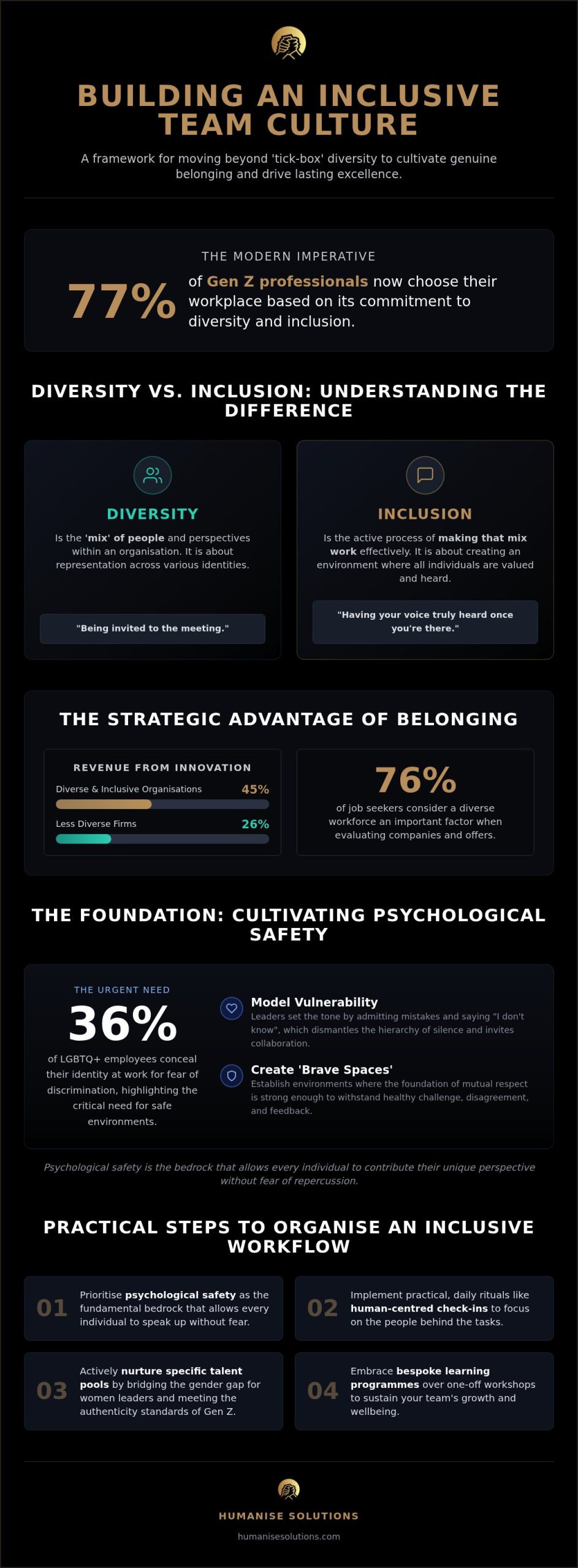
With 77% of Gen Z professionals now choosing their workplace based on its commitment to diversity, the traditional ‘tick-box’ approach to inclusion is no longer enough to sustain a thriving business. You likely recognise that understanding how to build an inclusive team culture is now a fundamental leadership skill, yet the path forward often feels obscured by the fear of saying the wrong thing or the exhaustion of high staff turnover amongst your most talented people. It’s a delicate balance to strike, especially when surface-level bonding fails to create the deep, psychological safety your team truly craves.
We believe that inclusion isn’t a policy to be implemented, but a human behaviour to be nurtured with intention and care. You deserve to lead with confidence, knowing that your environment supports every individual to show up as their authentic self. In this guide, we offer a practical, empathetic framework to help you cultivate a workplace where every person feels a genuine sense of belonging and purpose, transforming your professional space into a hub of innovation and resilience.
We will examine the transition from rigid corporate structures to human-centred environments, exploring how nurturing leadership and bespoke development can foster lasting team excellence. From supporting women leaders to engaging the next generation, you’ll discover the methodology needed to turn diversity into your team’s greatest strength.
Key Takeaways
- Grasp the essential distinction between simple diversity and genuine inclusion, where differences are actively sought and celebrated as collective assets.
- Discover how to build an inclusive team culture by prioritising psychological safety, the fundamental bedrock that allows every individual to speak up without fear.
- Implement practical, daily rituals like human-centred check-ins to ensure your workflow remains focused on the people behind the tasks.
- Learn to nurture specific talent pools by bridging the gender gap for women leaders and meeting the high authenticity standards of Gen Z.
- Move beyond one-off workshops by embracing bespoke learning and development programmes designed to sustain your team’s growth and wellbeing over time.
What is Inclusive Team Culture and Why Does it Drive Excellence?
True excellence isn’t found in uniformity; it’s cultivated through the intentional gathering of diverse perspectives. An inclusive team culture is an environment where differences in background, thought, and experience aren’t merely tolerated but are actively sought as vital assets. Whilst diversity provides the ‘mix’ of people, inclusion is the active process of making that mix work effectively. It’s the difference between being invited to a meeting and having your voice truly heard once you’re there. Understanding how to build an inclusive team culture requires a shift from viewing people as resources to seeing them as individuals capable of profound flourishing. This transformation is driven by human-centric leadership, a style that prioritises the psychological wellbeing of every team member as the foundation for collective success.
The Business Case for Human Flourishing
When individuals feel they belong, they perform with a level of creativity that homogenous groups struggle to replicate. Research indicates that diverse organisations generate 45% of their revenue from innovation, compared to just 26% in less diverse firms. This isn’t a coincidence. It’s the direct result of psychological safety allowing for bolder problem-solving and risk-taking. Beyond the balance sheet, inclusion is a critical retention tool. With 76% of job seekers reporting that diversity is a key factor when considering offers, building a sense of belonging is essential for reducing staff turnover. We see wellbeing and inclusion as two sides of the same coin; you cannot have one without the nurturing environment of the other.
Moving Beyond the Tick-Box Approach
Traditional diversity training often falls short because it focuses on external compliance rather than internal growth. True change doesn’t happen through a yearly seminar; it requires the cultivation of empathy and resilience within leadership. We advocate for a transition away from sterile corporate checklists toward a culture of genuine connection. This means moving beyond ‘the numbers’ to focus on how people actually experience their working day. By fostering building team excellence through bespoke learning and development, leaders can move past the hesitation of ‘saying the wrong thing’ and instead build lasting bonds rooted in mutual respect. This approach ensures that inclusion becomes a lived behaviour rather than a static policy.
The Foundations of Belonging: Cultivating Psychological Safety
Psychological safety is the invisible thread that binds a diverse group into a cohesive unit. Without it, even the most demographically balanced team will struggle to innovate or find common ground. When considering how to build an inclusive team culture, you must first ensure that every individual feels safe to take risks, share unconventional ideas, and speak up without fear of repercussion. Currently, 36% of LGBTQ+ employees conceal their identity at work for fear of discrimination; a statistic that highlights the urgent need for environments where safety is guaranteed. This isn’t about creating an environment where everyone is perpetually comfortable. Comfort often leads to stagnation. Instead, we aim for ‘brave spaces’ where the foundation of mutual respect is strong enough to withstand the friction of healthy challenge and disagreement.
Nurturing Vulnerability in Leadership
Leaders set the emotional tone for the entire organisation. By modelling vulnerability, you signal that perfection isn’t the price of entry. Admitting a mistake or simply saying “I don’t know” invites collaborative problem-solving and encourages others to be equally honest. This transparency is a cornerstone of nurturing leadership, as it dismantles the hierarchy of silence and replaces it with a culture of shared growth. Active listening plays a vital role here. It requires more than just silence; it demands a conscious effort to understand the nuance behind a colleague’s perspective, ensuring every voice carries equal weight, regardless of seniority or tenure.
Creating a Feedback-Rich Environment
Inclusion thrives when feedback is viewed as a gift for development rather than a weapon for criticism. To sustain this, teams need structured ‘brave spaces’ to discuss difficult topics like unconscious bias or systemic exclusion. These sessions shouldn’t be high-pressure; they should feel deliberate and reassuring, allowing for steady progression in understanding. Consider these practical approaches to feedback:
- Focus on the behaviour, not the person, to keep the dialogue constructive and objective.
- Practice radical candour by pairing directness with genuine empathetic warmth.
- Encourage ‘upward feedback’ to give junior staff, particularly Gen Z talent, a sense of agency and influence.
- Recognise that silence in meetings is often a sign of a safety deficit, not a lack of ideas or engagement.
By prioritising these foundations, you move beyond the surface level of team bonding. You’re not just asking people to work together; you’re inviting them to flourish together. This shift requires a methodical approach, acknowledging that meaningful change takes time and care. When people feel safe, they don’t just show up; they contribute their best, most innovative selves to the collective mission.
Five Practical Steps to Organise an Inclusive Daily Workflow
Mastering how to build an inclusive team culture requires moving beyond high-level policy and into the rhythmic habits of your daily operations. Whilst psychological safety provides the foundation, your workflow is the structure that allows inclusion to become a lived reality. It’s about shifting the focus from purely ‘what’ we achieve to ‘how’ we interact whilst doing it. By embedding small, intentional actions into your team’s routine, you move from a culture of compliance to one of genuine belonging. Here are five practical steps to refine your daily workflow:
- Initiate the ‘Human Check-In’: Dedicate the first five minutes of meetings to the human experience rather than the task list. This simple act acknowledges that team members are individuals with lives outside of their roles, fostering a sense of being seen and valued.
- Audit Meeting Dynamics: Regularly observe who dominates the conversation and who remains silent. Actively inviting quieter voices into the space ensures that your best ideas aren’t lost simply because they weren’t the loudest in the room.
- Implement Collaborative Decision-Making: Use frameworks that require input from various departments or seniority levels before a final choice is made. This prevents ‘echo chambers’ and ensures your strategy is resilient and well-rounded.
- Publicly Celebrate Diverse Contributions: Move beyond praising just the final outcome. Recognise the ‘small wins’ and the specific behaviours, such as someone challenging a bias or supporting a colleague, that contribute to Team Excellence.
- Refine Team Rituals: Review your social traditions to ensure they don’t inadvertently exclude. If your primary bonding happens at the pub on a Friday evening, you may be excluding those with caring responsibilities or those who don’t drink.
Inclusive Meeting Behaviours
To ensure every voice carries weight, adopt a ’round-robin’ technique where each person has a dedicated minute to share their thoughts without interruption. Assigning a ‘devil’s advocate’ to specifically look for gaps in a plan can also protect against groupthink. For neurodiverse team members, providing pre-reads 24 hours in advance is essential; it gives those who need more time to process information the opportunity to contribute as deeply as their peers.
Decoupling Performance from Proximity
Inclusive workflows must transcend the physical office. Ensure remote or flexible workers are never ‘out of sight, out of mind’ by prioritising digital-first communication. This means organising social events that cater to different time zones and lifestyles, such as virtual coffee mornings or midday workshops. Fostering ‘asynchronous’ inclusion-where contributions are valued regardless of when they are posted-allows your team to flourish without the pressure of constant, immediate presence.
Nurturing Diverse Talent: From Women Leaders to Gen Z
A monolithic approach to inclusion rarely succeeds because it fails to account for the unique systemic hurdles different groups face. Whilst the daily rituals and safety foundations we’ve discussed are vital, understanding how to build an inclusive team culture also requires a nuanced focus on specific talent pools. True equity isn’t about treating everyone the same; it’s about providing the specific support individuals need to reach the same heights of excellence. By tailoring your strategies to the distinct experiences of women leaders and early-career talent, you ensure that your culture of belonging is as practical as it is aspirational.
Empowering Women through Inclusive Leadership
Female leaders often navigate a ‘double bind’ where they’re perceived as either competent but unlikable, or likable but ineffective. Dismantling this requires a shift in how we evaluate leadership. Providing bespoke development tracks that focus on building inner confidence and resilience allows women to lead authentically without conforming to outdated corporate stereotypes. As of 2025, women hold only 32% of senior leadership roles globally, and the ‘broken rung’-where women are promoted at lower rates from the very first step into management-remains a persistent challenge. To address this, we invite you to explore our dedicated Women leadership programmes, which are designed to turn these systemic barriers into opportunities for growth and sustainable impact.
Engaging Gen Z and Early-Career Talent
For the newest generation entering the workforce, social purpose and authenticity aren’t just ‘nice-to-haves’; they’re non-negotiable. 77% of Gen Z workers report that a company’s commitment to diversity and inclusion is a primary factor in their choice of employer. However, many young adults face a ‘soft skills’ gap or lack the professional networks that their peers from more privileged backgrounds might possess. This is where social mobility training and Young Adult Programmes play a crucial role. These initiatives bridge the gap between academic potential and professional excellence, ensuring talent from all socio-economic backgrounds can flourish.
To deepen this connection, consider implementing a ‘reverse mentoring’ culture. This allows senior leaders to learn directly from the digital fluency and values-driven perspectives of Gen Z, whilst providing the sponsorship needed to propel young talent forward. Unlike traditional mentoring, sponsorship involves active advocacy in high-level meetings, ensuring that the contributions of diverse, early-career professionals are recognised and rewarded. By fostering these reciprocal relationships, you create a dynamic environment where wisdom and innovation flow in both directions, securing the long-term vitality of your team.
Building a sense of belonging isn’t a destination; it’s a continuous practice of cultivation. Many leaders mistakenly view inclusion as a ‘project’ with a defined end date, yet the most resilient organisations understand that learning how to build an inclusive team culture is an ongoing commitment to growth. Think of your culture as a garden. It requires constant nurturing, the removal of systemic weeds, and the enrichment of the soil through psychological safety. Without this steady attention, the initial excitement of a diversity initiative can quickly fade, leaving your team back where they started. Sustaining excellence requires a move away from sporadic events toward a methodical, long-term strategy rooted in building team excellence with a human-centred approach.
Why Bespoke Programmes Outperform Generic Training
Generic, ‘off-the-shelf’ training often fails because it ignores the unique psychological barriers and historical context of your specific organisation. Every team has its own blind spots that require an expert eye to identify and address. By opting for bespoke Learning & Development, you ensure that the training resonates with the lived experience of your staff. This tailored approach allows for a roadmap of sustainable change, moving beyond surface-level bonding to address the root causes of exclusion. It creates a rhythm of development that feels deliberate and reassuring, rather than a high-pressure demand for immediate perfection. Expert-led consultancy provides the mirror your leadership needs to see where genuine connection is being blocked.
Investing in the Human Element
The transition from managing people to nurturing potential is the hallmark of a truly inclusive leader. When you invest in the human element, the benefits extend far beyond social harmony. Measuring the return on investment in people can often feel abstract, but the data is undeniable. High-performing teams with low turnover are built on the confidence that every member is valued for their unique contribution. This atmosphere of trust is your greatest competitive advantage; it drives the innovation needed to thrive in an increasingly diverse global market.
Inclusive culture is not just a moral imperative. It’s a logical foundation for Team Excellence. As your partner in this journey, Humanise Solutions provides the expert-led training workshops and nurturing leadership needed to navigate these complexities with confidence and empathy. We help you move from where you are today to a future where every individual can truly flourish. Explore our Bespoke Learning and Development Programmes to begin your team’s next chapter of growth and belonging.
Nurturing Your Team Toward Sustainable Excellence
Cultivating a culture of belonging is a deliberate act of leadership that yields profound rewards. We have examined the essential shift from surface-level diversity to deep-rooted inclusion, where psychological safety and human-centred rituals form the core of daily excellence. Mastering how to build an inclusive team culture requires more than just policy; it demands a commitment to nurturing every individual, from empowering women leaders to engaging the unique values of Gen Z talent.
At Humanise Solutions, we act as your partner in this transformation, offering expert-led leadership development and bespoke programmes that prioritise wellbeing. Our methodology remains rooted in logic and empathy, ensuring that your journey toward psychological safety is both high-reaching and sustainable. We invite you to step beyond traditional corporate consulting and embrace a voice that is deeply invested in your team’s flourishing.
Cultivate Team Excellence with Humanise Solutions and discover how a truly human-centred approach can redefine your organisation’s future. The potential for growth is within your reach, and the first step starts with a single, intentional choice.
Frequently Asked Questions
How can I build an inclusive team culture with a limited budget?
You can build an inclusive team culture without a large budget by focusing on intentional daily habits. Start by implementing ‘human check-ins’ at the start of meetings and auditing your own listening behaviours. These small, free adjustments signal that you value the individual over the task. Building a sense of belonging is primarily about the quality of human connection, which requires time and empathy rather than financial investment.
What is the first step a manager should take to improve team inclusion?
The first step a manager should take is to model vulnerability by admitting their own mistakes or knowledge gaps. This courageous act dismantles the pressure for perfection and signals to the team that it is safe to be authentic. By showing your own humanity, you invite others to do the same, creating the psychological safety necessary for a truly inclusive environment to take root.
Can an inclusive culture really improve team performance and ROI?
Yes, inclusive cultures significantly improve performance, with ethnically diverse teams being 36% more likely to outperform peers on profitability. Diverse organisations also generate 45% of their revenue from innovation, compared to 26% in less diverse firms. When people feel safe and included, they contribute their best ideas, leading to higher engagement, lower turnover, and a more resilient bottom line.
How do I handle team members who are resistant to inclusion initiatives?
Address resistance through open, empathetic dialogue rather than direct confrontation. Seek to understand the underlying fears or misconceptions that cause hesitation, such as the fear of ‘saying the wrong thing’. By linking inclusion to shared team goals and excellence, you can help resistant members see that a supportive culture benefits everyone’s professional growth and wellbeing.
What is the difference between diversity, equity, and inclusion in the workplace?
Diversity is the demographic mix of people, whilst inclusion is the active behaviour that makes that mix work. Equity ensures that everyone has fair access to opportunities by acknowledging and removing systemic barriers. In a healthy workplace, diversity is the invitation, equity is the fair path to the table, and inclusion is the feeling of belonging once you arrive.
How can I ensure our hybrid or remote work culture remains inclusive?
Ensure hybrid inclusion by prioritising asynchronous communication and digital-first rituals. Use virtual coffee mornings or shared digital ‘kudos’ boards to maintain connection across different locations. It’s vital to ensure that remote workers have the same visibility and influence as those in the physical centre, preventing proximity bias from creating a two-tier team experience.
What role does psychological safety play in building an inclusive team?
Psychological safety acts as the bedrock of any inclusive team, allowing members to take risks and speak up without fear. Without this foundation, diversity remains surface-level because people won’t feel safe enough to share their unique perspectives. When you understand how to build an inclusive team culture, you’ll see that safety is what allows innovation to flourish and talent to stay.
How can I support Gen Z employees within an inclusive framework?
Supporting Gen Z requires a focus on values-alignment and authenticity. Since 77% of Gen Z workers prioritise diversity when choosing an employer, you must demonstrate a genuine commitment to social purpose and wellbeing. Implementing reverse mentoring programmes allows these young professionals to feel heard whilst providing senior leaders with fresh perspectives on digital fluency and social dynamics.
