

Article by
Scott Ward MBA CCMI
Scott Ward is the founder and CEO of Humanise Solutions, which he established three years ago to help organisations elevate their people, leadership and culture through a human-centric, evidence-based approach. Before moving into business and academia, Scott spent seven years as a professional footballer, playing for Luton Town, Crawley Town and Coventry City FC until injury brought his playing career to a close — a turning point that shaped both his research interests and his approach to leadership.
Scott holds an MBA from Warwick Business School, where his research explored the causal relationship between trauma and decision-making — work that continues to inform how he supports young adults, leaders and teams under pressure. Recognised as a Companion of the Chartered Management Institute (CCMI), its highest grade of membership, he combines academic rigour with the discipline, resilience and team-first mindset of the professional game. At the heart of everything he does is a simple belief: that people perform at their best when they are led, developed and valued as human beings first.
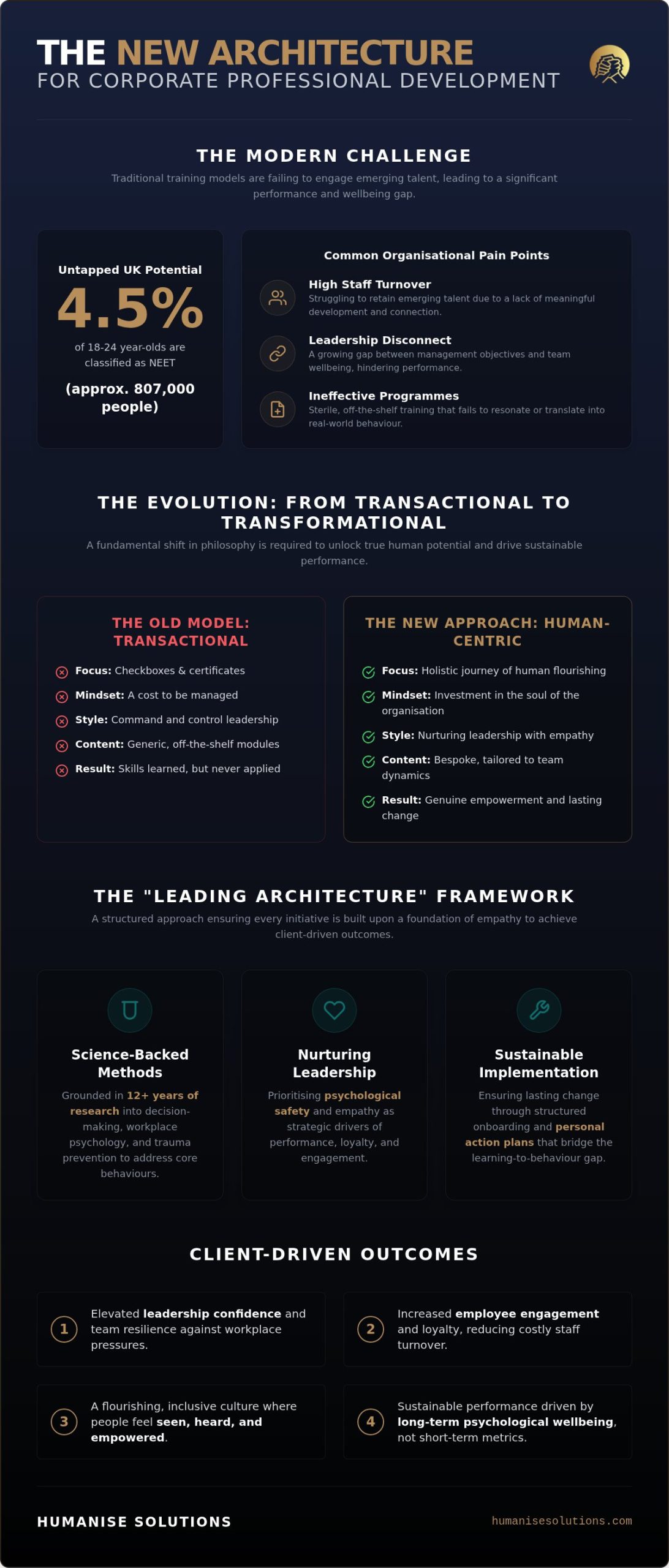
Did you know that 4.5% of 18-24-year-olds (approx. 807K people) in the UK are currently classified as NEET? This represents a significant reservoir of untapped potential that many organisations are struggling to reach or retain. You’ve likely felt the frustration of high staff turnover amongst emerging talent or noticed a growing disconnect between management objectives and team wellbeing. It’s a common challenge, often rooted in sterile, ineffective corporate professional development training programmes that fail to resonate because they overlook the essential human experience.
We believe that unlocking true potential requires a sophisticated blend of empathy and evidence-based logic. You deserve a strategy that treats your people as the living heart of your business, not just assets to be managed. This article will show you how a scientific, human-centric approach transforms corporate culture, elevates leadership confidence, and drives sustainable performance. We’ll explore how a “Leading Architecture” framework ensures that every development initiative is built upon a foundation of empathy, providing a clear path to achieving the specific, client-driven outcomes your organisation needs to flourish.
Key Takeaways
- Move beyond transactional skills by embracing a holistic journey that focuses on human flourishing and long-term psychological well-being.
- Discover how 12 years of research into decision-making and trauma prevention provides the scientific foundation for impactful corporate professional development training.
- Learn to identify high-value partners by looking for ILM-certified leadership programmes and a methodology that prioritises “Nurturing Leadership.”
- Address critical talent gaps by understanding the role of Young Adult Programmes, particularly for the 4.5% of 18-24-year-olds currently classified as NEET.
- Ensure lasting change through structured onboarding and personal action plans that bridge the gap between learning and daily workplace behaviour.
The Evolution of Corporate Professional Development Training in 2026
The traditional view of professional development has often been reduced to a series of checkboxes and certificates. In 2026, this transactional model is being replaced by a more profound understanding of what it means to grow within a workplace. True corporate professional development training is no longer just about acquiring technical skills; it’s a holistic journey of human flourishing. It’s about moving from a transactional mindset, where training is a cost to be managed, to a transformational philosophy, where learning is an investment in the soul of the organisation. When you align development with your core values, you create a culture where people feel seen, heard, and empowered to contribute their best work.
Empathy and nurturing have transitioned from being viewed as soft skills to becoming essential corporate performance drivers. In a world of increasing automation, the qualities that make us uniquely human, such as emotional intelligence and social connection, are the most valuable assets a business possesses. By weaving these values into the fabric of your Learning & Development strategy, you don’t just improve individual performance; you strengthen the entire organisational structure against the volatility of the modern market.
Why Human-Centric Training Outperforms Traditional Models
The old command and control management style is failing to meet the needs of a workforce that craves connection and purpose. Instead, we see the rise of nurturing leadership, a model that prioritises psychological safety and empathy as primary drivers of performance. Empathy is a strategic advantage that fosters deep loyalty and engagement amongst emerging talent. To make this transition sustainable, we utilise a concept called Leading Architecture. This structural theme ensures that every development initiative is built upon a foundation of empathy, providing a clear framework for achieving client-driven outcomes that actually stick. It moves the focus from mere compliance to genuine empowerment.
Addressing the Performance Gap in Modern Organisations
Many organisations still rely on generic, off-the-shelf training modules that fail to resonate with their specific challenges. These sterile programmes often result in a performance gap where skills are learned but never applied to real-world scenarios. Bespoke corporate professional development training addresses this by focusing on the unique behaviours and social dynamics of your team. By taking a scientific approach to learning, we can unlock true human potential that remains dormant under traditional methods. It’s about understanding the logic of why people behave the way they do and providing the tools to cultivate resilience and confidence across all levels. This shift towards tailored, research-backed initiatives ensures that your growth is not just rapid, but sustainable for the long term.
The Science of Growth: Research-Backed Learning and Development
Meaningful growth isn’t a happy accident. It’s the deliberate result of understanding the intricate mechanics of the human mind. At Humanise Solutions, our approach is built upon over 12 years of research into decision-making and trauma prevention. This isn’t just theory; it’s a practical application of workplace psychology that transforms how corporate professional development training is designed and delivered. By grounding our methods in science, we move beyond surface-level skills to address the deep-seated behaviours that drive performance.
Emotional intelligence serves as the bridge between raw talent and sustained professional resilience. It’s the ability to navigate complex social dynamics whilst maintaining a sense of internal balance. Psychological safety is the fundamental belief that one can speak up without fear of punishment or humiliation, acting as the bedrock upon which high-performing team excellence is built.
Trauma Prevention and Resilience at Work
Personal resilience is directly linked to organisational sustainability. When individuals feel supported, they’re better equipped to handle the inevitable pressures of the modern workplace. Our trauma-informed training focuses on preventing burnout by fostering an environment of dignity and mutual respect. We’ve found that integrating self-care and mental health awareness modules into our Learning & Development programmes isn’t just empathetic; it’s a strategic necessity. If you’re ready to build a more resilient workforce, reach out to our team to discuss a tailored approach.
Evidence-Based Decision Making for Leaders
Leadership is often described as an art, but it’s increasingly becoming a science. Evidence-based decision-making allows leaders to move past gut feelings and address the unconscious biases that can cloud judgement. Many academic corporate training programs emphasise the importance of data, but we focus on the intersection of data and human emotion. By improving emotional intelligence, leaders can resolve conflicts more effectively and cultivate a culture of transparency. Our certified workshops ensure these high standards are maintained, providing leaders with the logic and confidence needed to guide their teams through transition and growth.
Evaluating Professional Development Partners: A Buying Guide
Selecting a partner for corporate professional development training is a decision that extends far beyond browsing a brochure of course titles. Whilst many providers offer a directory of generic qualifications, true growth requires a methodology that aligns with your specific organisational DNA. You should look for a partner who views development as an end-to-end talent pipeline rather than a series of isolated training events. Leveraging our position as the 5th largest digital recruiter in EMEA, we understand that learning is the vital bridge between recruitment and long-term retention. This integrated approach, often mirrored by elite institutions like Harvard’s professional development programs, ensures that training isn’t just a day out of the office but a catalyst for a sustained cultural shift. Credibility is further bolstered by guest speakers who bring real-world wisdom and ILM certification, providing a globally recognised benchmark for quality.
Bespoke Design vs. Off-the-Shelf Modules
Generic modules often fail because they don’t account for the unique social dynamics and challenges within your team. For “Change & Transformation” initiatives to actually take root, you need bespoke learning and development programmes that are built from the ground up. Learning Design Support plays a critical role here, ensuring the curriculum reflects the actual behaviours you want to cultivate. Consider the ROI: a generic “Finance for Non-Financial Managers” course might provide basic knowledge, but a bespoke financial strategy session tailored to your specific industry and internal reporting structures will drive immediate, actionable results. Tailored content respects the intelligence of your staff and addresses their specific pain points with empathy and precision.
The Importance of Accreditation and Certification
Consistency is vital for national organisations that need to maintain high standards across multiple sites. Leadership ILM Programmes offer a structured pathway for career progression, providing emerging talent with the confidence and formal recognition they need to lead effectively. These certified programmes ensure that the “Nurturing Leadership” model is applied uniformly, creating a shared language of growth across the business. For busy teams, the flexibility of half-day or full-day certified workshops allows for intensive learning without causing significant operational disruption. By choosing accredited partners for your corporate professional development training, you aren’t just buying a workshop; you’re investing in a verified standard of excellence that empowers your people to reach their full potential.
Cultivating Inclusive Excellence and Social Mobility
True organisational growth isn’t just about internal efficiency; it’s about the impact we have on the wider community. In the UK, a staggering 4.5% of 18-24-year-olds (approx. 807K people) are classified as NEET. This represents a significant loss of potential that businesses can no longer afford to ignore. By integrating social mobility into your corporate professional development training, you don’t just fill vacancies; you actively bridge the talent gap whilst fostering a culture of belonging. Our young adult programmes are designed to unlock this latent talent, ensuring that background never dictates an individual’s future potential. Equality, Diversity & Inclusion (ED&I) training shouldn’t be a separate initiative; it’s the thread that binds a high-performing, inclusive team together.
Empowering Women in Leadership
Bridging the gender gap in management requires more than just policy changes; it requires a deep investment in confidence and resilience. Our Women Leadership ILM Programmes provide specific modules designed to help participants navigate challenges like Imposter Syndrome that often hinder career progression. By focusing on internal qualities and providing a supportive environment, we help women step into their authority with confidence. For a deeper look at these strategies, read our guide on empowering women in the workplace. It’s about creating a leadership architecture where everyone has the tools to succeed.
Supporting the Next Generation of Talent
Helping young adults navigate the complexities of the job market is a cornerstone of our mission. Whether it’s through career transition support or mastering the nuances of professional communication, our approach is always driven by empathy. The results speak for themselves: we maintain a 100% programme completion rate and achieve 50-80% job outcomes for our participants. This success is built on a foundation of mentoring and a Paying It Forward philosophy that encourages social mobility. When you invest in corporate professional development training that prioritises the next generation, you’re building a sustainable pipeline of talent that is both diverse and highly skilled. If you’re ready to transform your approach to talent development, get in touch with our specialists today to explore how we can support your goals.
Implementing a Nurturing Leadership Strategy with Humanise Solutions
At Humanise Solutions, we believe that organisational growth is the natural byproduct of human flourishing. Our mission is built on the conviction that empathy and science can coexist to elevate people to their highest potential. When you choose our corporate professional development training, you aren’t simply booking a course; you’re entering a partnership dedicated to sustainable transformation. We understand that meaningful change takes time and care, which is why our approach is always deliberate and reassuring.
We begin every journey with a structured onboarding process that sets the stage for genuine engagement. Each participant develops a personal action plan, ensuring that the insights gained during training are immediately applied to their specific workplace challenges. This methodical approach ensures that new skills aren’t lost in the daily rush but instead become part of the rhythmic flow of the organisation. Our perspective is uniquely broad; as the 5th largest digital recruiter in EMEA, we see the full lifecycle of talent, from initial attraction to long-term leadership development. This allows us to design programmes that are perfectly aligned with the realities of the modern job market. Ultimately, our goal is for Fostering Wellbeing to move from a concept to a permanent organisational behaviour.
Our Human-Centric Methodology
Our delivery team comprises seasoned Executive Coaches and Performance Behaviours leads who bring a wealth of psychological insight to every session. Every element of our bespoke learning initiatives is mapped directly to client-driven outcomes, ensuring that the value we provide is precise and measurable. This commitment to excellence is reflected in our 9.98% feedback rating for programme delivery. We don’t dictate from afar; we walk alongside your team as visionary guides, ensuring that while the goals are high-reaching, the foundation remains rooted in logic and methodology. This high level of emotional intelligence allows us to address the nuances of your team’s social dynamics with empathy and confidence.
Next Steps for Organisational Transformation
Transformation begins with an honest conversation. We encourage an initial consultation to identify current skill gaps and define your specific developmental needs. Whether you’re focused on succession planning to secure your company’s future or ensuring post-merger success through cultural alignment, our team is ready to support you. By choosing corporate professional development training that prioritises the human experience, you’re choosing a path of resilience and inclusive excellence. Explore our services to see how we can help you unlock the true potential of your workforce and build a culture where everyone can thrive.
Cultivate a Culture of Sustainable Excellence
The journey from transactional management to nurturing leadership is a fundamental shift in how we value the human experience at work. By prioritising psychological safety and evidence-based methodologies, your organisation can bridge the performance gap whilst fostering genuine wellbeing. We’ve explored how bespoke corporate professional development training serves as the vital architecture for this transformation, ensuring that every initiative is aligned with your specific cultural goals and team dynamics.
Backed by over 12 years of research-based methodology and our unique perspective as the 5th largest digital recruiter in EMEA, we’re committed to unlocking the latent potential within your team. Our 9.98% feedback rating for delivery is a testament to the care and precision we bring to every partnership. Whether you’re addressing the needs of emerging talent or empowering women in leadership, the foundation of your success remains rooted in a blend of empathy and logic. True growth isn’t just about the numbers; it’s about the people who drive them.
Ready to begin your journey? Discover how our human-centric training can elevate your organisation and help your people truly flourish. You have the power to create a workplace where every individual feels seen, heard, and empowered to succeed.
Frequently Asked Questions
What is the definition of corporate professional development training?
It is a holistic journey of human flourishing designed to align individual growth with organisational goals. Unlike traditional models, it focuses on transformational learning that nurtures internal qualities like resilience and confidence. By integrating corporate professional development training into the core business strategy, companies move beyond simple skills acquisition to cultivate a culture of social connection and psychological well-being. This approach ensures long-term sustainability and high-level team excellence.
Why should we choose bespoke training over generic online courses?
Bespoke training addresses the specific social dynamics and unique challenges within your team that generic modules often ignore. Tailored content ensures that our leading architecture is mapped directly to your client-driven outcomes, making the curriculum relevant to daily workplace behaviours. Whilst generic courses offer a broad overview, bespoke initiatives provide the nuance required for effective change and transformation. This results in a higher return on investment and more sustainable behavioural shifts.
How does nurturing leadership improve employee retention?
Nurturing leadership fosters an environment of psychological safety where employees feel seen, heard, and empowered. By prioritising empathy and support over traditional command-and-control management, you build deep loyalty amongst your staff. This approach is particularly effective with emerging talent who seek purpose and connection. When individuals feel their growth is genuinely supported through corporate professional development training, they are significantly more likely to remain committed to the organisation’s long-term mission.
What is the significance of the 4.5% NEET statistic for UK businesses?
The statistic that 4.5% of 18-24-year-olds (approx. 807K people) are classified as NEET represents a massive untapped talent pool for UK businesses. By engaging with this demographic through specialised Young Adult Programmes, organisations can bridge critical skill gaps whilst driving social mobility. Investing in these individuals through structured development not only solves recruitment challenges but also demonstrates a commitment to inclusive excellence and the wider flourishing of the community.
How do ILM-certified programmes benefit my management team?
ILM-certified programmes provide a globally recognised benchmark of quality that ensures consistency across your management team. These certified pathways offer structured career progression, helping leaders build the confidence and evidence-based skills needed to guide their teams effectively. By following a rigorous, research-backed curriculum, your managers gain the authority of specialists whilst maintaining an approachable, human-centric leadership style. This foundation is essential for modern organisational growth and high-level team excellence.
Can professional development training help with diversity and inclusion (ED&I)?
Yes, it is a primary tool for fostering belonging and inclusive excellence within the workplace. Effective training goes beyond policy by addressing the underlying psychological drivers of behaviour, such as unconscious bias. By integrating ED&I principles into broader leadership tracks, such as Women Leadership programmes, organisations can dismantle barriers like Imposter Syndrome. This ensures that diversity is not just a metric but a lived reality that strengthens the entire team’s resilience and social connection.
How is the ROI of a human-centric training programme measured?
ROI is measured through a combination of tangible job outcomes and qualitative feedback. For instance, our programmes achieve a 100% completion rate and 50-80% job outcomes for participants, alongside a 9.98% feedback rating for delivery. Beyond these figures, you can track improvements in employee retention, leadership confidence, and team performance. A human-centric approach ensures that growth is sustainable, reducing the long-term costs associated with high staff turnover and disengaged workers.
What role does psychological safety play in professional development?
Psychological safety serves as the essential foundation for all meaningful professional growth. It creates a safe space where individuals can take risks, share ideas, and learn from mistakes without fear of judgment. Without this foundation, even the most advanced training will fail to take root. By fostering an environment of trust and mutual respect, you unlock the true potential of your workforce, allowing team members to engage deeply with new concepts and behaviours.
