

Article by
Scott Ward MBA CCMI
Scott Ward is the founder and CEO of Humanise Solutions, which he established three years ago to help organisations elevate their people, leadership and culture through a human-centric, evidence-based approach. Before moving into business and academia, Scott spent seven years as a professional footballer, playing for Luton Town, Crawley Town and Coventry City FC until injury brought his playing career to a close — a turning point that shaped both his research interests and his approach to leadership.
Scott holds an MBA from Warwick Business School, where his research explored the causal relationship between trauma and decision-making — work that continues to inform how he supports young adults, leaders and teams under pressure. Recognised as a Companion of the Chartered Management Institute (CCMI), its highest grade of membership, he combines academic rigour with the discipline, resilience and team-first mindset of the professional game. At the heart of everything he does is a simple belief: that people perform at their best when they are led, developed and valued as human beings first.
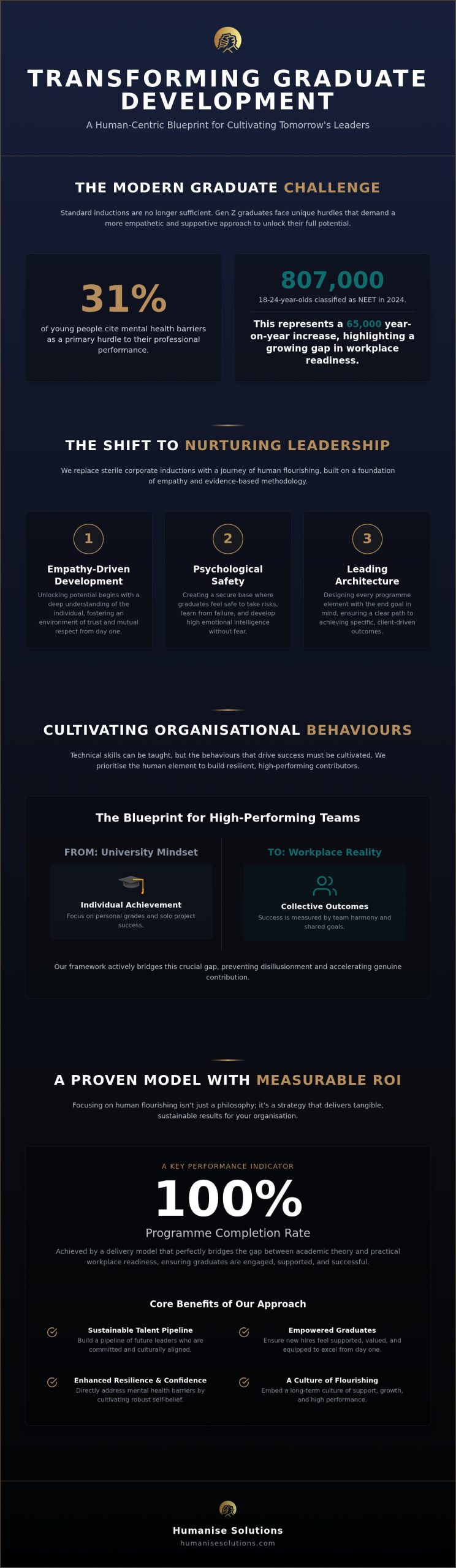
If 31% of young people cite mental health barriers as a primary hurdle to their performance, why do most corporate inductions still focus solely on technical processes? You likely recognise the frustration of watching ambitious talent struggle with workplace readiness or leave the organisation before they’ve truly begun to contribute. It’s a challenge that requires more than a standard induction; it demands a shift towards human-centric architecture. This guide provides innovative, research-backed graduate development programme ideas designed to transform your approach into a journey of human flourishing and high performance.
We believe unlocking potential begins with empathy and a deep understanding of the social dynamics that drive Gen Z. You’ll discover how to move beyond sterile training to cultivate resilience, confidence, and high emotional intelligence within your cohort. By the end of this article, you’ll have a clear framework for building a sustainable talent pipeline that delivers a measurable ROI whilst ensuring graduates feel supported and empowered to excel. We’ll explore the methodology behind nurturing leadership behaviours and creating an environment where every young professional can thrive for the long term.
Key Takeaways
- Learn why a standard induction isn’t enough anymore and how to transition to a journey of nurturing leadership that addresses the specific hurdles Gen Z graduates face.
- Discover research-backed graduate development programme ideas, grounded in 12 years of research, that prioritise psychological safety as the foundation for growth.
- Understand how to cultivate essential organisational behaviours through the “High Performing Teams” framework whilst keeping your talent resilient.
- Gain insights into a delivery model that achieves 100% completion rates. It bridges the gap between academic theory and workplace readiness perfectly.
- Explore how focusing on human flourishing can secure a measurable ROI; it’s the key to building a sustainable talent pipeline.
The Evolution of Graduate Development in 2026
Graduate development in 2026 has transitioned from a mere recruitment phase into a vital, nurturing leadership journey. It’s no longer enough to treat the first few months of employment as a standard onboarding exercise. Instead, we must view this period as the foundation for long term human flourishing. Traditional inductions often fail Gen Z because they rely on sterile, detached corporate language that doesn’t resonate with a generation seeking purpose and psychological well-being. To truly unlock potential, we need a human centric architecture that balances visionary guidance with grounded, evidence based methodology. This change is essential. Empathy is the key.
Addressing the NEET Gap and Workplace Readiness
The current environment for young adults is increasingly complex, making the transition from education to employment more difficult than ever. In 2024, data showed that 4.5% of 18-24-year-olds were classified as NEET, representing approximately 807,000 people. This is a significant 65,000 year-on-year increase that cannot be ignored. The numbers tell a story. If you’re exploring effective graduate development programme ideas, you must consider the specific barriers this generation faces. Research shows that 31% of young people in this category cite mental health barriers as their reason for not working. These hurdles aren’t just about a lack of technical skills; they’re about a lack of confidence and resilience. Our Young Adult Programmes are designed to bridge this gap, focusing on the human experience within a professional context.
The Shift Towards Nurturing Leadership
The old ‘command and control’ style of management is fading. In its place, we see the rise of nurturing leadership. This approach focuses on cultivation and social connection rather than mere oversight. Psychological safety is the bedrock of this shift. Without it, young talent cannot take the risks necessary for growth or display the emotional intelligence required in modern teams. We prioritise leading architecture as a central theme, ensuring that every element of a programme is structured around achieving specific, client driven outcomes. Leading architecture involves designing development paths with the final outcome in mind, ensuring every module directly supports your unique goals. This ensures that your graduate development programme ideas are not just theoretical concepts but practical tools for sustainable growth and high performance.
Prioritising Organisational Behaviours over Technical Skills
Technical skills can be taught in a classroom. Behaviours, however, are cultivated through experience, reflection, and the right environment. This distinction is fundamental to designing effective graduate development programme ideas. A graduate who understands a software system but struggles with accountability, collaboration, or self-awareness will consistently underperform. Conversely, a graduate who demonstrates emotional intelligence, adaptability, and inclusive thinking will grow into almost any technical role you need them to fill. The investment, therefore, must be weighted accordingly.
Aligning individual values with organisational culture is where this cultivation truly begins. When graduates arrive, they carry their own beliefs, motivations, and expectations. Rather than suppressing these, a human-centric programme channels them productively. Structured values-alignment workshops, peer dialogue sessions, and reflective journalling during the early weeks help graduates understand not just what the organisation does, but why it matters. That sense of purpose is what converts a new hire into a committed contributor.
The Blueprint for Team Excellence
High performance doesn’t emerge from individuals working in parallel; it emerges from teams working in harmony. The “High Performing Teams” framework positions collaborative leadership as a core graduate competency from day one. This means teaching graduates how to contribute to a team dynamic, manage shared expectations, and navigate the very real cultural shift between university life and corporate reality. University rewards individual achievement. The workplace rewards collective outcomes. Bridging that gap early prevents disillusionment and accelerates genuine contribution. Our guide on Building Team Excellence explores this methodology in depth, offering a practical framework for cultivating collaborative behaviours that sustain high performance over time.
Fostering Belonging through Inclusive Leadership
Inclusive leadership isn’t a module to be added later. It’s a lens through which every interaction should be understood from the very first week. Graduates who grasp Equality, Diversity and Inclusion (ED&I) principles early don’t just become better colleagues; they become better leaders, faster. Unconscious bias training during early career development is particularly powerful because it shapes habits before they solidify into patterns.
There’s a deeper commercial rationale here too. Graduates who feel a genuine sense of belonging are more likely to stay, advocate for the organisation, and perform at their highest level. When your programme builds a culture that graduates feel proud to represent, you’re not simply ticking a compliance box. You’re constructing a talent pipeline grounded in loyalty and shared identity, which is one of the most sustainable competitive advantages an organisation can cultivate.
Implementing Your Programme with Humanise Solutions
Implementing sophisticated graduate development programme ideas requires more than just a list of modules; it requires a partner who understands the intricate architecture of human growth. At Humanise Solutions, we provide an end-to-end provision that moves beyond traditional consulting. Each client is supported by a dedicated matrix partner, ensuring the delivery remains aligned with your specific organisational goals. The results speak for themselves. We maintain 100% completion rates for our programmes, whilst 50-80% of participants achieve successful job outcomes. This isn’t accidental. It’s the result of over 12 years of research into decision-making and trauma prevention. We hold a 9.98% feedback rating for our delivery, proof that our evidence-based methods resonate deeply with those we serve.
The Onboarding Architecture
A graduate’s first 72 hours can define their entire trajectory within your firm. We’ve refined a structured three-day onboarding process that serves as a model for excellence. On Day 1, we focus on personal action plans. This isn’t just about tasks; it’s about aligning individual aspirations with the company’s mission to create immediate emotional investment. Day 2 shifts to the practicalities of the job network and talent pipeline integration, ensuring they understand their place within the wider ecosystem. By Day 3, we introduce the matrix system. Here, graduates learn to search for and seize applicable growth opportunities independently. This methodical approach builds trust and clarity from the outset. It replaces anxiety with confidence.
A Partner for Sustainable Growth
Generic training often fails because it ignores the unique social dynamics of your workforce. Our bespoke L&D programmes provide a significantly higher ROI by addressing specific needs rather than ticking boxes. We don’t believe in one-size-fits-all solutions. Instead, we act as a visionary guide, helping you transition from current challenges to future potential. As the 5th largest digital recruiter in EMEA, we possess a unique vantage point on the global talent market. We combine this immense scale with a scientific, human-centric approach. This ensures that whilst our reach is wide, our foundation remains rooted in logic and the nurturing of internal qualities like resilience. We are here to help. We build a legacy of leadership that lasts.
Cultivating the Leaders of Tomorrow
Transforming your approach to early career talent is a journey that moves beyond standard checklists. By prioritising organisational behaviours and psychological safety, you create an environment where Gen Z can truly thrive. These research-backed graduate development programme ideas are designed to bridge the gap between academic theory and workplace reality, ensuring your talent pipeline remains resilient and high-performing. You have the power to turn recruitment into a journey of human flourishing.
Our methodology is grounded in over 12 years of scientific research into decision-making and trauma prevention. It’s a foundation that delivers tangible results, evidenced by our 100% programme completion rate and an average feedback rating of 9.98%. We don’t just deliver training; we partner with you to build a culture of nurturing leadership that lasts for years to come. Meaningful change takes time and care, and we’re here to guide every step of that transition.
Are you ready to unlock the full potential of your next cohort? Explore our Young Adult Development Programmes today to start building a legacy of excellence. Together, we can turn the challenges of today into the high-performance outcomes of tomorrow.
Frequently Asked Questions
What should be included in a modern graduate development programme?
A modern programme must integrate technical skills with core organisational behaviours. It’s essential to include modules on emotional intelligence, personal resilience, and inclusive leadership to ensure a holistic transition. Effective graduate development programme ideas should also feature personal action plans that align individual goals with the firm’s mission. This creates a foundation for human flourishing, moving beyond a standard induction to a journey of nurturing leadership that supports long-term growth and high performance.
How long should a graduate development programme last for maximum impact?
There isn’t a single duration that fits every firm, but meaningful change takes time and care. Most high-impact programmes span twelve to twenty-four months to allow for steady progression. This timeline ensures that the nurturing of internal qualities like confidence isn’t rushed. A methodical rhythm allows graduates to move from initial onboarding into deeper leadership development, ensuring the transition from university to a professional context is sustainable and deeply rooted in logic.
Why is wellbeing becoming a central pillar of graduate development?
Wellbeing is central because psychological safety is the bedrock of performance. Without fostering wellbeing, graduates often struggle with the social dynamics of a corporate environment. By prioritising self-care and mental health awareness, organisations reduce turnover and build more resilient teams. This human-centric approach acknowledges that a person’s ability to contribute is directly linked to their internal state. It’s about creating a supportive architecture where every young professional feels empowered to excel.
How can I measure the ROI of a human-centric development programme?
ROI is measured through completion rates, retention, and delivery quality. We see 100% completion rates for our programmes, which directly impacts the value of your development spend. Additionally, our 9.98% feedback rating demonstrates the high level of engagement and effectiveness. By focusing on human-centric architecture, you secure a sustainable talent pipeline and graduates who are ready to lead. This reduces recruitment costs whilst increasing the long-term productivity of your emerging leadership team.
What are the most common mistakes in graduate programme design?
The most common mistake is relying on sterile, detached corporate language that fails to engage Gen Z. Many organisations also focus too heavily on technical aptitude whilst ignoring the cultivation of essential behaviours like accountability and empathy. Another error is designing a high-pressure, fast-paced induction that overwhelms new hires. Successful graduate development programme ideas avoid these pitfalls by balancing visionary guidance with a grounded, evidence-based methodology that prioritises the human experience.
How do you support graduates transitioning into their first professional role?
Supporting the transition into a professional role requires a methodical approach that replaces anxiety with confidence. We focus on managing expectations and career transition through structured modules that bridge the gap between academic theory and workplace reality. By providing graduates with personal action plans and a dedicated matrix partner, we ensure they have a visionary guide throughout their journey. This level of support helps them navigate social dynamics whilst fostering a sense of psychological well-being from day one.
What is the role of mentorship in graduate development?
Mentorship provides the social connection and guidance necessary for long-term sustainability. It isn’t just about passing on technical knowledge; it’s about paying it forward and supporting others through their career journey. Effective mentoring modules teach senior staff how to become visionary guides for their junior colleagues. This relationship fosters a sense of belonging and helps graduates build their professional network, which is vital for both personal development and organisational growth within a nurturing leadership culture.
How does trauma prevention training benefit a corporate graduate scheme?
Trauma prevention training is a differentiator that builds deep resilience. Backed by over 12 years of scientific research, this training helps graduates understand decision-making processes under pressure. It provides them with a toolkit to manage stress and avoid burnout before these issues impact performance. By addressing the psychological well-being of your cohort from the outset, you create a safer, more inclusive environment. This scientific approach ensures that your graduate scheme is built on a foundation of long-term health.
