

Article by
Scott Ward MBA CCMI
Scott Ward is the founder and CEO of Humanise Solutions, which he established three years ago to help organisations elevate their people, leadership and culture through a human-centric, evidence-based approach. Before moving into business and academia, Scott spent seven years as a professional footballer, playing for Luton Town, Crawley Town and Coventry City FC until injury brought his playing career to a close — a turning point that shaped both his research interests and his approach to leadership.
Scott holds an MBA from Warwick Business School, where his research explored the causal relationship between trauma and decision-making — work that continues to inform how he supports young adults, leaders and teams under pressure. Recognised as a Companion of the Chartered Management Institute (CCMI), its highest grade of membership, he combines academic rigour with the discipline, resilience and team-first mindset of the professional game. At the heart of everything he does is a simple belief: that people perform at their best when they are led, developed and valued as human beings first.
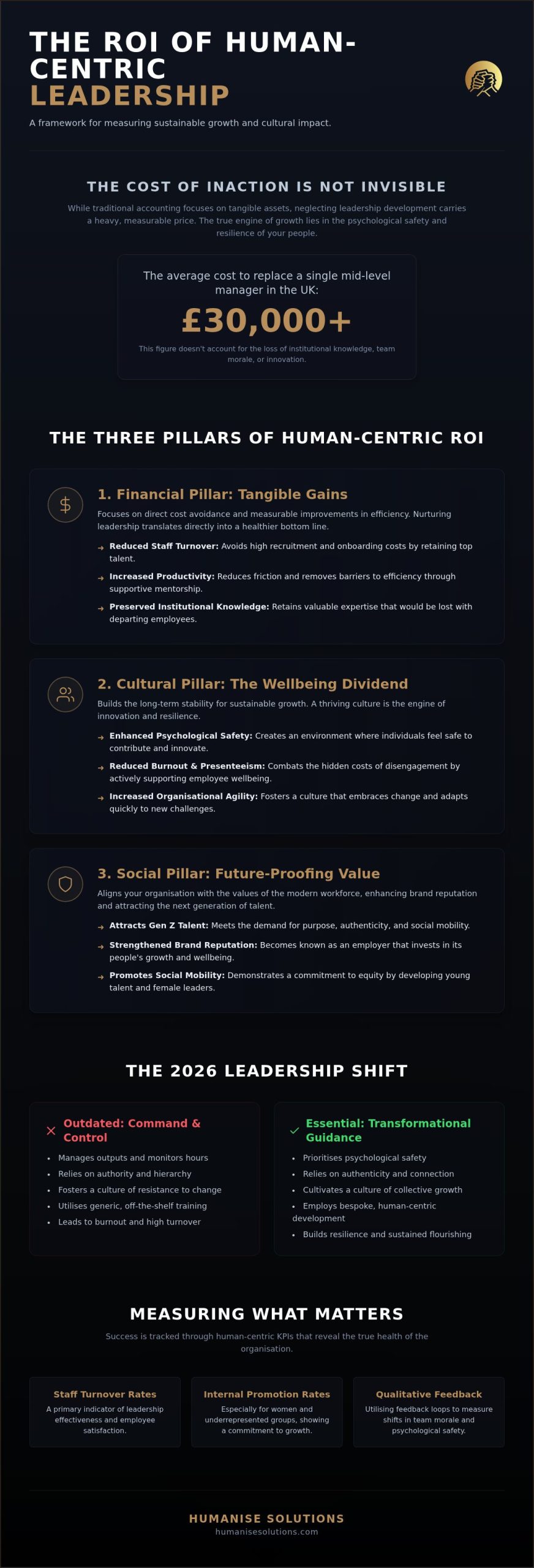
What if the most significant driver of your bottom line is currently invisible to your spreadsheets? While traditional accounting focuses on tangible assets, the true engine of sustainable growth lies in the psychological safety and resilience of your people. You likely recognise that “soft skills” like empathy are essential, yet proving the leadership development ROI to a skeptical finance department often feels like an uphill struggle. It’s frustrating to see high-potential talent leave because the culture lacks the depth to sustain them, especially when the cost of replacing a single mid-level manager in the UK can easily exceed £30,000.
We understand that you need more than just vague promises of “better culture” to secure L&D spend. This article provides a clear, evidence-based framework to quantify the financial and cultural impact of human-centric growth. You’ll discover how nurturing leadership directly influences employee retention, reduces turnover costs, and builds a workplace where every individual can truly flourish. We’ll examine how aligning wellbeing with social mobility creates a competitive edge that is as measurable as it is meaningful, moving your organisation from a state of survival to one of thriving potential.
Key Takeaways
- Learn how to evaluate leadership development ROI through a multi-dimensional lens that balances immediate financial gains with long-term cultural and social impact.
- Discover the direct link between nurturing leadership and reduced staff turnover, helping your organisation avoid the high costs associated with UK recruitment and onboarding.
- Master practical techniques for quantifying soft skills like empathy and resilience by utilising qualitative feedback loops and clear behavioural baselines.
- Establish a robust framework for measuring success through human-centric KPIs, such as internal promotion rates for women and the growth of young talent.
- Understand the strategic advantage of bespoke development programmes that align individual flourishing with your organisation’s broader sustainability goals.
Beyond the Balance Sheet: Why Leadership Development ROI Matters in 2026
The corporate world is shedding its skin. We’ve moved past the era of command-and-control, where leaders simply managed outputs and monitored hours. In 2026, the UK workforce demands transformational guidance that prioritises psychological safety and collective growth. While traditional accounting might struggle to track the ripple effect of a compassionate manager, the impact on your leadership development ROI is undeniable. Conventional metrics often fail because they treat human beings as static units of production rather than dynamic sources of potential. This narrow focus overlooks the quiet cultivation of confidence and the long-term sustainability that a healthy, nurturing culture provides.
The 2026 Leadership Landscape
Gen Z now forms a significant portion of the professional tier, and their expectations have fundamentally shifted the definition of “effective” leadership. They seek purpose over proximity and authenticity over authority. Sterile, off-the-shelf corporate training feels hollow to a generation that values social mobility and mental wellbeing. Navigating modern economic uncertainty requires a foundation in leadership development principles that emphasise empathy and resilience. Leaders who cannot connect on a human level will find it impossible to maintain team cohesion in a hybrid, high-pressure environment. Without these human-centric qualities, your most talented individuals will simply look elsewhere for a workplace that reflects their values.
Moving from ‘Nice-to-Have’ to Mission Critical
Neglecting leadership growth carries a heavy price tag. The cost of inaction isn’t just a line item; it’s seen in several critical areas that drain organisational energy:
- High staff turnover and the resulting loss of institutional knowledge.
- A stagnant culture that resists necessary change and innovation.
- Increased burnout as managers lack the psychological tools to support their teams effectively.
Nurturing leadership isn’t a luxury; it’s the bedrock of organisational agility. When leaders feel equipped to support their teams, execution improves and business resilience follows naturally. This transition from a “nice-to-have” perk to a mission-critical strategy ensures that your business remains competitive in a market that prizes emotional intelligence. Leadership development ROI is the vital intersection where organisational profit meets the sustained flourishing of your people.
The Three Pillars of Human-Centric ROI: Financial, Cultural, and Social
To truly understand leadership development ROI, we must look beyond simple profit margins. A holistic view acknowledges that value is generated across three distinct yet interconnected pillars. While the financial pillar offers the most immediate data, the cultural and social pillars provide the long-term stability that ensures those financial gains are sustainable. By adopting an evidence-informed framework for leadership ROI, organisations can begin to map how nurturing leadership translates into tangible organisational health. This multi-dimensional approach moves the conversation from “how much does this cost?” to “how much value does this create for our future?”
The financial pillar focuses on direct cost avoidance and efficiency. In the UK, where recruitment cycles are increasingly expensive, retaining a single high-performer is far more cost-effective than finding a replacement. When managers transition from oversight to mentorship, productivity naturally rises as friction decreases. This isn’t about working harder; it’s about working in an environment where clarity and support remove the barriers to efficiency. When people feel seen and supported, they stay, and when they stay, the institutional knowledge they hold continues to compound in value.
Quantifying the Wellbeing Dividend
Cultural ROI is often felt before it’s measured. We call this the “wellbeing dividend”. When leaders prioritise psychological safety, they directly combat the hidden costs of presenteeism, where employees are physically present but mentally disengaged due to stress or burnout. Our team excellence workshops demonstrate that when collective stress levels drop, creative problem-solving increases. It’s a clear correlation: supportive leadership reduces mental health-related absences, keeping your team’s energy focused on growth rather than survival. This cultural shift creates a resilient workforce capable of navigating change without the typical drop in morale.
The Value of Diversity and Social Mobility
Social impact is the third, often overlooked, pillar of modern ROI. Inclusive leadership isn’t just a moral imperative; it’s a strategic talent play. By investing in women leadership and young adult programmes, organisations tap into a broader spectrum of perspectives that drive innovation. These initiatives bridge the talent gap by improving social mobility, ensuring that your leadership pipeline is both diverse and resilient. Building a sustainable talent pipeline through inclusive learning and development ensures that your organisation reflects the world it serves. When evaluating corporate leadership training providers UK organisations trust, prioritising those with a genuine commitment to social mobility and inclusion will deliver the most enduring returns. This approach builds a future where growth is shared, creating a legacy of success that extends far beyond the current financial year.
Measuring the ‘Unmeasurable’: Quantifying Wellbeing and Team Excellence
Measuring the intangible requires a shift in perspective. We often hear that wellbeing and culture are “too soft” to measure, yet they are the very gears that drive your leadership development ROI. Qualitative data, such as narrative feedback and structured feedback loops, allows us to capture the transformation from command-and-control styles to nurturing leadership. These stories aren’t just anecdotes. They provide the necessary context behind the numbers, showing how a manager’s shift in tone can reignite a team’s motivation. This evidence of behavioural change is a primary signal of a more resilient, future-ready organisation.
Psychological safety metrics serve as a powerful predictor of team performance. When individuals feel safe to speak up, they identify risks earlier and innovate faster, preventing costly errors before they escalate. High engagement scores aren’t merely about employee satisfaction; they are a leading indicator of future financial health. A team that feels psychologically supported is far more likely to remain productive during periods of economic transition or organisational change, ensuring that your investment in people translates into long-term stability.
Tools for Tracking Behavioural Change
Implementing 360-degree feedback helps us see the ripple effect of leadership training across the whole team. It moves beyond the leader’s self-perception to the lived experience of those they guide, highlighting growth in areas like active listening and conflict resolution. Regular “Pulse” surveys capture real-time cultural shifts, providing a steady stream of data to track the progress of a nurturing leadership approach. Team excellence manifests in day-to-day interactions through active listening, shared accountability, and the courage to challenge ideas without fear of retribution.
Linking ‘Soft’ Skills to ‘Hard’ Outcomes
Improved communication isn’t just about being “nice.” It directly reduces project delays and operational friction by ensuring everyone is aligned and clear on their objectives. Inclusive environments foster higher levels of discretionary effort, as employees feel their unique contributions are valued and respected. Bespoke programmes transform team dynamics by addressing the specific psychological needs of the group rather than applying a generic template. This targeted approach ensures that the shift in behaviour is both deep-rooted and sustainable, leading to measurable gains in collective output and a stronger sense of shared purpose.
A Practical Framework for Evaluating Leadership Impact
Proving the value of internal growth requires a structured path that moves from intuition to evidence. To secure the leadership development ROI your organisation deserves, you must implement a framework that respects both the spreadsheet and the soul of the business. This isn’t about rigid control; it’s about creating a feedback loop where human flourishing becomes a measurable asset. By following a methodical sequence, you can demonstrate that nurturing leadership is a pragmatic investment in your company’s future resilience.
Setting Your Baseline Metrics
Before any intervention begins, you must identify your starting point. This involves looking honestly at current pain points like high staff turnover, stagnant engagement scores, or a lack of diversity in senior roles. Gather data from exit interviews and track current recruitment costs. In the UK, the cost of replacing a skilled manager often exceeds £30,000 when you factor in agency fees, lost productivity, and the time required for onboarding. Organising this data helps you understand where the culture is leaking value. It allows you to set a clear benchmark against which future success can be measured.
- Step 1: Establish Baseline Metrics. Document turnover rates and engagement scores before the programme starts to create a clear “before” picture.
- Step 2: Define Human-Centric KPIs. Set specific targets, such as increasing internal promotion rates for women or improving scores in young adult development tracks.
- Step 3: Monitor Implementation. Collect real-time “wellbeing” data points during the programme to track how team stress levels are evolving.
- Step 4: Analyse the ‘Leadership Dividend’. Conduct a thorough review 6-12 months post-intervention to capture the full impact of behavioural changes.
- Step 5: Refine and Iterate. Use the evidence and empathy gathered during the process to evolve the programme for future cohorts.
Analysing Long-term Sustainability
True transformation doesn’t happen overnight. While quarterly reports are necessary for tracking progress, the most profound leadership development ROI manifests over years rather than months. For instance, tracking the career progression of those in your young adult programmes reveals how early investment creates a loyal, high-performing talent pipeline. This long-term perspective prevents the “sugar hit” of short-term training and fosters a culture of continuous improvement. If you’re ready to build a framework that lasts, explore our bespoke learning and development programmes to start your journey.
Cultivating Sustainable Growth with Humanise Solutions
Off-the-shelf corporate training often feels like a sterile, one-size-fits-all solution that fails to stick. It lacks the cultural nuance required to navigate the complexities of the modern UK workplace. To achieve a truly transformative leadership development ROI, your programmes must be as unique as the individuals they serve. At Humanise Solutions, we don’t believe in tick-box exercises. Instead, we integrate nurturing leadership with your strategic organisational goals, ensuring that every workshop and coaching session serves a specific business purpose whilst fostering individual growth.
Our philosophy is simple: we invest in the person to grow the professional. When a leader develops internal qualities like resilience and empathy, their professional output improves as a natural byproduct. This human-centric approach is particularly evident in our dedicated tracks for women leadership and young adult programmes. These aren’t merely social initiatives; they are strategic investments that deliver a unique social ROI by bridging talent gaps and driving innovation through diverse perspectives. By focusing on the human experience within the professional context, we ensure that growth is both deep-rooted and sustainable.
A Partnership for Flourishing
We move beyond the traditional consultant-client dynamic, opting instead for a collaborative partnership. We don’t dictate from a distance; we walk alongside you on the journey of development. This partnership is rooted in a blend of evidence-based methodology and deep, empathetic warmth. By creating inclusive environments where psychological safety is the priority, we lay the foundation for sustainable growth that lasts long after the programme concludes. Every intervention is designed with both logic and heart, ensuring that your people feel supported as they reach for their highest potential.
Your Next Steps Toward Impact
The journey toward a more human-centric culture begins with an honest assessment of your current landscape. Initiating a leadership development audit allows you to pinpoint where your culture is thriving and where it may be stagnating. When choosing a growth partner, look for those who value flourishing as much as they value the bottom line. The right partner should understand your specific cultural needs and provide bespoke solutions that align with your long-term vision. If you’re ready to transform your culture and maximise your leadership development ROI, contact Humanise Solutions to cultivate team excellence today.
Building a Future Where People and Profit Flourish
The journey toward meaningful organisational change requires a departure from sterile, transactional management. By embracing the three pillars of financial, cultural, and social impact, you can move beyond simple cost-avoidance to a state of true sustainable growth. We’ve explored how a robust framework allows you to quantify wellbeing and team excellence, proving that “soft skills” are actually the hardest drivers of success. Measuring your leadership development ROI isn’t just about justifying a budget; it’s about validating a commitment to the people who make your business possible.
When you invest in nurturing leadership, you aren’t just improving retention; you’re cultivating an environment where every individual has the psychological safety to innovate. Our expert-led bespoke programmes are designed to bridge the gap between current challenges and future potential, delivering a proven impact on team excellence and long-term retention. It’s time to transition from a culture of oversight to a culture of flourishing. Cultivate your team’s potential with Humanise Solutions and start building a legacy of inclusive, resilient leadership today. Your organisation’s most vibrant chapter is waiting to be written.
Frequently Asked Questions
What is the average ROI for leadership development programmes in the UK?
Average returns on leadership investment in the UK are typically measured through a combination of cost-avoidance and productivity gains. While exact figures vary by sector, the leadership development ROI often manifests through reduced recruitment fees and improved operational efficiency. It’s about looking at the total value created rather than just a single percentage. This includes the long-term sustainability of your talent pipeline and the reduction of cultural friction.
How long does it typically take to see a return on leadership investment?
Measurable returns on leadership investment typically emerge between six and twelve months post-intervention. While you’ll often notice immediate shifts in team morale and communication, the most profound financial returns require time to become embedded in the daily culture. This timeframe allows for behavioural shifts to translate into improved retention and internal promotion rates. It’s a steady progression from initial awareness to sustained organisational transformation.
Can you measure the ROI of ‘soft skills’ like empathy and wellbeing?
Yes, you can measure the impact of soft skills by tracking reductions in staff turnover and burnout-related absences. While empathy and wellbeing are internal qualities, their impact is visible in external data points like “Pulse” survey scores. When leaders prioritise psychological safety, they secure a better leadership development ROI through increased innovation. Teams identify risks earlier and solve problems faster, creating a measurable “wellbeing dividend” that protects your bottom line.
How does leadership development help with employee retention?
Leadership development improves retention by fostering a culture of psychological safety where employees feel valued and supported. In the UK, the cost of replacing a manager often exceeds £30,000 when you account for agency fees and lost productivity. Training directly mitigates this expense by equipping managers with the tools to support their teams’ growth. It transforms the workplace into a space where people feel a sense of purpose and choose to stay.
Is there a specific ROI for women in leadership training?
Women in leadership training delivers a specific ROI through increased innovation and higher internal promotion rates. Organisations that prioritise gender diversity in senior roles often report better creative problem-solving and alignment with their customer base. This investment reduces external hiring costs for senior positions and builds a more resilient leadership structure. It ensures your organisation reflects the modern UK professional landscape whilst tapping into a broader spectrum of talent.
What are the hidden costs of not investing in leadership development?
The hidden costs of not investing in leadership include high staff turnover, cultural stagnation, and the loss of institutional knowledge. When managers aren’t equipped to lead with empathy, the resulting toxic dynamics can lead to a “quiet quitting” epidemic. These invisible drains on your resources are far more expensive than a structured development programme. You’re effectively paying for the lack of growth through inefficiency and the constant need to replace disillusioned talent.
How do you calculate the financial impact of improved team performance?
Calculate the financial impact of team performance by monitoring the reduction in project delays and operational friction. When a team operates with excellence, they require less oversight and can handle complex challenges with greater agility. Track the time saved on conflict resolution and the increase in successful project completions. These efficiencies translate directly into saved labour hours and improved client satisfaction, providing a clear financial link to your investment.
How can social mobility training benefit my organisation’s bottom line?
Social mobility training benefits the bottom line by expanding your talent pool and improving your brand’s market relevance. This approach builds a loyal and highly motivated workforce that brings fresh insights to your organisation. By reflecting the diversity of the UK market, you improve your ability to connect with a wider range of clients. It’s a strategic move that enhances your brand’s reputation whilst driving long-term commercial success.
How does investing in middle management affect overall leadership development ROI?
Investing in middle management leadership training has a significant multiplier effect on overall ROI, as these individuals directly influence the day-to-day experience of the largest portion of your workforce. When middle managers are equipped with nurturing, human-centric skills, they become the critical bridge between executive strategy and frontline execution, reducing burnout and improving retention across entire teams.
