Article by
Scott Ward MBA CCMI
Scott Ward is the founder and CEO of Humanise Solutions, which he established three years ago to help organisations elevate their people, leadership and culture through a human-centric, evidence-based approach. Before moving into business and academia, Scott spent seven years as a professional footballer, playing for Luton Town, Crawley Town and Coventry City FC until injury brought his playing career to a close — a turning point that shaped both his research interests and his approach to leadership.
Scott holds an MBA from Warwick Business School, where his research explored the causal relationship between trauma and decision-making — work that continues to inform how he supports young adults, leaders and teams under pressure. Recognised as a Companion of the Chartered Management Institute (CCMI), its highest grade of membership, he combines academic rigour with the discipline, resilience and team-first mindset of the professional game. At the heart of everything he does is a simple belief: that people perform at their best when they are led, developed and valued as human beings first.
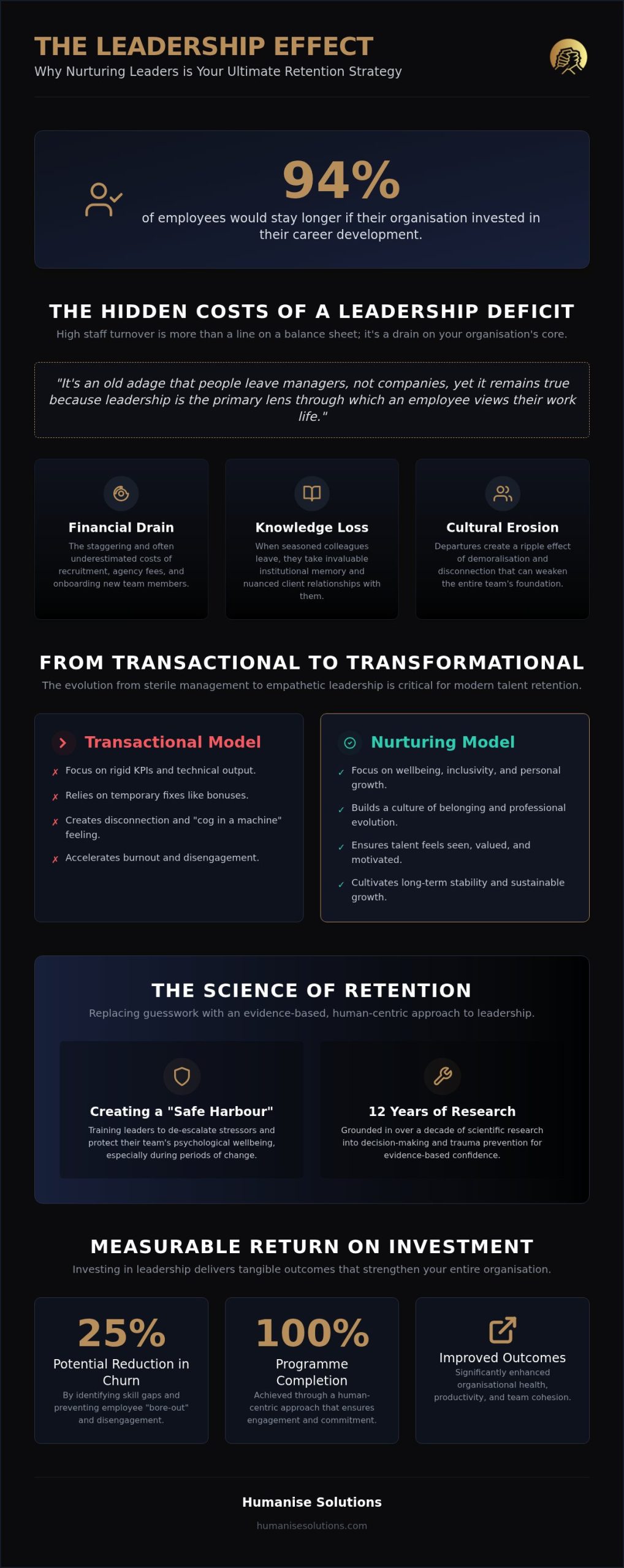
Did you know that 94% of employees would stay with their current organisation longer if it simply invested in their career development? This striking figure highlights that the impact of leadership training on staff turnover isn’t just a secondary benefit; it’s the very foundation of a resilient, high-performing workforce. When talented individuals walk out the door, they’re rarely leaving a brand or a salary. More often, they’re stepping away from a management style that feels sterile or disconnected. You’ve likely felt the drain of high recruitment costs and the heavy silence that follows the departure of a key team member.
It’s frustrating to watch technically brilliant managers struggle because they haven’t been equipped with the human-centric skills needed to nurture a team. We believe that every professional deserves a leader who fosters wellbeing and inclusivity. In this analysis, we’ll discover how nurturing leadership and evidence-based training can dramatically reduce churn whilst cultivating sustainable growth. We’ll explore the scientific link between manager behaviour and retention, providing you with the clear evidence needed to justify your L&D budget to the board.
Key Takeaways
- Understand how the positive impact of leadership training on staff turnover transcends temporary fixes like pay rises, creating a lasting foundation for talent retention.
- Learn how 12 years of research into decision-making and trauma prevention can help you build a “safe harbour” that protects your team’s psychological wellbeing.
- Discover why modern workforces, especially younger talent, prioritise transformational growth and professional development over transactional perks.
- Explore the measurable return on investment, including a potential 25% reduction in churn by identifying skill gaps and preventing employee “bore-out”.
- See how a scientific, human-centric approach to leadership leads to 100% programme completion rates and significantly improved organisational outcomes.
Why Leadership Development is the Antidote to High Staff Turnover
Leadership quality serves as the invisible pulse of an organisation. It dictates whether a desk remains occupied or becomes a vacancy. Whilst many firms reach for salary increases or one-off bonuses to stem the tide of departures, these are often temporary bandages on a deeper wound. Real stability comes from the human experience. By prioritising nurturing leadership, businesses move from transactional management to a model of sustainable growth. In 2026, employees don’t just want a job. They want a sense of belonging and professional evolution that only a skilled, empathetic leader can provide. Understanding the impact of leadership training on staff turnover requires looking past the balance sheet and into the heart of how people feel at work.
The Real Cost of Attrition in 2026
The financial burden of employee turnover is staggering, but the numbers only tell half the story. Beyond the immediate expenses of recruitment, agency fees, and onboarding, there’s a profound loss of institutional memory. When a seasoned colleague leaves, they take with them the subtle nuances of client relationships and team dynamics. This creates a ripple effect of cultural erosion that can demoralise those who remain. To combat this, we must view leadership as a protective architecture. By investing in nurturing leadership skills, organisations ensure that excellence isn’t just achieved but maintained through every transition. It’s about building a culture where talent feels anchored by the quality of the support they receive.
Why Employees Leave Managers, Not Companies
It’s an old adage that people leave managers, not companies, yet it remains true because leadership is the primary lens through which an employee views their work life. A sterile management style, focused purely on technical output and rigid KPIs, often leaves high-potential talent feeling like a cog in a machine. This disconnection is a fast track to burnout and disengagement. When managers lack the ability to foster wellbeing, they inadvertently create an environment where stress outweighs satisfaction. The impact of leadership training on staff turnover is most visible in these daily interactions.
By teaching managers to lead with empathy and clarity, you transform a workplace from a site of pressure into a centre of growth. This shift ensures that key talent feels seen, valued, and motivated to stay for the long term. In 2026, the human experience is the new benchmark for organisational health. Every interaction between a manager and their team either builds or erodes trust. Evidence-based training provides the tools to recognise individual needs before they turn into resignation letters. It empowers leaders to create a space where everyone feels they have the potential to flourish, turning managers into the ultimate retention tool.
The Science of Retention: How Nurturing Leadership Influences Decision-Making
Retention is more than a HR metric; it’s the result of thousands of micro-decisions made by employees every day. Our 12 years of research into decision-making processes reveals that leadership effectiveness is the primary variable in these choices. When managers operate from a place of evidence-based confidence rather than reactive guesswork, they create a stable environment where talent feels secure. The impact of leadership training on staff turnover becomes clear when you observe how scientific methodology replaces the “trial and error” approach often found in traditional consulting. By understanding the cognitive drivers of loyalty, leaders can actively shape an organisational culture that values the human experience above all else.
Decision-Making and Employee Loyalty
Leaders who grasp the mechanics of decision-making are uniquely equipped to support their teams through periods of transition. Change often triggers a threat response in the brain, leading to anxiety and a loss of focus. The Humanise mission focuses on enhancing this human experience by providing managers with the tools to de-escalate these stressors. Research shows a significant influence of leadership on turnover, particularly when leaders can articulate a clear path forward during uncertainty. Scientific leadership ensures that employees feel cognitively supported; this reduces the likelihood of “impulse quitting” triggered by temporary stress or perceived lack of direction.
Trauma Prevention and Psychological Safety
In 2026, trauma prevention has emerged as a critical leadership tool for organisations that prioritise long-term sustainability. This approach involves creating a “safe harbour” where employees can bring their whole selves to work without fear of exclusion or psychological harm. Inclusive leadership isn’t just a checkbox; it’s a deliberate practice of reducing unconscious bias and fostering a deep sense of belonging. When a manager uses emotional intelligence to navigate social dynamics, they build a team that is resilient and high-performing.
This focus on psychological safety directly correlates with the impact of leadership training on staff turnover. Employees who feel psychologically safe are far more likely to commit to an organisation for the long haul because their fundamental human needs for respect and safety are being met. If you’re ready to move beyond generic management styles, you might consider how a bespoke programme could transform your leadership culture. By anchoring management in the science of wellbeing, you turn your organisation into a place where people don’t just work, but truly flourish.
Beyond the Perks: Why Nurturing Training Outperforms Traditional Incentives
Traditional incentives like gym memberships or office snacks often fail to address the core reasons people choose to stay or leave. Whilst these perks provide a momentary lift, they don’t change the daily human experience of being managed. We distinguish between “Transactional Retention”, which relies on fleeting bonuses, and “Transformational Retention”, which focuses on long-term growth and psychological wellbeing. The impact of leadership training on staff turnover is most profound when it shifts the focus towards professional development. Modern research, including studies on The Science of Retention, suggests that employees are far more likely to remain loyal when they feel their potential is being actively nurtured by their superiors.
ILM-certified programmes play a vital role in this transition by professionalising the leadership journey. They move managers away from intuitive guesswork and towards a structured, evidence-based approach. This ensures that every interaction within the organisation is grounded in logic and empathy, creating a culture where talent feels both seen and supported.
Developing the Next Generation
Early-career talent requires a specific type of architectural support to flourish. As of 2024, 4.5% of 18-24-year-olds are classified as NEET, and a staggering 31% of this group cite mental-health barriers as a primary obstacle to employment. This data proves that traditional management isn’t enough; we need wellbeing-led leadership to bridge the gap. Our Young Adult Programmes are designed to provide this exact support, helping managers understand how to guide those entering the workforce for the first time. By focusing on nurturing potential, organisations can keep young talent engaged whilst reducing the likelihood of early-career churn.
The Impact of Women Leadership Programmes
Retention strategies must also be inclusive to be effective. Bespoke tracks, such as our Women Leadership ILM Programme, are essential for improving gender-diverse retention. These programmes address unique challenges and foster an environment of inclusive excellence, which is a key driver of organisational stability. When women see a clear, supported path to senior roles, their commitment to the organisation strengthens. Investing in empowering women in the workplace is not just a social imperative; it is a strategic move that significantly reduces turnover amongst high-potential leaders. This human-centric approach ensures that diversity becomes a source of resilience rather than a statistic on a report.
Measuring the ROI: How Leadership Training Reduces Recruitment Costs
Measuring the financial impact of leadership training on staff turnover involves looking beyond simple retention rates and into the heart of organisational efficiency. According to the Deloitte Global Human Trends report, organisations that implement structured, evidence-based programmes see a 25% reduction in turnover. This isn’t a coincidence. When leaders are trained to identify skill gaps and developmental needs early, they effectively prevent the “bore-out” that often leads high-potential talent to seek challenges elsewhere. By proactively addressing these needs, you transform your workplace from a temporary stepping stone into a long-term professional destination.
Maintaining this momentum doesn’t have to disrupt your daily operations. Certified half-day or full-day workshops allow for targeted interventions that keep the leadership journey moving forward whilst protecting productivity. These sessions foster a culture of “paying it forward”, where mentoring becomes a natural part of the organisational rhythm. This internal support network anchors talent to the business, creating a resilient community that values growth and connection over transactional benefits.
Calculating the Human Dividend
The reduction in cost-per-hire is the most visible dividend of effective leadership intervention. Beyond agency fees and advertising costs, the time saved by senior management in interviewing and onboarding new staff is immense. We hold ourselves to a 9.98% feedback rating for programme delivery, ensuring that every session provides the high-impact value needed to shift these financial metrics. Robust L&D also allows for effective succession planning. This protects your organisation from the “key person” risk that occurs when a lack of nurturing causes a pivotal manager to depart unexpectedly.
Bespoke Learning for Sustainable Change
Off-the-shelf training often fails because it ignores the unique social dynamics and specific challenges of your workforce. In contrast, Bespoke L&D Programmes are designed to align directly with your specific needs and client-driven outcomes. This approach utilises “Leading Architecture” to ensure that every learning intervention is part of a larger, sustainable cultural shift rather than a fleeting event. By building a bespoke framework, you ensure the training becomes a foundational element of your long-term growth strategy. If you’re ready to reduce your recruitment spend and elevate your team’s potential, speak with our experts about a tailored solution.
Cultivating Excellence: The Humanise Solutions Approach
Humanise Solutions operates on a fundamental belief: that the human experience is the heartbeat of every successful organisation. Our mission is to elevate people, leadership, and culture through a rigorous, scientific approach that transcends traditional consulting. By focusing on the impact of leadership training on staff turnover, we help businesses move from a state of constant churn to one of sustainable flourishing. Our success is reflected in our 100% completion rate on HS programmes and our 50-80% job outcomes. These figures aren’t just statistics; they’re proof that when training is deeply engaging and human-centric, it yields tangible, life-changing results.
This impact is driven by the unique expertise of our leadership team. Headed by Serena Kersten MBE and Scott Ward (MBA, CCMI), our approach blends high-level strategic thinking with a deep understanding of human psychology and trauma prevention. We don’t just deliver a workshop and depart. Our “Matrix Partner” system ensures that every participant is supported throughout their development journey. This provides a collaborative framework that extends far beyond the classroom, ensuring that new leadership behaviours are nurtured until they become second nature.
A Holistic Framework for High Performance
We believe that high performance is inseparable from wellbeing. Our core leadership tracks integrate resilience and emotional intelligence, drawing on our extensive experience across both elite sport and global corporate sectors. This cross-disciplinary insight allows us to build leaders who can navigate complex social dynamics whilst maintaining their own psychological health and that of their teams. We invite you to explore our services to see how these tailored solutions can transform your management culture from the inside out.
Your Journey to Organisational Excellence
Meaningful change requires a methodical and supportive start. Our three-day onboarding process is designed to ground participants in our methodology, resulting in personal action plans that drive immediate value for the individual and the business. Our insights are further sharpened by our position as the 5th largest digital recruiter in EMEA. This gives us a unique perspective on the modern talent pipeline and a deep understanding of the specific factors that make people stay in an organisation.
You have the power to secure your talent and humanise your leadership today. By moving away from sterile, detached management and towards a model of nurturing growth, you create an organisation where excellence is the standard and turnover is a thing of the past. Reach out to our team to begin a partnership grounded in empathy, evidence, and the shared goal of human flourishing.
Securing the Future of Your Talent Architecture
The journey towards a stable, high-performing workforce begins with a fundamental shift in perspective. We’ve explored how the impact of leadership training on staff turnover is rooted in the quality of the human experience, moving far beyond transactional benefits or rigid management styles. By anchoring your leadership in the science of decision-making and wellbeing, you create a “safe harbour” where talent doesn’t just stay, but actively flourishes. This transition from current challenges to future potential is both a logical necessity and a compassionate choice.
Humanise Solutions is dedicated to this transformation. Led by industry experts Serena Kersten MBE and Scott Ward MBA, our programmes maintain a 100% completion rate and a 9.98% feedback rating for delivery. We don’t believe in sterile, off-the-shelf fixes. Instead, we partner with you to build a resilient culture that values empathy as much as evidence. Your organisation’s potential is waiting to be unlocked, and the architecture for that growth starts with nurturing the people who lead it.
Humanise your leadership and reduce turnover—explore our bespoke programmes today. We look forward to guiding you towards a workplace where every individual has the support they need to thrive.
Frequently Asked Questions
How exactly does leadership training reduce staff turnover?
Leadership training reduces turnover by equipping managers with the emotional intelligence required to build genuine trust. When leaders move away from sterile, detached management, they create an environment where employees feel seen and valued. This shift in the human experience directly addresses the primary reasons people quit. By fostering a culture of support rather than pressure, the impact of leadership training on staff turnover becomes a marked increase in loyalty and a significant reduction in churn.
Is there a measurable ROI for leadership development programmes?
The measurable return on investment comes from the sharp reduction in “hidden” costs like lost institutional memory and cultural erosion. Whilst recruitment fees are obvious, the true ROI is found in the increased stability and productivity of existing teams. By professionalising management, organisations avoid the constant cycle of churn and onboarding. This creates a sustainable growth model where the cost of development is far outweighed by the financial benefits of a retained, high-performing workforce.
Can leadership training help with retaining Gen Z and young adult employees?
Leadership training is essential for retaining younger talent who prioritise professional growth and psychological wellbeing over static benefits. These demographics often seek a sense of purpose and a clear path for evolution within their roles. By implementing specific Young Adult Programmes, managers learn how to bridge the gap between technical tasks and human flourishing. This approach ensures that early-career professionals feel cognitively supported and mentored, which is a critical anchor in today’s competitive job market.
What are the main reasons employees leave despite good pay?
Employees often depart because of a disconnect between their daily experience and their internal need for growth and respect. Even with competitive salaries, a lack of nurturing leadership can lead to “bore-out” or a sense of being undervalued. When the workplace feels sterile or exclusionary, talented individuals will prioritise their mental health and seek a culture that aligns with their values. Addressing the human experience in every interaction is the only way to prevent these exits and secure talent.
How long does it take to see the impact of training on retention rates?
Whilst initial engagement and team morale often rise immediately following a workshop, the full impact of leadership training on staff turnover typically becomes measurable over six to twelve months. Meaningful cultural change is a methodical process that requires time for new behaviours to become second nature. Over time, as leaders consistently apply nurturing techniques, the organisation builds a resilient foundation. This steady progression eventually leads to a permanent stabilisation of retention rates across the business.
What is the difference between generic and bespoke leadership training for retention?
Generic training often relies on off-the-shelf models that ignore the unique social dynamics and specific challenges of your organisation. In contrast, bespoke leadership training utilises “Leading Architecture” to align directly with your client-driven outcomes. This tailored approach ensures that the training addresses the actual friction points within your teams. By focusing on bespoke learning, you ensure that the intervention feels relevant and authentic, which is far more effective at driving long-term retention and cultural excellence.
How does fostering wellbeing at work influence staff turnover?
Fostering wellbeing at work serves as a retention anchor by creating a “safe harbour” where employees feel protected from burnout and chronic stress. When managers are trained in trauma prevention and emotional intelligence, they can recognise the early signs of disengagement. This proactive support builds deep emotional loyalty. Employees who feel their psychological health is a priority are significantly more likely to commit to the organisation, as they feel a sense of belonging that salary alone cannot buy.
Why is ILM certification important for leadership programmes?
ILM certification is crucial because it provides a recognised benchmark for excellence and ensures that training is grounded in proven methodology. It professionalises the leadership journey, moving it away from intuitive guesswork and towards a structured framework of expertise. For the organisation, this certification offers clear evidence of quality and impact. For the participants, it provides a sense of achievement and professional validation, which further strengthens their engagement and commitment to the organisation’s long-term success.