

Article by
Scott Ward MBA CCMI
Scott Ward is the founder and CEO of Humanise Solutions, which he established three years ago to help organisations elevate their people, leadership and culture through a human-centric, evidence-based approach. Before moving into business and academia, Scott spent seven years as a professional footballer, playing for Luton Town, Crawley Town and Coventry City FC until injury brought his playing career to a close — a turning point that shaped both his research interests and his approach to leadership.
Scott holds an MBA from Warwick Business School, where his research explored the causal relationship between trauma and decision-making — work that continues to inform how he supports young adults, leaders and teams under pressure. Recognised as a Companion of the Chartered Management Institute (CCMI), its highest grade of membership, he combines academic rigour with the discipline, resilience and team-first mindset of the professional game. At the heart of everything he does is a simple belief: that people perform at their best when they are led, developed and valued as human beings first.
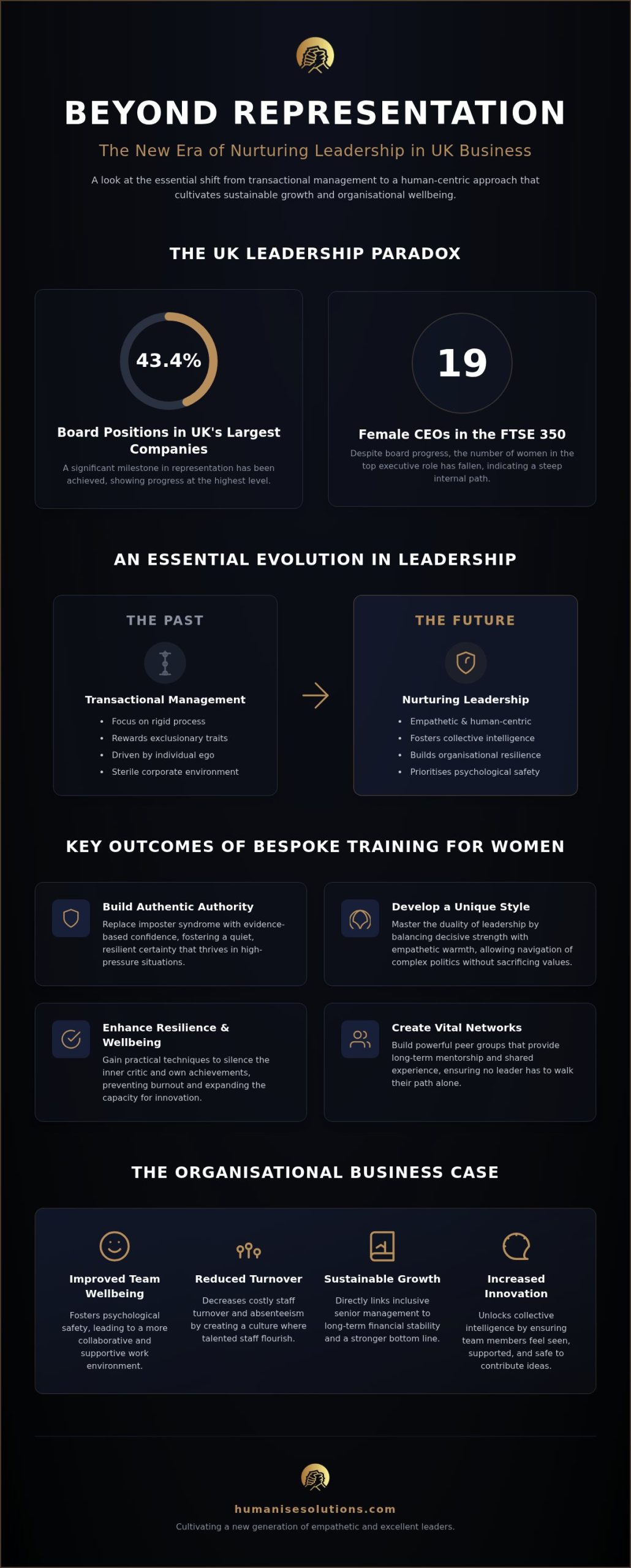
Whilst women now hold 43.4% of board positions in the UK’s largest companies, the number of female CEOs in the FTSE 350 has fallen to just 19. This stagnation suggests that whilst the door is open, the internal path remains unnecessarily steep. You likely recognise that a lack of diverse perspectives at the top doesn’t just hurt your bottom line; it erodes the very fabric of your workplace culture. The benefits of women in leadership training extend far beyond individual skill-building. They offer a way to transform a sterile corporate environment into a space where empathy and excellence coexist.
In this article, we’ll show you how bespoke leadership development for women cultivates a culture of wellbeing, psychological safety, and sustainable organisational growth. We’ll examine the shift from traditional consulting to a more human-centric approach that nurtures the next generation of leaders. By the end, you’ll have a clear business case for investing in a future where your most talented staff don’t just stay, but flourish.
Key Takeaways
- Discover why shifting from transactional management to a nurturing leadership philosophy is the essential evolution for high-performing UK teams in 2026.
- Understand the core benefits of women in leadership training, specifically how evidence-based confidence building replaces imposter syndrome with authentic authority.
- Learn how empathetic leadership directly fosters team excellence by improving psychological safety and reducing costly staff turnover and absenteeism.
- Build a robust business case for diversity by exploring the tangible link between inclusive senior management and long-term financial sustainability.
- Gain a practical framework for implementing bespoke development programmes that begin with a human-centric audit of your unique organisational culture.
Beyond Representation: The Evolution of Leadership in 2026
Leadership in 2026 has moved far beyond simple representation. Whilst hitting a 40% board target is a milestone, the real transformation happens in the daily interactions between leaders and their teams. We’ve seen a decisive shift towards “nurturing leadership”, which we define as the new gold standard for high-performing UK teams. This isn’t about being “soft”. It’s about moving from transactional management to a model of empathetic, human-centric guidance. This style builds the kind of organisational resilience that allows a firm to weather economic storms. When people feel seen and supported, they innovate. This is one of the most strategic benefits of women in leadership training, as it fosters a culture where collective intelligence thrives over individual ego.
The Shifting Expectations of the Modern Workforce
The modern workforce, especially the rising generation of young adults, is redefining the contract between employer and employee. They don’t just want a salary; they want a sense of belonging and a leader who prioritises mental health. The demand for transparency and social purpose has never been higher. Women are often uniquely positioned to meet these expectations, as their leadership styles frequently emphasise social connection and long-term sustainability. By following the global trends for women in business, organisations can see that the most successful firms are those that embrace these “nurturing” qualities. It’s no longer a niche preference; it’s a commercial necessity for firms that want to remain relevant.
Why General Training Often Misses the Mark for Women
Why does general training often fall short? Most generic programmes were designed within a framework that rewards traditional, often exclusionary, corporate traits. They don’t address the specific social dynamics women navigate every day in the UK. For many women, leadership development requires a process of unlearning. It’s about shedding the sterile masks of the past to find a voice that is both authoritative and authentic. Gender-specific spaces provide a safe harbour for this work. In these environments, vulnerability becomes a strength, allowing for a level of professional exploration that general courses stifle. The benefits of women in leadership training lie in this bespoke approach, providing the logic and methodology needed to turn potential into sustainable influence.
Core Benefits of Women in Leadership Training for Individuals
Individual growth acts as the heartbeat of organisational change. Whilst the broader corporate culture must evolve, the personal journey of a leader remains deeply significant. One of the most profound benefits of women in leadership training is the shift from feeling like an accidental success to wielding authentic authority. This evidence-based confidence allows women to replace “imposter syndrome” with a grounded understanding of their own value. It is not about bravado. It is about a quiet, resilient certainty that survives high-pressure environments.
Effective development also helps individuals discover their favourite leadership style. This often involves a delicate balance between decisive strength and empathetic warmth. By mastering this duality, leaders can navigate complex UK organisational politics without sacrificing their core values. They also build vital networks. These peer groups provide long-term mentorship, ensuring that no leader has to walk the path alone. According to the latest UK government data, women now hold over 40% of board positions in the FTSE 350, yet the transition into these roles requires more than just technical skill. If you are looking to support your team’s growth, our learning & development programmes offer the methodology needed for this transformation.
Building Inner Confidence and Resilience
Resilience is more than just “bouncing back”. It is about sustainable flourishing. Training provides practical techniques for silencing the inner critic and owning professional achievements. This psychological safety prevents burnout amongst high-potential women who might otherwise feel overwhelmed by the “double burden” of leadership. When a leader feels truly seen and supported, their capacity for innovation expands. This internal shift is a key pillar of our nurturing leadership philosophy.
Nurturing the Next Generation: Young Adult Development
The workforce of 2026 requires a new approach to the leadership pipeline. We must bridge the gap between academic success and professional excellence for young women entering the market. Many talented graduates possess the logic but lack the practical experience of leading human-centric teams. Our young adult programmes focus on social mobility, ensuring that leadership opportunities are accessible to all, regardless of background. By nurturing this next generation early, firms secure a diverse and resilient future. This proactive approach ensures that talent is not lost in the transition from education to the boardroom.
How Women Leaders Drive Team Excellence and Wellbeing
Leadership is rarely a solo performance. Its true measure lies in the flourishing of the collective. One of the most significant benefits of women in leadership training is the ripple effect it creates across an entire department. When leaders are encouraged to lead with empathy, they naturally foster an environment where every team member feels they can contribute without fear of judgement. This inclusive culture isn’t just a moral choice; it’s a strategic one. High emotional intelligence allows these leaders to resolve conflicts with nuance, turning potential friction into collaborative success. This shift directly impacts the bottom line by reducing staff turnover and absenteeism, as employees are far more likely to remain loyal to a manager who prioritises their human experience.
Creating a Culture of Psychological Safety
Psychological safety acts as the bedrock of team excellence. It’s the shared belief that the team is safe for interpersonal risk-taking. Women leaders often serve as the catalysts for this state, promoting open and honest communication that invites diverse perspectives. When a team feels safe, innovation thrives. People aren’t afraid to suggest “radical” ideas or admit to mistakes early, which prevents small issues from becoming systemic failures. This openness is essential for any organisation aiming for sustainable growth. By fostering this safety, leaders ensure that the collective intelligence of the group is fully utilised rather than stifled by hierarchy.
Wellbeing as a Strategic Performance Driver
We believe that wellbeing should never be reduced to a list of corporate perks. It must be a deep-rooted culture of care. One of the key benefits of women in leadership training is that it empowers leaders to move beyond transactional management and prioritise the mental health of their teams. This approach recognises that a healthy workforce is a productive one. As we look at women’s representation in public life, it’s clear that the demand for empathetic leadership is growing across all UK sectors. Investing in this humanised approach provides a tangible ROI. Happy, supported employees are more engaged, more creative, and significantly more resilient in the face of change. This isn’t just about fostering wellbeing; it’s about building a robust foundation for long-term excellence.
The Organisational Business Case: ROI and Sustainable Growth
Profitability and human flourishing are not competing interests. In fact, they are deeply interdependent. When we analyse the financial performance of UK firms, the evidence is clear: organisations with diverse executive committees and senior management teams consistently achieve higher margins than their less inclusive peers. The benefits of women in leadership training manifest as a more agile, resilient, and profitable business. By investing in the internal talent pool, firms significantly reduce the staggering costs associated with external recruitment and executive search fees. Every mid-level leader who feels supported enough to stay represents a saving of thousands of pounds in agency costs and lost productivity. Retention is the silent engine of a healthy balance sheet.
Future-proofing your business requires a commitment to a broad and diverse talent pipeline. Whilst board representation in the FTSE 350 has reached 43.4%, the decline in women leading SMEs to 14% in 2025 suggests that the pipeline is leaking at the foundational levels. Addressing this is a commercial imperative. Empowering women in the workplace requires more than surface-level policy changes; it demands a deliberate investment in the cultural conditions that allow female leaders to thrive at every level. If you are ready to strengthen your organisation’s future, our bespoke women leadership programmes provide the logic and methodology needed to turn potential into performance.
Attracting and Retaining Top Talent
Top-tier candidates in 2026 are incredibly discerning. They don’t just look at the salary on offer; they research the leadership team to see if they can envision a future for themselves. If an interview panel or a company website reflects a uniform, exclusionary culture, talented women will take their expertise to a competitor. This is particularly true for Gen Z talent, who prioritise social purpose and visible representation. Bespoke development programmes act as a powerful signal that your firm is an employer of choice. They demonstrate a genuine investment in the human experience, which fosters a level of staff loyalty that generic perks cannot match. Providing a clear, supported path to the top prevents the “brain drain” that often occurs when high-potential staff feel they have hit an invisible ceiling.
Driving Innovation through Cognitive Diversity
Innovation thrives on healthy friction. It requires a variety of lived experiences to challenge the status quo and find creative solutions to complex problems. Bringing more voices to the decision-making table is the most effective way to break the cycle of “groupthink” that leads to corporate stagnation. When leaders from different backgrounds collaborate, they bring unique perspectives that lead to better risk assessment and more robust strategies. There is a direct link between inclusive leadership and market-leading innovation. This cognitive diversity ensures that the organisation remains relevant and responsive in a volatile market. By cultivating a culture where diverse perspectives are not just heard but integrated, firms build a foundation for sustainable, long-term growth.
Implementing a Bespoke Women in Leadership Programme
Real change begins with a deep breath and an honest look in the mirror. Implementing a programme that actually works requires moving past the superficial. One of the most lasting benefits of women in leadership training is its ability to reshape the very foundations of how people work together. This process starts with a human-centric audit of your current organisational culture. We don’t just look at data; we listen to the lived experiences of your staff. This allows us to design bespoke tracks that address the specific challenges unique to your firm, rather than offering a one-size-fits-all solution that leaves participants feeling misunderstood.
Wellbeing and psychological safety are the core of our methodology. They aren’t optional extras or “nice-to-have” perks. We integrate these themes into every module, ensuring that leaders learn how to protect their own mental health whilst fostering a culture of care for their teams. To ensure the impact lasts, we provide ongoing coaching and peer support groups. These spaces allow for continued reflection and the nurturing of long-term professional relationships. This steady, methodical approach ensures that the benefits of women in leadership training are felt across every level of the business, making the transition from potential to excellence permanent.
The Humanise Solutions Approach: Nurturing Growth
Our philosophy is rooted in the belief that leadership is a journey of development, not a destination. We move away from the sterile language of traditional consulting to become a deeply invested partner in your organisation’s flourishing. Our focus remains fixed on the transition from your current state to a future of untapped potential. We prioritise human flourishing as the ultimate metric of success, knowing that when people feel safe and valued, high performance follows naturally. This is a journey we take together, rooted in logic and methodology but driven by empathy and a commitment to long-term sustainability.
Next Steps for Your Organisation
Transformation starts with identifying your high-potential talent and understanding their specific needs. It requires a willingness to listen and a commitment to long-term growth. We invite you to organise an initial discovery call to explore how a bespoke programme can be tailored to your unique culture. Discover how our bespoke Women in Leadership programmes can transform your organisation and help you build a more resilient, humanised future for your entire workforce.
Cultivating a Future of Nurturing Leadership
Leadership in the UK is undergoing a profound transformation. It’s no longer enough to simply fill seats; we must evolve the very nature of how we guide our teams. By embracing a nurturing leadership philosophy, organisations can bridge the gap between transactional management and genuine human flourishing. The benefits of women in leadership training extend far beyond individual career progression, acting as a catalyst for psychological safety and long-term organisational resilience. When women are empowered to lead authentically, they don’t just follow existing paths; they create new ones that prioritise empathy and sustainable growth.
We specialise in creating bespoke programmes designed specifically for the unique cultural landscape of UK organisations. Our expertise in fostering wellbeing and team excellence ensures that your leaders don’t just achieve targets; they cultivate environments where everyone feels seen and supported. Meaningful change requires a partner who is deeply invested in your success. Partner with Humanise Solutions to cultivate your next generation of leaders. Let’s work together to build a future that is as empathetic as it is effective, ensuring your firm remains a place where talent truly wants to stay.
Frequently Asked Questions
What are the primary benefits of women in leadership training for the wider team?
The primary benefits for the wider team include increased collaboration and a shift towards an empathetic workplace culture. When leaders prioritise human connection, teams feel more supported and engaged. This nurturing approach encourages collective problem-solving rather than internal competition. It transforms the office environment from a sterile space into one where team excellence is the natural outcome of mutual respect and shared goals.
How does leadership training for women improve employee retention in UK firms?
Leadership training for women improves retention by fostering a deep-rooted culture of care that values the individual. Employees are significantly less likely to leave an organisation when they feel their manager is invested in their professional growth and personal well-being. By reducing the “brain drain” of talented staff, firms save on the high costs of recruitment. A supportive leadership style ensures that high-potential employees see a long-term future within the company.
Can women’s leadership programmes help reduce the gender pay gap?
Women’s leadership programmes help reduce the gender pay gap by strengthening the internal pipeline for senior executive roles. Whilst board representation has improved, the gap often persists because women remain concentrated in mid-level positions. By providing the tools for advancement, these programmes ensure more women reach the highest-paid tiers of the organisation. This systemic shift is essential for achieving long-term pay parity and creating a more equitable corporate structure.
Is bespoke training more effective than off-the-shelf leadership courses?
Bespoke training is significantly more effective than off-the-shelf courses because it addresses the unique cultural dynamics of your specific firm. Generic programmes often rely on outdated corporate moulds that don’t resonate with modern leaders. A tailored approach allows for a human-centric audit of your organisation’s current state. One of the core benefits of women in leadership training is this ability to focus on the precise hurdles your female leaders face, leading to more sustainable growth.
How do women leaders contribute to psychological safety in the workplace?
Women leaders contribute to psychological safety by championing open dialogue and vulnerability as professional strengths. They often act as catalysts for a workplace where team members feel safe to take risks or admit mistakes without fear of retribution. This safety is the bedrock of innovation. When a leader models transparency, it invites the rest of the team to do the same, creating a resilient environment where collective intelligence can truly flourish.
What role does mentorship play in women’s leadership development?
Mentorship provides a vital safety net and a roadmap for navigating complex organisational politics. It connects emerging leaders with experienced peers who can offer evidence-based guidance and emotional support. Within women’s leadership development, these relationships help bridge the gap between individual potential and senior-level influence. This social connection ensures that the journey to the top isn’t a solitary one, fostering resilience and confidence that lasts throughout a leader’s entire career.
How can we measure the success of a women in leadership programme?
Success can be measured through a combination of quantitative data and qualitative human insights. You should track metrics such as internal promotion rates, female staff retention, and the reduction of recruitment agency spend. Equally important are regular well-being audits and surveys that gauge the level of psychological safety within teams. These indicators provide a holistic view of how the training is transforming the organisational culture and driving sustainable growth.
Does women’s leadership training benefit young adult employees differently?
Training benefits young adult employees by focusing on the specific transition from academic success to professional leadership. For those early in their careers, the focus is often on building evidence-based confidence and unlearning socialised behaviours that might stifle their authentic voice. It also plays a crucial role in social mobility. By nurturing talent early, firms ensure that leadership opportunities are accessible to all, regardless of background, future-proofing the talent pipeline for the years ahead.
