

Article by
Scott Ward MBA CCMI
Scott Ward is the founder and CEO of Humanise Solutions, which he established three years ago to help organisations elevate their people, leadership and culture through a human-centric, evidence-based approach. Before moving into business and academia, Scott spent seven years as a professional footballer, playing for Luton Town, Crawley Town and Coventry City FC until injury brought his playing career to a close — a turning point that shaped both his research interests and his approach to leadership.
Scott holds an MBA from Warwick Business School, where his research explored the causal relationship between trauma and decision-making — work that continues to inform how he supports young adults, leaders and teams under pressure. Recognised as a Companion of the Chartered Management Institute (CCMI), its highest grade of membership, he combines academic rigour with the discipline, resilience and team-first mindset of the professional game. At the heart of everything he does is a simple belief: that people perform at their best when they are led, developed and valued as human beings first.
What if the very support system intended to accelerate your career is actually contributing to your stagnation? It’s a common paradox for high-performing women who find themselves receiving plenty of advice but very little active advocacy in the rooms where decisions are made. You might feel over-mentored yet under-sponsored, stuck in middle management despite a track record of excellence and a lack of visibility amongst senior decision-makers. Understanding the critical nuances of sponsorship vs mentorship for women leaders is the first step toward breaking this cycle and unlocking your true executive potential.
In this article, you’ll discover the vital differences between these two roles and learn how to leverage both to elevate your career through a human-centric, scientific approach. We’ll provide a clear framework for implementing sponsorship that draws on over 12 years of research into decision-making and workplace psychology. By moving beyond simple guidance toward a structured, nurturing architecture, you can increase your representation in executive roles whilst significantly improving your psychological wellbeing. Let’s explore how to transform your professional journey from a path of persistence into a trajectory of excellence.
Key Takeaways
- Distinguish between guidance and advocacy to ensure you are not just being advised, but actively advanced within your organisation.
- Understand why the distinction of sponsorship vs mentorship for women leaders is vital for overcoming the “isolation tax” often paid in executive spaces.
- Learn how to foster an environment of psychological safety where nurturing leadership allows high-potential women to flourish and lead with confidence.
- Discover a practical framework for organisations to identify talent through objective analysis and train senior executives in the art of active sponsorship.
- Explore how evidence-based programmes, such as the Women Leadership ILM Programme, provide the architecture needed for sustainable career momentum and growth.
Defining the Duo: What is Sponsorship vs Mentorship for Women Leaders?
To understand the path to excellence, we must first clarify the roles of those who support us. Whilst many use the terms interchangeably, the distinction between sponsorship vs mentorship for women leaders is fundamental to career progression. Mentorship is essentially a developmental relationship where an experienced individual shares wisdom and guidance to help another grow. It’s about the “behind the scenes” work of refining your craft, building resilience, and understanding the unwritten rules of organisational life.
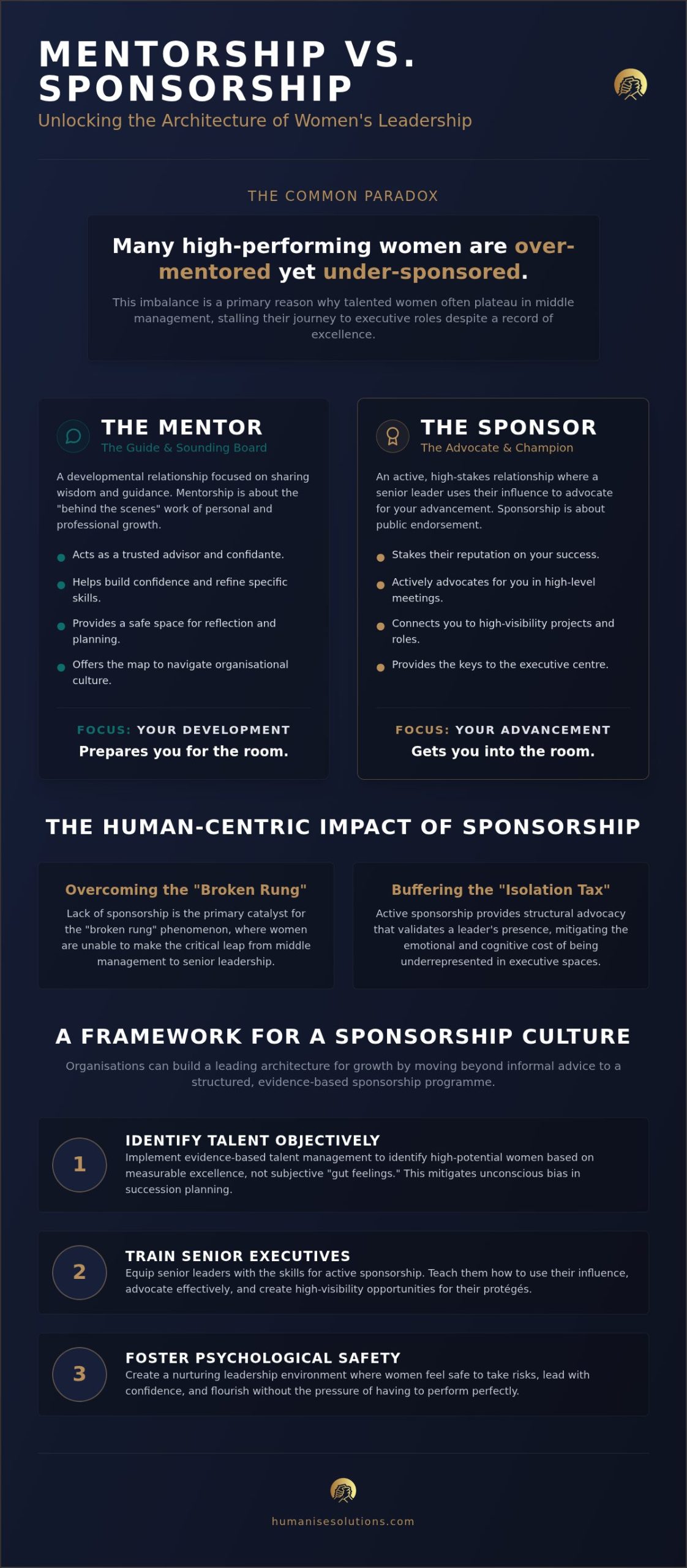
However, evidence-based research frequently highlights a frustrating trend. Women are often over-mentored but significantly under-sponsored compared to their male peers. This disparity is a primary reason why high-performing women often reach a plateau in middle management. When we look at the data surrounding sponsorship vs mentorship for women leaders, it becomes clear that mentorship prepares you for the room, but sponsorship actually gets you into it. One focuses on your personal development, whilst the other focuses on your professional visibility at the highest levels.
The Mentor: The Guide and Sounding Board
A mentor acts as a trusted advisor, focusing heavily on building your inner confidence and identifying specific skill gaps. When Defining Mentorship in a professional context, it’s helpful to see it as a safe space for reflection and career transition planning. This relationship is ideal for navigating the complexities of imposter syndrome or developing your emotional intelligence. It’s a nurturing connection that helps you understand who you are as a leader, providing the psychological foundation required for long-term sustainability. Mentors provide the map, helping you avoid common pitfalls and encouraging you to stay the course during challenging periods.
The Sponsor: The Advocate and Door-Opener
A sponsor’s role is inherently more active and high-stakes. They don’t just offer advice; they stake their own reputation on your success. A sponsor is a senior leader who uses their influence to advocate for you during talent reviews or executive board meetings. They’re the ones who actively seek out high-visibility opportunities and assignments that you might not even know exist. For many women, having a sponsor is the essential catalyst for breaking through the “broken rung” of middle management. It’s the difference between being prepared for an opportunity and actually being handed the keys to the executive centre. Sponsorship is about power and advocacy, ensuring your name is mentioned when you aren’t there to speak for yourself.
The Human-Centric Impact on Women Leadership
Nurturing leadership isn’t just about professional skills; it’s about creating an environment where women feel psychologically safe to lead. In male-dominated executive centres, women often pay an “isolation tax”—the emotional and cognitive cost of being underrepresented or overlooked. Effective sponsorship vs mentorship for women leaders acts as a powerful buffer against this tax. Whilst mentorship offers a vital sounding board, sponsorship provides the structural advocacy that validates a leader’s presence in high-stakes environments. You can read more about building these supportive environments in our guide on Empowering Women in the Workplace.
Mitigating Unconscious Bias through Evidence
Advocacy shouldn’t rely on a “gut feeling”. Our 12 years of research into decision-making processes shows that subjective choices are often fertile ground for unconscious bias. To truly leverage mentorship and sponsorship, organisations must move toward objective talent management and succession planning. This scientific approach ensures that high-potential women are identified based on measurable excellence rather than proximity or similarity to current leaders. By implementing a leading architecture for growth, sponsors can mitigate bias and champion diversity with evidence-based confidence. It’s about creating a culture where talent is seen and celebrated without the cloud of tradition-bound assumptions.
Fostering Wellbeing during Career Elevation
The journey to the top is often physically and mentally demanding. When a leader is “the first” or “the only” woman in the room, the pressure to perform perfectly can be overwhelming. Structured sponsorship programmes do more than open doors; they prevent burnout by providing a safety net of support. This nurturing leadership style promotes resilience, ensuring that career elevation doesn’t come at the expense of mental health. It’s about long-term sustainability. Fostering wellbeing ensures that once women reach executive roles, they have the internal resources to thrive and stay there. If you are looking to build a culture that prioritises both performance and flourishing, you might start a conversation with our specialists today.
Key Differences: A Comparison Framework for Organisations
The most effective way to distinguish these roles is through the direction of the conversation. Mentors talk to you, providing the advice and perspective needed to refine your leadership style. Sponsors, conversely, talk about you in the high-level meetings where promotions and project assignments are decided. Whilst mentorship is often informal and voluntary, sponsorship must be a strategic organisational behaviour. It’s the difference between helping someone prepare for a role and ensuring they are the top candidate considered for it. If mentorship is about building a favourite career path, sponsorship is about the disciplined execution of that path. For organisations, understanding sponsorship vs mentorship for women leaders isn’t just about terminology; it’s about building a robust architecture for talent execution.
Relationship Dynamics and Power
The power balance shifts significantly between these two models. Mentorship thrives on a safe, egalitarian space where vulnerability is encouraged. Sponsorship is more transactional and carries higher accountability. Because a sponsor stakes their reputation on their protege, the relationship requires a deep level of mutual trust. We advocate for a human-centric approach to this dynamic. By focusing on evidence-based potential rather than “gut feel” or social similarity, understanding the nuances of sponsorship vs mentorship for women leaders allows organisations to avoid the trap of perceived favouritism. This ensures that sponsorship remains an inclusive tool for growth, creating professional networks that are both diverse and high-performing.
Outcome Alignment and Accountability
Meaningful change requires clear metrics. At Humanise Solutions, our focus on scientific methodology has resulted in a 9.98% feedback rating for programme delivery, reflecting the value of structured support. This level of excellence is achieved when sponsorship is tied directly to organisational design and long-term success. It’s not enough to simply open a door; there must be a framework for measuring progress and ensuring the leader has the resources to thrive once they step through. A vital part of this framework is the concept of “paying it forward”. We teach women leaders that as they ascend, their own ability to sponsor others becomes a core leadership skill, ensuring the cycle of empowerment continues. To explore how this framework can be integrated into your culture, you can view our full range of leadership services.
How to Organise a Sponsorship Culture for Women Leaders
Building a sustainable pipeline of female talent isn’t an accident. It requires a leading architecture that moves beyond passive support and into the territory of active, intentional advocacy. To truly embed the benefits of sponsorship vs mentorship for women leaders, organisations must transition from informal coffee chats to a structured framework that prioritises both professional growth and human flourishing. This transformation begins by shifting the cultural foundation toward nurturing leadership, ensuring every woman has the visibility she deserves.
Implementing this culture involves five strategic steps:
- Identify talent objectively: Use skill gap analysis and evidence-based research to find high-potential women, removing the “gut feeling” bias that often hinders diversity.
- Train senior advocates: Senior executives must be coached in the art of active sponsorship, learning how to use their influence to open doors whilst maintaining a nurturing approach.
- Strategic matching: Pair sponsors and proteges based on mutual values and business goals rather than social similarities.
- Performance loops: Establish clear KPIs and regular feedback sessions to ensure the relationship is delivering tangible career momentum.
- Integrate wellbeing: Ensure that career elevation is supported by resilience training and psychological safety to prevent burnout.
Developing Mentoring and Sponsorship Skills
Architecture is only as strong as its materials. We utilise ILM-certified programmes to professionalise these relationships, ensuring that internal mentors and sponsors have the tools to succeed. Our Women Leadership ILM Programme is specifically designed to prepare proteges for the high-stakes advocacy that sponsorship brings, helping them build the internal resilience required for executive roles. It’s never too early to start this journey. By encouraging early networks through our Young Adult Professional Development Programmes, organisations can begin cultivating a culture of support from the very start of a leader’s career.
Creating Inclusive Environments for Advocacy
A sponsorship culture cannot thrive in a vacuum. It requires an environment where diversity is a lived experience rather than just a policy on a wall. This means addressing the specific human transitions that women face, such as menopause in the workplace or the complexities of returning from life transitions. When leadership training is human-centric, it builds a deep level of trust and transparency. This foundation allows sponsors to advocate with confidence, knowing the organisation supports the whole person, not just the professional persona. If you’re ready to move beyond definitions and start building a high-performing, inclusive culture, you can book a cultural audit with our team today.
Elevating Potential with Humanise Solutions
Humanise Solutions doesn’t just offer training; we provide the leading architecture for leadership excellence. Our bespoke learning and development programmes are meticulously designed to nurture the next generation of female talent, ensuring that the transition from middle management to the boardroom is both successful and sustainable. By combining over 12 years of research into decision-making processes with a compassionate, expert-led approach, we help firms navigate the complexities of sponsorship vs mentorship for women leaders. We believe that true organisational growth happens when scientific methodology meets empathetic support, allowing leaders to flourish rather than just perform.
Our intervention strategies range from intensive 1-1 coaching to certified ILM workshops, all delivered with a focus on human flourishing and psychological wellbeing. We understand that a firm’s success depends on the collective resilience and confidence of its leaders. Discover how our Nurturing Leadership skills can transform your firm by creating a culture where advocacy and development are deeply intertwined. This evidence-based foundation is what allows us to maintain a 9.98% feedback rating for programme delivery across diverse corporate environments.
The Women Leadership ILM Programme
This specialised track serves as the gold standard for structured growth, focusing specifically on the unique needs of women in leadership roles. We go beyond traditional management theory to integrate emotional intelligence, resilience, and strategic influencing into every module. This approach ensures that proteges are not only prepared for the technical demands of executive roles but also possess the psychological strength to thrive in high-stakes centres. Our commitment to excellence is reflected in our 100% completion rates, proving that when the architecture is right, the outcomes follow. We empower women to lead with authenticity whilst providing the tools needed to navigate complex organisational dynamics.
Partnering for Sustainable Growth
Sustainable change requires a partner who understands the intricate social dynamics of the modern workplace. Led by the expertise of Serena Kersten MBE in Workplace Psychology and Scott Ward’s vision for nurturing leadership, our team guides your organisational transformation with precision and care. We offer the benefit of a multi-million-pound infrastructure delivered with a personal, human touch that feels deeply invested in your specific goals. Whether you are looking to refine your internal sponsorship culture or certify your next cohort of mentors, we are here to support your journey. Explore our Full Range of Services to begin building a legacy of excellence today.
Cultivating the Next Generation of Excellence
True career acceleration for women requires more than just advice; it demands a strategic shift from passive guidance to active advocacy. By understanding the critical distinctions of sponsorship vs mentorship for women leaders, your organisation can build a robust architecture that transforms potential into executive presence. Mentorship provides the essential map for personal development, whilst sponsorship delivers the keys to the rooms where high-level decisions are made. Balancing these two pillars is the secret to moving beyond stagnation and toward sustainable leadership excellence.
At Humanise Solutions, we specialise in bridging this gap through evidence-based programmes led by experts including Serena Kersten MBE. Our commitment to human flourishing is reflected in our 9.98% feedback rating for programme delivery and 100% programme completion rates. We don’t just teach leadership; we nurture the psychological wellbeing and resilience required for long-term sustainability. It’s time to move beyond traditional consulting and embrace a human-centric path to growth. Elevate your leadership team with Humanise Solutions today and start your journey toward a more inclusive, high-performing future. Your potential is waiting to be unlocked.
Frequently Asked Questions
Is sponsorship more important than mentorship for women leaders?
Whilst both roles are essential, they serve distinct purposes in a leader’s journey. Mentorship provides the psychological foundation and skill development needed to lead, whereas sponsorship is the active engine for career advancement. Because women are often over-mentored but under-sponsored, finding an advocate who will speak for you in high-level meetings is frequently the missing piece for those aiming for executive roles. A balanced approach ensures you have both the map and the keys.
How can I find a sponsor if my organisation doesn’t have a formal programme?
Finding a sponsor informally requires intentional visibility and the consistent delivery of high-quality results. You should start by identifying senior leaders whose values align with yours and look for opportunities to work on high-stakes projects that demonstrate your executive potential. Don’t be afraid to share your career aspirations clearly. When senior decision-makers see your impact and understand your goals, they are more likely to stake their reputation on your future success.
What are the risks of sponsorship for the sponsor and the protege?
The primary risk for a sponsor is reputational, as they are publicly backing your performance and potential. For the protege, the pressure to deliver can be intense, as any significant failure reflects directly on your advocate. To mitigate these risks, it’s vital to build the relationship on a foundation of transparency and objective skill analysis. Using a scientific approach to talent management helps ensure that the partnership is based on merit rather than social similarity.
Can a mentor also be a sponsor at the same time?
It’s possible for one individual to fulfil both roles, but the behaviours involved are quite different. A mentor provides a safe, private space for reflection and growth, whilst a sponsor acts as a public advocate in the rooms where you aren’t present. The key to successful sponsorship vs mentorship for women leaders is knowing which hat your supporter is wearing at any given time. Clear communication ensures that developmental advice doesn’t get confused with active career advocacy.
How do I know if I am ready to be sponsored for a senior role?
You are likely ready for sponsorship when you have a proven track record of excellence and a clear vision for your next career transition. Readiness is often marked by a shift from needing guidance on how to do your job to needing access to new opportunities. If you feel you have the skills to lead but lack the visibility amongst senior decision-makers, it’s the right time to seek an advocate who can open those executive doors.
What should a woman leader look for in a potential sponsor?
Look for a leader who possesses significant organisational influence and a genuine commitment to nurturing leadership. Your ideal sponsor should be someone who has a seat at the table where talent decisions are made and whose professional values resonate with your own. Beyond their position, they must be willing to spend their social capital on your behalf. A sponsor who understands the human-centric impact of their advocacy will be your most effective champion.
How does sponsorship contribute to equality, diversity, and inclusion (ED&I)?
Sponsorship is a critical tool for ED&I because it moves beyond policy and into the territory of lived experience. It helps break down unconscious bias by ensuring that high-potential women from all backgrounds are intentionally pulled into the executive pipeline. By reducing the isolation tax often paid by underrepresented leaders, sponsorship creates a more inclusive culture where diverse talent can flourish. It’s a strategic organisational behaviour that transforms diversity goals into measurable executive representation.
How do Humanise Solutions’ programmes support women in leadership?
Our programmes, such as the Women Leadership ILM Programme, provide a structured architecture for growth based on over 12 years of research. We combine scientific methodology with empathetic support to help women navigate the nuances of sponsorship vs mentorship for women leaders. With a 9.98% feedback rating for delivery and 100% completion rates, our initiatives ensure that participants develop the resilience and strategic influence needed to reach the highest levels of organisational leadership.
