

Article by
Scott Ward MBA CCMI
Scott Ward is the founder and CEO of Humanise Solutions, which he established three years ago to help organisations elevate their people, leadership and culture through a human-centric, evidence-based approach. Before moving into business and academia, Scott spent seven years as a professional footballer, playing for Luton Town, Crawley Town and Coventry City FC until injury brought his playing career to a close — a turning point that shaped both his research interests and his approach to leadership.
Scott holds an MBA from Warwick Business School, where his research explored the causal relationship between trauma and decision-making — work that continues to inform how he supports young adults, leaders and teams under pressure. Recognised as a Companion of the Chartered Management Institute (CCMI), its highest grade of membership, he combines academic rigour with the discipline, resilience and team-first mindset of the professional game. At the heart of everything he does is a simple belief: that people perform at their best when they are led, developed and valued as human beings first.
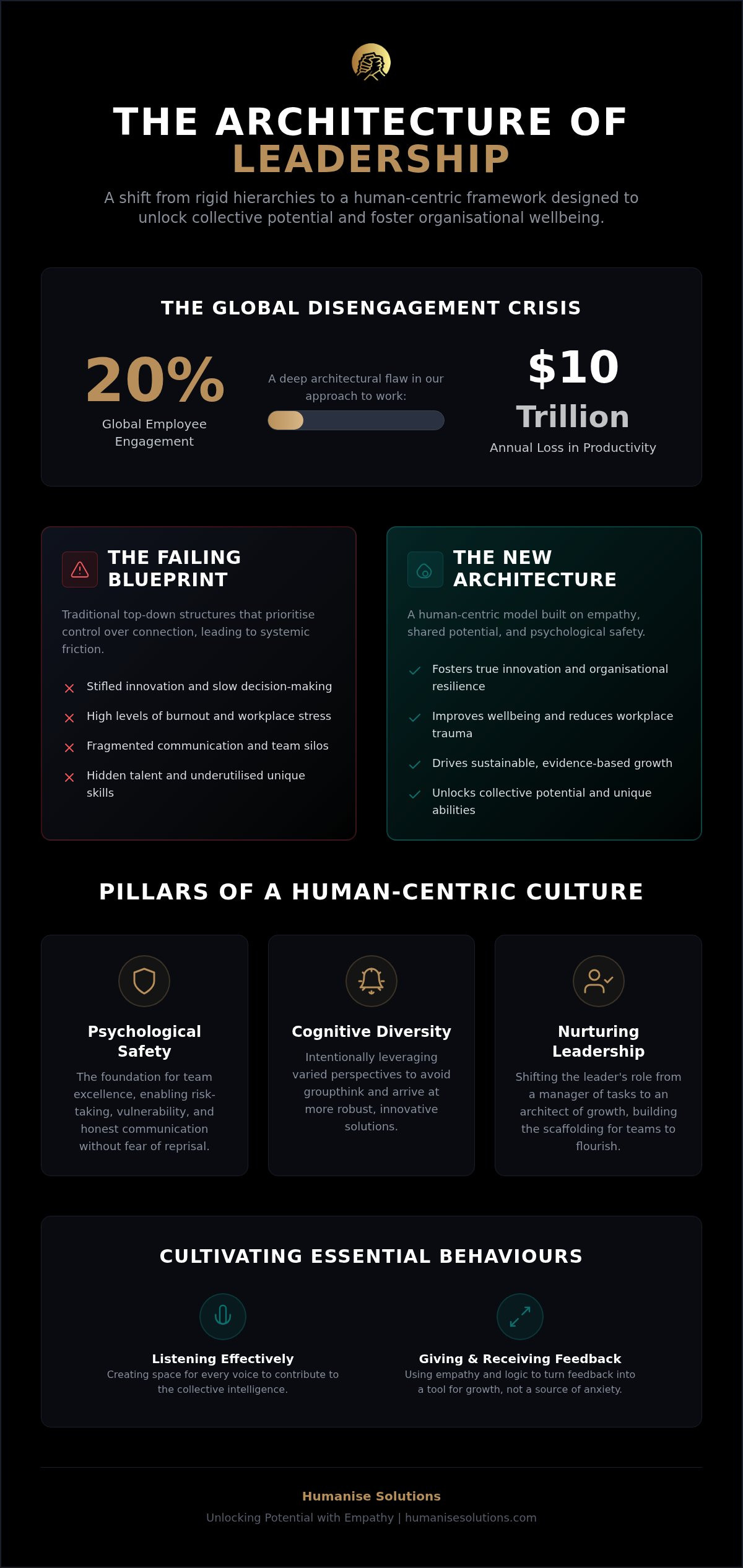
Did you know that global employee engagement plummeted to just 20% in 2025, resulting in a staggering $10 trillion loss in productivity? This isn’t just a failure of output; it’s a clear symptom of a deeper architectural flaw in how we approach collaborative leadership. You’ve likely felt the daily friction of fragmented communication or watched talented team members struggle with burnout whilst trapped in rigid, slow-moving hierarchies. It’s exhausting to operate in a system that prioritises control over connection, leaving little room for individual flourishing or team excellence.
We believe there’s a more courageous way to grow. Transitioning to a human-centric architecture allows you to unlock collective potential by celebrating unique abilities rather than enforcing conformity. By shifting your focus from top-down commands to a nurturing leadership model, you can transform your workplace into a sanctuary of innovation and resilience. This article explores the practical steps to move away from rigid structures toward a framework that fosters psychological safety, improves wellbeing, and drives sustainable organisational growth through evidence-based methodology.
Key Takeaways
- Understand why rigid hierarchies are no longer effective and how to transition towards a more responsive, human-centric architecture.
- Discover how collaborative leadership serves as a scientific framework to reduce workplace trauma and foster long-term psychological wellbeing.
- Learn to dismantle the myth that distributed authority weakens accountability by implementing structured decision-making processes.
- Gain a clear, five-step roadmap for auditing your organisation’s current behaviours and cultivating the essential skills for team excellence.
The Evolution of Collaborative Leadership in 2026
Traditional command-and-control models are failing in the modern UK workplace. They were built for a different era. Today, the complexity of our challenges requires something more sophisticated. Collaborative leadership has emerged as the necessary evolution, moving beyond the management of tasks to the intentional cultivation of human potential. It’s an architecture designed for shared success, where the goal isn’t just to get things done, but to grow the people doing them.
From Hierarchy to Human-Centricity
Rigid structures often stifle the very innovation they aim to produce. In 2026, we’re seeing a decisive transition from these top-down frameworks to fluid, collaborative networks. This shift enhances the human experience in every interaction by prioritising psychological safety and mutual respect. When leaders focus on nurturing leadership skills within their teams, they create an environment where empathy isn’t a “soft skill” but a foundational pillar. It’s about moving from a culture of “doing” to a culture of “being” together, where every voice contributes to the collective intelligence.
Why Collaboration is the Foundation of Team Excellence
True team excellence isn’t an accident; it’s the result of a deliberate, human-centric design. Shared goals create a sense of belonging and purpose that traditional hierarchies simply cannot replicate. When individuals feel their unique skills are seen and valued, their engagement naturally deepens. Collaborative leadership is a strategic framework for 2026 that integrates emotional intelligence with logic to drive sustainable growth.
Leading with empathy allows you to unlock unique skills that remain hidden in more restrictive environments. Instead of managing tasks through a lens of surveillance, modern leaders act as architects of growth. They build the scaffolding that allows their teams to reach higher, ensuring that organisational success is a byproduct of human flourishing. This approach doesn’t just improve productivity; it restores the human connection that is so often lost in the noise of modern business. By dismantling the barriers of traditional authority, we make room for a more inclusive and resilient future.
The Scientific Architecture of Shared Potential
At Humanise Solutions, our approach is built on a foundation of over 12 years of research into decision-making and trauma prevention. We don’t view collaborative leadership as a vague management style. Instead, we see it as a precise architecture designed to protect and elevate the human experience within a professional context. Traditional hierarchies often inadvertently create environments of chronic stress, whilst a collaborative framework actively reduces workplace trauma by distributing authority and fostering genuine agency amongst all team members.
Psychological Safety as a Catalyst
A collaborative leader’s primary role is to serve as a catalyst for psychological safety. This means creating an environment where it’s safe to take risks, admit mistakes, and challenge the status quo without fear of negative consequences. This focus on safety is the cornerstone of our Fostering Wellbeing programmes. When people feel psychologically secure, their brains move out of “survival mode” and into a state of openness. This transition is essential for inclusive leadership, as it allows for the high-level engagement and trust required for teams to excel in complex environments.
Cognitive Diversity and Decision-Making
Shared leadership environments are specifically designed to leverage cognitive diversity. By intentionally bringing together varied perspectives, organisations can avoid the pitfalls of groupthink and arrive at more robust, innovative outcomes. Learning how to practice collaborative leadership requires a commitment to specific skill sets, such as our modules on “Listening Effectively” and “Giving and Receiving Feedback.”
Our trauma prevention research informs this architecture by ensuring that communication remains supportive rather than punitive. When feedback is delivered with empathy and logic, it becomes a tool for growth rather than a source of anxiety. This methodical approach to decision-making ensures that every choice is backed by the collective intelligence of the group. If you’re looking to implement these evidence-based strategies in your own organisation, you might find it helpful to reach out for a conversation about your unique needs.
Dismantling the Myths of Distributed Authority
Many leaders fear that shifting away from traditional hierarchy means losing control. The most common objection we hear is that collaborative leadership creates a vacuum of accountability where no one is truly responsible for outcomes. This couldn’t be further from the truth. In fact, a human-centric architecture requires a higher level of precision and clarity than command-and-control ever could. When authority is distributed, the structures supporting it must be robust enough to ensure that every individual feels empowered and responsible.
Accountability in a Collaborative Framework
In a rigid hierarchy, responsibility is often obscured by layers of bureaucracy. A collaborative model clarifies responsibility by anchoring individual contributions to shared success. We use structured “Personal Action Plans” to ensure that whilst the journey is collective, the steps are individual. By prioritising “Expectation Management” and precise “Job Descriptions,” we remove the ambiguity that often leads to stress and underperformance. Our “Setting up for Success” onboarding methodology is a core part of our services, designed to clarify these boundaries from day one. It isn’t about doing less; it’s about doing the right things with full awareness of how they impact the whole organisation.
The “Too Many Cooks” Fallacy
Another persistent myth is that collaboration is simply too slow for fast-paced industries. This view often mistakes true collaboration for “leading by committee,” which is a recipe for stagnation. Structured collaborative leadership relies on robust “Facilitation Skills” and efficient “Meeting Skills” to drive momentum rather than stall it. When a team operates with high psychological safety and clear protocols, they can actually solve problems faster than a solitary leader.
- Collective Intelligence: Diverse perspectives allow for the rapid identification of blind spots that a single manager might miss.
- Structured Facilitation: Precise modules ensure that the loudest voice doesn’t dominate, allowing the best ideas to surface quickly.
- Agile Decision-Making: Shared authority means teams don’t have to wait for “sign-off” from a distant executive for every minor hurdle.
When teams are equipped with the right architectural tools, they move with a speed and agility that traditional models cannot match. The transition from a solitary decision-maker to a collaborative network is a strategic move toward organisational resilience. By dismantling these myths, we open the door to a culture where everyone is empowered to lead from where they are, ensuring that growth is both sustainable and inclusive. It’s a shift from managing through fear of failure to leading through the excitement of shared potential.
Cultivating Collaborative Behaviours in Your Organisation
Transitioning to a model of collaborative leadership isn’t an overnight change; it’s a methodical cultivation of new habits and perspectives. We’ve developed a five-step roadmap to guide this transformation, ensuring your organisation moves from fragmented communication to unified excellence through a deliberate architecture of growth.
- Step 1: Audit and Identify. Begin by looking at current organisational behaviours. Where are the silos? What specific skill gaps prevent open dialogue?
- Step 2: Implement Bespoke L&D. Standard training often fails to address unique cultural nuances. Tailored programmes are required to address your specific architectural needs.
- Step 3: Foster Emotional Intelligence. Empathy must be the standard, not the exception, at every level of the hierarchy.
- Step 4: Create Inclusive Environments. Prioritise ED&I initiatives that give every voice a platform, ensuring that diverse perspectives are sought and valued.
- Step 5: Measure and Refine. Use performance reviews and training evaluation to ensure the growth is sustainable and aligned with your goals.
Nurturing Emotional Intelligence and Empathy
Empathy acts as the glue in a collaborative leadership model. It allows team members to see beyond their own tasks and understand the human experience of their colleagues. By integrating “Emotional Intelligence” and “Unconscious Bias” training, you dismantle the invisible barriers that stifle shared potential. This isn’t just about being “nice”; it’s about building the cognitive resilience required for complex problem-solving. For those ready to design a unique path for their teams, our Bespoke L&D Programmes provide the evidence-based tools required for this deep cultural shift.
Practical Strategies for Inclusive Dialogue
Dialogue is the heartbeat of collaboration. We teach teams how to implement “Positive Relations” and “Customer Conversations” techniques internally, treating colleagues with the same care and curiosity we’d offer a client. The “Listening Effectively” and “Communication” modules are essential here. They move teams away from simply waiting for their turn to speak and toward genuine understanding. We also recognise the specific value of “Women Leadership ILM Programmes” in fostering diversity. These programmes empower leaders to bring inclusive perspectives to the table, enriching the collective decision-making process and ensuring a wider range of talent is celebrated.
True transformation happens when these behaviours are woven into the daily fabric of the workplace. If you’re ready to start your journey toward a more inclusive culture, get in touch with our team to discuss a tailored approach for your organisation.
Elevating Your Culture with Humanise Solutions
Building a culture of collaborative leadership is a journey that requires more than just a change in policy. It demands a fundamental shift in how we perceive the human architecture of our organisations. Humanise Solutions acts as a visionary guide in this transformation, offering a partnership rooted in evidence-based methodology and empathetic warmth. We focus on achieving client-driven outcomes by designing leadership frameworks that are directly aligned with your specific goals. This isn’t corporate consulting from a distance; it’s a deep investment in the flourishing of your people and the long-term sustainability of your growth.
Bespoke Development for Modern Leaders
Our Leadership and Team Development Programmes are built on a bedrock of scientific rigour. This foundation is reflected in our 9.98% feedback rating for programme delivery and 100% completion rates across all HS programmes. We believe in nurturing potential at every stage of the professional life cycle, which is why our work extends to Young Adult Programmes. With 807,000 young people currently categorised as NEET, bridging this gap is essential for the future of the UK workforce. Whether through Half-Day or Full-Day Certified Workshops, we provide the practical tools required to dismantle silos and build a more inclusive environment where every individual can thrive.
Fostering Sustainable Growth and Wellbeing
True organisational excellence is only sustainable when it is rooted in the wellbeing of its people. The Fostering Wellbeing pillar ensures that leadership development isn’t just about output; it’s about the psychological safety and resilience of every team member. We integrate specialised “Resilience” and “Stress Awareness” modules to help leaders navigate the complexities of modern work whilst maintaining their own mental health. By prioritising these internal qualities, we help you transition from rigid, high-pressure structures to a future where high performance and human flourishing coexist. We invite you to enquire about our bespoke leadership programmes today and discover how we can help you unlock your team’s collective potential through collaborative leadership and leading architecture.
Architecting a Culture of Collective Excellence
Shifting toward collaborative leadership is more than a structural change; it’s a commitment to the human flourishing that drives sustainable growth. We’ve explored how dismantling rigid hierarchies allows for greater agility whilst fostering the psychological safety necessary for innovation. By grounding your leadership architecture in our 12 years of research into decision-making and trauma prevention, you can replace burnout with a sense of shared purpose and team excellence.
Meaningful transformation requires a partner who understands the nuance of human dynamics. With a 9.98% average feedback rating and 100% completion rates for our bespoke programmes, we’re dedicated to delivering outcomes that empower every level of your organisation. It’s time to move beyond traditional management and embrace a model that celebrates unique potential. Discover how our Nurturing Leadership programmes can elevate your organisation and help you build a resilient, inclusive future together. Your journey toward a more human-centric workplace starts with a single, courageous step.
Frequently Asked Questions
What is the primary difference between traditional and collaborative leadership?
Traditional models rely on a top-down hierarchy where decision-making is centralised at the peak of the organisation. In contrast, collaborative leadership distributes authority across the team, treating leadership as a shared architecture rather than a solitary role. This approach prioritises the collective intelligence of the group, ensuring that every individual’s unique skills are utilised to solve complex problems. It shifts the focus from managing tasks through surveillance to nurturing potential through trust and mutual respect.
Can collaborative leadership work in highly regulated or top-down industries?
Yes, it is particularly effective in high-stakes environments because it enhances risk management through diverse perspectives. Whilst regulations require clear lines of accountability, a collaborative framework provides the structured architecture needed to maintain these standards without stifling innovation. By using precise modules like “Risk Management” and “Managing Expectations,” leaders can ensure compliance whilst empowering their teams to contribute to safer, more efficient decision-making processes. It transforms rigid compliance into a proactive, shared responsibility amongst all staff.
How does collaborative leadership impact employee retention and wellbeing?
This model directly addresses the root causes of burnout by reducing workplace trauma and chronic stress. When employees feel they have genuine agency and that their wellbeing is a priority, their commitment to the organisation deepens. Our research shows that fostering a sense of belonging and psychological safety is essential for long-term retention. By moving away from punitive hierarchies, you create a supportive environment where people feel valued for their unique abilities, leading to more sustainable professional growth.
What specific skills do managers need to lead collaboratively?
Managers must transition from being directors to becoming facilitators. Key skills include “Listening Effectively,” “Facilitation Skills,” and the ability to give and receive feedback with empathy. They also need high levels of emotional intelligence to navigate social dynamics and support their team’s mental health. Our “Nurturing Leadership” programmes focus on these uniquely human capabilities, helping managers build the confidence required to lead without relying on traditional authority. It’s about architecting an environment where others can excel.
How do you measure the success of a collaborative leadership programme?
Success is measured through a combination of qualitative feedback and quantitative performance metrics. We utilise “Training Evaluation and Performance Review” modules to track how new behaviours are integrated into daily operations. Key indicators include improved team engagement scores, higher completion rates for internal projects, and a measurable reduction in reported stress levels. At Humanise Solutions, our 9.98% feedback rating serves as a benchmark for the excellence we strive to achieve in every bespoke leadership transformation we partner on.
Is collaborative leadership suitable for small teams or only large organisations?
This approach is highly scalable and provides significant benefits to teams of all sizes. For small organisations, it fosters the agility required to compete in fast-paced markets by ensuring that every team member can contribute to strategic decisions. In larger organisations, it helps dismantle silos and improves cross-functional communication. The core principles of leading with empathy and unlocking potential remain the same, regardless of the group’s size. It’s about building a foundation of trust that supports sustainable growth.
What role does emotional intelligence play in a collaborative model?
Emotional intelligence is the foundational pillar that allows a collaborative architecture to function. It enables leaders to recognise individual needs, manage social dynamics, and create the psychological safety required for open dialogue. Without it, distributed authority can lead to confusion or conflict. By integrating “Unconscious Bias” and “Mindset and Attitude Tool Kit” modules, we help leaders develop the self-awareness needed to lead with compassion. This ensures that the transition to shared leadership is both logical and emotionally resonant.
How can we start transitioning to a more collaborative leadership style today?
You can begin by auditing your current organisational behaviours to identify where communication is failing. Start by introducing “Listening Effectively” techniques into your regular meetings to encourage more inclusive dialogue. It’s also helpful to clarify “Job Descriptions” and “Expectation Management” to provide the safety of structure whilst you begin distributing authority. Small, intentional shifts in how you handle feedback and decision-making can create the momentum needed for a full cultural transformation. Consistency and empathy are your most valuable tools.
