

Article by
Scott Ward MBA CCMI
Scott Ward is the founder and CEO of Humanise Solutions, which he established three years ago to help organisations elevate their people, leadership and culture through a human-centric, evidence-based approach. Before moving into business and academia, Scott spent seven years as a professional footballer, playing for Luton Town, Crawley Town and Coventry City FC until injury brought his playing career to a close — a turning point that shaped both his research interests and his approach to leadership.
Scott holds an MBA from Warwick Business School, where his research explored the causal relationship between trauma and decision-making — work that continues to inform how he supports young adults, leaders and teams under pressure. Recognised as a Companion of the Chartered Management Institute (CCMI), its highest grade of membership, he combines academic rigour with the discipline, resilience and team-first mindset of the professional game. At the heart of everything he does is a simple belief: that people perform at their best when they are led, developed and valued as human beings first.
What if the persistent friction in your team isn’t a lack of talent, but a disconnect in your organisational architecture? Many leaders feel the weight of high staff turnover and a growing sense of disengagement amongst middle management, yet they struggle to bridge the gap between corporate values and daily behaviour. A meaningful workplace culture transformation requires more than a new mission statement or a tick-box exercise. It demands a shift towards a human-centric model that values psychological well-being as much as performance. You likely already recognise that your people are your greatest asset, but seeing that potential flourish requires a deliberate, scientific approach to leadership.
In this guide, you’ll discover how to evolve your organisational environment by nurturing leadership and unlocking human potential through an empathetic lens. We draw on over 12 years of research into decision-making to provide a roadmap for sustainable growth. We will explore the methodology behind building a high-performing, inclusive team where every individual feels empowered to contribute. By the end, you’ll understand how to move from resistance to resilience, positioning your organisation as a genuine employer of choice whilst driving measurable success.
Key Takeaways
- Understand why a workplace culture transformation is the essential operating system for your organisational success rather than a surface-level initiative.
- Learn how to apply over 12 years of research into decision-making and trauma prevention to build a psychologically safe and high-performing environment.
- Identify and dismantle the subtle barriers to growth, such as “banter and bullying” or poor communication, that hinder long-term evolution.
- Implement a practical framework that starts with a deep-dive audit of current behaviours to align daily actions with your core mission.
- Discover how nurturing leadership and bespoke Learning & Development initiatives create a sustainable talent pipeline and drive client-driven outcomes.
Beyond the Buzzword: What Workplace Culture Transformation Really Entails
A workplace culture transformation is far more than a simple adjustment to policies or a fresh set of values printed on a lobby wall. It represents a fundamental shift in the shared behaviours, mindsets, and values that define how an organisation breathes. Think of culture as the invisible operating system of your business. If the software is outdated or the code is cluttered with legacy issues, no amount of new hardware will improve performance. True transformation requires a deep dive into the underlying patterns that dictate how your people interact, solve problems, and perceive their value within the collective.
Moving away from the traditional command and control structures of the past, modern success is built on nurturing leadership. This isn’t about micromanagement; it’s about creating a leading architecture that provides the scaffolding for human potential to flourish. When leaders act as visionary guides rather than distant dictators, they build a structure where empathy and logic coexist. This approach ensures that every individual feels seen and supported, which is the foundational requirement for any high-performing team to sustain its momentum over the long term.
The Difference Between Culture Change and Culture Evolution
The word “change” often triggers an instinctive sense of loss or resistance amongst staff, as it implies that what came before was inherently wrong. In contrast, evolution suggests growth and refinement. A successful workplace culture transformation invites participation rather than demanding compliance. It involves identifying the daily behaviours that currently hinder progress and gently aligning them with your mission statement. If your current culture feels like a barrier to sustainable growth, it’s usually because there’s a disconnect between what is said in boardrooms and what is felt on the shop floor. Evolution bridges this gap by making every employee a co-author of the new narrative.
Why Human-Centricity is the Catalyst for Success
When we stop viewing employees as mere resources and start seeing them as unique individuals with distinct needs and aspirations, the entire organisational dynamic shifts. Human-centricity is the bridge to resilience. By prioritising nurturing leadership and psychological well-being, you reduce the friction that typically slows down progress during periods of transition. Empathy-driven leadership doesn’t just make people feel better; it unlocks a level of loyalty and innovation that “control” can never buy. This focus on human flourishing ensures that your growth is not just rapid, but deeply rooted and sustainable for years to come.
The Science of Change: Why a Human-Centric Approach Outperforms Traditional Models
Effective workplace culture transformation isn’t a matter of chance; it’s a matter of science. At Humanise Solutions, our methodology is anchored in over 12 years of research into decision-making and trauma prevention. This evidence-based foundation allows us to look past surface-level symptoms and address the psychological drivers that govern team behaviour. When we understand how the human brain responds to stress and change, we can build environments where professional excellence is a natural outcome of personal flourishing. It’s about moving from a “gut feel” to a grounded methodology that respects the complexity of the human experience.
Inclusive leadership serves as the glue in this scientific model. By integrating emotional intelligence and self-care into the daily rhythm of the office, organisations foster a level of team cohesion that traditional “command and control” models simply cannot replicate. This approach doesn’t just improve the atmosphere; it drives innovation by ensuring that diverse perspectives are not only heard but actively nurtured within a safe, leading architecture.
Psychological Safety and Trauma Prevention
High-performing teams aren’t built on pressure alone. They’re built on psychological safety. Scientific data consistently shows that when employees feel safe to take risks and voice concerns without fear of retribution, innovation thrives. However, true safety goes deeper than an open-door policy. It requires trauma-informed leadership that recognises the diverse lived experiences of a modern workforce. Moving beyond simple wellbeing perks like fruit bowls or gym memberships, we focus on deep psychological support systems. This involves:
- Recognising how past professional or personal traumas impact current decision-making and confidence.
- Creating a culture where vulnerability is seen as a precursor to courage and creativity.
- Establishing clear protocols for conflict resolution that prioritise human dignity and long-term resilience.
Evidence-Based Decision Making in Leadership
Logic and methodology are the best tools for identifying skill gaps and developmental needs. By utilising research to understand how leaders make choices under pressure, we can design bespoke Learning & Development initiatives that actually rewire organisational habits. This isn’t about generic training; it’s about a leading architecture that identifies specific developmental needs through data and empathy. If you’re ready to explore how a scientific approach can stabilise your team and unlock latent potential, we invite you to discuss your specific goals with us. We believe that when the foundation is rooted in logic, the potential for growth is limitless.
Overcoming the Barriers to Sustainable Cultural Evolution
Identifying the obstacles to growth is the first step in any successful workplace culture transformation. Often, these barriers are subtle; they manifest as “banter and bullying” masked as office humour, or a chronic lack of constructive feedback that leaves employees guessing about their performance. A common objection from leadership is that culture is too “soft” to measure or sustain. We challenge this by applying a scientific lens, showing that cultural health is directly visible in retention rates, innovation speed, and bottom-line growth. When we treat culture as a measurable asset, we can move beyond reactive fixes to proactive excellence.
One of the most significant challenges is middle management “permafrost,” where executive vision stalls before reaching the frontline. These managers often feel caught between high-level demands and the daily needs of their teams. We melt this permafrost through nurturing leadership, providing managers with the emotional intelligence and tools they need to become facilitators of growth rather than gatekeepers of the status quo. Central to this is ensuring that equality, diversity, and inclusion (ED&I) are treated as core pillars of the leading architecture, rather than optional add-ons.
Bridging the Communication Gap
Poor communication acts as a silent tax on productivity. Friction in remote meetings or poor conference call etiquette creates a sense of isolation and frustration amongst team members. To foster positive customer conversations, an organisation must first fix its internal relations. When the internal dialogue is rooted in respect and clarity, it naturally reflects in how the team interacts with clients. Establishing a culture of giving and receiving feedback ensures that communication becomes a bridge to improvement rather than a source of anxiety.
Supporting the Next Generation of Talent
A healthy culture must also look outward to the future of the workforce. Current data reveals a concerning trend: 4.5% of 18-24-year-olds in the UK are currently NEET (Not in Education, Employment, or Training), representing a 65,000 year-on-year increase. Research shows that 31% of these young people cite mental-health barriers as a primary reason for not working. This highlights a clear need for social mobility initiatives and specialised young adult programmes. By supporting the next generation through empathetic leadership and tailored development, organisations don’t just fill roles; they build a resilient, diverse talent pipeline that is essential for long-term sustainability.
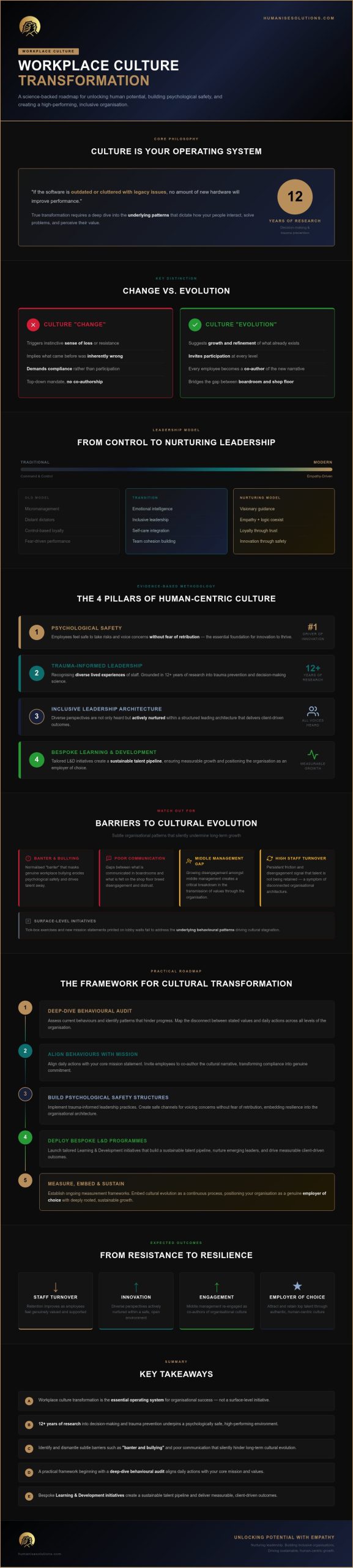
A Practical Framework for Organising Cultural Change
Success isn’t accidental. It’s engineered through a deliberate leading architecture that aligns human potential with organisational goals. A sustainable workplace culture transformation begins with a clear-eyed assessment of where you are today and a visionary map of where you intend to be. This journey isn’t about imposing new rules; it’s about cultivating an environment where excellence becomes the default behaviour. We believe that when the structure is sound, the people within it can truly flourish.
Our five-step framework ensures that every initiative is rooted in logic and empathy:
- Step 1: Deep-Dive Audit. we start by examining current organisational behaviours and performance metrics to identify the invisible barriers to growth.
- Step 2: Define Client-Driven Outcomes. we align your culture strategy with your specific mission statement, ensuring every change serves a practical, measurable purpose.
- Step 3: Bespoke Development. we implement specialised tracks, such as Women Leadership ILM programmes, to nurture talent at every level.
- Step 4: Foster Wellbeing. we integrate resilience and mental health awareness training to ensure your team has the psychological strength to thrive under pressure.
- Step 5: Monitor and Refine. continuous feedback loops allow us to target a 9.98/10 excellence level, ensuring the transformation remains permanent and impactful.
Developing High-Performing Teams
True team excellence is built through collaborative leadership rather than top-down mandates. We utilise High Performance Leads to guide workshops and team days, creating a space where collective intelligence can solve complex problems. This isn’t a one-off event; it’s a continuous process of refinement. To sustain momentum after the initial phase, leaders must remain visionary guides, consistently reinforcing the new cultural architecture through their own daily actions and interactions.
Bespoke Learning Design
Off-the-shelf training often fails because it ignores the unique social dynamics and specific challenges of your organisation. For a workplace culture transformation to take hold, learning must be personal and relevant. We integrate e-learning and LMS support to provide continuous professional development that fits naturally into the daily flow of work. By designing individual action plans, we empower every team member to take ownership of their own growth and professional journey. If you’re ready to build a bespoke roadmap for your organisation, get in touch with our expert guides today to begin the process.
Cultivating Future-Ready Excellence with Humanise Solutions
At Humanise Solutions, we believe that the most successful organisations are those that treat human potential as a living, breathing ecosystem. Our approach to workplace culture transformation is uniquely grounded in a scientific lens, drawing on over 12 years of research to elevate the human experience in every interaction. We don’t just provide consulting; we act as visionary guides, helping you build a leading architecture where empathy and logic work in harmony to drive sustainable growth. By focusing on the psychological well-being of the collective, we ensure that your organisational evolution is both profound and permanent.
Our commitment to excellence is reflected in our 100% completion rate for programmes and a consistent 9.98/10 feedback rating from the leaders we’ve guided. we focus on creating high-quality job outcomes through a unique end-to-end talent pipeline and recruitment infrastructure. By prioritising nurturing leadership skills, we ensure that your organisational evolution is supported by individuals who are both resilient and highly skilled. This isn’t just about filling roles; it’s about cultivating a legacy of excellence that attracts and retains the very best talent.
The Humanise Solutions Difference
What sets us apart is the calibre of our expertise and the depth of our reach. Led by CEO Scott Ward MBA and featuring experts like Serena Kersten MBE, our team brings a wealth of experience in high-performance environments. We aren’t just specialists in culture; we’re also the 5th largest digital recruiter in EMEA. This gives our clients access to a unique talent pool and a recruitment infrastructure that most consulting firms simply cannot match. We don’t just tell you how to change; we provide the human capital and the methodological foundation to make that change a reality.
Next Steps for Your Organisation
Embarking on a workplace culture transformation is a deliberate choice to prioritise the long-term health of your team. You can begin this journey by engaging with our certified workshops, available in both full-day and half-day formats to suit your specific organisational needs. Our onboarding process is thorough and supportive, moving from the development of bespoke personal action plans to seamless job network integration. This ensures that the momentum gained during training is immediately applied to client-driven outcomes. We invite you to explore our full range of services and discover how we can partner with you to unlock the true potential of your workforce.
Building a Legacy of Human-Centric Excellence
True organisational evolution is a journey of aligning your leading architecture with the inherent potential of your people. We’ve explored how moving beyond surface-level buzzwords to embrace a scientific, evidence-based methodology creates a foundation for lasting success. By prioritising psychological safety and nurturing leadership, you don’t just solve immediate disengagement; you cultivate a resilient environment where every individual can flourish. This shift from traditional management to empathetic guidance is the catalyst for genuine, sustainable growth.
Your workplace culture transformation deserves a partner that values both logic and human well-being. At Humanise Solutions, we bring over 12 years of research into organisational psychology and a 9.98/10 feedback rating for programme delivery to every collaboration. With a 100% completion rate across our bespoke programmes, we’re committed to helping you achieve client-driven outcomes that matter. It’s time to bridge the gap between your corporate values and daily behaviour to become an employer of choice. Begin your workplace transformation with Humanise Solutions today and unlock the extraordinary potential within your team. The future of your organisation starts with a single, human-centric step.
Frequently Asked Questions
What is the first step in workplace culture transformation?
The initial step involves conducting a deep-dive audit of your current organisational behaviours and performance metrics. This allows you to identify the invisible barriers hindering your team’s potential. Once these gaps are clear, you can define client-driven outcomes that align with your core mission statement. This logical foundation ensures that any subsequent changes are purposeful rather than reactive, setting the stage for a sustainable and meaningful evolution of your professional environment.
How long does it take to see real change in company culture?
Meaningful change is a deliberate and methodical process that varies depending on the size and complexity of the organisation. Whilst initial shifts in sentiment can occur within weeks of starting bespoke workshops, a full workplace culture transformation typically takes months of consistent effort to become permanent. It requires steady progression from the initial audit through to the integration of new habits, ensuring that the transition from current states to future potential is rooted in long-term sustainability.
Why do most culture change initiatives fail?
Most initiatives fail because they are treated as sterile, top-down mandates rather than human-centric evolutions. When there’s a disconnect between corporate values and daily employee behaviour, resistance naturally grows amongst staff and middle management. Initiatives also falter when they lack a scientific foundation or fail to address psychological well-being. Without nurturing leadership and clear feedback loops, the permafrost of old habits remains frozen, preventing any new cultural architecture from taking root effectively.
Can workplace culture be measured scientifically?
Yes, culture can be measured through a combination of qualitative feedback and quantitative metrics backed by logic and methodology. We utilise over 12 years of research into decision-making and trauma prevention to assess the health of an organisational environment. Metrics such as programme completion rates, staff retention, and feedback ratings, like our 9.98 out of 10 average, provide clear evidence of progress. This scientific approach moves workplace culture transformation from a vague concept to a measurable asset that drives growth.
How does nurturing leadership differ from traditional management?
Nurturing leadership replaces the traditional command and control model with a visionary guide approach. Traditional management often focuses on micromanagement and rigid hierarchies, whilst a nurturing model prioritises unlocking human potential through empathy and psychological safety. It involves a deep investment in the flourishing of every individual, creating a leading architecture where leaders act as mentors. This shift fosters a high-performing, inclusive team environment where resilience and confidence are cultivated as core professional qualities.
What role does mental health play in organisational culture?
Mental health is the cornerstone of a high-performing and sustainable organisational culture. Research indicates that 31% of young people currently not in education or employment cite mental-health barriers as a primary reason for their situation. In a professional context, ignoring psychological well-being leads to disengagement and high turnover. By integrating trauma prevention and fostering wellbeing into your cultural architecture, you create a safe space where employees feel supported, reducing friction and enhancing collective innovation.
How can we support young adults and Gen Z in our workplace culture?
Supporting the next generation requires a focus on social mobility and bespoke young adult programmes. With 4.5% of 18-24-year-olds in the UK currently classified as NEET, there’s a vital need for career development that addresses their unique needs. Providing mentorship, clear personal action plans, and job network integration helps bridge the gap between education and employment. This approach celebrates their unique abilities whilst building a resilient talent pipeline that ensures your organisation remains future-ready and inclusive.
Is culture transformation suitable for small businesses or just global corporates?
Cultural evolution is essential for organisations of every size, from small teams to global corporates. Whilst the scale of the leading architecture may differ, the fundamental need for nurturing leadership and psychological safety remains constant. Small businesses often find that a human-centric approach allows them to be more agile and innovative by reducing internal friction. Every organisation, regardless of its headcount, benefits from aligning daily behaviours with a clear mission to drive sustainable growth and excellence.
