
Article by
Scott Ward MBA CCMI
Scott Ward is the founder and CEO of Humanise Solutions, which he established three years ago to help organisations elevate their people, leadership and culture through a human-centric, evidence-based approach. Before moving into business and academia, Scott spent seven years as a professional footballer, playing for Luton Town, Crawley Town and Coventry City FC until injury brought his playing career to a close — a turning point that shaped both his research interests and his approach to leadership.
Scott holds an MBA from Warwick Business School, where his research explored the causal relationship between trauma and decision-making — work that continues to inform how he supports young adults, leaders and teams under pressure. Recognised as a Companion of the Chartered Management Institute (CCMI), its highest grade of membership, he combines academic rigour with the discipline, resilience and team-first mindset of the professional game. At the heart of everything he does is a simple belief: that people perform at their best when they are led, developed and valued as human beings first.
Did you know that 75% of cross-functional teams are considered dysfunctional, failing to meet even basic success criteria? It’s a sobering statistic that highlights why traditional approaches to cross-functional team development often fall short of their lofty goals. You’ve likely felt the friction yourself; the fragmented communication between specialist departments, the quiet erosion of trust amongst diverse project groups, and the unsettling churn of staff when organisational change feels forced rather than fostered. It’s exhausting to lead when departments feel like separate islands rather than part of a unified whole.
We believe that the bridge between these silos isn’t built with more software or rigid processes, but through the intentional cultivation of human connection. This guide explores how to transform these disconnected units into high-performing teams by prioritising psychological safety and nurturing leadership. You’ll discover a scientific, evidence-based methodology to move beyond mere collaboration and into a culture of inclusive excellence. We’ll show you how to create an environment where every specialist feels truly nurtured, ensuring your organisation achieves sustainable growth whilst delivering results that matter. The journey from fragmentation to cohesion starts with a shift in perspective, moving from managing tasks to empowering people.
Key Takeaways
- Learn to shift from a task-focused mindset to a human-first philosophy that treats cross-functional team development as the intentional cultivation of diverse perspectives.
- Understand how twelve years of research into stress and trauma can help you dismantle the “Us vs Them” mentality that often sabotages collaborative efforts.
- Discover why Nurturing Leadership is the essential catalyst for transforming fragmented departments into cohesive, high-performing units.
- Learn how to implement bespoke learning and development programmes that align team behaviours with shared organisational values for long-term sustainability.
- Move beyond generic, off-the-shelf training by applying a scientific, human-centric lens to elevate your workplace culture and achieve inclusive excellence.
What is Cross-Functional Team Development in a Human-Centric Workplace?
In many corporate environments, the concept of a cross-functional team is often reduced to a spreadsheet of names and departments. However, true cross-functional team development is the intentional cultivation of diverse perspectives, woven together to achieve a shared mission. It’s a shift from seeing people as mere functions to recognising them as the heartbeat of the organisation. While a traditional “task-first” approach focuses solely on outputs and deadlines, a “human-first” philosophy understands that sustainable results are the natural byproduct of healthy, connected relationships.
Understanding What is a Cross-Functional Team? is only the beginning of a much deeper transformation. Modern organisations must move beyond these rigid silos to foster sustainable growth, as fragmented departments often lead to duplicated efforts, drained morale, and missed opportunities for innovation. We view Team Excellence not as a static goal to be ticked off a list, but as a dynamic, ongoing process of evolution and discovery. It’s a commitment to constant improvement where the focus remains on the social dynamics and psychological safety of the group.
Beyond the Organisational Chart
Companies often attempt to fix collaboration issues by redrawing the lines on an organisational chart or introducing new project management software. These structural changes usually fail because they don’t address the underlying human behaviours that drive every interaction. Nurturing Leadership acts as the essential bridge here, moving leaders from a position of authority to one of facilitation, active listening, and empathy. Cross-functional development is a behavioural alignment rather than a structural one. By focusing on how people feel and relate to one another, leaders can unlock the immense potential that sits dormant between departmental boundaries.
The Shift from Silos to Synergy
Departmental silos carry hidden costs that extend far beyond missed deadlines; they significantly impact employee wellbeing. When teams feel isolated or pitted against one another, stress levels rise and the sense of belonging diminishes. This friction erodes the foundation of trust needed for genuine innovation. In contrast, collaborative leadership creates a human-centric competitive advantage by making the workplace a space of psychological safety and shared purpose. This approach ensures that every individual feels seen and valued whilst contributing to the wider corporate vision. To explore how this works in practice, you can read our detailed guide on Building Team Excellence.
The Psychological Barriers to Effective Cross-Functional Collaboration
The friction often encountered during cross-functional team development rarely stems from a lack of technical expertise. Instead, it is rooted in deep-seated psychological barriers that remain unaddressed in traditional corporate settings. Our 12 years of research into decision-making and trauma prevention reveals that when individuals feel under pressure or undervalued, their cognitive capacity for collaboration diminishes. They retreat into familiar departmental identities, creating a defensive posture that sabotages collective goals. This “Us vs Them” mentality is often a direct consequence of a lack of inclusive leadership, where specialists feel their unique contributions aren’t recognised by the wider group.
When specialists step outside their comfort zones to work with diverse groups, they often face the quiet weight of imposter syndrome. This fear of being “found out” or appearing incompetent amongst peers from other disciplines can lead to a withdrawal from active participation. Personal resilience becomes the critical link here. By nurturing individual confidence and emotional intelligence, we enable team members to stay present and engaged even when the work feels challenging. If you’re looking to support your leaders through these complex transitions, you might explore our bespoke leadership support.
Why Psychological Safety is the Foundation
Psychological safety is the shared belief that the team is a safe environment for interpersonal risk-taking. In the context of building a cross-functional team, this means members feel free to admit mistakes or propose “wild” ideas without fear of ridicule. Without this foundation, organisations often suffer from “silent silos”. These are groups that appear to collaborate on the surface whilst secretly withholding information or feedback to protect their own interests. Integrating trauma prevention into your culture ensures that past organisational failures don’t dictate future behaviours, creating a truly secure space for innovation to flourish.
Addressing the “Us vs Them” Mentality
The “Us vs Them” mentality is frequently fuelled by unconscious bias, where we project stereotypes onto colleagues from different departments. A developer might view a marketer’s goals as superficial, whilst the marketer sees the developer as a bottleneck. These perceptions erode cross-departmental trust before the first meeting even begins. Overcoming this requires more than just shared objectives; it demands a deliberate strategy for fostering a sense of belonging amongst diverse skill sets. By highlighting shared values and human experiences, we can bridge these divides. Truly high-performing teams are built on a foundation of mutual trust and respect, not just a set of shared KPIs.
Human-Centric Leadership: The Catalyst for Team Excellence
Traditional management often relies on hierarchy and top-down instruction, which can inadvertently stifle the fluidity required for successful cross-functional team development. In contrast, Nurturing Leadership focuses on creating the specific conditions where diverse talents can thrive together. This approach moves beyond simple oversight; it prioritises the development of an environment where equality and diversity are not just corporate metrics, but lived experiences that enrich every project. When a leader facilitates rather than directs, they empower team members to take ownership of their unique roles, fostering a deeper sense of accountability and shared purpose across the organisation.
A core behaviour in this transformative process is the continuous exchange of feedback. It’s not about annual reviews or rigid performance metrics; it’s about a rhythmic, supportive dialogue that helps individuals grow whilst keeping the entire group aligned. The Project Management Institute on achieving cross-functional teams emphasises that team composition is only half the battle; the leadership style determines whether that composition translates into high-level performance. By focusing on the human element, leaders can turn a group of specialists into a unified force for change.
Nurturing Leadership as a Core Competency
Transitioning from a technical manager to a collaborative leader requires a fundamental shift in identity. It’s about moving from being the person with all the answers to the person who asks the most insightful questions. We use the science of empathy to drive this transformation, drawing on 12 years of research to show how emotional intelligence directly impacts organisational change and long-term stability. By understanding the neural pathways of connection, leaders can bridge departmental divides more effectively and unlock the hidden potential within their teams. You can learn more about these specific techniques in our guide to Nurturing Leadership Skills.
Fostering Wellbeing Across Departmental Lines
Staff wellbeing is the primary indicator of cross-functional health. When teams are stretched across multiple project streams, the risk of burnout is high, and the quality of collaboration often suffers. A human-centric leader monitors these dynamics closely, ensuring that the pace of work remains sustainable and that individuals feel supported rather than overwhelmed by competing demands. This involves a commitment to fostering wellbeing as a collective responsibility. Leaders must also prioritise their own self-care; managing complex team dynamics is emotionally demanding work that requires personal resilience. By modelling healthy boundaries, leaders give their teams permission to do the same, creating a culture of sustainable excellence.
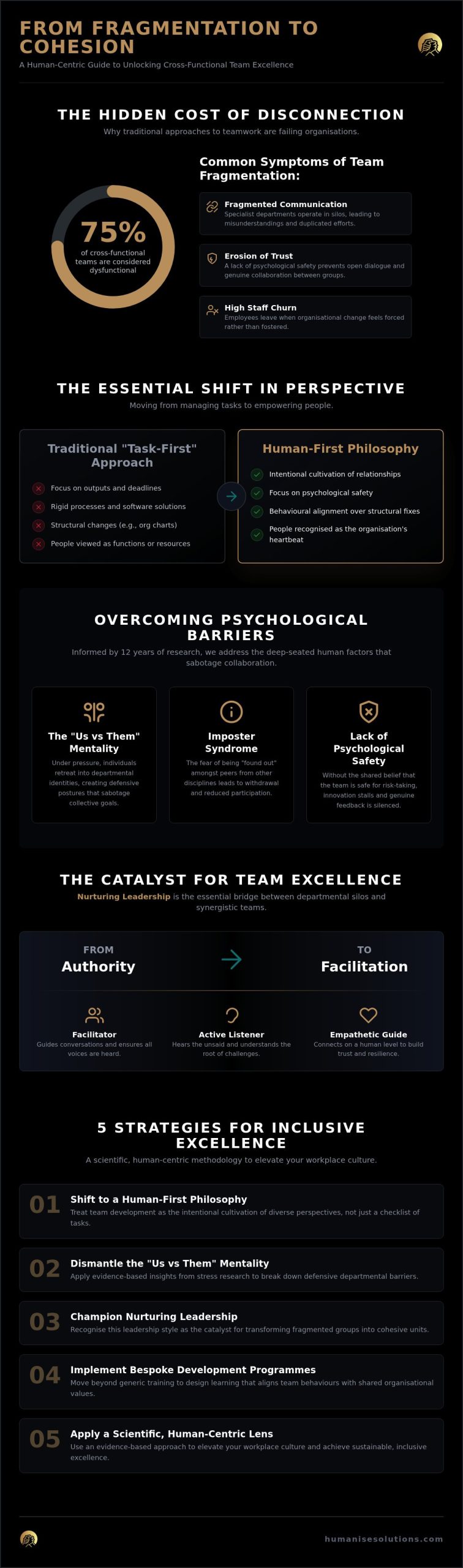
5 Strategies to Organise and Nurture Cross-Functional Teams
Moving from the philosophy of Nurturing Leadership to the practicalities of cross-functional team development requires a methodical yet empathetic approach. Unlike rigid engineering frameworks that often ignore the human element, these strategies focus on the social architecture needed for departments to truly thrive together. By following these steps, you can create a resilient structure that supports both individual growth and collective achievement.
- Step 1: Define shared organisational behaviours and values. Establishing these from the outset ensures every team member understands the human “rules of engagement” beyond their technical remit.
- Step 2: Implement bespoke learning and development programmes. Off-the-shelf training rarely addresses the deep-seated cultural nuances of a specific organisation. For a deeper look at how customisation drives results, explore our guide to Bespoke L&D Programmes.
- Step 3: Establish a “human-centric” communication etiquette. Setting clear expectations for digital communication helps reduce email stress and prevents the “always-on” culture that leads to burnout.
- Step 4: Use 1-1 coaching. Individual support is vital when specialists transition into collaborative roles that require a broader set of soft skills.
- Step 5: Celebrate unique abilities. Regular, public recognition of diverse skills reinforces the value of cross-functional perspectives.
Establishing Shared Behaviours and Values
Success begins with a co-created team charter that prioritises dignity at work. This document should serve as a moral compass, outlining how team members will support one another whilst navigating complex projects. We encourage a mentoring culture where “paying it forward” becomes a standard behaviour. When experienced specialists mentor those from other departments, it breaks down the “Us vs Them” barriers discussed earlier, replacing competition with a sense of collective investment in each other’s success.
Developing Emotional Intelligence for Conflict Resolution
When diverse perspectives meet, friction is natural. We utilise specific “Problem Solving” and “Mindset and Attitude” toolkits to help teams navigate these moments with grace. By focusing on the underlying emotional drivers of a disagreement, leaders can turn conflict into a catalyst for growth and performance improvement. Conflict is inevitable in cross-functional work, but its resolution is a choice. Choosing to resolve it through empathy and logic strengthens the team’s bond and builds the resilience needed for future challenges. To begin transforming your departmental silos into a unified force, get in touch with us to discuss our Team Excellence programmes.
Elevating Your Culture with Bespoke Team Development Programmes
Generic training often acts as a sticking plaster for deep-seated cultural wounds. It fails because it doesn’t account for the unique social dynamics or the specific historical context of your organisation. At Humanise Solutions, we move beyond the superficial by applying a scientific lens, backed by 12 years of research into trauma prevention and decision-making. This evidence-based approach ensures that cross-functional team development is a transformative journey rather than a temporary fix. By focusing on the root causes of fragmentation, we help you cultivate an environment where people don’t just work together; they flourish together.
We believe that performance and wellbeing are two sides of the same coin. When you prioritise the psychological health of your staff, high-level results follow as a natural consequence. Our programmes are designed to integrate these two elements, ensuring that organisational growth is both sustainable and inclusive. This commitment to the human experience is why our initiatives consistently achieve 100% completion rates and lead to exceptional job outcomes. We don’t just deliver content; we facilitate a shift in mindset that empowers every individual to contribute their best work.
Bridging the Gap for Young Adults and Emerging Leaders
The long-term success of any collaborative framework depends on how well you support the next generation of talent. Our Young Adult Development programmes are specifically tailored to meet the needs of Gen Z talent, addressing the 31% of this demographic who cite mental-health barriers as a significant obstacle in their professional lives. By integrating mentoring and early careers support into your cross-functional pipelines, you foster a culture of resilience from the ground up. This proactive approach to succession planning ensures that your future leaders are equipped with the emotional intelligence needed to navigate complex, diverse environments.
Tailored Initiatives for Lasting Impact
Professional credibility is essential for any development initiative, which is why we offer ILM certified programmes that meet the highest industry standards. However, the true value lies in the customisation. Your journey begins with diagnostic workshops that allow us to understand the specific gaps and opportunities within your current culture. From there, we co-create a roadmap for full culture transformation, moving at a pace that feels deliberate and reassuring. We invite you to move beyond the limitations of off-the-shelf training and embrace a path that truly honours the potential of your people. Contact Humanise Solutions today to discuss your bespoke team development needs.
Cultivating a Future of Collaborative Excellence
Transforming fragmented departments into high-performing units isn’t a matter of luck or simply installing the right software. It’s about a fundamental commitment to the human experience within your organisation. By prioritising psychological safety and addressing the “Us vs Them” mentality through evidence-based methods, you create a space where diverse talent can truly flourish. Effective cross-functional team development relies on leaders who act as facilitators, nurturing the internal qualities of their people whilst driving collective results.
Our approach is built on over 12 years of research-backed methodology and delivered through certified ILM leadership programmes. With a 9.98/10 feedback rating for programme delivery, we’ve seen first-hand how bespoke initiatives unlock potential and foster long-term resilience. You don’t have to navigate these complex cultural shifts alone; we’re here to partner with you on this journey of transformation. Elevate your team’s potential with a bespoke development programme. Contact us today. Your organisation’s future potential is waiting to be realised with care and confidence.
Frequently Asked Questions
What is the biggest challenge in cross-functional team development?
The most significant hurdle is overcoming the “Us vs Them” mentality that naturally arises when specialists from different departments are grouped together. Without a foundation of psychological safety, teams often retreat into defensive silos. Successful cross-functional team development requires moving beyond task-based management to address these deep-seated social dynamics. By focusing on behavioural alignment rather than just structural changes, leaders can bridge departmental divides and foster a culture of high-level collaboration.
How does psychological safety impact cross-functional performance?
Psychological safety acts as the essential bedrock for any high-performing group. When team members feel secure enough to take interpersonal risks, admit mistakes, or propose unconventional ideas, innovation flourishes. In a cross-functional team development context, this safety prevents the formation of “silent silos” where information is withheld due to fear or mistrust. Our research indicates that a secure environment directly correlates with improved decision-making and collective resilience, allowing diverse groups to deliver results whilst maintaining wellbeing.
Why should we prioritise nurturing leadership over technical management?
Technical management focuses on directing tasks and monitoring outputs, which often stifles the fluidity needed for cross-departmental success. Nurturing leadership, however, prioritises the cultivation of an environment where diverse talents can thrive. This approach facilitates collaboration by empowering individuals and fostering a sense of shared purpose. By acting as a mentor rather than just a manager, you unlock the hidden potential between silos, driving sustainable growth and ensuring that every team member feels truly valued.
How can bespoke learning and development programmes reduce staff turnover?
Off-the-shelf training often fails to address the unique cultural friction points that lead to disengagement. Bespoke learning and development programmes identify and target specific skill gaps and behavioural needs within your organisation. By investing in tailored initiatives, you demonstrate a deep commitment to your employees’ personal and professional growth. This human-centric investment creates a stronger sense of belonging and loyalty, leading to our 100% completion rates and significantly reducing staff turnover during periods of change.
What role does emotional intelligence play in team collaboration?
Emotional intelligence is the catalyst for turning departmental friction into a growth opportunity. It allows team members to navigate complex social dynamics with empathy and logic, ensuring that conflict is resolved constructively. By utilising specific toolkits for problem-solving and mindset, individuals can overcome unconscious biases that hinder trust. High emotional intelligence fosters an inclusive environment where unique abilities are celebrated, making it a critical component for achieving excellence in any diverse work environment.
How do you support young adults in a cross-functional work environment?
We support young adults through specialised programmes that address the specific barriers they face, such as the 31% of NEET individuals who cite mental-health issues as a reason for not working. By integrating mentoring and early careers support, we help Gen Z talent navigate the complexities of corporate collaboration. Our structured onboarding and personal action plans ensure that emerging leaders feel nurtured and confident, leading to job outcomes between 50% and 80% for our participants.
Can cross-functional teams help with post-merger integration?
Cross-functional teams are vital for successful post-merger integration because they force a break from old departmental loyalties. By bringing individuals from both organisations together on shared projects, you can begin to align organisational behaviours and values from the outset. This collaborative approach reduces the friction of transition and helps to build a unified culture focused on future potential. Our scientific methodology ensures that these new groups develop the trust needed to navigate large-scale organisational change effectively.
What are the measurable benefits of a human-centric approach to team building?
A human-centric approach yields tangible results that go beyond surface-level metrics. Our programmes consistently achieve a 100% completion rate and result in job outcomes ranging from 50% to 80%. Additionally, our 9.98/10 feedback rating reflects the deep impact our training has on leadership confidence and team cohesion. By prioritising wellbeing and inclusive excellence, organisations see measurable improvements in performance, retention, and the overall psychological health of their workforce, ensuring long-term sustainability and growth.
